
You are here
- Home
- Publikationer og rapporter
- Data insights
- Utilising online job advertisements to identify labour market imbalances
Utilising online job advertisements to identify labour market imbalances
Summary
This work presents the first set of results of an exploratory work by Cedefop on testing the applicability of online job advertisement (OJA) data collected via the Web Intelligence Hub (led by Eurostat) for the analysis of labour market imbalances across the EU-27. The long-term aim of this work is to provide a different approach in understanding, monitoring, or detecting changes in labour-market demand, skills needs or occupations, which could accompany traditional methods. A forthcoming Cedefop Working Paper will provide more details of the entire process and the validation of the developed method.
Introduction
The labour and skills shortages have increasingly emerged as a significant focus in policy discussions. Although concerns about labour shortages have periodically emerged in the discussions during economic expansions, labour and skills shortages became a major topic of policy debate from the late 1990s onwards. Interest in the issue intensified during the 2000s due to demographic ageing and skill-biased technological change and increased further in the aftermath of the COVID-19 pandemic. Yet, unlike unemployment or vacancy rates, shortages are based more on individual perceptions of employers and are driven by ad hoc, and in many cases based on surveys rather than administrative data.
Online job advertisements (OJAs) offer a real-time and granular information about the demand side of the labour market. OJA content reflecting the recruiting behaviour of employers may convey information that can be utilised to identify vacancies for which employers are likely facing hiring difficulties. Therefore, OJA can have the potential to build an effective ‘early warning system’ for occupations in shortage.
Labour market imbalances and shortages. Labour market imbalances and shortages arise when labour demand does not match with labour supply. From a macroeconomic perspective, two types of imbalances are regularly measured and reported via official statistics: unemployment and vacancy rates. Unemployment occurs when labour supply exceeds demand. There are various types of unemployment: frictional (temporary, driven by voluntary transitions between jobs), structural (arising from skill mismatches due to technological shifts), or cyclical (caused by economic downturns or recessions). Short-term unemployment up to 12 months is typically considered a “normal” part of working life. Mirroring unemployment, there are moments when a company’s demand for labour is greater than the available labour supply. This can happen temporarily when employees leave positions for various reasons and companies need time to replace them, or cyclically as the company grows and needs to take on additional staff. Technological change (e.g., green transition) can also generate demand for new skills and contribute to labour market imbalances when education and training systems fail to adapt their curricula quickly enough. These situations are very often referred to as labour shortages. |
Employers may utilize a diverse array of strategies to mitigate occupational shortages, including increasing reliance on overtime hours and lowering entry-level qualification requirements for candidates (Barnow et al., 2013). Organizations may restructure operational workflows, substitute labour with capital investments in machinery and automation or prioritize internal upskilling initiatives (Barnow et al., 2013). Furthermore, although organizations may seek to improve working conditions or increase wages, they may alternatively resort to outsourcing specific tasks or declining incoming work entirely (Barnow et al., 2013). Looking solely at the demand side of the labour market allows only a few of these responses to be observed.
In this context, an increase in the number of Online Job Advertisements (OJAs) for a particular occupation in multiple EU Member States might signal an increase in demand and only when coupled with additional information may it indicate employment growth, labour shortages or replacement demand due to higher turnover of workers; an increase in the duration that an OJA remains online could signal likely hiring difficulties for the advertised position; growing demand for digital skills in a particular occupation may contribute to labour market imbalances if the available workforce lacks the competencies required by employers, reflecting a mismatch between evolving job requirements and workers’ educational backgrounds; employers who compete for employees in perceived shortage occupations might decide to increase offered wages or benefits.
Compared to traditional, well-established, surveys, OJAs have several advantages but also some limitations. On the advantage side, OJA-derived indicators for measuring likely labour market imbalances provide more timely data than employers surveys. Additionally, this information can be very granular at the occupational, country, or even regional level. In particular, the Web Intelligence Hub, led by Eurostat, has collected hundreds of millions of OJAs across the entire EU-27 (and the EFTA) countries, thus offering a unique resource for this purpose.
On the other hand, OJAs are only representative for the occupations that are advertised online (Napierala et al., 2022). Cedefop and Eurostat have developed a "landscaping" methodology to identify and map relevant online vacancy sources and thereby maximise coverage and avoid duplication at the same time. Nevertheless, data gaps may still occur when web scrapers are blocked or when vacancy sources become temporarily inaccessible. Any analysis on classified data (i.e., data resulting upon converting the raw textual content into structured labour market relevant information, such as ISCO occupations) is also prone to misclassifications which might additionally vary across Member States, languages, and time. Finally, OJA data can only cover the demand (and not the supply) side of the labour market and cannot fully account for exact labour shortages.
With these considerations in mind, this exploratory work establishes Cedefop’s first methodology to estimate occupational imbalances based on employer’s recruitment behaviour, as observed through OJAs. The findings provide a vital new source of labour market intelligence. By functioning as an early warning system, they highlight occupations at risk of imbalance, giving policymakers the insights needed for targeted monitoring and timely intervention.
Data and Methods
Data
The analysis was carried out in approximately 134 million OJAs across the entire EU27, collected via the Web Intelligence Hub by Cedefop and Eurostat during the years 2021-2024. The collection, preprocessing and classification pipelines of the OJAs are described in detail in Cedefop & Eurostat (2025). Briefly, for each OJA, these involve the classification of the (ISCO 4-digit) occupation being advertised and its country of employment, the identification of the language of the OJA, the skill requirements needed to perform the role, the first/last active date of the OJA (i.e., when it first appeared on a job portal and when it stopped being online), and others.
Our findings confirm the representativeness issue of the collected data, with occupations relevant to Professional roles being much more likely to appear in OJAs compared to occupations in Agricultural roles. In the current analysis, 308 ISCO 4-digit occupations were selected on the basis of them having (a) at least 50 OJAs in 2023-24 (b) in more than half of the Member States. 81 Professional and 59 Associate professional occupations (ISCO Major Groups 2 and 3, respectively) met these criteria, whereas on the other end only two Agricultural and 19 Elementary occupations (ISCO Groups 6 and 9, respectively) were included in the analysis.
Figure 1. Share of online job advertisements ISCO 1-digit occupations (ISCO Major Groups) for each of the EU-27 Member States.

Source: Cedefop calculations based on WIH-OJA data.
Methodology
Working on the OJAs concerning each Member State independently, several variables were measured for each ISCO 4-digit occupation. The variables were selected on their relevance to signalling likely imbalances:
- Increased demand. The demand growing faster relative to the relevant pool of labour market supply might indicate potential imbalances. Similarly, an occupational imbalance on the demand side is expected to be reflected on its change in share of OJAs (Brown et al., 2024). We also include variables related to changes in the share of OJAs to employment in different points in time.
- High duration. Recruiters are more likely to leave OJAs online for prolonged periods in cases of hiring difficulties and/or shortages (Napierala, 2023; Dossche et al., 2025).
- Skill mismatches. A significant increase in the digital skills required for a particular occupation may signal emerging imbalances as education and training systems often require time to adapt curricula and training provision to changing skills demands.
- Increased recruitment effort. When facing recruitment difficulties, employers may opt for advertising vacancies in languages other than the local one (Napierala, 2023) and/or extend their recruitment efforts across national borders.
Upon deriving different variables under these themes and calculating their values for each of the ISCO 4-digit occupation within each Member State, a single OJA (Occupational) Imbalance score was assigned to each of the 308 occupations at the EU-27 level. The exact methodology of this entire process will be described in a forthcoming Cedefop Working Paper.
Results
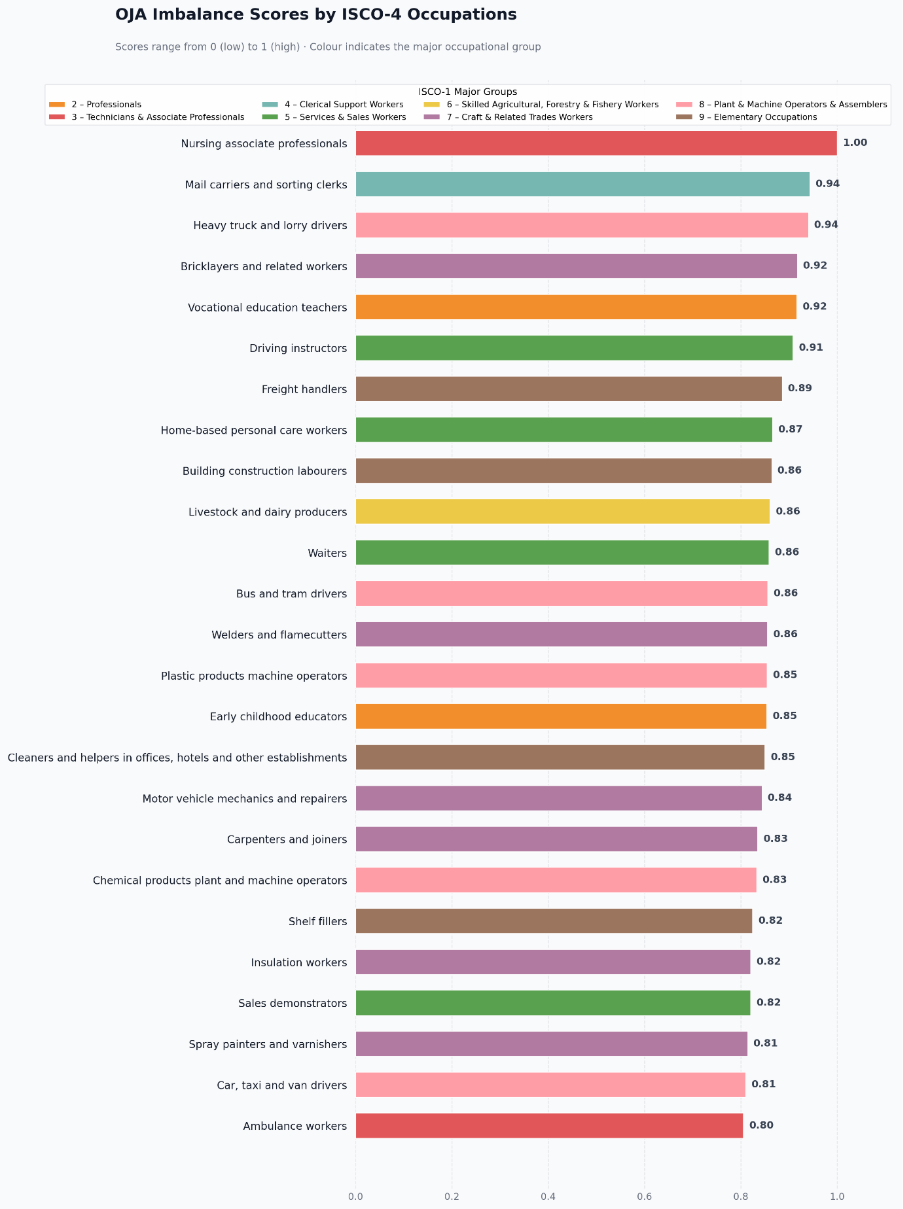
The complete list of results can be found in the accompanying .xlsx file, with higher scores signalling higher imbalances. Figure 2 shows the 25 occupations with the highest scores. Among others, these include occupations associated with the critical for the ageing challenge of the EU27 healthcare sector (e.g. Nursing associate professionals, Home-based personal care workers, Ambulance workers) as well with education (Vocational education teachers, Early childhood educators). Other occupations with high imbalance scores include several technical occupations (‘Craft and related trades workers’), as well as occupations relevant to drivers (most of which fall under ISCO group 8, ‘Plant and machine operators, and assemblers’).
Across the ISCO major (1-digit) groups (excl. the ISCO group 6, for which only two occupations were included in the analysis) the highest imbalances exist in the groups 7-9. Craft and related trades workers (ISCO group 7) and Plant and machine operators and Assemblers (ISCO Group 8) are particularly important for Vocational Education and Training, as several occupations in these groups are directly linked with VET. Indeed, on average, occupations that are linked with VET have a higher OJA Imbalance score compared to the rest.
Figure 2. Occupations with the highest OJA Imbalance scores across the EU-27.
Conclusions
This brief Cedefop Data Insights report presented the first set of results, covering the years 2021-24, for measuring labour market imbalances in the EU-27 through online job advertisements. A forthcoming Cedefop Working Paper will provide in-depth insights and a detailed technical analysis on the methodology, validation and results.
References
Barnow, Burt S.; Trutko, John; Piatak, Jaclyn Schede (2013). Occupational Labor Shortages: Concepts, Causes, Consequences, and Cures. Kalamazoo, MI: W.E. Upjohn Institute for Employment Research. https://doi.org/10.17848/9780880994132
Brown, Duncan; Magrini, Elena; Pelucchi, Mauro (2024). Predicting Skill Shortages with Real-Time Data: Using Online Job Adverts to Predict UK and Italian Employer Perceptions. Shortages of Labour and Skills, p.89.
Cedefop & Eurostat (2025). Delivering evidence from online job advertisements: tapping into 10 years of experience. Cedefop research paper. Publications Office of the European Union, https://doi.org/10.2801/5070484
Dossche, Wouter; Vansteenkiste, Sarah; Baesens, Bart; Lemahieu, Wilfried (2025). Anticipating delays in recruitment: Explainable machine learning for the prediction of hard-to-fill online job vacancies. European Journal of Operational Research.
Napierala, Joanna; Kvetan, Vladimír; Branka, Jiri (2022). Assessing the representativeness of online job advertisements, Cedefop working paper series, No. 17, ISBN 978-92-896-3456-4, Publications Office of the European Union, Luxembourg, https://doi.org/10.2801/807500
Napierala, Joanna (2023). The feasibility of using online job advertisements in analysing unmet EU demand, Publications Office of the European Union, https://data.europa.eu/doi/10.2801/10233
Data insights details
Downloads
Article in PDF format
Table of contents
Page 1
SummaryPage 2
IntroductionPage 3
Data and MethodsPage 4
ResultsPage 5
ConclusionsPage 6
References
