
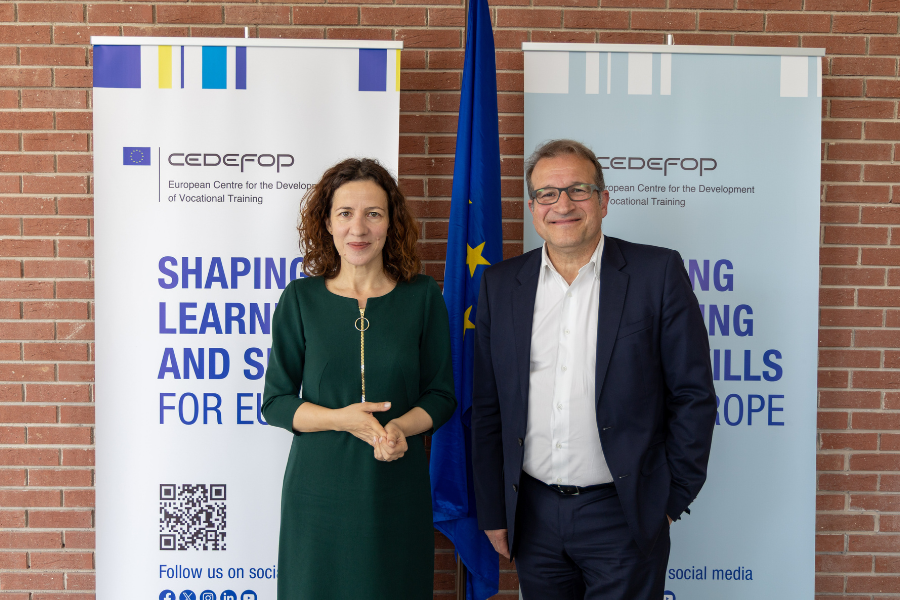
Thessaloniki, 13 March 2026 — Executive Vice-President for Social Rights and Skills, Quality Jobs and Preparedness, Roxana Mînzatu, paid her first official visit to Cedefop's headquarters in Thessaloniki today, marking just over a year since the launch of the Union of Skills and reaffirming the Agency's central role in delivering on the Commission's ambitions for people, preparedness and competitiveness.
The visit came as the EU enters a decisive phase of implementation, with the ongoing Fair Labour Mobility Package and the Skills Portability Initiative — milestones that place Cedefop's research, skills intelligence and policy monitoring at the very centre of European policymaking.
The EU is advancing the Skills Portability Initiative to make it easier to recognise qualifications, skills and non-formal learning across borders. This will help address labour shortages, boost mobility and create new opportunities. The changes we are implementing across several policy domains will have a real impact on people’s lives and on workplaces across Europe.
— Roxana Mînzatu, EVP for Social Rights and Skills, Quality Jobs and Preparedness
The Union of Skills, launched on 5 March 2025, placed skills at the very top of the EU's political agenda. Its vision — that the success of every person in learning, at work and in life is essential for competitiveness and for a stable, resilient Union — now guides a wide-ranging action plan spanning basic skills, upskilling and reskilling, skills portability, and lifelong learning.
Cedefop's evidence base has been integral to shaping that agenda from the outset: the agency's research estimating that at the start of 2020 around 128 million EU adults required upskilling or reskilling has given the policy debate tangible scale and urgency.
For EVP Mînzatu, whose portfolio explicitly encompasses preparedness alongside skills and quality jobs, Cedefop's work resonates across multiple policy fronts. Citizenship education in vocational education and training (VET) — which the Vice-President has described as the "fifth basic skill" – is now the subject of a dedicated three-year Cedefop study. The Agency's analysis of AI in the workplace, digital skills gaps and the green transition further position it as an indispensable source of evidence for an economy and society in rapid transformation. In addition, Cedefop is working with selected Member States, through the Technical Support Instrument (TSI) to make skills intelligence smarter and more accessible. Work is already under way with Estonia, with similar support planned for Italy and Czechia.
With social rights and skills, quality jobs and preparedness under the leadership of Executive Vice-President Roxana Mînzatu, Europe has a strong foundation for a more integrated approach to skills, jobs and learning. It also reinforces Cedefop’s role in providing the VET and skills intelligence that inform EU policymaking, including the upcoming European VET Strategy.
— Jürgen Siebel, Cedefop Executive Director
Today's visit signals the strength of the partnership between the agency and the Commission at a pivotal juncture. Cedefop stands ready to provide the evidence, expertise and institutional memory that sound skills policy demands — for learners, workers, and citizens across Europe.