
As Europe faces persistent skills shortages, labour-market mismatches and the demands of the digital and green transitions, the need for transparent and comparable qualifications has become increasingly urgent. The ambition of the Union of Skills to support competitiveness and mobility across the single market depends on making skills visible and trusted, enabling learners and workers to move across borders and ensuring education systems respond to evolving labour-market needs.
In this context, national qualifications frameworks (NQFs) play a key role by providing structured systems that enhance transparency, comparability and mutual trust between Member States, while supporting flexible learning pathways essential for Europe’s economic and social resilience.
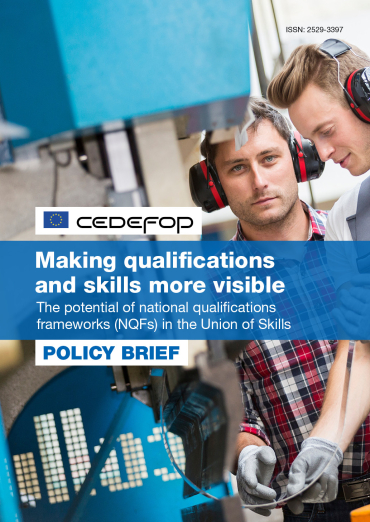
Cedefop’s latest publication, Making qualifications and skills more visible: the potential of national qualifications frameworks (NQFs) in the Union of Skills, provides an updated and forward-looking assessment of how NQFs are evolving to meet these challenges. Launched during a recent Cedefop webinar, the brief draws on data from the 2025 update of the European inventory of NQFs covering 41 countries and examines recent trends in implementation, use and impact. As noted by Koen Nomden, Team Leader for Transparency and Recognition of Skills and Qualifications, during the presentation event of this publication:
NQFs are not merely technical instruments but living systems that must keep pace with evolving skills and qualifications — especially as labour markets and technologies rapidly change.
Expanding the Scope of NQFs and Flexible Learning Pathways
A key trend highlighted in the publication is the growing inclusiveness of national qualifications frameworks. Many countries are expanding their frameworks to include qualifications awarded outside formal education and training. Almost half of the countries analysed have already done so, and 18 have integrated microcredentials. These developments support more flexible learning pathways and make lifelong learning more accessible and better aligned with labour-market needs.
Examples include:
Sweden, which has included around 100 qualifications awarded outside the formal system in its NQF.
Germany, which recently incorporated its first qualification awarded outside formal education and training at NQF level 6.
Digital Tools Unlocking Qualification and Skills Portability
The publication highlights the growing role of online qualification databases in making skills and qualifications visible and comparable across borders. These digital tools support learning progression, lifelong learning and skills matching, while also strengthening Europe’s attractiveness for third-country talent through smoother recognition processes
Examples include:
Latvia, where the national qualifications database provides information on all LQF-levelled qualifications in Latvian and English, with 2,707 entries as of October 2024.
Ireland, where the NARIC database includes comparability statements for 1,927 qualifications from more than 160 countries, supporting recognition for employment and further education.
Strengthening Cooperation Between Education and Labour Markets
NQFs increasingly function as platforms for cooperation between education and employment sectors. Their standardised procedures and level descriptors help education providers align programmes with labour-market needs, while labour-market actors are progressively integrating NQF and EQF levels into recruitment, professional development and mobility processes.
Although the use of NQFs in recruitment is still emerging in most countries, some are more advanced. In France, for example, NQF qualifications are recognised as proof of competences and used to support professional mobility. Company size also plays a role: studies in Norway and the Netherlands show that large companies tend to be more aware of NQFs than small and medium-sized enterprises.
Looking Ahead
The publication concludes that the future of NQFs lies in three interconnected priorities:
Expanding coverage: Broadening the range of qualifications included in NQFs, particularly microcredentials and non-formal learning, to reflect diverse learning pathways.
Raising user awareness: Strengthening understanding among employers, education providers, learners and guidance professionals on how to use NQFs and EQF levels effectively.
Strengething digital infrastructure: Investing in interoperable digital tools to support smoother recognition and cross-border portability of qualifications.
These priorities will reinforce lifelong learning, improve labour-market functioning, and support the EU’s objective of building a competitive and future-ready Union of Skills.