
AI brings profound changes in workplace tasks and roles. Job descriptions across the board are being updated to include AI-related competencies and responsibilities. Graduates of VET and apprenticeships need to collaborate with AI for the execution of technical tasks and to adjust to agentic workflows. Apprenticeship curricula and qualifications need to be updated to match the evolving skill needs and improve future workers’ capacity to work with AI-based technologies. More than that, AI takes over baseline tasks which were in many cases performed by apprentices or apprenticeship graduates who get entry-level roles once their programmes are completed. As apprenticeships continue to expand into new fields and occupations, they may also be exposed to a decline in entry-level openings. To date this contraction appears concentrated in white-collar roles, so the effect on apprenticeships is likely to be uneven and occupation-specific rather than uniform.
At the same time, apprenticeships can once again prove to be an agile and effective policy response for building the skills and qualifications needed in AI-impacted labour markets, where traditional education and training can struggle to keep pace with the rapid integration of AI at the workplace. Building on their core features — learning-by-doing and the combination of two learning venues — apprenticeships can develop both broad, baseline AI-related skills and the advanced skills needed in occupations at the heart of AI expansion. Whether AI is a net threat or a net opportunity for any given apprenticeship will depend largely on how quickly its content and level are upgraded — moving learners away from tasks that AI absorbs and towards tasks where AI complements human work. Beyond changing what apprenticeships teach, AI can also reshape how they are delivered: AI-supported learning can ease the load on instructors, help scale provision and expand the number of available places, potentially lowering the cost of delivering quality apprenticeships.
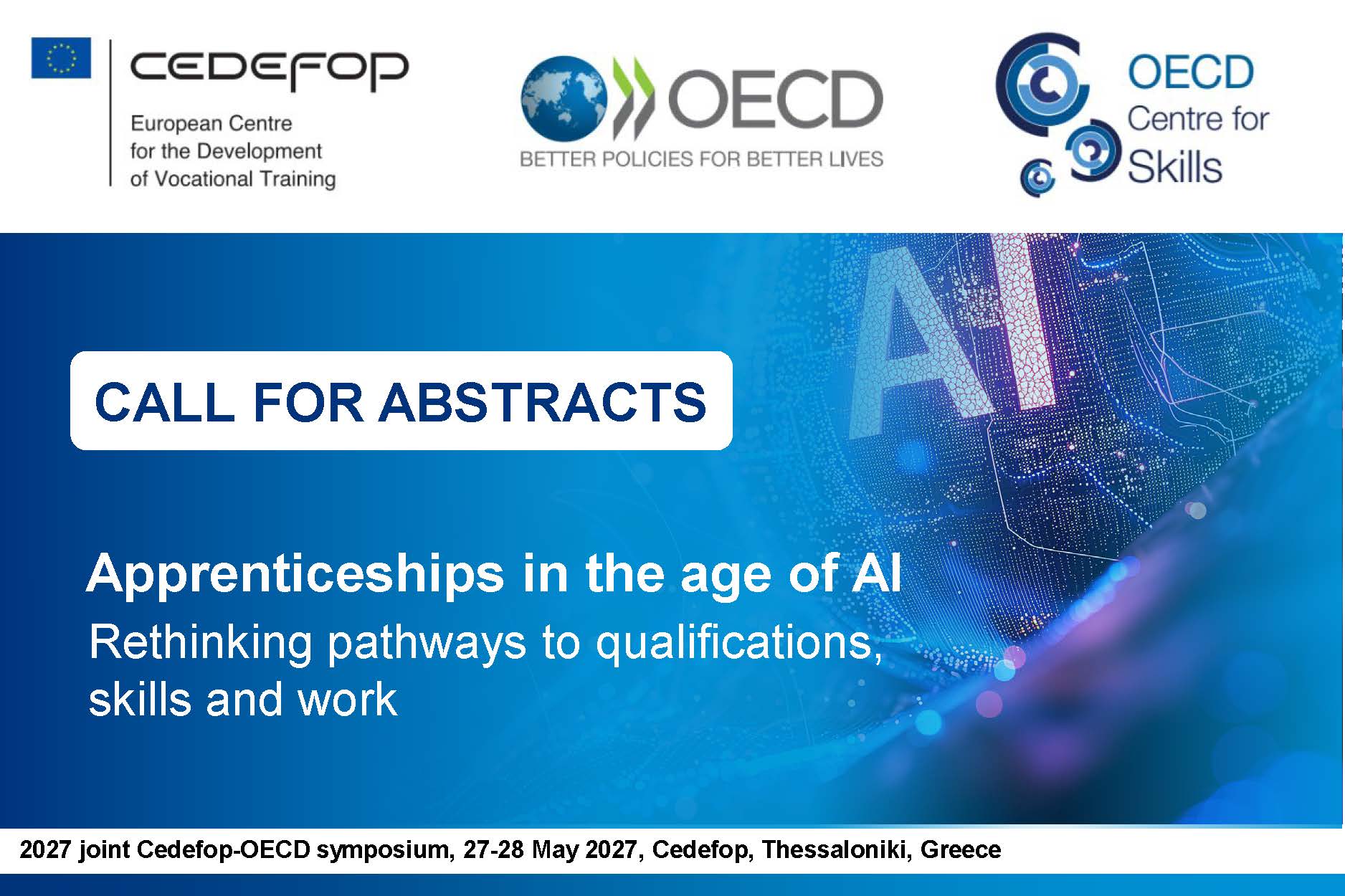
The 2027 joint Cedefop/OECD apprenticeship symposium intends to capture how the changes in tasks and jobs affect company preferences and learner choices, what it means in terms of apprenticeship qualifications (content, level, purpose) and what enables apprenticeship to remain an effective education and training option in changing workplaces, and AI-impacted job markets. The symposium will provide an opportunity to gain insights from research on these topics from around the world.
Call for abstracts
You are invited to share via [email protected] by 15 October 2026:
a) abstracts of advanced, unpublished papers
b) abstracts/links to published papers and reports
The abstract should include (a) the research question/key issue, (b) main findings/analytical points and how they address the question/issue at hand, (c) overview of methodology/analytical approach, (d) conclusions or policy recommendations. Abstract length: up to 500 words.
Papers that originally cover the topic more broadly (e.g. overall labour market transitions in the context of AI, impact on all vocational education and training etc.) will need to be refocused/redrafted to examine this in relation to apprenticeships in specific.
The organisers will assess submissions on the basis of (a) relevance, (b) evidence basis, (c) methodology and analytical approach and (d) appeal to an international audience.
Selected papers will be presented in the 2027 Cedefop/OECD symposium and/or included in a subsequent Cedefop-OECD publication.
See more in the full call for abstracts below
Submission topics/angles
The organisers are seeking papers regarding the impact of Artificial Intelligence on apprenticeships, in one or more of the following angles (indicative and non-exhaustive list):
- AI implications for purpose, content and level of apprenticeship qualifications
- AI exposure, labour market outcomes, impact on occupations and learner choices
- Responses regarding workplace practices and system governance
- Pedagogies, assessment and inclusiveness
Important dates
Deadline for abstract submission: 15 October 2026
- You are invited to share via [email protected]:
a) abstracts of advanced, unpublished papers
b) abstracts/links to published papers and reports
- The abstract should include (a) the research question/key issue, (b) main findings / analytical points and how they address the question/issue at hand (c) overview of methodology/analytical approach, (d) conclusions or policy recommendations. Abstract length: up to 500 words
- The organisers will assess submissions on the basis of (a) relevance, (b) evidence basis, (c) methodology and analytical approach and (d) appeal to an international audience.
- Within four weeks from this deadline, the organisers will decide which abstracts are suitable for presentation and/or publication and invite their authors to submit full papers.
- Selected papers will be presented in the 2027 Cedefop/OECD symposium and/or included in a subsequent Cedefop-OECD publication.
Deadline for full paper submissions: 15 January 2027
- At this point, the organisers will accept published papers, reports, working papers, as well as finalised unpublished papers. Extended abstracts or unfinished papers will not be accepted.
Confirmation of papers to be presented: 22 February 2027
Symposium: 27-28 May 2027, Thessaloniki, Greece
Deadline for submitting revisited (if needed) papers for the publication: 30 June 2027
- Terms applying to the joint Cedefop-OECD publication are detailed in the call for abstracts document below
News details
Ke stažení
Call for abstracts