
Eight million young Europeans are stuck in limbo- neither in school, training, nor work. The solution isn’t just motivation - it’s opportunity. Cedefop’s new report shows how vocational education and training (VET) can turn disengagement into empowerment, offering personalized pathways, hands-on skills, and a real chance to thrive in the digital and green economy.
Cedefop’s latest report, Building Inclusive Futures for NEETs: VET Solutions for Europe’s Young People Not in Employment, Education or Training, offers a roadmap to tackle this pressing challenge. Drawing on years of research, practical toolkits, and recent Eurostat data, it provides policymakers and vocational education and training (VET) practitioners with clear, actionable strategies to help young people re-engage with learning, develop skills, and transition smoothly into the labour market.
VET as the Backbone of Inclusive Youth Systems
The report underscores that VET should not be an afterthought - it must anchor Europe’s youth inclusion efforts. By integrating education, employment, and social policies, VET can act as a bridge, guiding young people from disengagement to opportunity. Holistic, individualized pathways - combining outreach, guidance, mentoring, work-based learning, and systematic follow-up - are key to unlocking the potential of NEETs.
VET is most effective when it functions as a strategic connector, linking social inclusion, learning, and sustainable employment, rather than being treated as just one part of the solution.
Prevention and Reintegration: Two Sides of the Same Coin
Early leaving from education and NEET status are interconnected challenges. The report shows that prevention and reintegration must be treated as a single continuum. Early identification of risk, combined with second-chance pathways, guidance, and work-based learning, ensures that young people who disengage from learning have clear routes back into education and employment.
Effective policies recognize that support is most powerful when it flows seamlessly from early intervention to re-entry, rather than being fragmented or reactive.
Personalization Over One-Size-Fits-All
NEETs are not a homogeneous group - they differ in their proximity to education, skills, and employment, making personalized pathways and precise targeting essential. Some are close to re-entering work or study, while others face deep disengagement. Cedefop identifies six profiles, from re-entrants and recent job-seekers to young people unavailable due to family, health, or discouragement, each requiring tailored support. Effective policies match the type and intensity of intervention to these needs, from light guidance for those near re-entry to intensive, multisectoral support for the most vulnerable. As Europe works toward its goal of reducing the NEET rate to 9% by 2030, success will depend on reaching young people facing the most complex barriers. Fairness and effectiveness go hand-in-hand: precision in policy ensures support reaches those who need it most, in ways most likely to succeed.
Box 1. Overview of six NEET profiles defined by Cedefop

Source: Cedefop VET toolkit for empowering NEETs
Structural Barriers Drive Exclusion
Contrary to common assumptions, NEETs are often excluded by structural barriers rather than lack of motivation. Gender and geography matter. In 2024, 12.1% of young women aged 15–29 were NEETs, with rural and remote areas amplifying the risk of exclusion. Challenges like childcare gaps, care responsibilities, and inflexible learning opportunities disproportionately affect young women and young mothers.
Box 2. Overview of risk factors for becoming NEETs identified by Cedefop
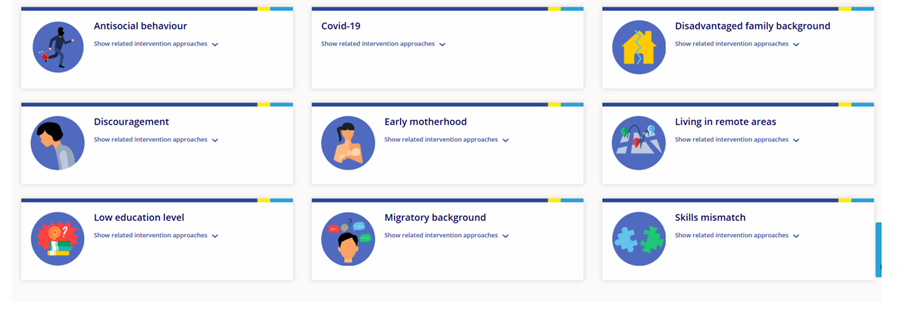
Source: Cedefop VET toolkit for empowering NEETs
Addressing NEET exclusion therefore requires gender-sensitive and place-based solutions, rather than a one-size-fits-all approach.
High-Intensity Support for the Most Excluded
Some NEETs face multiple, overlapping barriers and rarely respond to short-term interventions. The report emphasizes that trusted outreach, sustained mentoring, and holistic support are essential for reaching the most marginalized youth. As Europe moves toward its NEET reduction target, the hardest-to-reach groups will define the success of inclusion efforts.
Continuity and Cross-Sector Cooperation
Successful VET programmes go beyond isolated initiatives. They combine continuous support - from outreach to training to employment - with coordinated action across VET, social, and local services. Integrated delivery produces stronger, longer-lasting outcomes, providing NEETs with coherent support rather than fragmented assistance.
Evidence-Based Action
The report highlights the importance of data-driven policy. Disaggregated data and a deep understanding of NEET profiles allow interventions to be targeted effectively. Cedefop’s VET toolkit for empowering NEETs compiles good practices, key interventions, and practical tools, helping policymakers scale what works across contexts.
Strengthening Delivery Systems
Achieving the EU’s 9% NEET target by 2030 is possible, but only with stronger implementation capacity, sustained investment, and coordination across education, employment, and social systems. Without intensified effort, some Member States risk stagnation, and the remaining excluded youth will become increasingly difficult to reach.
VET and the Green & Digital Transitions
Finally, the report highlights how the green and digital transitions offer both opportunities and risks. NEETs without access to relevant skills risk being left behind. Inclusive, high-quality, and flexible VET systems can equip young people with the competences, confidence, and pathways needed to thrive in emerging sectors, ensuring economic transformation drives inclusion rather than widening disadvantage.
Cedefop’s report is more than a policy guide - it is a call to action. By embedding VET in inclusive youth systems, personalizing pathways, addressing structural barriers, and relying on evidence, Europe can build a future where no young person is left behind.
Read the report: Building inclusive futures for NEETs: VET solutions for Europe’s young people not in employment, education or training.
Blog article details
Links