
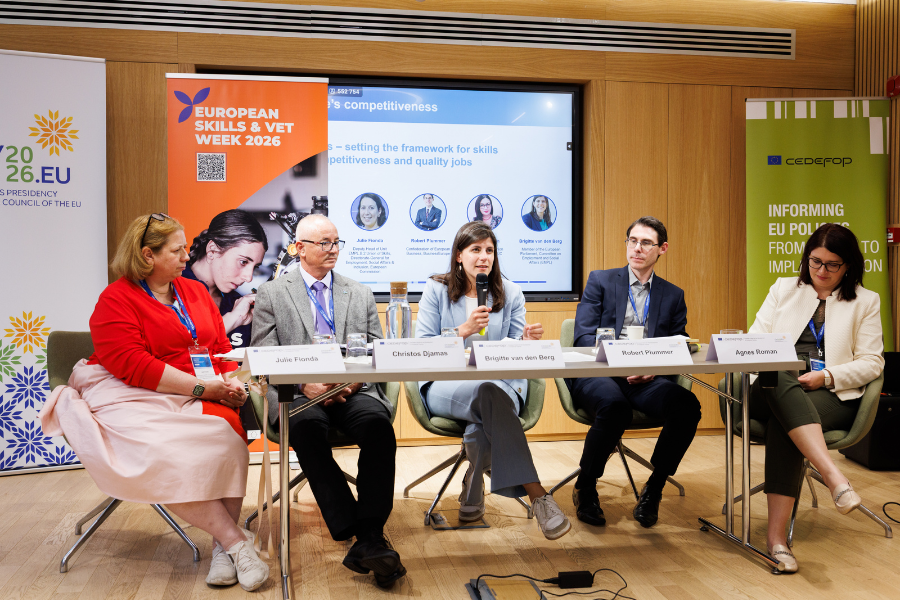
Brussels, 2 June 2026 — What does it take for Europe to compete? Cedefop convened policymakers, social partners, researchers, and Brussels stakeholders for the 20th Cedefop Brussels Seminar — Skills for Europe's Competitiveness — co-organised with the Cypriot Presidency of the Council of the European Union.
The milestone event arrived at a pivotal moment. Europe's productivity gap with major global competitors remains a pressing concern. Technological innovation, skills utilisation, and workplace learning quality have emerged as core levers — yet their connection to organisational performance and policy design remains underdeveloped. The seminar set out to change that, bringing fresh evidence and political commitment to bear on a challenge that cuts across industrial strategy, employment policy, and education reform.
Central to the day's discussions was Cedefop's new European Training and Learning Survey (ETLS) — the first pan-European survey to map systematically how skills are developed, deployed, and updated in European workplaces. Its findings shed new light on why low skills demand persists in many organisations and how that constrains both productivity and job quality. Supplementary evidence from the European Skills and Jobs Survey (ESJS) and European Company Survey added further granularity on skill mismatch, job design, and the role of organisational practices in enabling or inhibiting effective skills use.
Curricula and qualifications open doors, paving people’s pathway to good jobs. But equally powerful drivers of continuing skill development are workplace conditions — job autonomy, managerial support, and a culture where learning is part of work itself.
Jürgen Siebel, Executive Director, Cedefop
The seminar addressed four interconnected questions:
- how workplace skills development can translate into higher job quality and stronger competitiveness;
- how organisational practices shape skills demand;
- what role workplace learning plays in linking technological innovation to productivity; and
- what policy frameworks are needed to bring these elements into alignment.
The framing was deliberately human-centred. Competitiveness, participants heard, is not simply a matter of what skills workers possess — it hinges equally on how those skills are valued, developed, and used within organisations. Sustained investment in both initial VET and continuous workforce development remains critical, particularly as technological change accelerates and labour and skills shortages persist across Member States. The 2026 Council Recommendation on Human Capital, alongside the Union of Skills, signals growing political will to act on these fronts.
Human capital has become the decisive factor in economic competitiveness and strategic influence. In an increasingly knowledge-driven and competitive world, Europe's future prosperity and resilience will depend on its capacity to invest in skills, knowledge, and innovation, and to place human capital at the heart of its long-term development strategy.
Elias Margadjis, Director, Secondary Technical and Vocational Education and Training, Ministry of Education, Sport and Youth, Cyprus
As the host Presidency, Cyprus's engagement with the seminar reflected its broader priorities around fair and inclusive employment and adequate working conditions — priorities that align closely with Cedefop's research focus on job quality as a driver of competitiveness, not merely an outcome of it.
The event also served as the launch platform for the 2026 European Skills and VET Week. The Week will convene the wider skills and VET community across Europe to examine how upskilling, reskilling, and vocational education and training can help the EU remain economically strong and strategically independent.
VET and skills are at the center stage in the work of the Cabinet. The Skills & VET Week is a valuable opportunity to raise awareness and help VET achieve the recognition and importance it deserves.
Georgi Dimitrov, Member of Cabinet of Executive Vice-President Roxana Mînzatu, Social Rights and Skills, Quality Jobs and Preparedness, European Commission
The 20th Brussels Seminar brought a milestone quality that went beyond the number: twenty editions of evidence-to-policy dialogue, each shaped by a Presidency's priorities, each drawing on Cedefop's expanding research base. As the Union of Skills takes shape and the Competitiveness Compass points toward skills as a strategic pillar, today's seminar offered a timely reminder that Europe's competitive future is, at its core, a human capital story.