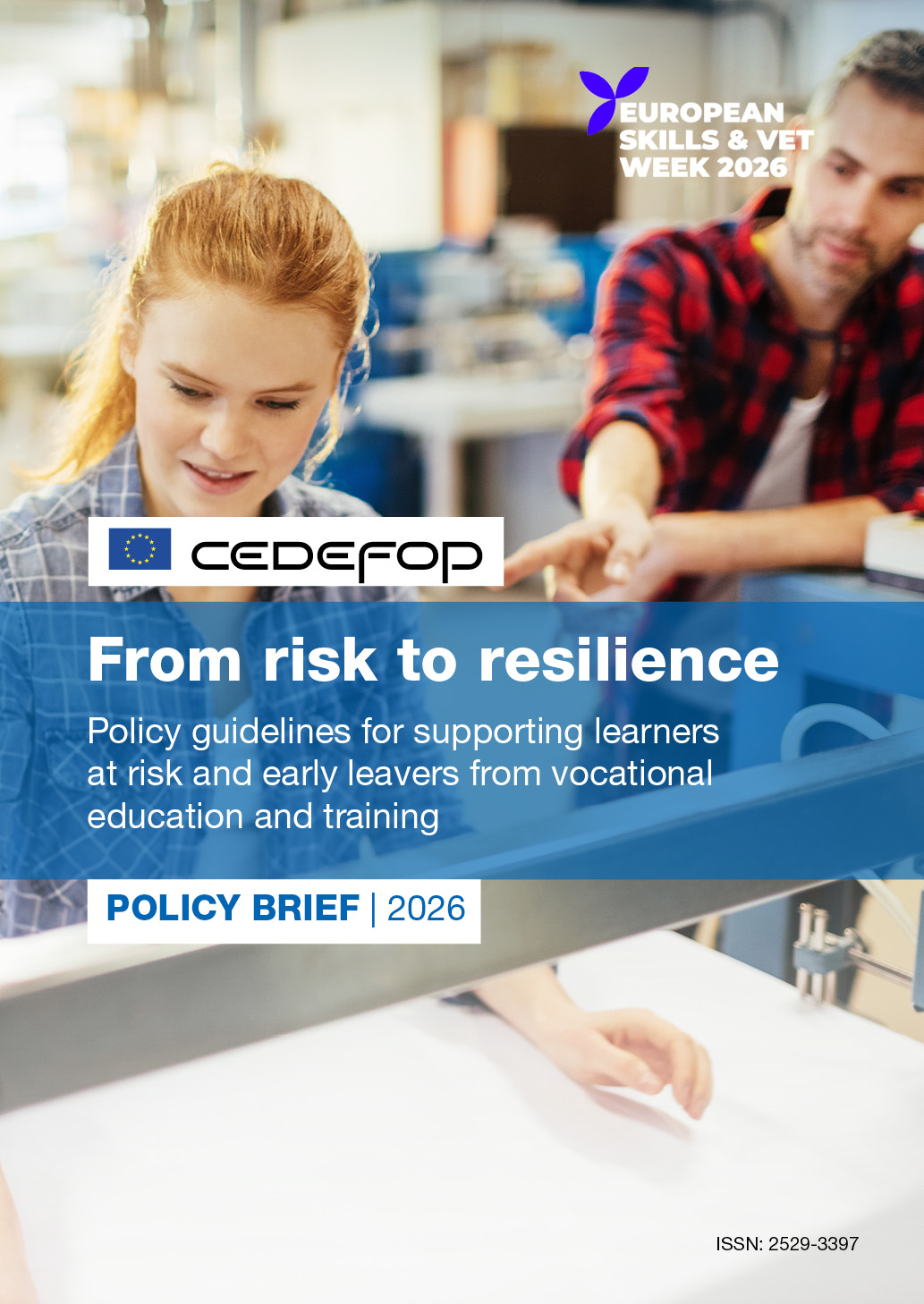
Early leaving from education and training remains a significant challenge across Europe. While the EU has made substantial progress, with the early leaving rate falling to 9.1% in 2025, important disparities persist across countries, regions and population groups. The EU has now set a more ambitious target of reducing early leaving to below 8% by 2030.
Against this backdrop, Cedefop’s new policy brief takes a closer look at what happens before, and what can happen after, a learner leaves education and training. Rather than treating early leaving as a single event or simply an individual decision, it looks at the different risk profiles and disengagement factors that can lead learners away from education and training.
Drawing on Cedefop research and its VET toolkit for tackling early leaving, the brief brings these factors together with 20 intervention approaches covering system capacity, early identification, targeted support and re-engagement.
This provides policymakers and practitioners with a more differentiated way of looking at early leaving: understanding who is at risk, why disengagement happens, where intervention can make a difference, and how VET systems can support learners both before and after early leaving.
Facts and findings
- Early leaving is a process, not a single event. Learners can experience different combinations of social, educational, personal and labour-market-related factors that gradually increase their risk of disengagement.
- Understanding different risk and disengagement profiles matters. There is no single pathway into early leaving, and therefore no single intervention that will work for every learner.
- Prevention starts with recognising disengagement early. Identifying warning signs while learners are still engaged gives education and training systems greater scope to provide timely and appropriate support.
- The response needs to go beyond prevention. Effective policies should also create opportunities for those who have already left to reconnect with education and training.
- VET has a distinctive role to play. Its links with practical learning, work and employers can help strengthen engagement, while flexible pathways can provide routes back into learning.
- System capacity matters as much as individual interventions. Effective responses depend on data, early-warning mechanisms, cooperation between services, skilled staff and the capacity to provide personalised support.
Key messages
- The brief turns evidence into a practical intervention framework. Its 20 intervention approaches offer policymakers and practitioners a structured menu of possible responses across prevention, targeted support and re-engagement.
- The brief calls for a shift from reacting to early leaving to building systems that can recognise disengagement early, respond to learners’ different needs and keep pathways to learning open.
- The goal is not simply to prevent learners from leaving, but to create education and training systems that help learners stay engaged, reconnect when they leave, and move towards their future pathways.
Policy pointers
- Use risk and disengagement profiles to strengthen prevention, recognising that learners can arrive at the point of early leaving through different pathways.
- Build early identification into VET systems so that signs of disengagement can be recognised and acted upon before learners leave.
- Match support to learners’ circumstances, drawing on the range of intervention approaches identified by Cedefop rather than relying on one-size-fits-all solutions.
- Make VET learning meaningful and relevant through strong links with work, employers, practical learning and career guidance.
- Keep pathways back into learning open through flexible education and training routes and the recognition and validation of previous learning.
- Strengthen cooperation around learners at risk, bringing together VET providers, guidance services, social services, employers, families and other relevant actors.
- Build monitoring and evaluation into interventions to improve understanding of what works, for which learners and in which contexts.
Publication details
Cedefop. (2026). From risk to resilience: Policy guidelines for supporting learners at risk and early leavers from vocational education and training. Cedefop policy brief. Publications Office of the European Union. DOI: 10.2801/0047507 https://www.cedefop.europa.eu/en/publications/9211
Файлове за изтегляне
From risk to resilience: Policy guidelines for supporting learners at risk and early leavers from vocational education and training