
Early leaving from education and training (ELET) remains a major challenge for Europe. The EU has made significant progress in reducing early leaving, but persistent differences across countries, regions and population groups show that further action is needed.
ELET is no longer solely a question of equity and social inclusion. It is also a challenge for Europe’s skills and competitiveness ambitions. Young people who leave education and training without an upper-secondary qualification face a higher risk of unemployment, precarious employment and poverty, while being less well positioned to benefit from changing labour market opportunities and growing demand for skills.
In 2025, the EU average ELET rate stood at 9.1% among 18- to 24-year-olds. Seventeen EU Member States had already reached the previous 2030 benchmark of less than 9%. Building on this progress, the EU has raised its ambition and set a new target of less than 8% by 2030. Meeting this target will require sustained and, in many cases, accelerated action – particularly to reach the groups that remain most at risk of leaving education and training early.
Why tackling early leaving matters
As demand for skills grows and the labour market is transformed by the green and digital transitions, the consequences of leaving education and training early can extend well into adult life.
Many early leavers face disadvantages in acquiring basic, digital and transversal skills. At the same time, labour market demand is becoming increasingly skills-intensive. Preventing early leaving and creating effective pathways back into education and training are therefore essential to ensuring that no talent is lost.
Tackling ELET requires a shift from remedial approaches towards systemic strategies that combine prevention, early intervention and flexible reintegration pathways.
What is the role of VET?
Vocational education and training (VET) can be part of the solution to early leaving – both by helping learners stay engaged and by providing pathways back into education and training for those who have already disengaged.
Its contribution depends on the quality and inclusiveness of provision and its ability to respond to diverse learner needs. Effective learner support, high-quality work-based learning, flexible learning pathways, strong links with employers and clear progression opportunities can help learners remain engaged, complete their qualifications and progress towards further learning or employment.
Cedefop’s work therefore focuses on strengthening the capacity of VET systems to provide inclusive, flexible and responsive pathways that support learners to remain in education and training, complete their qualifications and progress towards further learning or employment.
A knowledge hub for inclusive VET pathways
Cedefop’s work on early leaving contributes to a broader knowledge hub for inclusive VET pathways. It brings together comparative research, evidence on effective interventions, inspiring practices and interactive tools to support policymakers and practitioners in designing and delivering more inclusive education and training systems.
The work connects three complementary priorities:
- Prevent early leaving by identifying and addressing risks before learners disengage.
- Intervene through timely, targeted and learner-centred support.
- Reintegrate early leavers and young people not in employment, education or training (NEETs) through flexible second-chance and progression pathways.
Together, these approaches help education and training systems move from reacting to early leaving to preventing it, intervening earlier and creating effective routes back into learning.
Cedefop research
Cedefop research strengthens the evidence base for understanding, preventing and tackling early leaving from VET, as well as empowering NEETs. It brings together comparative analysis, national evidence and research on the factors that influence learners’ participation, progression and decisions to leave education and training.
Recent work has examined how VET systems can become more inclusive and how targeted support can help learners at risk of early leaving and those who have already disengaged. It includes research on supporting NEETs, the role of teachers and trainers, and approaches to strengthening inclusion in and through VET.
Explore selected Cedefop research and evidence:
- VET teachers at a turning point: Pilot evidence from Cedefop’s European Vocational Teacher Survey (EVTS) — shows how teacher capacity, working conditions, inclusion and professional development affect the ability of VET systems to respond to increasingly diverse learners.
- Building inclusive futures for NEETs: VET solutions for Europe’s young people not in employment, education or training - examines inequalities among NEETs and how VET can support personalised pathways back into learning and work.
- The role of guidance and counselling in minimising ELET – examines how guidance and counselling policies and practices can support learners at risk of early leaving and those who have already left education and training.
For further research and publications, explore Cedefop’s publications on early leaving.
Explore Cedefop resources
Cedefop brings together research, comparative analysis, policy evidence and practical resources to support policymakers, VET providers and practitioners in turning evidence into action.
- VET toolkit for tackling early leaving
The VET toolkit for tackling early leaving provides evidence, practical guidance and examples of practice from across Europe. It supports policy development, professional reflection and action at national, regional and local levels.
The toolkit brings together:
- approaches covering prevention, intervention and compensation;
- profiles of learners at risk of early leaving and early leavers;
- examples of practice from across Europe;
- analytical and policy publications on ELET;
- practical tools to support planning, reflection and evaluation.
The toolkit helps users understand why learners disengage, explore what can be done and identify approaches that can be adapted to their own context.
Cedefop’s 20 intervention approaches for tackling early leaving in functional clusters
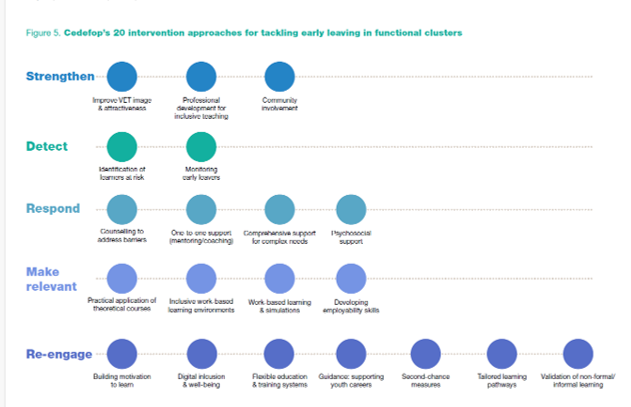
Explore the VET toolkit for tackling early leaving.
- VET toolkit for empowering NEETs
Young people who have already left education and training may face multiple and interconnected barriers to re-engagement. Cedefop’s VET toolkit for empowering NEETs brings together evidence, practical tools and examples of practice to help policymakers and practitioners understand these barriers and design more effective approaches to outreach, engagement and empowerment.
The toolkit supports efforts to reconnect NEETs with education, training and employment, and complements Cedefop’s work on preventing and tackling early leaving.
Explore the VET toolkit for empowering NEETs.
- Ambassadors for tackling early leaving
Cedefop’s ambassadors’ network brings together practitioners, policymakers and stakeholders from across Europe committed to reducing early leaving.
Ambassadors contribute to turning evidence into practice by sharing effective approaches, supporting peer learning, disseminating Cedefop tools and fostering dialogue between policy, research and practice.
Meet the ambassadors tackling early leaving from VET.
Get involved
Tackling early leaving requires action and learning across countries, systems and organisations.
Explore the toolkits, join the ambassadors’ network, or contact Cedefop to share good practices and practical tools contributing to the exchange of knowledge and experience on tackling early leaving and promoting inclusion in and through VET.
Interviews and articles
Read here what Dr Irene Psifidou and other people say about the VET toolkit for tackling early leaving.
- "Cal canviar el valor social que se li dona a l'FP a Espanya" [We need to change the social value given to vocational training in Spain] (interview in Catalan). In Universitat Autònoma de Barcelona. 28 November 2025.
- "Espanya necessita orientació integrada en etapes primerenques" [Spain needs to integrate guidance into early stages of the education system] (interview in Catalan). In El diari de l'educació. 30 October 2023.
- "España necesita una orientación integrada en el sistema que empiece en etapas tempranas" [Spain needs to integrate guidance into early stages of the education system] (interview in Spanish). In El diario de la educación. 19 October 2023.
- "Hay más abandono de los estudios allí donde la educación obligatoria termina antes de los 18" [There are more dropouts of education where compulsory education finishes before 18 years old] (interview in Spanish). In Diari ARA. 13 October 2023.
- "Elementos para avanzar hacia una política educativa integral contra el abandono escolar prematuro: ¿Qué hacen los otros países Europeos?" [Moving towards a comprehensive education policy to tackle early leaving from education: What do other countries do?] (speech in Spanish). In Jornada 'Traçant camins cap al Zero Abandonament', Fundació Bofill, in Barcelona, 22 September 2023.
- “Making VET fit for young people's needs”. In Cedefop magazine promoting learning for work: Skillset and Match, Issue 25, May 2022, pp. 12-13. Publications Office of the European Union, Luxembourg.
- “Cedefop toolkit helps tackling VET early leaving” In Cedefop magazine promoting learning for work: Skillset and Match, Issue 19, May 2020, page 6. Publications Office of the European Union, Luxembourg.
- “Tackling early leaving from education and training? You need Cedefop's new toolkit!”. In EPALE, August 2019.
- “VET supporting the qualification of migrants”. In Skills panorama Blog article, 7 December 2018.
- “VET as a solution to tackling early leaving”. In Cedefop's policy learning forum on vocational education and training (VET) as a solution to leaving education early in Thessaloniki, 16 and 17 May 2017.
- “An unsolved problem: How to address early school leaving?” (interview in English) / “Un problema no resolt: com abordar l'abandonament escolar prematur?” (interview in Spanish). In International Perspectives on Education Conference organised by Jaume Bofill Foundation in Barcelona, 26 October 2016.
- “La formazione on the job è un «antidoto» alla dispersione scolastica” [On-the-job training as an "antidote" to early school leaving]. In Scuola 24. Sfoglia il Quotidiano Digitale. 18 November 2016.
- “La formazione-lavoro contro la dispersione scolastica” [Work-based learning against early school leaving]. In school website: In Tecnica della Scuola. 18 November 2016.
- “La decisió d’abandonar els estudis no es pren d’un dia per l’altre” [The decision to leave school is not taken from one day to the next]. In Diari de l'Educació, 4 November 2016.
- “Hay países que dan incentivos a alumnos para que no abandonen la FP” [There are countries giving incentives to students to prevent them from leaving VET]. In Diario de Mallorca, Spain, 24 June 2016.
- “VET helps people say yes to education and training”. In Cedefop magazine promoting learning for work: Skillset and Match, Issue 6, January 2016, page 8. Publications Office of the European Union, Luxembourg.
Other related projects