
Europe’s digital transformation is accelerating but its skills base is not keeping pace. Despite years of policy focus, only around half of Europeans possess even basic digital competences, while employers across sectors increasingly report that skills shortages are constraining investment, innovation, and growth. The challenge is no longer about recognising the importance of digital skills. It is about delivering them systematically, equitably, and at scale.
Europe’s digital transformation is accelerating but its skills base is not keeping pace. Despite years of policy focus, only around half of Europeans possess even basic digital competences, while employers across sectors increasingly report that skills shortages are constraining investment, innovation, and growth. The challenge is no longer about recognising the importance of digital skills. It is about delivering them systematically, equitably, and at scale.
This is where initial vocational education and training (IVET) becomes critical. Positioned at the intersection of education and the labour market, IVET systems are expected to equip learners not only for today’s jobs, but for rapidly evolving, technology-driven careers. Yet a forthcoming Cedefop working paper Digital skill integration in IVET curricula: How governance frameworks shape implementation across eight European countries by Michail Papazoglou, Irene Psifidou and Zoi Maria Kamopoulou suggests that the real barriers to progress are not technical, but structural.
The uncomfortable truth: governance matters more than ambition
Across eight European countries, digital skills are firmly embedded in policy discourse. But early results show that their translation into curricula in some cases remains uneven, fragmented, and often slow. Why? Because curriculum systems are not neutral delivery mechanisms, hey are deeply shaped by governance arrangements, institutional traditions, and competing policy priorities.
Centralised systems, such as those in Greece or France, excel at ensuring coherence, standardisation, and equal recognition of qualifications. But this comes at a cost: slow curriculum updating cycles that struggle to keep pace with technological change. In some cases, programmes remain unchanged for over a decade - an eternity in the digital age. In Croatia, for example, curriculum revisions typically follow fixed multi-year cycles, limiting the system’s ability to respond to rapidly evolving digital skill needs.
Decentralised and partnership-based systems, like those in Germany, Finland, or the Netherlands, tell a different story. Here, employers and sectoral bodies play a direct role in shaping curricula, allowing faster adaptation to emerging technologies. Yet this responsiveness introduces new challenges: uneven implementation, sectoral disparities, and growing inequalities between learners. In Estonia, strong skills anticipation mechanisms (such as OSKA) enable relatively rapid updates, yet even there, differences persist between sectors in how effectively digital skills are embedded.
There is no perfect model. Instead, the evidence points to a fundamental trade-off between coherence and adaptability - one that digitalisation is making increasingly difficult to manage.
This structural trade-off becomes particularly visible when comparing how countries organise curriculum authority and updating processes. Figure 1 maps the eight countries along these two dimensions, revealing a clear pattern: systems with centralised governance tend to update curricula less frequently, while those with more distributed or partnership-based arrangements are better able to sustain continuous or demand-driven revision. Spain occupies an intermediate position, reflecting its ongoing transition towards faster updating under recent reforms.
Figure 1. Locus of curriculum authority and updating frequency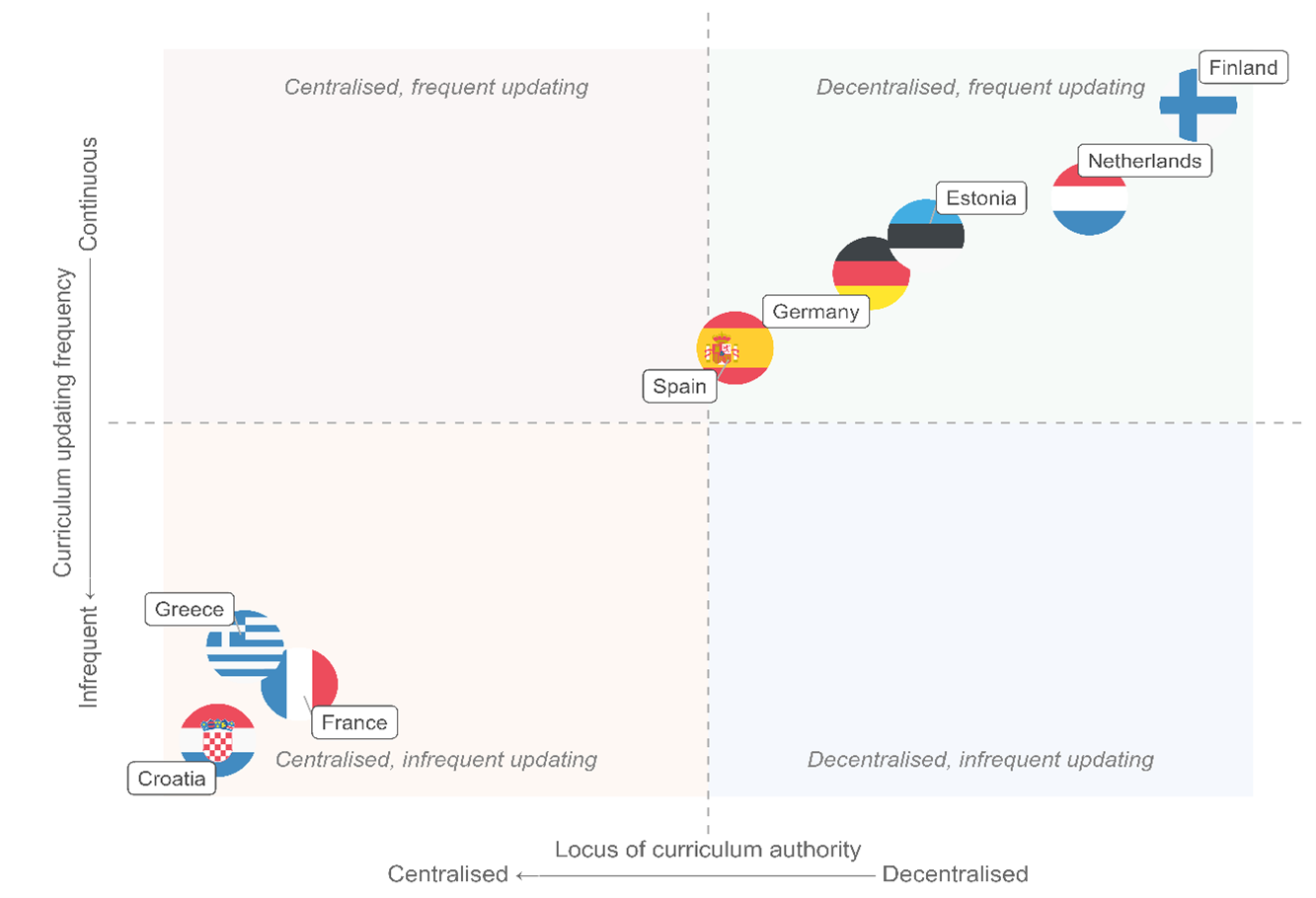
Source: authors
Digital skills for all or only for some?
Another critical finding challenges a common assumption: that simply adding digital skills to curricula will ensure inclusive outcomes.
In practice, how digital skills are integrated matters as much as whether they are included at all. Systems that rely solely on transversal digital modules may guarantee basic literacy but risk superficial learning disconnected from real work contexts. Conversely, systems that embed digital skills only within specific sectors often achieve strong occupational relevance, but leave large groups of learners behind.
The most effective approaches combine both. But hybrid models are complex, resource-intensive, and difficult to coordinate, particularly multi-level governance systems. Spain’s recent reforms illustrate this effort to combine transversal digital modules with sector-specific content, while Germany applies a universal digital module across apprenticeships alongside occupation-specific standards.
Even more concerning is the persistence of sectoral and regional inequalities. Advanced digital integration is concentrated in ICT and engineering pathways, while service-oriented and traditional sectors lag behind. At the same time, learners in urban centres and well-equipped institutions benefit disproportionately compared to those in rural areas or smaller providers. In countries like the Netherlands, optional curriculum components (“keuzedelen”) allow flexibility and innovation, but access to these opportunities often depends on institutional capacity, potentially leading to uneven learning experiences.
Without targeted policy intervention, digitalisation risks exacerbating – rather than reducing – existing inequalities in IVET.
The missing link: implementation capacity
Consistent with existing evidence, curriculum reform alone is not sufficient and needs to be supported by effective implementation. Across the eight countries, a common pattern emerges: ambitious policies and revised curricula, but with a risk of uneven impact in practice.
The reason is simple. Implementation capacity remains the weakest link.
Teachers and trainers are expected to deliver digital and AI-related competences, often without sufficient training, support, or infrastructure (Psifidou, et al.). Many rely on informal, self-directed learning to keep up with technological change. Meanwhile, disparities in resources across institutions further undermine consistent delivery. In Greece, for instance, innovative digital practices are often concentrated in pilot or experimental schools, while mainstream provision struggles to scale these approaches system-wide.
In this context, digital curriculum reform risks becoming symbolic to a certain extent rather than truly transformative.
From reform to reality: what needs to change
These preliminary findings point to a clear policy message: Europe does not need more digital skills strategies - it needs better-aligned systems to implement them.
This means:
- Guaranteeing a baseline: embedding transversal digital skills across all IVET programmes to ensure no learner is left behind.
- Ensuring relevance: complementing transversal skills with strong sector-specific integration.
- Speeding up adaptation: introducing more responsive and flexible curriculum updating mechanisms.
- Strengthening coordination: aligning stakeholder involvement with system-wide coherence and equity goals.
- Investing in people: placing teacher and trainer development at the centre of digital reform - not at its margins.
- Addressing inequalities head-on: targeting support to lagging sectors, regions, and institutions.
Critically, this also means moving beyond reliance on pilots and isolated innovations, and ensuring that successful practices are systematically scaled across entire IVET systems.
These first insights from Cedefop’s new evidence show that at EU level, frameworks and tools already exist. The challenge is no longer design - it is operationalisation.
A turning point for IVET
The integration of digital skills into IVET is not a technical exercise. It is a systemic transformation that tests the limits of existing governance models, institutional capacities, and policy coordination.
The message of this new Cedefop research first insights is both clear and challenging: progress is happening, but not fast enough - and not for everyone.
If IVET systems are to remain relevant in digital economies, the focus must now shift decisively from policy ambition to implementation capacity. Because in the end, the success of digital transformation will not be measured by strategies or frameworks, but by whether learners - across all sectors and regions - actually acquire the skills they need.
The time for incremental change has passed. The question is no longer whether Europe can integrate digital skills into VET but whether its systems are ready to do so at the scale and speed required.
These insights are only a first step in a broader research effort. The forthcoming paper contributes to Cedefop’s work on generating more systematic comparative evidence on how digital skills policies are translated into IVET curricula and forms part of the project “Mapping digital skills in initial VET curricula using natural language processing (NLP) techniques.” As further findings emerge, this work aims to inform EU and national debates by identifying key structural challenges and pointing to where policy action can most effectively support inclusive, future-oriented digital skills provision.
Blog article details
Links