

Problem statement
Addressed problem: Lack of community involvement
Personal, social, economic, educational, institutional, or family-related circumstances shape learners’ complex needs and influence the probability of early leaving from education and training. The type of support a learner requires depends on their needs and specific circumstances. A learner may require a range of interventions on different dimensions simultaneously.
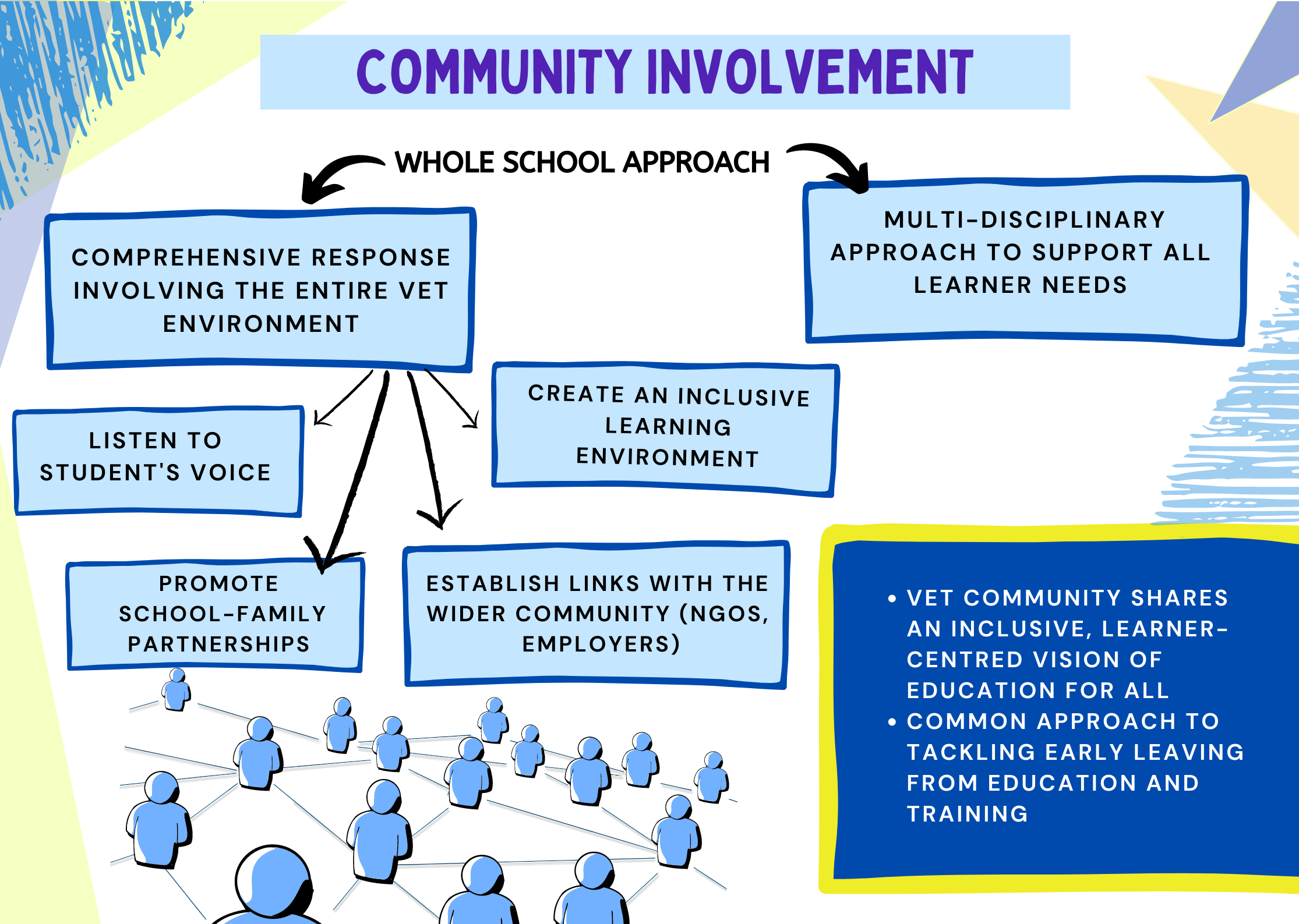
A comprehensive response to early leaving from education and training requires action from the entire VET community. This includes VET institution leaders, teaching and non-teaching staff, trainers, parents and families, but also the employers involved in the work-based elements of the VET programmes. This means that VET institutions also need to cooperate with companies, external stakeholders, and the wider community.
Beneficiaries
All learners can benefit from community involvement in their education and training. The aim is to ensure each learner is supported in the most appropriate way to achieve their educational goals. Involving key stakeholders from within the VET institution and beyond can be useful for young people at risk of early leaving from education and training or who have already dropped out and, in particular, for:
- Young people with a high level of disengagement and possibly also complex barriers to learning (e.g. health issues, poverty, etc.);
- Young people who lack motivation to continue learning and who may have a low appreciation of the value of learning;
- Young people who have low self-esteem and a lack of longer-term perspective for themselves.
Addressing the problem
How can the entire VET community be involved in the prevention of early leaving?
The following tips are offered to policy makers and practitioners involved in the design and delivery of VET. The information is also based on Cedefop research into successful measures and inspired by the European Commission’s ‘whole school approach’, which aims to create a multidisciplinary framework to support all learners’ needs, foster a shared institutional culture, and position education as a continuum - from the home, through primary and secondary education, and beyond.
In practice, this approach requires strong leadership and governance, as well as a strategic vision grounded in an inclusive, learner-centred concept of education for all.
For the VET context, this perspective is further developed into a “whole community approach”, which extends beyond the school setting to include actors that shape the wider environment of learners, teachers, and families. These include employers, NGOs, social and health services, and creative communities, all of whom play a role in supporting learner engagement and preventing early leaving.
At the VET institution level, a development / action plan is an important feature of the continuous improvement process. It can be used for monitoring and self-evaluation of practices and processes.
A VET institution development / action plan that aims to involve the entire VET community should, at a minimum:
- Be developed and implemented collaboratively by the whole VET community, including learners, parents and families, as well as trainers, employers, multi-professional teams, and external local services;
- Be based on shared goals and responsibilities with clearly defined roles for all actors involved;
- Include targets and measures that address the underlying causes of early leaving from education and training;
- Include support measures for VET staff (initial and continuing professional development);
Specify the key outcomes and targets to be achieved within a defined timeframe. For the purpose of these plans, collaborative digital planning and tracking platforms can support stakeholder involvement in co-developing the action plan and monitoring its implementation in real time. Digital dashboards and data analytics can further help translate targets into measurable indicators and evaluate the institution’s progress in practical terms.
Engaging the entire VET community, both within the institution and beyond, requires creating safe, welcoming, and caring learning environments. Such environments promote student engagement, stimulate motivation and commitment to learning, and encourage individuals to develop to their full potential while fostering a strong sense of belonging.
Welcoming and inclusive environments can be achieved by:
- Offering sports and/or cultural activities that help create a positive climate and foster a sense of belonging among all learners;
- Creating shared spaces that promote diversity, including virtual spaces and hybrid community events, enabling participation for learners in remote areas or those with limited resources;
- Encouraging the use of shared facilities and spaces to strengthen relationships between teachers, trainers, learners, and parents;
- Ensuring that all learners have access to teachers, trainers and other professionals who can support their educational and personal development needs;
- Actively celebrating learner achievement and progress;
- Ensuring that anti-bullying and conflict resolution strategies are in place, including digital reporting tools and referral mechanisms to prevent and address harmful behaviours in both physical and virtual environments;
- Engaging staff and learners in institutional surveys and evaluations, for example, through digital “school climate” surveys, that allow learners, staff, and parents to provide anonymous feedback and inform continuous improvement.
It is important all learners are given the opportunity to express their views on their learning experience. They should also be able to contribute to institutional decision-making. Empowering learners in this way has a strong impact on their engagement in both school life and in-company training, as well as on their motivation to learn. Formal mechanisms include school councils as well as school surveys and evaluations. Digital tools - such as virtual meetings, assemblies, and online student council platforms - can be used to ensure participation, including for learners and families who lack the time or resources to attend in-person events. Digital dashboards and surveys can enable learners and their families to provide feedback or vote on decisions related to both the school- and work-based elements of their curriculum, as well as administrative and organisational aspects of student life. These tools can be offered in multiple languages, thereby enhancing accessibility to learners and families with migrant and diverse ethnic backgrounds.
Less formal mechanisms may also be needed to reach marginalised learners and those at risk of disengagement (e.g. one-on-one sessions, small group work, and motivational project-based activities).
Establishing links with the wider community offers mutual benefits for young people, VET institutions and, the community as a whole. This includes building connections with local NGOs representing minority and vulnerable groups at risk, as well as other stakeholders such as employers.
Collaboration with local NGOs, social services, and other community organisations representing minority and/or vulnerable groups can help ensure that providers are better prepared to support young people at risk of early leaving. Information about these community actors should be easily accessible through dedicated online platforms and repositories, ensuring effective dissemination and uptake.
Building partnerships between VET institutions and local employers can help facilitate the transition from education to work. Employers can support VET institutions in a variety of ways, including by offering:
- Career talks, site visits, or virtual workplace tours;
- Work experience, taster sessions and platforms, including AI-powered close-to-real simulations
- Equipment and other resources donations;
- Up-to-date information about careers in their sectors, supported by digital tools tracking real-time labour market data;
- Shared digital platforms for community coordination and for facilitating the recruitment of learners into work-based learning opportunities during their VET programmes.
Through initial and continuing professional development (CPD), all teachers and trainers should have the opportunity to deepen their understanding of the factors contributing to early leaving from education and training. This includes developing their ability to assess the diverse needs of individual learners and determine the most appropriate interventions. Teachers and trainers should also have opportunities to strengthen their skills in addressing educational disadvantage, diversity, conflict resolution, and bullying. Supporting their professional development is essential and can include, but is not limited to:
- Opportunities to work in multi-professional teams - either in physical or virtual environments - to develop the skills needed to collaborate effectively with different professionals and understand the complementarity of their contributions;
- Access to a range of teaching methods, tools, and online CPD platforms to foster more inclusive classroom environments, support conflict resolution, and implement diversity-sensitive pedagogical practices;
- Collaboration between VET teachers, trainers, and other professionals to promote peer-to-peer learning and mutual support.
Actively engaging parents in their child’s education and personal development can play a crucial role in reducing the risk of early leaving. School-family partnerships can be fostered in multiple ways, including:
- Promoting parental participation in school decision-making - through formal mechanisms such as parent associations, parent councils, and consultations, as well as through less formal approaches to ensure all parents’ voices are heard, including collaborations with local NGOs or community organisations. Multilingual school communication platforms can ensure families from diverse linguistic or cultural backgrounds can access and engage with school communications. Online participation mechanisms and digital parent portals can further enhance inclusion and keep families continuously and transparently involved.
- Creating designated spaces for parents and families to strengthen partnerships. Participation in formal and informal school activities provides parents opportunities to develop new skills, build positive relationships with the school and other parents, increase self-confidence, and gain a deeper understanding of school life and the curriculum.
- Leveraging parents as resources - parents can support one another and contribute to the school community. For example, parents could be invited to share their professional expertise through talks or guidance activities.
Building school-family partnerships based on trust and mutual respect helps identify families with high levels of need. Targeted outreach measures can then be deployed, such as assigning a key school worker to engage directly with individual families facing complex challenges.
Expected outcomes
When the entire VET community embraces an inclusive, learner-centred vision of education and adopts a shared approach to preventing early leaving from education and training, the following outcomes can be expected at individual, institutional, and system levels:
|
|
|
|---|---|---|
INDIVIDUAL | INSTITUTIONAL | SYSTEM |
|
|
|