

Problem statement
Addressed problem: Bridging the digital divide and ensuring well-being in a tech-driven VET environment
Technological advances can transform the way vocational education and training (VET) programmes are conceived, developed, and implemented, offering transformative potential for VET systems at multiple levels. Digital tools enable personalised learning pathways that adapt to individual student needs and cognitive profiles. They can reshape how learners approach information and knowledge, and how teachers implement different pedagogical methods to increase engagement and reduce early leaving from education and training.
Nevertheless, technological advances have not been effectively integrated into teaching practice across Europe to date. The use and effectiveness of digital tools vary widely across Member States and across different school environments. The stark digital divide and education inequalities became clear and worsened with the COVID-19 pandemic and the rapid shift to distance learning methods and online tools, because such measures were not accompanied by the appropriate socioeconomic instruments to ensure equal access to education for all. In a context where digital devices, the internet, and artificial intelligence are increasingly used in school and workplace settings, it is becoming increasingly evident that digital exclusion – that is, according to the Cedefop glossary, the “marginalisation of an individual, deprived of full access and capacity to use information and communications technologies (ICT), which hinders their participation in economic, social, and political life” – may lead to educational, professional, and social exclusion.
Digital education strategies have typically been designed with all learners in mind, without sufficient attention to the specific barriers faced by marginalised learners or groups. Conversely, inclusive education measures have not always included a clear ‘digital’ dimension. For this reason, policy makers should better link digitalisation and inclusion to support vulnerable VET learners (e.g. migrants, refugees, those from low socioeconomic background or special educational needs) by enhancing their access to and use of digital means.
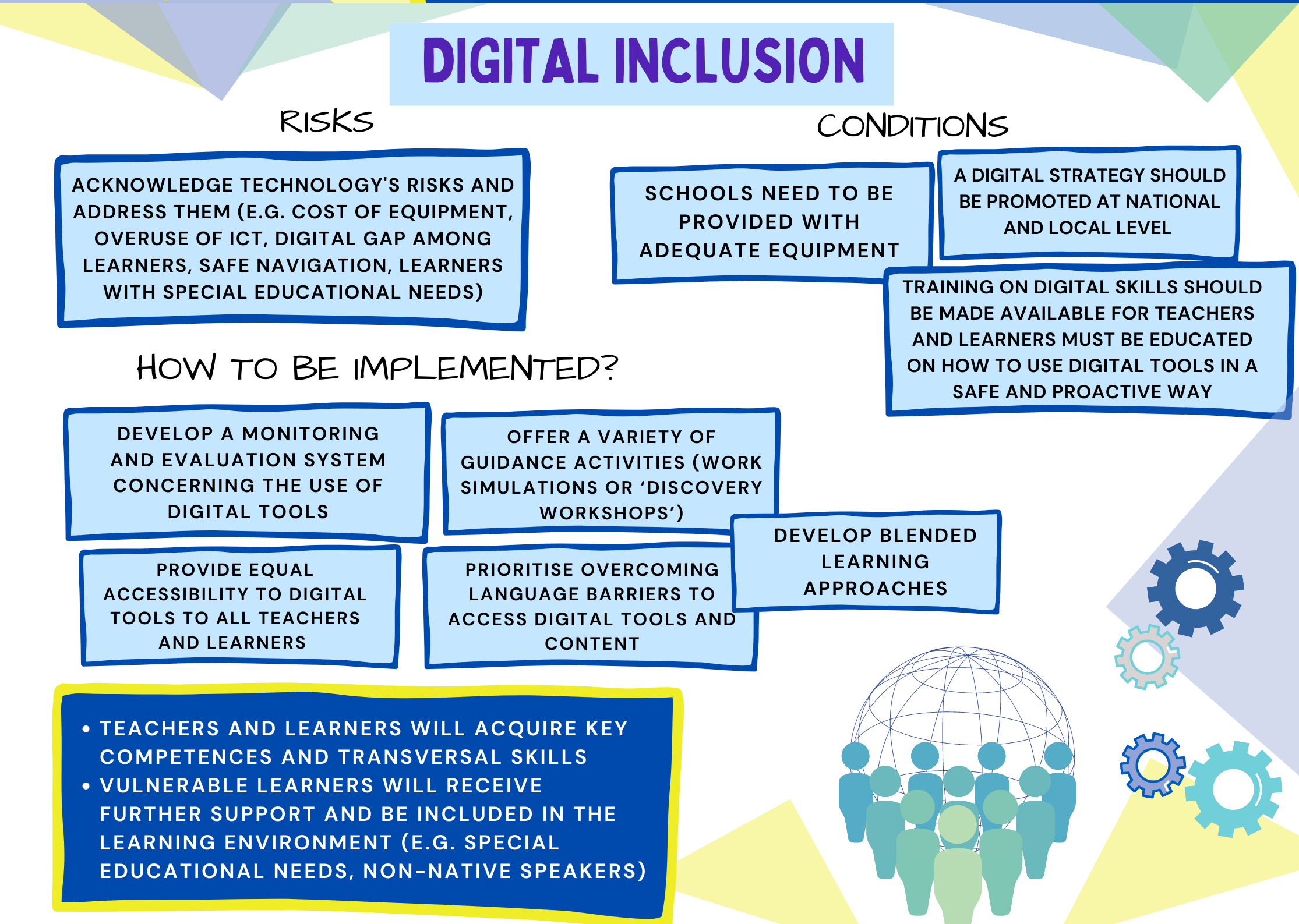
Despite the clear benefits of integrating digital technologies and artificial intelligence in VET systems, the digital transformation of education can present challenges for learners’ and teachers’ digital well-being. These challenges include physical, cognitive, psychological, and social dimensions of well-being, as well as safety issues and the digital divide. In particular, the use of such tools comes with the following risks and limits:
- the overuse of ICT can lead to a rise in mental health issues (such as depression and anxiety, burnout, emotional dysregulation, reduced sense of self-worth and purpose or belonging issues that increased among students and teachers during distance learning in the COVID-19 period);
- learners with special educational needs and neurodivergent learners may have different learning paces while using ICT tools and are at greater risk to face difficulties during the learning process;
- student agency and creativity can be restricted, while problem-solving capacities and motivation may be reduced, and learners can also face discriminatory treatment facilitated by the use of digital technologies (e.g. through algorithmic biases in AI systems, where decisions are based solely on past data or socio-economic factors);
- unmonitored use of digital technologies and AI can lead to exposure to harmful content, abusive digital behaviours, and privacy breaches;
- learners and teachers who do not have access/connectivity or the needed skills are excluded;
- equipping classrooms, teachers, and learners with digital tools entails a considerable cost;
- equipping teachers and learners with sufficient digital skills and AI literacy can be costly and time- consuming;
- vulnerable learners can become even more vulnerable online without tailored support to navigate safely.
Beneficiaries
Addressing the problem
Digital technologies and artificial intelligence (AI) offer significant opportunities to enhance learning, inclusion, and well-being in VET. By enabling personalised learning pathways, immersive experiences, and flexible engagement, digital tools can help learners overcome barriers related to absenteeism, language, learning difficulties, or social marginalisation. They also support the development of key skills and competences needed for education and the workplace.
However, the effective integration of technology is not automatic. Many VET learners and teachers face challenges related to access, digital skills, safety, and well-being, which can reinforce inequalities and reduce learning outcomes. Vulnerable learners - such as migrants, refugees, low-performing students, or those with special educational needs - may struggle to benefit without targeted support, guidance, and monitoring.
To achieve meaningful digital inclusion, a systemic approach is required. This involves adequate infrastructure, teacher training, learner guidance, ethical governance, and mechanisms to monitor both learning progress and digital well-being. Such an approach ensures that technology enhances engagement, confidence, autonomy, and participation, while safeguarding mental health and supporting inclusive learning environments.
The following tips provide practical guidance for policy makers and practitioners on integrating digital tools and AI in VET to promote inclusion and well-being. The recommendations are grounded in evidence from Cedefop research and successful practice across Europe.
Tips: How can the integration of digital tools and AI in VET contribute to inclusion and promote well-being?
The EU’s political commitment to advancing the digital inclusion agenda in education is reflected in the Digital Education Action Plan 2021-2027, which aims to develop a high-performing digital education ecosystem and enhance learners’ digital skills and competences for the digital transformation.
The variety of digital tools offers a wide range of possibilities and innovations in VET programmes. Digitalising VET is no longer an option; policy makers should recognise it as a core component of providing students with hands-on practical experience in industries they will later work in. To ensure sustainability and positive outcomes, the use of digital tools should be targeted, needs-based, and pedagogically grounded.
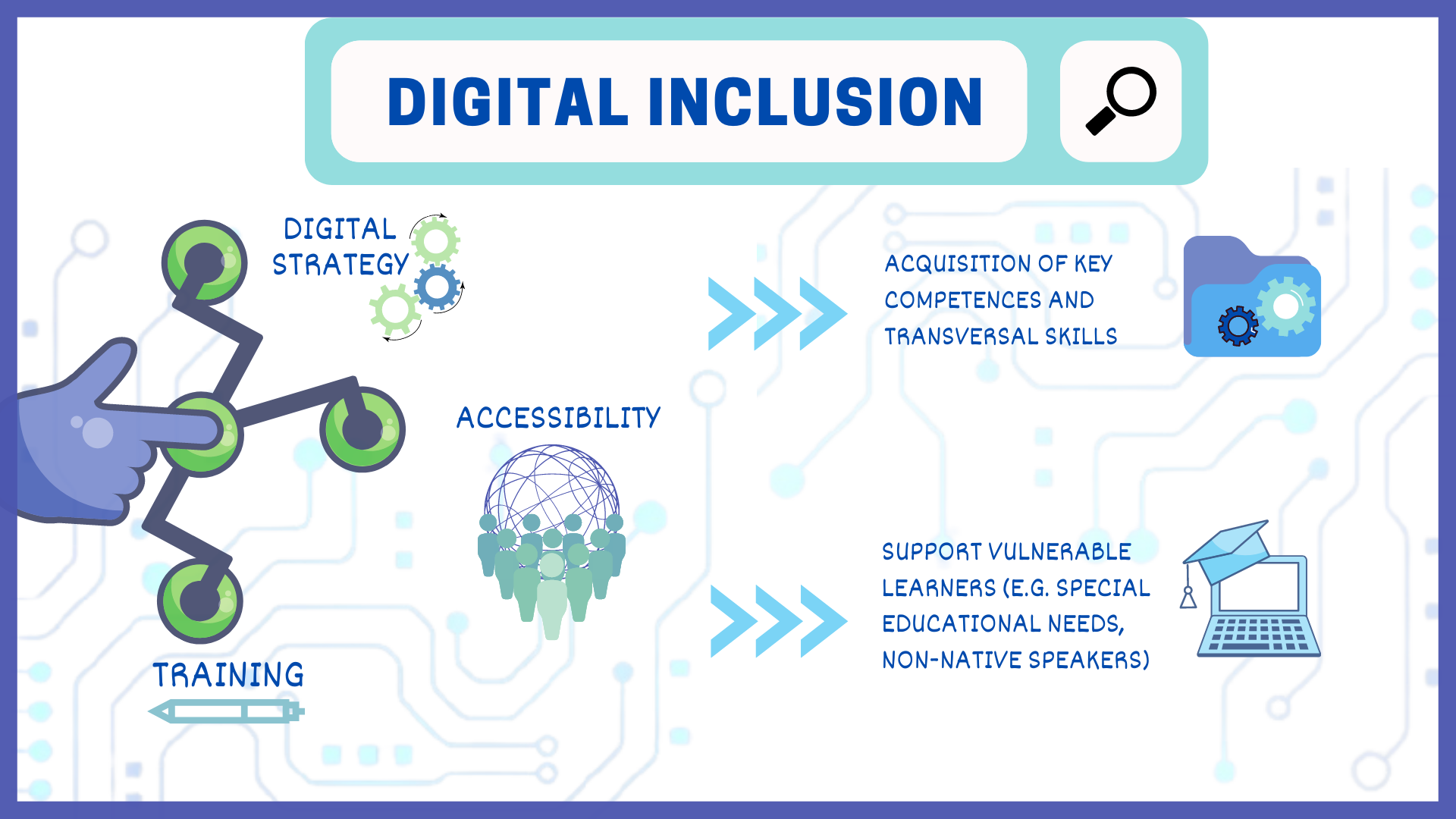
Moreover, policy makers should ensure that certain conditions are met for practitioners to effectively use technology and facilitate inclusive practices: schools need to be equipped with adequate infrastructure, training on digital skills should be made available for teachers, and learners must be educated on how to use digital tools in a safe and proactive way.
The following tips provide actionable guidance to policy makers and practitioners involved in the design and delivery of such measures.
Digital technologies enable learning and teaching practices to better address the needs of marginalised learners or learners with complex needs. It is therefore important to ensure awareness of the digital tools available for schools (i.e. tablets, interactive whiteboards, online courses, etc.) and raise awareness of their potential. This can be achieved through targeted teacher training programmes, school-wide professional development sessions, dissemination campaigns highlighting success stories, and partnerships with EdTech providers to demonstrate practical applications in the classroom context.
Technology-enabled personalised learning methods can be beneficial for all learners, enrich their experience, and provide alternative pathways for different groups:
- For learners with long term illnesses who frequently experience extended school absenteeism, digital tools can support learning continuity by ensuring their connection to what is happening in the classroom and by supporting their socio-emotional well-being.
- For learners with developmental and attention difficulties, digital interventions can increase focus and productivity, support control over the learning process, and foster ownership, independence, and self-mastery in performing specific learning tasks. Tools such as VR/AR (Virtual and Augmented Reality), AI (Artificial Intelligence) or AT (Assistive Technologies) have proven useful in supporting Special Educational Needs (SEN) learners with reading, physical disabilities or attention disorders. For neurodivergent learners specifically, these tools can provide real-time support for executive functioning, such as breaking complex vocational tasks into manageable, AI-guided steps.
- For early leavers reintegrated into VET who are struggling with traditional pedagogies, digital tools have the potential to present new ways of learning which can be more engaging and motivating. For instance, digital games, online repositories, learning management systems, and mobile applications can enhance the learning process, by making learning more practically oriented through visual or immersive tools and approaches (e.g. Augmented Reality, Virtual Reality, Gamification). These immersive environments create “safe-to-fail” simulations, allowing learners to develop critical skills without the anxiety associated with real-life errors; such environments can boost self-confidence for those with previous negative educational experiences.
However, the potential of digital tools and AI cannot be maximised unless users -both teachers and learners- move beyond basic tool usage and adopt the “Understand - Apply - Create” approach, as proposed by the UNESCO AI Competency Framework. Understanding how technologies and AI work and knowing how to take advantage of them to one’s benefit helps develop “AI agency”, a skill highly sought after in an increasingly digitalised labour market. To achieve this shift from basic usage to deeper AI agency, awareness-raising efforts should be systematic and ongoing. The European Commission’s guidelines on the ethical use of AI, as well as the EU AI framework, should be widely disseminated and serve as a basis for policies aiming to reform VET through AI.
Digital resources and tools offer key benefits for migrant and ethnic minority learners in at least three areas:
- Translation and multilingual learning tools can bridge the language barrier while also drawing on students’ home languages as a resource for continued learning. Modern Large Language Models (LLMs) have transformed translation from simple word-to-word translations to multilingual context generation and allow students to receive complex explanations and contextualisation of information in their native language.
- Digital tools can function as cultural mediators as they play a key role in promoting cultural and ethnic open-mindedness. AI-driven cultural and social “framing” tools can help students from different ethnic backgrounds understand cultural nuances and sociolinguistic intricacies of a new country and training programme they attend.
- For practical modules and workshop sessions, VET providers can use real-time “speech-to-speech” AI tools, allowing those with different language barriers to participate fully and acquire the same skills as their classmates. These tools can help students with language barriers contribute their own cultural and linguistic perspectives, thus increasing their sense of belonging and reducing the risk of early leaving due to social exclusion.
It is therefore necessary for policy makers to identify, scale up, and disseminate successful approaches concerning how multilingual tools, such as digital bookshelves, can support the development of language skills both in the mother tongue and in the language of instruction for VET and compulsory school-level migrant learners.
Vocational education and training is uniquely positioned to benefit from neuro-inclusive practices due to its focus on practical and task-oriented learning. As highlighted in OECD research on AI and neurodivergent learners, AI and advanced digital tools can be treated as "cognitive assistance tools" that directly address the executive functioning challenges faced by learners with ADHD, autism, dyslexia, and dysgraphia.
To implement this effectively, policy makers and VET providers should:
- Deploy immersive adaptive learning (see Tip 8), using XR and AI, tailored to ADHD and autism profiles to reduce sensory overload;
- Foster “neuro-inclusive pedagogy” by equipping teachers with digital and AI tools to generate multiple versions of the same exercise suited to different cognitive profiles;
- Enable AI-driven executive functioning support by integrating generative AI tools to help learners structure complex projects, manage time, and plan future career paths.
For inclusion to succeed, teachers require specific training on using AI as an assistive tool for neurodivergent learners, ensuring they can personalise learning without increasing administrative burden. Providing teachers with ready-to-use digital toolkits and AI-curated lesson plans can reduce “technostress” associated with digital transitions, making professional development a source of support rather than distress.
AI can also support the protection of neurodivergent learners from bullying; according to OECD evidence, anti-bullying AI tools can be used to identify isolated learners and propose targeted interventions to prevent or address bullying.
According to the European Commission’s research on how digital technology can promote inclusion, the way digital tools are applied is of paramount importance: ICT should facilitate and complement rather than replace traditional teaching methods and classroom practices.
Ongoing and targeted training is fundamental to provide VET practitioners with the digital competences and skills required to confidently integrate technology into teaching practice and benefit from it. Evidence from the European Vocational Teacher Survey (EVTS) pilot indicates that less than one in three teachers frequently use AI technologies and that many need support in identifying relevant tools. Research also shows that the relationship between digital competence and teacher well-being is bidirectional, with low confidence linked to higher stress and reduced capacity to integrate technology effectively.
To improve teachers’ digital and AI skills, the creation and use of networks and platforms to share good practices, methods, and skills has proven effective. Examples from across Europe, such as the Youth Guidance Centres of Denmark, the Integrated Pedagogical System in Hungary, and the OrientaFP in Spain, demonstrate the effectiveness of teacher training, mentorship programmes, and collaborative projects for professional development. Such programmes should be further enriched to include AI and digital technology applications relevant to teachers’ work. Research also shows that international cooperation programmes (e.g. eTwinning) positively impact teachers’ well-being and enhance digital skills and AI literacy.
Drawing from the UNESCO AI Competency Framework, training should move beyond technical operation of AI and focus on pedagogical integration. This includes equipping teachers to act as “human-in-the-loop” facilitators guiding the ethical use of AI.
An additional requirement is ensuring the availability of staff with technical competences at school level to support the integration of pedagogical and technological practices.
Furthermore, training and guidance should be provided on the use of EU frameworks DigComp, DigCompEdu, DigCompOrg), and self-reflection tools (SELFIE and related tools) designed to establish common definitions and standards for digital competences. These should be adapted to national and regional contexts to ensure relevance and effectiveness.
Research shows that teachers are more likely to engage in upskilling when granted “protected time” to adopt new technologies. Policy makers and VET providers should therefore provide incentives and dedicated resources to support adoption. Professional development should also be formally recognised through micro-credentials or career advancement pathways.
Policy makers should provide guidelines and tools to develop monitoring and evaluation mechanisms for the use of technology in VET programmes. This should include regular feedback collection from learners, parents, and teachers at provider, local, and national levels. Regular reporting should be established to assess ongoing results and impacts.
Monitoring systems should move beyond academic performance to include digital well-being indicators, such as technostress, social isolation, and exposure to harmful content. Data collection should ensure anonymity and protect privacy while identifying systemic trends.
In line with UNESCO guidance on generative AI, providers should cooperate with public authorities to support monitoring and reporting of misuse. VET providers should also implement mechanisms to monitor AI systems, including audits, assessments, and data protection measures.
Where significant risks to well-being are identified, such as psychological, social, cognitive, safety, or inclusion risks, VET providers must have a pre-established referral pathway, integrating counselling services or contact with experts. If problematic patterns are detected, such as high levels of digital fatigue or exclusionary behaviour, mechanisms should ensure timely access to appropriate support services.
Strong and effective school leadership, supported by a clear digital strategy, should guide the integration of technology in classrooms. Policy makers and VET providers should establish a supportive school climate and promote positive attitudes towards the role of digital technologies in teaching and learning. Digital well-being guidelines should also be integrated into the workplace component of VET programmes to ensure supportive learning environments in work-based settings.
In distance learning environments, VET providers and practitioners should foster parental engagement as partners in learners’ digital education. Collaboration between teachers and families should support parents in understanding both the benefits and safety aspects of digital tools, thereby strengthening learner motivation and engagement. Existing initiatives (e.g. “Involve parents, improve school”) can support this process by familiarising parents with digital tools and demonstrating their added value. Promoting a “safe-to-experiment” culture can support both staff and learners in becoming confident and creative users of digital technologies.
Digitalised education programmes come with challenges that can hinder learners’ and teachers’ well-being, such as cyberbullying and the digital divide. Evidence from the COVID-19 pandemic shows that extensive use of distance learning and ICT tools can lead to digital detachment, weakened social relations, and increased risks of anxiety and depression. Recent European Commission priorities include addressing the impact of digital environments and social media on well-being. The Commission’s report “Promoting Well-being in Digital Education” proposes a Model of Emerging Practices structured around key guiding principles, including fostering a whole-school approach and addressing barriers to the implementation of well-being in digital education. This evidence highlights that digital environments can lead to isolation, cyberbullying, hate speech, social comparison, and ‘fear of missing out’, negatively affecting well-being and motivation. For learners at risk of early leaving, accessible psychosocial support systems are essential to prevent distress.
To safeguard mental health, policy makers and VET providers should adopt a “whole-community” approach to well-being, supported by common definitions, strategies, and guidelines at national and EU level. This approach should shift the focus from preventing harm to actively promoting digital well-being. Teachers, learners, and staff should be encouraged to engage in open dialogue and jointly address technostress and digital fatigue.
VET providers and national authorities should ensure that digital tools promote “well-being by design”. This includes developing institutional policies on digital well-being and strengthening cooperation with the EdTech sector to ensure that technologies are accessible, context-appropriate, and support healthy learning environments. Specialised EdTech solutions should be implemented and adapted to individual learner needs, particularly for learners with special educational needs or neurodivergent profiles.
Social dialogue is central to this “whole-community” approach. Consultation with education stakeholders is essential to ensure manageable workloads, the right to disconnect, and overall well-being are prioritised.
Research findings suggest that a balanced level of integration of digital tools is more effective than purely face-to-face or fully online learning. This approach combines flexible and self-paced learning with classroom interaction, supporting engagement and well-being. The main goal of blended learning is therefore fostering classroom interaction while maximising the benefits of technology and digital resources and differentiating instruction methods according to students’ needs. The goal of blended learning is to balance interaction with the effective use of digital resources and differentiated instruction.
The 2021 Council Recommendation defines blended learning as combining multiple approaches in the learning process:
- combining school-based and other physical environments (either with the presence of a teacher/trainer or separated by space and/or time in distance learning); and
- combining digital (including online) and non-digital learning tools.
Evidence indicates that learners in blended environments often achieve higher outcomes compared to purely face-to-face settings. However, blended learning may pose challenges for some learners (e.g. according to the European Agency for Special Needs and Inclusive Education, blended learning can be stressful for learners with special educational needs due to transitions between differing sensory environments). For these cases, consistent distance-learning routines may be more appropriate.
To address this, VET providers should adopt “immersive adaptive learning”. This includes using Extended Reality (XR) to allow learners to rehearse technical tasks in “safe-to-fail” environments before transitioning to physical workshops. This approach supports anxiety management while maintaining social connection and teacher guidance.
Teachers should also use AI-driven tools to provide modular feedback that learners can access flexibly while maintaining learning quality.
Cross-sectoral partnerships between technology companies, NGOs, and education providers can help bridge the digital divide by providing equipment, connectivity, and expertise. To ensure sustainability, these partnerships should move beyond one-off donations towards long-term collaboration. This includes co-designing curricula aligned with labour market needs and adapting EdTech tools for pedagogical use.
Public-private partnerships have become increasingly common in education, particularly since the pandemic. This has raised concerns regarding the increasing privatisation of public education systems. As the influence of the EdTech sector grows, public education systems must be safeguarded from commercial interests that may compromise pedagogical quality or data privacy. VET providers should ensure that governance, ethics, and learner data are managed with high standards of transparency and that technological solutions are adapted to educational needs.
Member States should develop regulatory frameworks to safeguard the public value of education and ensure that digital tools serve the common good.
Key safeguards include:
- social dialogue: platforms and tools should be developed in consultation with stakeholders to ensure respect for teacher autonomy and working conditions;
- data protection and privacy: robust legal frameworks and funding mechanisms should ensure data protection and intellectual property rights;
- inclusive co-design: practitioners and learners should be involved in developing tools that follow “ethics-by-design” principles.
Digital citizenship education aims to equip individuals with the competences required to participate in a digital society. It is essential for fostering transversal skills and supporting active citizenship. A digital citizen can engage responsibly in both online and offline contexts. It can be implemented across formal, non-formal, and informal settings through a wide range of activities. Policy makers should support teacher training and cross-curricular integration of digital citizenship education.
In the current context, digital citizenship should include AI literacy and algorithmic awareness. The 2025 European Commission’s Report on Digital well-being highlights the need for learners to understand how data-driven systems influence their choices, privacy, and interactions. Learners should transition from passive consumption to active and ethical engagement with digital technologies.
Expected outcomes
Education technologies can enhance learning experiences and support the acquisition of key competences and transversal skills (e.g. digital literacy, communication, technical skills) relevant to professional contexts. The integration of digital tools in education and training can help bridge the digital divide and remove barriers for vulnerable groups (e.g. migrant learners, learners with health conditions, learners with attention difficulties), increasing their engagement, participation, and likelihood of successful outcomes.
 |  |  |
INDIVIDUAL | INSTITUTIONAL | SYSTEM |
|
|
|