
Problem statement

Addressed problem: Barriers to learning

Young people may struggle to engage in learning due to broader challenges, such as health issues, caring responsibilities, housing instability, financial difficulties, antisocial behaviours, or substance misuse. Professional counselling, especially when embedded in education and training programmes, can help young people to tackle these issues and enable them to pursue education and training more easily.

Professional counselling, particularly when embedded within education and training programmes, can help young people address these barriers. By providing personalised guidance and support, counselling enables learners to participate more fully in education and training and pursue their learning goals more fully in education and training and pursue their learning goals more effectively.

06_counselling to address barriers to learning


Addressing the problem

Tips: How should professional counselling be provided to young people?

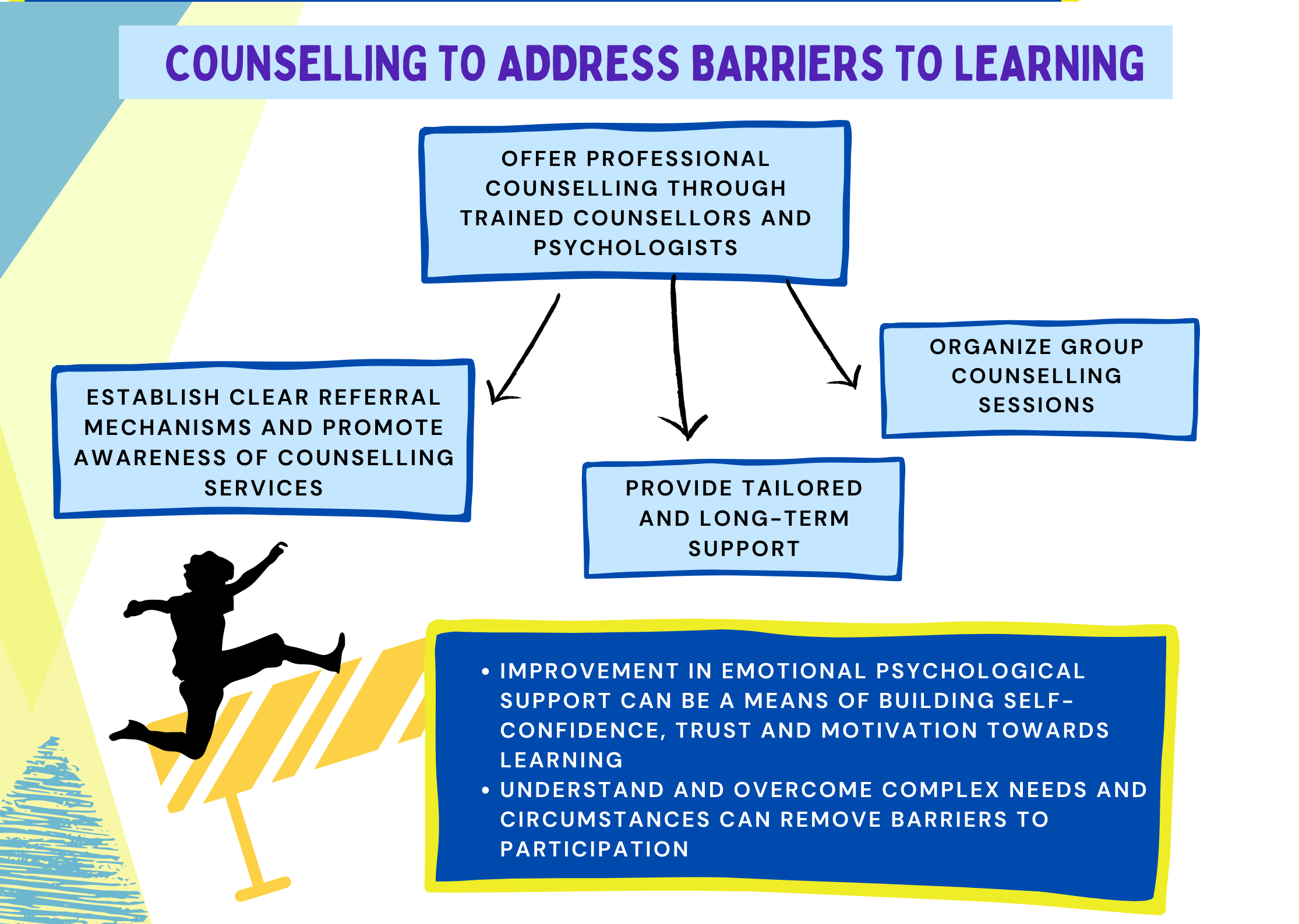
Professional counselling is delivered by trained professionals, including counsellors and psychologists. It helps young people understand their personal circumstances, overcome obstacles, and make informed decisions about education, training, and career pathways.

Counselling may be accessed through ‘one-stop-shops’ that bring together multiple services for young people, or it may be provided directly within the learning environment. It can also form part of reintegration measures for learners returning to education or training.

For young people facing particularly complex challenges, counselling is often one component of a broader package of support delivered by a multidisciplinary team, such as school care teams or student support services.

The following tips are provided as guidance for policy-makers and practitioners involved in designing and delivering counselling services. The recommendations are grounded in evidence from Cedefop research and successful practice across Europe.

Tip 1: Establish clear referral mechanisms and promote awareness of counselling services

Young people may be reluctant to access counselling due to low motivation, lack of confidence, or limited awareness of available support. It is therefore essential for teaching staff and other professionals working with young people to identify those facing complex challenges and be fully aware of the counselling services available.

Where counselling is not embedded within the learning environment, clear and effective referral mechanisms should be in place to ensure that no young person ‘falls through the net’. Counselling services should actively promote their existence, informing professionals, young people, and parents about the types of challenges leaners may face and the support available to address them.

Digital tools can play a key role in improving access to counselling. Providing online contact options or the possibility of fully remote counselling can help young people overcome barriers that might prevent them from participating in traditional in-person services.

Tip 2: Tailor support to the needs of the young person

All young people are unique, and the challenges they face, as well as their personal context and capacity to cope, differ. Counselling provision, including its intensity and duration, should therefore be centred on the individual needs of the learner and progress over time. All young people are unique, and the challenges they face, as well as their personal context and capacity to cope, differ. Counselling provision, including its intensity and duration, should therefore be centred on the individual needs of the learner and their progress over time.

Support should be based on an initial diagnostic or assessment of the young person’s needs and objectives. Counselling should continue until the young person has achieved their goals and has developed the confidence and coping skills to manage their personal circumstances independently.

Digital technologies and Artificial intelligence (AI) can improve the personalisation of counselling. AI can be used to suggest appropriate methods or match the young person with the most suitable counsellor based on their specific situation. When applied carefully, these tools can improve the efficiency and effectiveness of counselling while maintaining the essential human oversight and relational aspect provided by the counsellor.

Tip 3: Provide long-term support

At the heart of effective counselling is the development of a trusting and respectful relationship between the young person and the counsellor. Building this relationship requires time and regular contact and cannot be achieved through one-off interventions.

Counselling should therefore be provided over the longer term, with continuity of support ideally ensured by the same counsellor throughout the young person’s education or training programme. In some cases, it may also be necessary to extend counselling beyond the duration of the programme to ensure that the learner has fully developed the skills, confidence, and coping strategies needed to manage personal challenges independently.

Ensuring that such long-term support is possible and accessible is essential for the effectiveness of counselling interventions.

Tip 4: Integrate counselling as part of a case management approach

Comprehensive support for young people with complex needs requires identifying individual support needs and ensuring that the right services and professionals are engaged to address them. Professional counselling should therefore be an integral part of a case management approach, forming one option in a broader “menu” of services tailored to the learner’s needs.

Integrated digital platforms and tools play a key role in connecting services and harmonising information for case management across different authorities and stakeholders. In addition, easy digital access to these services, combined with digital guides on the rights and support available to young people, is essential for encouraging uptake and ensuring that counselling reaches those who need it most.


Tip 5: Offer group sessions for settings with a high number of at-risk young people

In learning environments or communities where many young people face complex challenges, group counselling or information sessions can be an effective complement to individual support. For example, second chance programmes may include group sessions addressing health, well-being, or social issues.

To maximise participation – especially among leaners in marginalised or remote communities group sessions should be offered in both physical and digital formats, ensuring accessibility and engagement for all participants.

Tip 6: Monitor, evaluate, and adapt counselling services

To ensure the effectiveness and sustainability of counselling, services should incorporate regular monitoring and evaluation mechanisms. This includes:

  • Collecting feedback from young people on their experience, satisfaction, and perceived benefits of counselling;
  • Tracking measurable outcomes, such as improvements in well-being, engagement, confidence, and academic or vocational progress;
  • Analysing patterns to identify which interventions work best for different groups of learners (e.g., those facing complex personal, social, or family issues);
  • Using insights to adapt counselling methods, session formats, or intensity to better meet learners’ evolving needs; and
  • Ensuring data collection and analysis respects privacy and confidentiality, while supporting evidence-based improvements in service delivery.

Integrating evaluation and feedback into counselling ensures interventions are responsive, effective, and continuously improving, increasing the likelihood of positive outcomes for young people at risk.

For more information on monitoring and evaluation, see here.

Expected outcomes

Counselling provided by a qualified counsellor or psychotherapist can be particularly beneficial for young people facing complex challenges. Emotional and psychological support can help build self-confidence, trust, and motivation, enabling young people to develop a more positive outlook on their future.

This type of support is especially important for learners who are highly disengaged from education and training and face multiple, complex barriers. Counselling can help them understand and overcome these barriers, facilitating participation in education and training and improving their overall well-being.

The following outcomes can be expected at different levels:

INDIVIDUALINSTITUTIONALSYSTEM
  • Improved well-being
  • Social, economic, and psychological challenges addressed
  • Improved work habits and social skills
  • Greater uptake of counselling and support through digital tools Enhanced ability to manage learning difficulties Reduced absenteeism
  • Development of a positive attitude toward learning and education
  • Improved self-awareness, including understanding of personal abilities, aptitudes, and interests
  • Enhanced 'work readiness'
  • Enhanced support for teachers and trainers to work with learners facing complex personal, social, or family challenges
  • Reduced risk of early leaving among students with complex personal, social, or family issues
  • Better allocation of resources through AI-supported matching of young people with appropriate counsellors
  • Increased institutional capacity to manage cases through digital counselling
  • Reduced rates of early leaveReduced rates of early leavers
  • Stronger and more resilient support systems
  • Increased efficiency in outreach and support delivery
  • Ensured Improved interconnection between services to address complex needss

Related protective factors

Related resources

    Good practices
    Good practice

    In Germany, assisted VET (‘Carpo’) incorporates intensive individual social-pedagogical coaching and guidance, offered by certified social-pedagogues.

    Good practice

    In Estonia, Pathfinder centres provide careers information; career counselling; speech therapy; psychological guidance; socio-pedagogical guidance; and special educational guidance.

    Good practice

    The overarching goal is to reduce the number of contract dissolutions, which lead to a permanent drop-out of education and training.

    QuABB also aims to support vocational schools as well as companies in working with "high-maintenance" apprentices.

    Good practice
    Jugendberufsagentur - Hamburg

    German youth labour employment agencies (JBA) bring together career guidance and counselling services in one single place.

    Good practice

    Supporting educational and social inclusion of young early leavers and those at risk of early leaving through mechanisms of orientation and tutorial action.

    Good practice
    FUORI SCUOLA Percorsi di recupero dalla dispersione scolastica

    FUORI SCUOLA is a project that aims to tackle early leaving from education and training at the local level of provinces.

    Having a holistic approach aiming at the wellbeing of young early leavers, each organisation provides services in four areas:

    a) development of professional skills;

    b) development of personal and social skills;

    c) development of key competences;

    d) reaching out, engagement, reception, listening and guidance.

    Tools
    Tools

    The EU-funded ‘Stop Dropout!’ project has developed a ‘Counselling Profile’ (or personal profile) for use by qualified professionals in fields such as counselling, psychology or human relations. It is a structured interview scheme which can be used to use to guide individuals who are at risk of dropping out.

    Tools

    The DIDO toolkit contains practical tools aimed at preventing dropout in adult education.

    Publications
    Publications

    Different approaches schools adopt when providing individualised support to students. This study analyses the types of measures used by schools to provide one-on-one emotional and behavioural support.

    Download the report here.

    Publications
    Antoni Cerdà-Navarro, Francesca Salvà-Mut, Rubén Comas-Forgas & Mercè Morey-López

    This article looks at the differences and similarities between Spanish-born and immigrant students enrolled in the first year of Intermediate Vocational Education (IVET) programmes in Spain.

    Publications
    Based on the COFACE Disability S.H.I.F.T. guide for a meaningful inlusion of persons with disabilities and their families. COFACE Families Europe is a pluralistic network of civil society associations representing the interests of all families.

    According to article 24 of the United Nations Convention on the Rights of Persons with Disabilities (UNCRPD), signed and adopted by the European Union and all its Member States, and of its General Comment No. 4, State parties must ensure the realisation of the right of persons with disabilities to education through an inclusive education system at all levels, including pre-schools, primary, secondary and tertiary education, vocational training and lifelong learning, extracurricular and social activities, and for all students, including persons with disabilities.

    Publications
    Report advocating for ending violence in and through education

    The book addresses the critical issue of violence in educational settings. It highlights the prevalence and various forms of violence, including physical, sexual, psychological abuse, bullying, and neglect, and their impact on learners and educators.

    Quick wins
    Quick win

    Formal protocols for the referral of young people to specialist support services saves time for the VET provider, and facilitate a quicker response to the learners’ needs.