

Problem statement
Addressed problem: "One-size-fits-all" approaches and risk of early leaving
Vocational Education and Training (VET) systems often struggle to respond effectively to the diversity of learners they serve. Many programmes remain standardised in structure, pace, and delivery, limiting their capacity to address individual needs, backgrounds, and aspirations. This “one-size-fits-all” approach is particularly ineffective for young people at risk of early leaving, as well as for those who have already disengaged and wish to return to education or training.
Learners in these situations require individualised and flexible educational responses. However, current VET systems frequently offer limited personalisation, with rigid curricula and teaching methods that do not adequately reflect different learning styles, prior experiences, or personal circumstances. As a result, many learners experience disengagement, face difficulties in re-entering education, or struggle to overcome personal, social, or academic barriers.
Tailored learning pathways are therefore essential. This implies that the content of learning programmes, the modes of delivery, and any additional support mechanisms should be adapted to the learner’s needs, identity, and goals. Such personalisation enables learners to follow pathways aligned with their interests and aspirations, while also providing targeted support to address challenges and barriers.
Without this shift toward more learner-centred and flexible approaches, VET systems risk perpetuating exclusion and early leaving, particularly among vulnerable groups. Strengthening tailored pathways is thus critical to improving retention, re-engagement, and overall learner success.
Beneficiaries
Addressing the problem
How can a tailored approach be achieved?
A tailored, individualised approach can be implemented through a combination of pedagogical, structural, and support measures that respond to learners’ diverse needs and circumstances.
Key elements include:
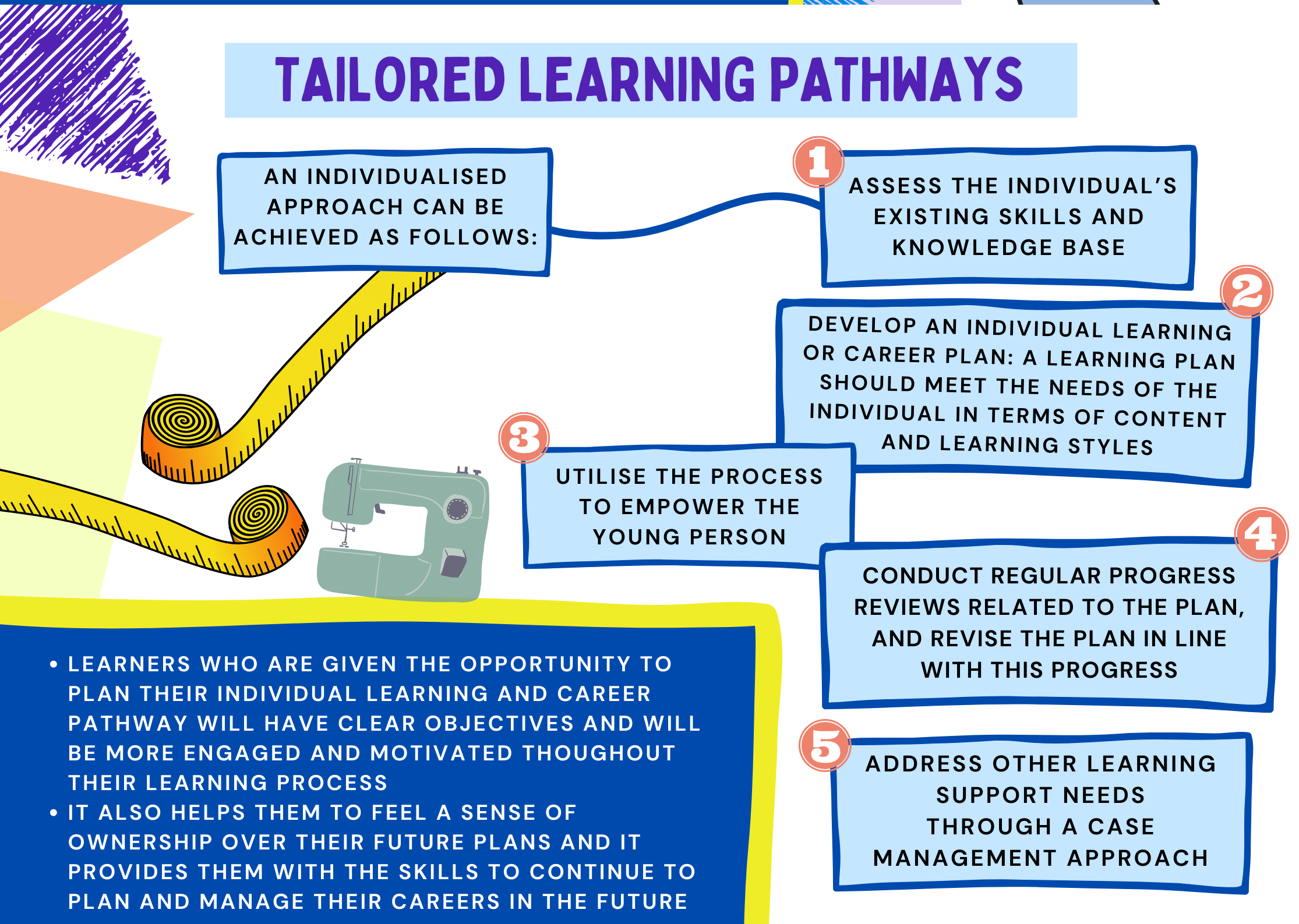
- Developing individual learning and career plans, enabling learners to set goals and follow pathways aligned with their interests, skills, and aspirations.
- Providing needs-based learning support, including academic assistance, skills assessment, and targeted interventions to address learning gaps.
- Establishing individual health and well-being plans, recognising that personal circumstances and mental health play a critical role in learning outcomes.
- Implementing a case management approach, ensuring coordinated support that addresses both educational and non-educational needs (e.g. social, financial, or personal challenges).
- Offering mentoring and coaching, to guide learners, strengthen motivation, and support decision-making throughout their learning journey.
- Leveraging digital tools and artificial intelligence (AI) to enhance engagement, personalise learning experiences, and support the development of learning and career pathways.
An individualised approach also depends on the availability of flexible learning pathways, which allow learners to progress at their own pace, re-enter education when needed, and combine different forms of learning (formal, non-formal, and work-based).
The following recommendations are addressed to policy-makers and practitioners involved in the design and delivery of such measures. They are based on research by Cedefop on effective practices in VET systems.
Establishing an individual learning plan that outlines personalised learning objectives enables young people to benefit from a tailored learning experience. The learning objectives should be clear, realistic and measurable, so that the learner understands what is required to achieve them and can measure their achievements against them.
A learning plan should meet the needs of the individual in terms of both content and learning styles. It could cover for example: subjects to study as part of a learning programme; academic support to be provided; long-term goals for the learner; and post-secondary plans and how the young person can prepare for these. Similarly, a career plan is a way of identifying the learning and development needed to be undertaken in the transition towards or through working life. It may set out a career objective as well as short-term career goals, and identify potential barriers to progression.
An individual learning plan or career plan should be developed in collaboration with the teacher/trainer or other support staff (e.g. counsellor, mentor). It is important that the staff involved in preparing these plans receive appropriate training on how to design and implement them effectively. Where appropriate, parents or guardians may also be involved in the process.
An individual learning or career plan should be formulated based on an initial assessment of the young person’s profile and existing skills, and should build on these. This assessment might look at, for example, the level of basic and digital skills of the learner, prior learning and work experience, as well as motivation. It should also identify the individual’s needs, for example in terms of learning support. A self-assessment by the learner might form part of this process.
To ensure efficiency in the assessment process, digital tools and AI-powered diagnostic applications can be used to access and verify the level of pre-existing knowledge. Moreover, digital open badges, e-Portfolios or digital micro-credentials can be used to capture “hidden” or under-recognised skills, that may not have received formal recognition. This can ensure that all skills and competences of the learner are taken into account for the learning and/or career path.
Taking this kind of holistic approach to the development of the plan and basing it on an in-depth individual assessment, rather than providing ‘directional’ guidance (i.e., offering a number of options and asking the young person to choose one) is more likely to be effective with this target group.
Undertaking this kind of initial assessment can help to ensure that the learning programme offered (in terms of level and content) is suited to the young person. It also means that the learner’s pathway within that programme can be tailored to their needs.
A learning and/or career plan should take account of the young person’s individual circumstances, as well as their existing talents, competences and skills, including their strengths and weaknesses. It is important, for example, to take account of any basic skills that are lacking and to ensure that these are tackled in the early stages of the learning pathway.
The plan should set out realistic learning objectives and clear goals, and should also cover how the individual’s support needs will be addressed. For instance, for young people with a high record of absence, the individual plan could address how missed learning time will be recovered.
The use of predictive career mapping tools, digital representations of work in different sectors, or other AI tools that link VET modules to real-time labour-market data can allow learners to see where each pathway leads in the local, regional, and national economy. Such tools can be leveraged to help learners see the relevance of VET programmes, maintain their interest, and thus prevent early leaving.
It is important that any individual plan is developed in collaboration with the learner. There should be opportunities for the young person to decide what and how they will learn, for example, through opportunities to choose work-based options.
The initial assessment can be an empowering process for the young person. Helping them to identify existing skills and competences, and how these relate to the curriculum, can help to boost their self-awareness, confidence and self-esteem.
This is particularly important for young people who have never achieved a formal qualification, or who have been led to see themselves as a ‘failure’ in a formal educational context. A supportive and participatory approach can help to rebuild learners’ confidence and foster a more positive engagement with education and training.
Once the plan has been agreed, ongoing support should be provided by a teacher/trainer, mentor, careers adviser, counsellor or other support person. This ongoing support means that the learning objectives can be regularly reviewed to assess progress. There should be periodic opportunities to provide one-to-one feedback on progress in relation to the plan, and if necessary, to revise the plan in line with this progress.
Digital tools, such as AI-powered dashboards, can be used for monitoring purposes. Such tools can keep track of the learning path of each learner, and flag to teachers, trainers, parents, and other relevant stakeholders if there is any sudden change in the learner’s trajectory.
In this way, monitoring progress against the plan can also serve as an early warning system, helping to identify signs of risk of early leaving.
For any individual plan to succeed, it is important that the young person is committed to achieving the targets and goals set out. This commitment can be achieved in a number of ways, including through a positive relationship with the staff member responsible for reviewing the plan, as well as regular opportunities to receive feedback on their progress.
Contracts can also be used as a way of setting out an individualised learning pathway and support plan, which formalises the commitment of the young person. A contract might include, for example, objectives for the young person, together with details of the help and support they are entitled to receive. It may also refer to financial support the young person will receive whilst participating in the contract.
Signing the contract can demonstrate the young person’s commitment to meeting their obligations as set out in the contract, e.g. regular attendance, timely completion of assignments, etc. Having the contract in place establishes a two-way agreement, outlining the expectations of the young person and the organisation supporting them and can help to secure the young person’s buy-in.
Lastly, validating each step or achievement attained by the learner - for example through the issuance of physical or digital recognised diplomas or badges - can help them feel a sense of accomplishment and motivate them to complete the agreed upon plan.
It is important to ensure that any learning support needs are addressed in order to enable the learner to achieve the objectives set out in their learning plan. These support needs could relate to learning difficulties such as dyslexia, ADHD, autism, and other needs associated with neurodivergent profiles, or to language needs in the case of learners from migrant backgrounds or ethnic minorities for example.
Learners who are often absent need support to develop a plan to make up missed learning time. It is also important to provide alternatives to suspension or expulsion, including onsite support services with multidisciplinary teams.
Digital tools, such as translation software, or applications developed for neurodivergent learners with learning difficulties, can be leveraged to support teachers and learners in implementing learning plans effectively.
For young people facing complex barriers to learning, an individual health or well-being plan, or an integrated education and health plan, may be required. Similarly to learning and career plans, a health plan should be based on an initial assessment and should take account of the basic physiological needs (e.g. sleep, hunger) of the learner, as well as their social and psychological needs.
It should aim to achieve the best possible health outcomes, whilst at the same time maximising engagement in learning. A health plan should be regularly monitored. Ideally, parents or guardians should be involved in the process, together with the young person, a staff member from the learning provider, and where appropriate, a health professional.
A tailored approach is most effective when all actors involved in supporting the young person work in a coordinated and coherent way. This includes teachers, trainers, career advisers, mentors, social workers, psychologists, health professionals, and, where appropriate, employers and parents or guardians.
Clear communication channels and shared responsibility help ensure that the individual learning or career plan is consistently implemented across different contexts. This prevents fragmented support and reduces the risk of conflicting guidance or duplicated interventions.
Multi-disciplinary collaboration is particularly important for learners with complex needs, where educational, social, and health-related challenges are interconnected. Regular coordination meetings and shared digital case-management systems can support this integrated approach, ensuring that all stakeholders have a common understanding of the learner’s progress, needs, and risks.
Strengthening coordination ultimately improves the coherence, efficiency, and impact of tailored learning pathways, and increases the likelihood of successful re-engagement and completion.
Expected outcomes
Giving young people the opportunity to steer their own educational pathway through the development of individual learning and career plans and clearly setting-out learning objectives, can increase their engagement and motivation. It also helps them feel a sense of ownership over their future plans and a greater sense of control over their future. Furthermore, if they are actively involved in developing the individual plan, this will give them skills to continue to plan and manage their careers in the future.
Ensuring provision is needs-based and addresses the additional support needs of the young person can break down barriers to learning. This is likely to contribute to increased motivation, attendance, and ultimately higher success rates.
The following outcomes can be expected at different levels:
 |  |  |
|---|---|---|
| INDIVIDUAL | INSTITUTIONAL | SYSTEM |
|
|
|