

Problem statement
Addressed problem: Locating and re-engaging early leavers
Determining the whereabouts of early leavers, as quickly as possible after they leave education and training, is critical to increasing the likelihood that they re-engage.
Once learners drop out, the longer they stay outside education and training, the more consequences they may face:
- Re-joining former classmates becomes increasingly difficult, and young people may face the additional barrier of having to study with younger cohorts, unless flexible or alternative pathways are available.
- They are more likely to become engaged in activities that reduce the likelihood of returning to education and training, such as unqualified employment, informal care responsibilities, or social environments discouraging them to return to learning.
- Basic routines and habits associated with student life and education (e.g. following a timetable, completing tasks, engaging with peers) erode over time, making the practical and psychological challenge of re-integration greater.
Monitoring systems should nevertheless recognise that not all early leavers require the same type or intensity of intervention, and that re-engagement should remain voluntary and responsive to young people's circumstances and aspirations.
Education and training providers hold data on the students who drop out of their programmes, or leave the school or training centre before attaining a qualification. However, they lack the wider information needed to determine whether a young person has transferred to another programme or provider, entered employment, or permanently left education and training early. A centralised monitoring system, allowing data to be cross-referenced across providers, public authorities and services, can greatly facilitate accurate identification, timely outreach and coordinated support for young people at risk of prolonged disengagement.
Beneficiaries
The tips target specifically young people who have already left education and training early, and particularly those who have done so recently and have not been contacted regarding this. This also concerns young people who return to education and training after a period of early leaving, whose perspectives and testimonies can be useful to understand better what encouraged them to both leave VET and return.
Addressing the problem
Tips: How can a centralised monitoring system for early leavers be established and made effective?
The following tips are given as advice to policy makers at national or regional level aiming to introduce a centralised system to monitor early leavers. The information is based on Cedefop research into successful measures.
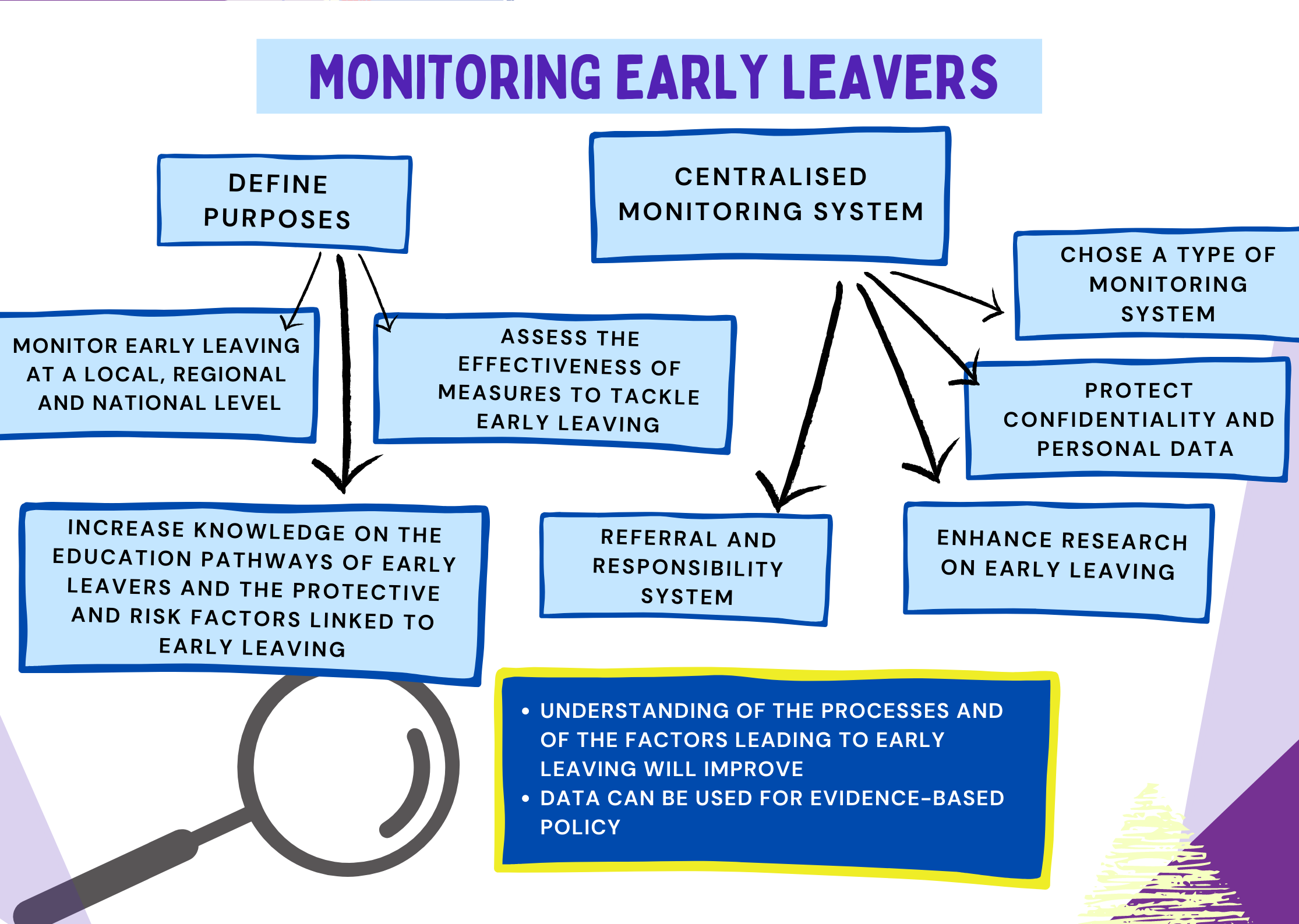
Before deciding what data to collect, how to collect it, and with whom to share it, it is essential to clearly define the purposes that the monitoring system is intended to serve. The primary focus of a centralised monitoring system is to identify and locate early leavers, allowing for timely and appropriate support provided to them. Nevertheless, such systems can serve a wide range of other valuable purposes, such as:
- Monitoring the distribution of early leaving at local, regional or national level, to inform resource allocation and policy priorities;
- Assessing the effectiveness of measures designed to tackle early leaving by re-engaging young people and tracking whether individuals who received support have subsequently completed any qualifications;
- Supporting inter-agency coordination by providing a shared reference system across education, employment, and social services
- Increasing knowledge and enabling longitudinal research on early leaving, protective and risk factors linked to it, as well as its long-term consequences.
Different purposes require different types of data, as well as different governance arrangements and stakeholder involvement. For instance, for individual identification and outreach purposes, nominal and person-level data, unique for each individual, is necessary. For monitoring and research purposes, aggregated data on the evolution of early leavers can be sufficient.
The core technical function of a monitoring system for early leavers is to identify, at the individual level, young people who have left education and training without attaining a qualification and who are not enrolled elsewhere. Three broad approaches can be distinguished:
Option A: Cross-referencing enrolment data from different education and training providers
It is possible to detect early leavers by comparing enrolment data from the different education and training providers. The aim is to identify young people who are not enrolled in any education and training programme and have not attained a qualification.
- The incompatibility of data formats, definitions, and updating cycles,
- The complexity of cross-referencing between school-based and work-based VET programmes,
- The possibility of matching errors without unique personal identifiers, and
- The time lags between dropout and identification due to the complexity of the process.
Option B: Student registers based on unique personal identifiers
Under this option, each learner is given a unique identification number, which is persistent across administrative data, providers sub-systems, and services. This makes it very easy to cross-reference administrative data from various education and training sub-systems and providers, and to identify who has left the education and training system. This model is technically efficient and offers great potential for timely identification. However, data protection regulations may pose some challenges to the implementation of such systems. Key considerations include:
- The unique identifier must be genuinely universal and used consistently across all education and training sub-systems, public employment services, and where applicable social services.
- Data protection legislation may restrict or condition the use of unique identifiers, particularly where these are connected to national identity systems. Legal frameworks must explicitly authorise this use.
- Strong data security measures are essential to protect the integrity of a system that links multiple datasets through a single identifier.
Option C: Centralised register of early leavers
In this model, every education and training centre is required to notify a designated central service or authority when students leave without completing their programme. The central service or authority maintains a specific register of early leavers, which is used as the basis for outreach. Key strengths for this practice include:
- Clear standardised reporting obligations for providers, with defined timelines,
- A reliable and consistently used channel for providers to report dropouts to the central service,
- Mechanisms for providers to update the register if they subsequently learn that a reported early leaver has re-enrolled elsewhere or entered employment.
In practice, the most robust monitoring systems combine elements of more than one model. For example, a centralised register may be complemented by cross-referencing with employment and social security databases to verify the status of individuals already on the register and to catch young people who were not reported by their provider.
A monitoring system is only as useful as the currency and accuracy of its data. Data in centralised monitoring systems need to be regularly updated and reviewed to ensure that the time elapsed between a young person dropping out and the moment they are first contacted is as short as possible.
Regularly updating data in monitoring systems requires the following:
- Clear obligations and timelines for providers and other data contributors: notification should be required of VET providers within a short and explicitly defined period, and not left to the discretion of individual providers;
- Automated data feeds: where possible, the monitoring system should be designed to receive automated notifications or data updates from provider systems, rather on relying on manual reporting;
- Regular quality checks on data completeness, consistency, and comparability;
- Timely de-registration: when an early leaver re-enters education or training or permanently enters employment, the register should be updated and exclude individuals who no longer require support.
Modern digital infrastructure can strengthen monitoring systems by making information sharing more efficient, reducing delays in identifying early leavers, and supporting timely outreach and intervention.
When supported by appropriate legal and governance frameworks, digital tools can contribute to monitoring systems in several ways:
- Interoperable data systems: Common data standards and interoperable systems can facilitate the exchange of information between education and training providers, public authorities and other relevant services, reducing the need for manual reporting.
- Cross-sector data linkage: Linking education data with employment and social service data, where legally permitted, can provide a more complete understanding of a young person's situation and help avoid duplication of efforts.
- Automated notifications and alerts: Digital systems can generate alerts when a learner leaves education and training, helping designated staff to initiate outreach activities promptly.
- Digital dashboards: Aggregated data can be visualised through dashboards to support policy-makers and practitioners in monitoring trends, identifying vulnerable groups, and informing decision-making.
- Secure communication tools: Messaging applications, email, or dedicated online platforms can facilitate communication with young people, provided that consent has been obtained and confidentiality is ensured.
- Advanced data analytics: In some contexts, analytical tools may support the identification of patterns associated with early leaving and inform policy analysis and service planning.
Any use of digital technologies should comply with data protection legislation, adhere to the principles of data minimisation and purpose limitation, and remain subject to human oversight. Digital tools should complement rather than replace traditional outreach methods to ensure that young people with limited digital access are not excluded.
In order to be meaningful and lead to concrete results, monitoring systems need to be complemented by procedures ensuring that each person identified as an early leaver is contacted as soon as possible. The governance and organisation of this response is as important as the technical design of the monitoring system itself.
Different governance arrangements can be adopted:
- There can be a centralised service, operating at national or regional level, in charge of all initial contacts with early leavers. This model ensures consistency, dedicated resourcing and a clear accountability structure.
- There can also be models where more responsibility is delegated to providers. In this model, the provider from which a learner dropped out has the responsibility to initiate contact with the young person. This model preserves the existing relationship between the learner and the institution, but requires that providers have the capacity, mandate and training to fulfil this role effectively.
- Other models can be structured around multi-stakeholder coordination, where outreach responsibility is distributed across a network of actors, including education providers, public employment services, social services, youth services and community organisations. This model is well suited to complex cases where the young person’s needs span multiple service areas but requires robust coordination to avoid duplication and gaps.
The approach adopted when reaching out to early leavers needs to take into account the specific characteristics of each young person. In particular, early leavers facing significant barriers to education, including those with complex life situations, are more easily reached through community-based interventions. These young people often do not trust people who represent ‘the system,’ so people who are closer to their community may be better placed to help them re-engage. This can involve street work (for instance, a youth educator could visit the young person at his/her house or during outdoor activities with other young people).
The moment an early leaver is identified and contacted, the monitoring system must move swiftly from identification to a personalised assessment of needs and, from there, to a concrete offer of support. Monitoring without a well-functioning response mechanism is of limited value.
The services or structures contacting early leavers are in charge of:
- Verifying if the young person is indeed an early leaver (excluding, for instance, those who transferred to other programmes, entered employment, or left the country);
- Establishing whether the young person is already receiving support from any service;
- Collecting information on the person’s particular circumstances, preferences, and needs to offer tailored support;
- Presenting a clear picture of all available re-engagement pathways; and
- Coordinating the different services and education and training providers to offer an adequate response to each young person, including flexible and part-time programmes, recognition of prior learning, and bridging programmes. Attention should also be given to addressing non-educational barriers to re-engagement, such as housing problems, mental health difficulties, financial hardship, or childcare responsibilities. Throughout this process, it is essential that re-engagement is genuinely voluntary: approaches that are experienced as coercive or stigmatising are likely to undermine trust and long-term engagement.
Monitoring systems involve the collection, storage and sharing of sensitive personal data about vulnerable young people with other relevant services (e.g. public employment services, social services, health services, youth services, or other). Robust data protection is a legal obligation, an ethical imperative, but also a condition for the system to succeed: young people who do not trust that data will be handled responsibly are less likely to consent to its use and engage with outreach.
Core principles that must be embedded from the outset include the following:
- Legislation needs to allow for the exchange and use of data for monitoring and contacting young people.
- Protocols of collaboration need to be created to enable databases to be shared and used by various organisations.
- VET providers and other relevant organisations need to ask young people for permission in registration forms, surveys and other data collection tools, to use the data, including by third parties, and to use personal codes/identifiers to link young people’s records in different systems. Before giving their consent, young people need to receive clear information on how data might be shared and used by other entities.
Principles such as access limitation and data minimisation are also key and should be respected throughout the monitoring process.
Legislation may need to be changed, and the creation of protocols requires political leadership to bring all actors on board.
Two overarching principle that should govern the whole monitoring system are purpose and access limitation. Data should only be used by organisations providing support to young people, or by researchers and evaluators in charge of assessing if the support provided is beneficial. If data is to be used for other research purposes, it must be anonymised.
Specific ethical guidelines in using the data should be followed by all actors involved. In many countries, it is not possible to use or share data to monitor or contact young people. In these cases, the use of anonymised data for research on the factors related to early leaving, can enable the design of more targeted measures.
Information on individuals’ characteristics and their education pathways can greatly contribute to the analysis of the problem of early leaving in a country. A better understanding of the phenomenon requires collecting data that allows to establish:
- Who is leaving the system, based on information on the socio-demographic characteristics of the learners?
- When are learners leaving the system?
- Where are they dropping out from?
- Why are they leaving the system?
WHO IS LEAVING THE SYSTEM? | WHEN ARE EARLY LEAVERS LEAVING THE SYSTEM? | WHERE ARE EARLY LEAVERS DROPPING OUT FROM? | WHY ARE YOUNG PEOPLE LEAVING THE SYSTEM? |
|
|
|
|
Monitoring systems generate data that is uniquely well suited to evaluating whether the measures used to re-engage early leavers are actually working. To fulfil this function, systems must be designed with evaluation in mind from the outset: records of the support measures received by each individual should be captured and linked to outcome data, so that changes can be attributed to specific interventions.
Moreover, outcomes should be tracked at multiple time points to capture both short-term and longer-term enrolment and qualification completion. Comparing outcomes across different types of re-engagement offers important evidence about what works for whom. Evaluation findings should be reported back systematically to policy makers and to the services and providers involved.
It is important to note that, though monitoring data can establish correlations between support received and subsequent outcomes, establishing causation and scientific evidence requires more rigorous evaluation designs, including where possible comparison groups. Monitoring infrastructure and data should be a foundation for further research.
A monitoring system that involves multiple education sub-systems, and stakeholders, requires a robust governance framework. This entails clear mandates, defined responsibilities, accountability mechanisms, and sustained political commitment from all participating institutions.
A designated lead body could hold overall responsibility for the system’s technical operation, data quality, legal compliance, and coordination with other services. Formal participation and cooperation agreements between all contributing bodies should set out their respective obligations.
To ensure the system takes into account input from stakeholders representing different perspectives within the system, a multi-stakeholder governance structure, representing education providers, employment services, social services, youth services and learner representatives, could oversee the process, resolve disputes, and drive continuous improvement.
Clear escalation and referral pathways are also needed for complex cases, where a young person’s early leaving is linked to mental health issues, justice system involvement or homelessness, requiring a coordinated multi-agency response that no single service can provide alone.
Young people who have experienced early leaving and subsequently re-engaged in education or training can provide valuable insights into how monitoring and outreach mechanisms are perceived. Their experiences can help identify barriers to engagement, improve communication strategies, and ensure that monitoring systems are designed and implemented in ways that are respectful, non-stigmatising and responsive to young people’s needs.
Expected outcomes
Monitoring systems that enable the timely identification of early leavers, combined with services responsible for outreach and support, can improve information sharing, strengthen cooperation among stakeholders, and facilitate more coordinated re-engagement measures.
 |  |  |
|---|---|---|
INDIVIDUAL | INSTITUTIONAL | SYSTEM |
|
|
|