

Problem statement
Addressed problem: Drop-out at transition points
Students are at greater risk of dropping out during transition phases and the first year of a new programme. Uncertainty, lack of information on available options, low confidence, reduced perceived relevance of VET programmes, and disengagement from learning can all contribute to dropout.
Ongoing coaching and mentoring can help maintain a young person’s motivation and prevent drop-out at key risk points, such as during transitions between pathways or education levels, or in the initial stages of a new programme. It can support learners in overcoming challenges affecting their learning, whether these challenges are related to their educational programme or external factors.
Beneficiaries
Young people with higher levels of disengagement and those facing complex barriers to learning, can particularly benefit from mentoring and coaching. These supports are especially useful at transition points, such as the move from lower secondary education to VET, or the reintegration of learners returning after dropping out.
Addressing the problem
How can coaching and mentoring effectively prevent early leaving during transition points?
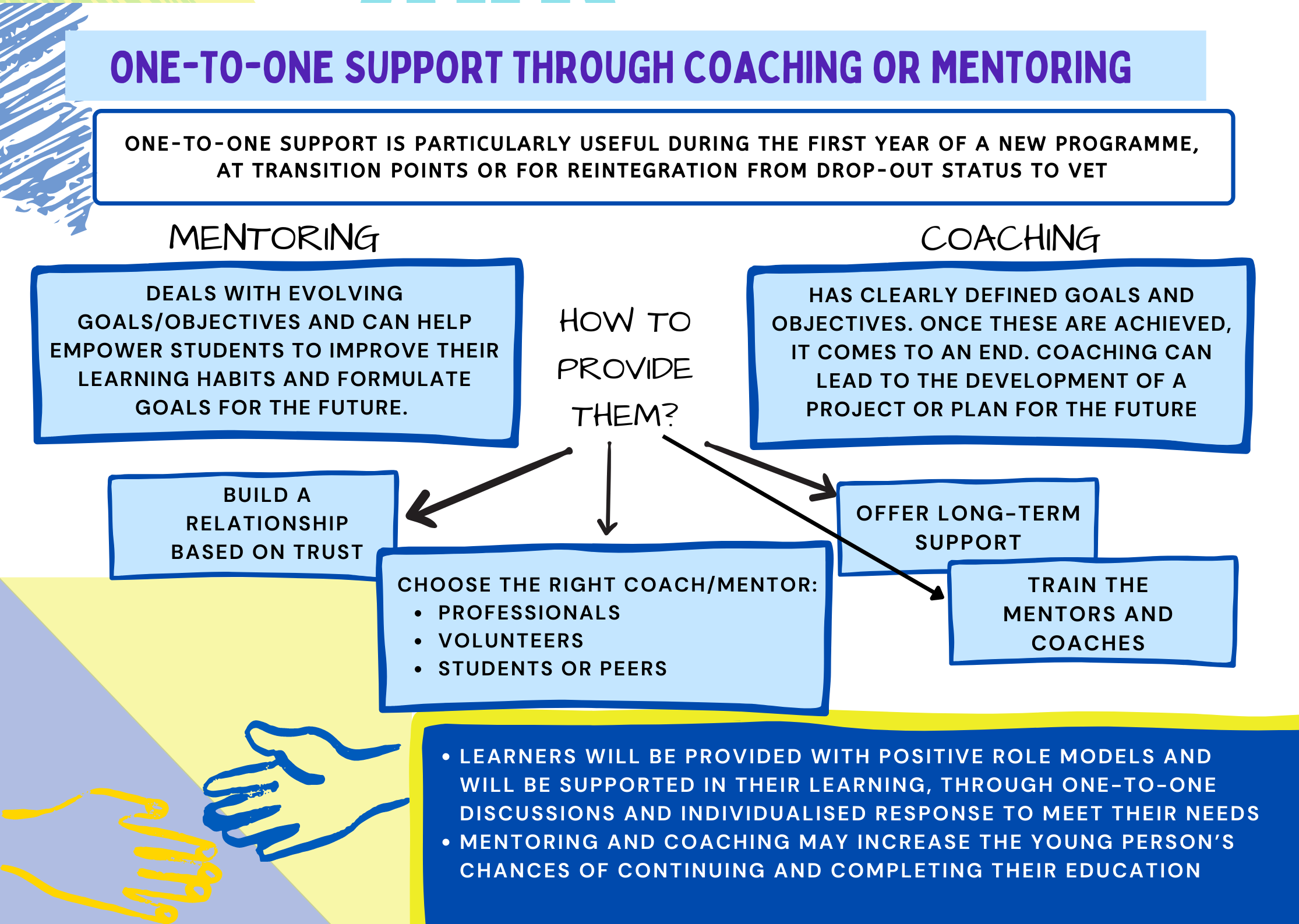
Coaching and mentoring involve one-to-one support for young people, but they are not the same. Coaching has clearly defined goals and objectives: it aims to improve performance, focusing on specific skills or targets and typically ends once these are achieved. Mentoring is broader, with evolving goals and objectives. According to the Cedefop glossary, mentoring refers to “any support provided to a young person or novice by an experienced person who acts as a role model, guide, tutor, coach or confidante”.
Mentoring and coaching can achieve a range of outcomes depending on the needs of the young person and the characteristics of the mentor or coach (e.g. whether they are internal or external to the learning provider, adults or peers, volunteers or paid staff). The relationship, activities and communication methods will vary according to the learner’s needs.
The following tips provide practical guidance for policy-makers and practitioners designing and delivering these measures. The information is based on Cedefop research into successful practices.
Coaches/mentors may be professionals (e.g. guidance counsellors, teachers or tutors), volunteers (e.g. from the business community or students) or peers. An independent mentor - someone not affiliated with the learning provider or company (for apprentices/trainees) - can make it easier for the young person to discuss questions and difficulties openly. Similarly, peer mentoring connects learners with others who are independent of “the system” and may have experienced similar challenges. Peer mentoring can be particularly useful for addressing social or motivational issues, sharing learning experiences, and exchanging study techniques.
Training is essential for coaches and mentors before they begin working with young people. This is especially important for volunteers, such as students or community members.
Advanced tools, including those using artificial intelligence (AI) and smart algorithms, can support the matching of learners with coaches or mentors. These tools go beyond simple availability-based matching and can consider the coach’s or mentor’s academic and professional background, previous experiences, interests, hobbies, qualifications, and past coaching or mentoring experience to ensure an optimal fit with the learner’s profile.
Over time, the coach or mentor and the young person need to develop a relationship founded on trust. A key benefit of mentoring or coaching is that, through this relationship, the young person can receive advice and support from an adult who is often “external” to their learning and home environments, or who is perceived by the learner as neutral and supportive.
This positive relationship can be especially important for young people at risk of disengaging from learning. For some, the coach or mentor may be the only adult they feel is genuinely supporting them in their education and/or career.
Mentoring and coaching can support a range of goals, and the activities involved should be tailored to the individual learner. The support should be led by the young person and their needs, meaning the activities undertaken with the coach or mentor can vary considerably and may evolve as the coaching or mentoring relationship develops.
For example, mentoring can help identify problems that might lead to drop-out, enabling the young person, with their mentor’s guidance, to address these issues proactively. Mentoring can also empower learners to improve their learning habits, formulate future goals, and benefit from the experience of professionals. It may provide opportunities to discuss technical topics or practice for assessments.
Coaching may focus on developing a project or plan for the learner’s future, identifying additional training or support needed to successfully complete their learning pathway. This is an individualised approach, tailored to the learner’s specific needs. The coach may also advocate on behalf of the young person, helping to identify and address barriers beyond learning, such as health or welfare issues.
Shared digital spaces or mobile apps can facilitate co-creation and management of learning and career goals. Additionally, career and education planning tools, together with interactive digital platforms that present occupations and work environments vividly, can help inspire the learner. This approach makes goal-setting more realistic while aligning with the learner’s interests and aspirations, as well as the practical realities of available learning and career options.
To build a relationship of trust, coaching and mentoring should take place over the long term rather than as a one-off session. The duration and intensity of the intervention should be adapted to the young person’s needs, particularly for those facing complex barriers to learning, reflecting the specifics of their situation.
Digital technologies can help maintain ongoing connection between the mentor or coach and the learner, especially when the learner faces accessibility or other practical challenges.
It is important to clarify roles, responsibilities, and communicate expectations at the outset of the coaching or mentoring process. Clear boundaries help establish mutual respect, ensure confidentiality, and prevent misunderstandings. Young people should understand what the coach or mentor can provide and the limits of their support, while mentors should receive guidance on professional conduct, safeguarding, and ethical considerations.
Regular monitoring of learner progress is essential to ensure that mentoring and coaching remain effective. Feedback sessions between the learner and coach, supported by digital tracking tools, can help identify emerging challenges early and adjust the support provided. This process allows for flexible adaptation of goals, activities, and intensity based on the learner’s evolving needs.
Mentoring and coaching should empower learners to reflect on their own learning habits, achievements, and challenges. Encouraging self-directed learning helps develop autonomy, resilience, and critical thinking skills, which are key to preventing early leaving. Reflection can be facilitated through digital portfolios, journals, or regular review meetings with the mentor.
Mentoring and coaching should connect learning with real-world opportunities. By integrating career guidance and providing information on labour market trends, apprenticeships, and higher education options, learners can make informed choices about their future pathways. AI-enhanced career guidance tools can help map learners’ interests to labour market data, supporting realistic and evidence-based decisions.
In addition to one-to-one mentoring, peer networks can provide ongoing social and motivational support. Peer mentors can share experiences, learning strategies, and practical advice, helping learners feel part of a supportive community. This is particularly useful for learners at risk of isolation or disengagement.
Engaging parents or other key adults in the mentoring process can provide additional support outside the formal learning environment. Coordination between home, school, and mentoring activities ensures that learners receive consistent guidance and encouragement, particularly for those facing complex personal or socio-economic barriers.
Expected outcomes
Mentoring and coaching alone cannot solve all the challenges faced by young people. However, the one-to-one relationship that develops through these interventions can be a crucial element of a broader, comprehensive support package. It provides learners with a positive role model, guidance on learning, opportunities to discuss and overcome personal and academic challenges, and an individualised response to their specific support needs.
Through mentoring and coaching, young people can improve social and communication skills, build resilience, and develop strategies to manage challenges in learning, work, and life. They may also experience positive behavioural changes, such as reduced absenteeism, improved engagement with their studies, and enhanced attainment outcomes. Overall, mentoring and coaching increase the likelihood that learners continue and complete their education, while preparing them for future careers and lifelong learning.
The expected outcomes can be categorised across three different levels:
 |  |  |
|---|---|---|
| INDIVIDUAL | INSTITUTIONAL | SYSTEM |
|
|
|