

Problem statement
Addressed problem: Psychological and social challenges faced by vulnerable learners
Mental health and well-being are key factors influencing students’ educational trajectories and determine school success or failure. Early leaving from VET can be caused by health issues, psychosocial problems, or experiences of trauma, which are often not addressed with appropriate care and attention. Moreover, teachers and trainers frequently confront challenging situations related to bullying, discrimination, behavioural issues, or adaptation difficulties faced by students settling into a new cultural or linguistic environment.
For this reason, it is crucial to develop modern methods and approaches to provide effective psychosocial support to students throughout the educational process.
Recent large-scale events have strongly impacted learners’ well-being in Europe. These include the Covid-19 pandemic, the arrival of Ukrainian refugees in European schools, financial crises, and rising wealth inequalities. These circumstances have left profound consequences on young people, teachers, and the wider community. Addressing these challenges requires multi-layered psychosocial support for both learners and educational staff.
Providing such support entails addressing several key challenges in VET, such as:
- Coordinating psychosocial support across different system levels;
- Understanding the scale and nature of learners’ needs;
- Monitoring and evaluating whether learners’ needs are being met;
- Equipping teachers, trainers, and other professionals to provide culturally and linguistically meaningful interventions;
- Fostering learners’ well-being both inside and outside the learning environment.
Beneficiaries
Addressing the problem
Tips: How to support learners on a psychosocial level to prevent early leaving?
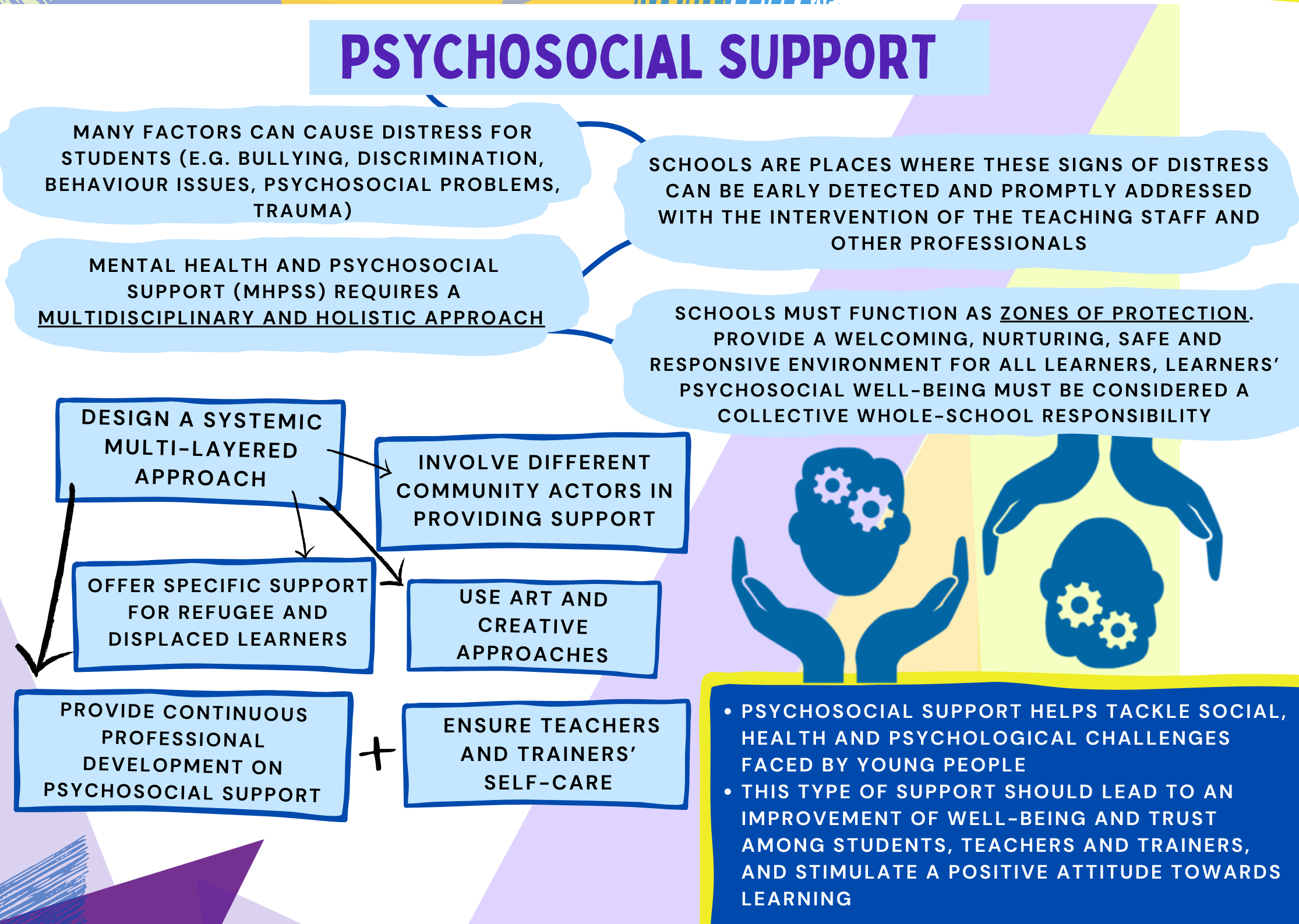
To provide effective and holistic psychosocial support to learners, multiple approaches, practices, and tools can be adopted, including social and emotional learning (SEL), resilience-building, trauma-informed education, fostering mutual understanding, and constructive conflict resolution. Mental Health and Psychosocial Support (MHPSS) requires a multidisciplinary and coordinated approach, ensuring consistency across all actions.
Students may experience distress due to a variety of external and school-related factors. Schools play a crucial role in detecting these early signs and addressing them promptly through the intervention of teaching staff and other professionals. Cedefop research indicates that learners and their families generally prefer interventions delivered within VET settings - such as schools or workplaces - rather than clinics, as these are more accessible and less stigmatizing.
For psychosocial interventions to be effective, schools must function as safe spaces. VET institutions should provide a welcoming, nurturing, and responsive environment that fosters a positive and inclusive school climate. Learners’ psychosocial well-being should be treated as a collective responsibility across the whole school and community. Teachers and trainers must be well prepared to support all learners in addressing both academic and behavioural challenges.
The following tips offer guidance for policy makers and VET practitioners involved in designing and delivering psychosocial support or VET policies. These are based on Cedefop research into successful policies and practices in Europe.
A successful psychosocial support system in VET begins with a school‑wide approach that embeds well‑being and mental health into the culture, organisation, and everyday practices of the institution. VET providers should adopt whole‑school well‑being policies and prevention frameworks that:
- Demonstrate leadership commitment and define clear roles and responsibilities for staff, learners, and partners;
- Promote an inclusive and safe learning climate that values mental health as a core educational objective;
- Coordinate actions across school services, families, and community actors; and
- Systematically monitor well‑being indicators to inform prevention and early intervention.
This approach aligns with key EU policy priorities, including the Council Recommendation on Promoting Common Values, Inclusive Education and the European Dimension of Teaching, the EU Pact for Mental Health and Well‑Being, and broader EU strategies that call for whole‑school mental health promotion, early identification, and prevention. By situating subsequent interventions (multi‑layered support, community engagement, teacher training, trauma‑sensitive practices, and digital/AI tools) within an overarching framework, schools ensure that psychosocial support is sustainable, coordinated, and impactful across the whole learning community.
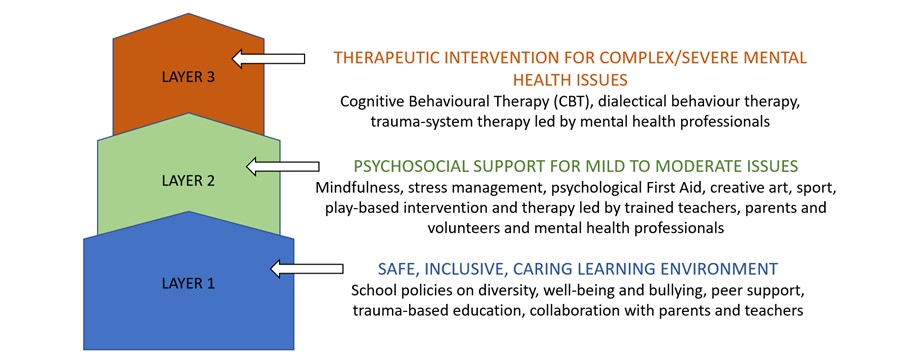
Creating a safe and protective school environment that supports students’ self-expression and emotional disclosure is the first step in developing effective mental health and psychosocial support interventions. Digital dashboards and AI-powered early warning systems can help schools and teachers monitor well-being indicators - such as attendance patterns, changes in grades, and engagement with school activities - and identify learners in need of support.
At the second level, moderate issues can be addressed through psychological first aid, social and emotional learning (SEL), and art- or play-based therapies. These interventions can be delivered by teachers, trainers, volunteers, parents, or other professionals. SEL programmes can incorporate evidence-based digital apps, allowing students to track moods and feelings and communicate concerns anonymously.
At the highest level, complex cases should be addressed through targeted therapeutic interventions provided by mental health professionals. Secure video-consultation platforms can improve access to mental health services, especially for learners in areas with limited local services or for those facing mobility or stigma-related barriers.
Effective psychosocial support requires structured cooperation and coordination between students, pedagogical staff, families, and mental health professionals. A whole-community approach, involving multi-professional teams working alongside school staff, ensures that signs of distress are detected early and addressed promptly through internal interventions or referral systems. This approach follows the principle of community orientation, which considers the student’s entire social environment - including all contexts and people they interact with both inside and outside the learning setting.
Digital tools can strengthen multi-actor coordination. Case-management platforms accessible to families, teachers, mental health professionals, and social workers keep all stakeholders informed about the student’s progress and needs. Secure family-teacher communication apps reduce barriers for family members who cannot attend in-person meetings, while AI-powered 24/7 referral tools can generate suggestions tailored to a student’s needs, speeding up response times.
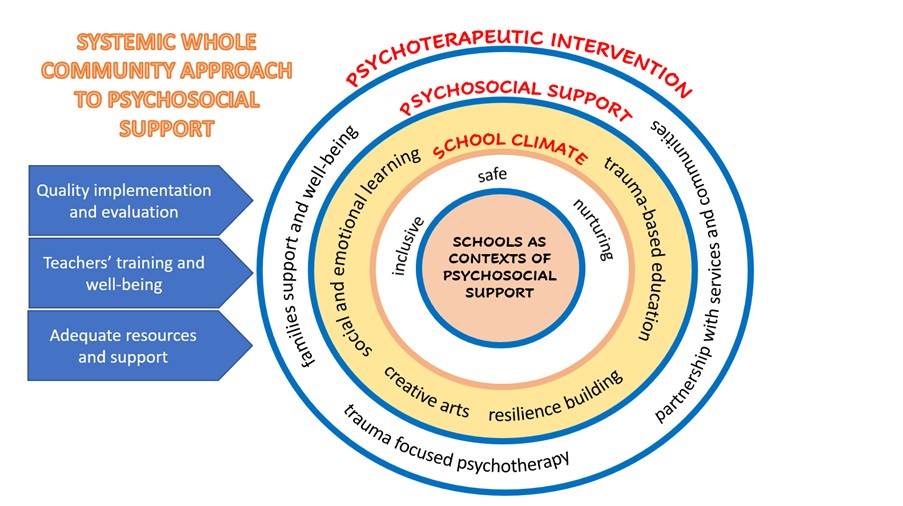
To create a supportive learning environment, VET teachers and trainers need ongoing training on topics such as trauma-informed teaching, social and emotional learning (SEL), recognition of mental health issues, and appropriate intervention strategies.
During these training sessions, teachers and trainers can develop knowledge of how students may react to crisis events and learn how to approach such situations effectively. They gain skills to act as pedagogical professionals who support students’ rehabilitation and future well-being. AI-driven scenario, crisis, and conflict simulations allow teachers to practice responding to student distress in real-time, within a safe and low-stakes environment. Additionally, digital tools and apps can provide asynchronous training programmes that fit teachers’ schedules, increasing participation in continuing professional development (CPD).
Through professional development focused on trauma-informed approaches, teachers and trainers can learn:
- How to build a learning environment that is sensitive and responsive to trauma and stress;
- How to identify trauma and understand its impact on students;
- How to respond appropriately while maintaining a trauma-sensitive classroom or workplace.
It is also essential to address teachers' and trainers' own well-being (see tip 7). Understanding causes of burnout, including secondary trauma, and learning methods for prevention and recovery are crucial steps that enable educators to provide effective psychosocial support to learners.
Learners accessing second-chance measures often come from diverse starting points. Traumatic events, extreme crises threatening the learner or their relatives, and relocation to a new country with unfamiliar social and linguistic contexts can all be sources of distress. Such experiences can undermine the individual’s sense of security and lead to trauma, with psychological, emotional, cognitive, and physical consequences that vary from person to person. Trauma can affect behaviour, emotions, brain development (e.g., language and communication skills), and physical responses (e.g., heightened sensitivity to light and sound).
The primary goal of psychosocial support for learners who have experienced crises is to stabilize their emotional state, acknowledge that reactions to extreme events are normal, and promote self-awareness, self-perception, self-regulation, and self-control.
A trauma-informed approach can guide support in both physical and virtual classrooms, based on six principles:
- Safety: Ensure all students and staff feel physically and psychologically secure.
- Trustworthiness and transparency: Maintain open and honest communication among school administration, staff, students, and families.
- Peer support and solidarity: Encourage trust, empowerment, and a sense of safety through peer connections.
- Collaboration and mutuality: Foster cooperation among all education and training actors to create a trauma-sensitive environment.
- Empowerment, voice, and choice: Recognize each student as unique, providing opportunities to express needs and ensuring those needs are addressed.
- Cultural, historical, and gender responsiveness: Deliver teaching and training that is sensitive and appropriate to diverse backgrounds.
Focus should be on personal development, positive social interaction, and building a hopeful vision for the future. Schools and workplaces should provide stability and foster a sense of belonging, enabling recently arrived learners to learn, interact, and thrive.
Practical digital tools can further support inclusion:
- AI-powered translation and multilingual communication tools (e.g., real-time speech translation) reduce language barriers and help students feel safe and understood;
- Digital orientation platforms in multiple languages can provide accessible information about schools, training programmes, and local social services;
- Any AI-driven educational content or assessment tools must be culturally sensitive, adapted to the learners’ context, and trained on appropriate datasets to prevent bias and discrimination.
Mental health issues can significantly affect students’ school performance. These issues may stem from:
- Externalising disorders – outward-directed behaviours such as disruptive behaviour, attention deficit disorder, or oppositional defiant disorder;
- Internalising disorders – inward-directed disorders affecting emotions, such as anxiety and depression. These are often less visible but can strongly impact cognitive functioning and academic achievement, leading to reduced memory, poor concentration, distractibility, daytime sleepiness, low self-esteem, and decreased motivation.
Acknowledging and addressing mental health problems is essential for preventing early leaving from VET. Particular emphasis should be placed on identifying and treating symptoms of depressive disorders to mitigate negative effects on learning outcomes. AI-enhanced early warning systems can monitor signs of mental health issues and help teaching staff efficiently identify learners in need of support.
Mental health interventions can be implemented at three levels:
- Universal programmes – targeting the entire student population to promote general well-being and resilience.
- Selective programmes – focusing on groups of students with a higher likelihood of experiencing anxiety or depression.
- Individual programmes – tailored for students showing a high level of anxiety or depressive symptoms.
Continuous monitoring of interventions and their outcomes is critical for effectiveness. Digital dashboards (see Tip 1) can centralise real-time information on students’ psychosocial status and the interventions applied, enabling timely adjustments and support.
To effectively support learners facing mental health, psychosocial, or distress-related challenges, it is essential that educators are themselves supported and encouraged to prioritise self-care. The Council Recommendation on Promoting Common Values and Inclusive Education underscores that a high-quality, inclusive learning environment is only possible when educators are physically and mentally equipped to model these values.
Pilot findings from Cedefop’s European VET Teacher Survey (EVTS) highlight the urgency of this issue: 42% of teachers report anxiety related to their work, 16% experience depression, and around 60% have sleeping difficulties. These figures align with the EU Mental Health Strategy, which calls for a “comprehensive approach” to mental health, including improved psychosocial working conditions in schools to prevent secondary trauma.
Caring for students with complex needs can result in secondary trauma, making timely support for educators critical. Efficient referral systems should be in place to allow staff to access specialised interventions when needed. Digital referral directories listing available programmes and services can make teachers and trainers obtain support quickly.
Daily monitoring of well-being can also be facilitated through digital apps that allow staff to log challenging situations, track stress and fatigue levels, and receive tailored guidance from professionals.
The EU Pact for Mental Health and Well-being identifies the workplace, including schools, as a key setting for intervention, advocating structural support against burnout and excessive workloads. EVTS findings show that teachers face rising demands: nearly half take on additional tasks due to staff shortages, and over a third (37%) report excessive administrative duties. To reduce burnout, VET teachers can also leverage AI tools to manage routine tasks, freeing time and energy for human-focused activities that require care and intervention.
Finally, teachers and trainers need support in managing learner behaviour and conflict. The EVTS pilot indicates that one in three teachers feels they need to strengthen skills in handling challenging behaviours, including bullying or school violence. Supporting teachers’ and trainers’ well-being is therefore a fundamental component of a sustainable psychosocial support system for learners.
Creative arts can help learners reframe personal histories and develop new meaning from their experiences, making them a valuable tool to promote well-being and positive mental health, especially for refugee and displaced students.
Drama and role-play activities, carefully guided, allow young people to share experiences and process emotions in a safe and controlled environment. It is essential that students are never pushed to revisit traumatic experiences before they feel ready; those who prefer to observe rather than actively participate can still benefit from listening to others’ stories.
Music, dance, and movement can also alleviate distress, anxiety, and separation. Digital apps with guided, evidence-based exercises can extend the benefits of these therapies beyond the classroom, enabling students to practice in familiar and safe environments.
AI-assisted creative tools can further support engagement, particularly for students who feel intimidated by traditional art forms or lack access to materials. These tools can provide accessible, personalized, and low-pressure opportunities to explore creative expression.
Effective psychosocial support systems should actively involve learners as partners in the design, implementation, and evaluation of well-being initiatives. Moving beyond a model where learners are passive recipients of support, VET providers should create opportunities for meaningful participation and co-creation.
This can include:
- Involving learners in shaping school well-being policies and activities;
- Establishing peer support systems, such as mentoring schemes or student well-being ambassadors;
- Using anonymous digital feedback tools to regularly capture learners’ experiences and needs; and
- Encouraging student participation in school governance and decision-making processes.
By fostering agency and empowerment, this approach strengthens learners’ sense of ownership, trust, and engagement with the learning environment. It is particularly beneficial for vulnerable groups, whose voices are often underrepresented.
Transitions represent critical moments of vulnerability in learners’ educational pathways and are often associated with increased risk of disengagement or early leaving. Psychosocial support should therefore be continuous and coordinated across key transition points.
VET providers should:
- Implement structured transition support between educational levels, training pathways, and entry into the labour market;
- Provide mentoring or case coordination to ensure continuity of care;
- Establish “warm handover” mechanisms between institutions and services; and
- Conduct early psychosocial screening and orientation activities at entry points, particularly for newly arrived or returning learners.
Ensuring continuity helps maintain stability, reduces uncertainty, and supports learners in adapting to new environments and expectations.
In VET contexts, learners’ well-being is closely linked to their sense of purpose, motivation, and future orientation. Psychosocial support should therefore be closely connected with career guidance and counselling services.
This includes:
- Providing career guidance that addresses both emotional and motivational aspects of decision-making;
- Supporting learners in building self-efficacy, confidence, and realistic aspirations;
- Helping learners cope with uncertainty, anxiety, and perceived barriers related to employment prospects; and
- Integrating career development activities within broader well-being programmes.
By aligning psychosocial support with career pathways, VET providers can strengthen learners’ engagement and reduce the risk of early leaving linked to lack of direction or low motivation.
A sense of belonging is a key protective factor for learners’ well-being and retention. Beyond ensuring safety, VET institutions should actively cultivate inclusive environments where all learners feel valued, respected, and connected.
This can be achieved by:
- Promoting inclusive school cultures that celebrate diversity and mutual respect;
- Implementing anti-bullying and anti-discrimination strategies focused on inclusion and community-building;
- Ensuring representation of diverse cultural, linguistic, and social backgrounds in curricula and school activities; and
- Creating safe and supportive spaces for specific groups of learners where needed.
Strengthening belonging enhances learners’ emotional security, participation, and commitment to education and training.
While digital tools and AI systems offer significant opportunities to enhance psychosocial support, their use must be guided by ethical principles and safeguards to protect learners’ rights and well-being.
VET providers should:
- Ensure compliance with data protection and privacy regulations, particularly when handling sensitive psychosocial information;
- Guarantee transparency in how data are collected, used, and shared with stakeholders;
- Monitor and mitigate potential biases in AI systems to avoid discrimination;
- Obtain informed consent from learners and families, where appropriate; and
- Promote trust by clearly communicating the purpose and benefits of data-driven tools.
Ethical and responsible use of technology is essential to maintain trust, ensure fairness, and maximise the effectiveness of psychosocial support interventions
Expected outcomes
Psychosocial support in VET helps address social, health, and psychological challenges faced by young people. It contributes to improved well-being, trust, and resilience among learners, teachers, and trainers, while fostering a positive attitude toward learning and education. Embedding these interventions within a whole-school well-being framework ensures systemic coordination, early prevention, and sustainable impact.
The following outcomes can be expected at different levels:
 |  |  |
|---|---|---|
| INDIVIDUAL | INSTITUTIONAL | SYSTEM |
|
|
|
