

Slovakia has introduced individual learning accounts (ILAs) as part of a broader reform under the Act on adult education. The national ILA portal opened on 1 April 2026, after the platform and the provider certification process were developed throughout 2025. EUR 10.4 million from EU resources has been allocated over three years for the preparation, pilot implementation and follow-up of the ILA scheme.
In the first phase, each ILA is worth EUR 200. In subsequent phases, the value may rise to up to EUR 1 500 per learner. Courses must last at least 12 hours, microcredentials at least 25 hours and accredited programmes at least 100 hours. ILAs can also be used to support guidance and validation of prior learning.
How ILAs work
ILAs are available to adults aged 16–65, except full-time students and self-employed people. The process is fully digital. Learners create an account on the ILA portal, choose a programme and apply online for financial support. If the application is approved, the system generates the necessary documents for the agreement.
The ILA subsidy is paid directly to the provider, while the learner pays any remaining balance. Training through ILAs may only be offered by providers certified by the education ministry. Certification is granted following the ministry’s acceptance of evidence submitted by the the provider that they have taken initial steps towards the introduction of a quality assurance system.
Early take-up
By 14 July 2026, 313 of the 609 registered certified providers had listed training offers for ILA applicants. These included 117 accredited programmes, 2 310 non-accredited programmes and 10 microcredential programmes. In total, 28 370 adults had registered their interest in learning, and the first 5 000 applicants were accepted for the pilot phase.
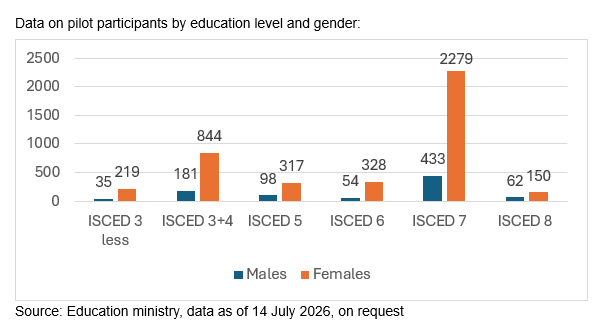
The above figure shows that women and adults with higher educational attainment were among those most interested in using ILAs, particularly those with ISCED level 7 qualifications. The three most frequently requested courses were on the use of artificial intelligence and digital technologies in education.
Early observations
Initial pilot data point to strong demand for the scheme. However, they also raise questions about whether ILAs will reach adults with the greatest need for upskilling and reskilling, including those facing a higher risk of labour market exclusion. The scheme’s capacity to achieve its longer-term objectives will also depend on the availability of funding in the context of fiscal constraints.
Early indications suggest that teachers may have been particularly active among the first applicants, possibly reflecting the immediate need to respond to the growing use of AI and digital technologies in education. This may also point to a need for targeted continuing professional development (CPD) opportunities for teaching staff on the use of AI in education. Such provision could help ensure that ILAs remain accessible to a broad range of adult learners. More detailed monitoring of the profile of ILA participants could help to identify possible distortions and also better target not sufficiently informed groups.
The low share of microcredentials among the training offers and/or applications also calls for further examination. It may point to issues related to the availability and attractiveness of microcredentials, as well as to the way they are designed and regulated nationally.
More broadly, rapid technological change, including AI, makes it more difficult to anticipate future skills needs. Slovakia’s experience with ILAs may contribute to wider European discussions on inclusive adult learning, skills anticipation and the role of microcredentials.
| Please cite this news item as: ReferNet Slovakia, & Cedefop (2026, August 31). Slovakia: individual learning accounts launch. National news on VET |