

Problem statement
Addressed problem: Disengaged young people exiting education and training
The process leading a young person to leave education and training early is cumulative and complex. However, it is not – or should not be - a one-way pathway. Many early leavers wish to return to education. Second chance measures provide opportunities for re-entry and support young people to acquire a qualification.
There are many reasons why young people leave education early. Second chance measures are often designed to address these barriers. For example, some young people need to work due to their own or their family’s economic situation, while others have caring responsibilities. To accommodate these circumstances, second chance education opportunities may be delivered outside standard study hours or through flexible formats, such as distance or blended learning (combining online and face-to-face instruction).
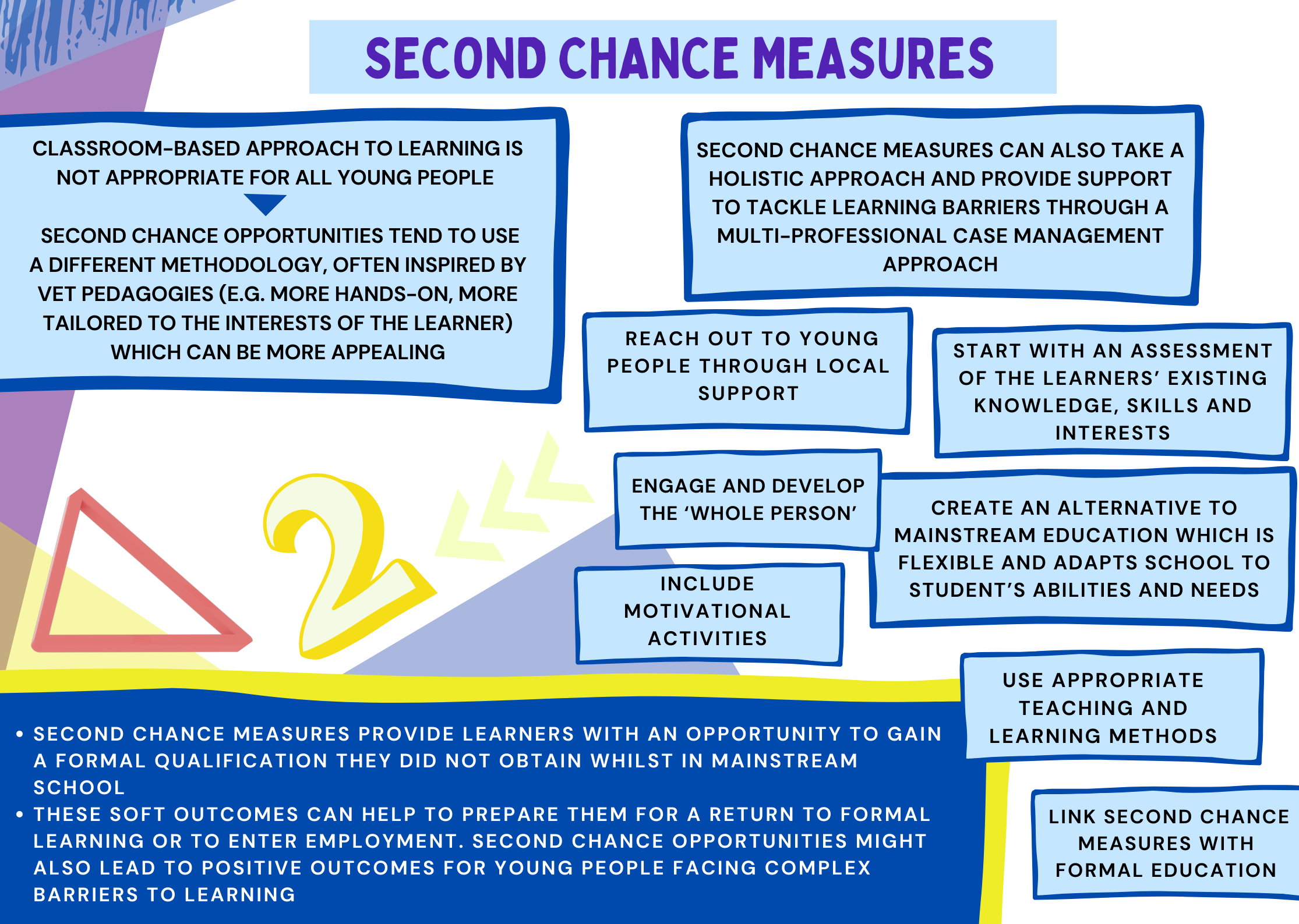
Another factor contributing to early leaving is that traditional, classroom-based approaches to learning do not suit all young people. Second chance provision typically adopts alternative methodologies, often inspired by VET pedagogies (e.g. more hands-on, practice-oriented, and tailored to learner’s interests) which can enhance engagement.
For young people facing complex barriers to learning (e.g. health issues, housing instability), some second chance measures adopt a holistic approach. These combine formal learning with targeted support services, using a multi-professional case management approach to address individual needs.
Beneficiaries
Second chance measures can support individuals who have already dropped out of education. In some cases, they may also be appropriate for young people who are still in education but are at high risk of early leaving.
Addressing the problem
Tips: How to re-engage young people in VET through effective second chance measures?
Second chance measures can take different forms. Some provide an opportunity to acquire a formal qualification. These programmes typically involve individualised provision, use alternative methodologies compared to initial education, and may be delivered in flexible formats (e.g. part-time).
Other second chance measures do not lead directly to a formal qualification. Instead, they aim to support young people in progressing towards re-entry into formal education or transition to employment. These more comprehensive measures often start by rebuilding motivation for learning, while supporting the development of key skills and behaviours needed to access formal education or work. At the same time, they address a wide range of barriers (e.g. related to health, poverty, or social circumstances).
Second chance measures may also be implemented as part of activation efforts of the public employment services. Second chance measures may also be implemented as part of activation policies delivered by public employment services.
The following tips are intended to support policy makers and practitioners involved in the design and delivery of both vocational second chance programmes and comprehensive measures (i.e. those addressing a broad range of barriers to learning). They are based on Cedefop research on effective practices, as well as other relevant evidence.
Successful second chance provision is embedded in the local community, enabling providers to effectively reach and engage young people in their area.
Engagement often begins with a very ‘light touch’ approach, gradually building trust with the young person. This can lead to more formal enrolment in a programme and sustained participation. Second chance measures typically involve a range of staff beyond teaching personnel, including those responsible for outreach and engagement activities.
Close cooperation with other professionals who are in contact with young people (e.g. social and healthcare workers) is essential. Local services should be supported and empowered to identify and refer young people at-risk to second chance opportunities.
Social media and digital outreach strategies can further strengthen engagement by raising awareness and capturing young people’s interest in available opportunities. In addition, digital referral platforms that connect social workers, employers and second chance providers can facilitate information sharing and help ensure that young people access appropriate programmes.
Most second chance measures provide an alternative to mainstream education. This may relate to group size (often smaller than in mainstream settings), programme organisation (e.g. evening or weekend classes, blended or fully online options), access requirements (e.g. removing barriers such as minimum prior qualifications), teaching methods, or learning content. Curricula and educational practices are designed flexibly, with the aim of adapting provision to learners’ abilities and needs, rather than requiring learners to adapt to rigid structures.
A key distinguishing feature is the learning environment. Second chance measures typically aim to create a supportive, inclusive and respectful setting. This helps young people feel valued, treated as equals, and able to build trusting relationships with staff. Such an environment is particularly important for those who have previously struggled in formal education settings or who come from non-supportive backgrounds.
In addition to addressing learning needs, second chance provision often integrates wider support services, such as legal, financial, housing or therapeutic support, to respond to the broader challenges faced by learners.
Second chance measures typically take a broad approach, addressing the physical, emotional, and psychological well-being of learners - though the extent varies depending on the nature of measure.
Comprehensive programmes often employ multi-professional teams that first reach out to young people and engage them in participation. These teams then identify and address the full range of barriers to learning. For example, social and healthcare workers may collaborate with teaching staff, and learners may have access to counselling or other support services. A case management approach allows this multi-faceted support to be tailored to the individual. Digital platforms shared across multi-professional teams, can be particularly useful for managing individual cases, ensuring visibility, and maintaining cohesion in the support provided.
Teaching staff in second chance measures often see their role as extending beyond teaching to include social and emotional support, helping learners work through personal challenges. Digital well-being check-in tools can assist in this process by monitoring learners’ emotional states and identifying emerging issues before they escalate into dropout risks.
Coaching or mentoring programmes are also commonly integrated into second chance measures.
These activities form a core part of the support offered, running in parallel with, or in preparation for, formal education and training. They help participants re-discover an interest in learning and develop the behaviours and competences needed to succeed in formal learning or the workplace.
Learners accessing second chance measures come from different starting points and face varying barriers to learning. The knowledge and skills ‘gaps’ they need to address depend on when they left school and their prior attendance and achievements. The knowledge and skills “gaps” they need to address depend on when they left school and their prior attendance and achievements.
Second chance measures are typically individualised, taking account of prior learning and work experience. This is especially important for young people who may have partially completed studies or acquired skills and competences through work, non-formal or informal learning. Second chance measures are typically individualised, taking account of prior learning and skills.
An individualised approach should begin with an assessment of learners’ existing knowledge, skills, and interests. The goal of this assessment is to boost confidence and help learners identify learning objectives and an overall pathway. It should also consider any additional support needs and determine how these will be addressed.
Digital initial assessment tools can map learners’ knowledge, skills, interests, and barriers in a non-threatening, engaging way. These tools also produce comprehensive learner profiles, often more detailed than those generated by traditional interviews or exams. Additionally, the wider use of digital portfolios for recognising skills and prior learning can streamline validation of existing competences while empowering young people.
For a more in-depth discussion, see the intervention approach on flexible education and training systems.
Second chance measures should provide alternative pathways toward a formal, recognised qualification or employment. This can involve delivering the qualification within the second chance programme or preparing learners to return to mainstream education. Such measures need to operate within a flexible system, allowing young people to progress in their learning or move laterally to another option at the same level. Digital qualification frameworks and e-credentials (e.g., badges and digital certificates) can facilitate formal recognition and transfer of learning outcomes between second chance programmes and mainstream qualifications.
Strong links with the mainstream education system are essential. These connections can enable referrals in both directions and support the awarding of formal qualifications - or components such as units or modules - through second chance provision. In some cases, second chance measures may even be located within mainstream schools.
Employer engagement is also crucial. Collaborating with local companies to provide on-the-job training, apprenticeships, or work-based learning ensures that learners gain relevant skills for the local labour market and supports successful career pathways. Digital employer engagement platforms can connect second chance providers with local businesses for placements, simulations, and structured work experiences.
Flexibility can also be enhanced through recognition of prior learning and modular course structures, allowing learners to follow a tailored learning path. AI-powered labour market intelligence tools can help align curricula with current and emerging skills needs in the local and regional economy.
For a more in-depth discussion, see the intervention approach on flexible education and training systems.
Many young people returning to second chance education have other commitments and demands on their daily lives. Flexibility in provision is therefore essential, including how learning is delivered and how enrolment and registration are managed.
Flexibility also extends to attendance requirements. Young learners may face complex personal circumstances that affect their ability to attend regularly. Avoiding punitive measures for non-attendance and working collaboratively with learners to address underlying issues is more effective in a second chance environment. Rigid requirements - such as attending eight hours a day, five days a week - may not be realistic. Alternative, achievable, part-time attendance patterns can help retain learners and support programme completion.
Asynchronous and on-demand learning content, such as recorded lessons, self-paced modules, and downloadable resources, allows learners to engage with the curriculum alongside work, caring, or other commitments without stigma or penalty. Additionally, rolling digital enrolment systems, which enable learners to join at any point during the year rather than fixed intake dates, help bridge the gap between a learner’s decision to return to education and their ability to start.
Negative perceptions of second chance education among teachers, professionals, parents, and peers can act as significant barriers to participation. Such stigma may also hinder learners’ progression back into mainstream education or training after completing a second chance measure.
To address this, it is important to strengthen the credibility and visibility of second chance provision. This can be achieved by ensuring that learning outcomes are formally accredited and linked to clear progression pathways, including recognised qualifications and access to further education, training, or employment. Strong partnerships with employers can further reinforce second chance education as a valid and valuable pathway.
Promoting positive attitudes among mainstream teachers and trainers is particularly important. As key referral agents, their perceptions can directly influence learners’ decisions to engage with second chance opportunities. Ensuring that these professionals are well-informed about the purpose, structure, and benefits of second chance measures - and the profiles of learners who may benefit from them - is essential.
Providing targeted training for mainstream educators on supporting young people at risk, including awareness of second chance pathways, can help reduce stigma and improve referral practices.
Second chance measures should apply flexible and learner-centred pedagogies, often drawing on approaches from vocational education and training (VET). These may include work-based learning, company visits, and practical activities in workshops. Integrating theoretical content with practical application helps ensure relevance and supports learner engagement, particularly for those who have previously disengaged from education.
Strong cooperation with employers is essential to provide authentic learning environments and opportunities for in-company learning. Such partnerships can enhance the quality and credibility of second chance provision.
Second chance learners, particularly young adult returners, often have different motivations and learning preferences compared to those in mainstream education. As a result, an adult learning approach may be appropriate. This includes offering a broad and flexible curriculum that supports critical reflection, personal development, and the acquisition of meaningful, transferable skills.
Adapting teaching methods to learners’ needs and experiences can improve participation, retention, and overall learning outcomes.
Motivational activities can play a key role in second chance provision by supporting learners’ confidence, engagement, and overall well-being. They offer opportunities to develop social, communication, and teamwork skills, while also strengthening relationships between learners and staff.
Such activities often take place in informal settings, which can encourage open interaction and trust. This can be particularly beneficial for learners facing external barriers to participation, as it creates space for tailored social and emotional support.
Motivational activities can also help learners reflect on their personal circumstances, better understand the challenges they face, and identify possible solutions. As part of a holistic approach, they contribute to improved participation, retention, and progression outcomes.
Effective second chance measures should include systematic monitoring and evaluation processes to track learners’ progress and improve programme quality over time.
At the individual level, regular follow-up and feedback mechanisms can help identify emerging challenges, adapt support, and maintain learner engagement. This may include ongoing assessment of learning progress, well-being, and participation, supported by personalised learning plans.
At programme level, collecting and analysing data on participation, retention, completion, and progression outcomes is essential. This evidence can inform continuous improvement, ensuring that provision remains responsive to learners’ needs and labour market demands.
Feedback from learners, staff, and employers should also be actively gathered and used to refine programme design and delivery. Digital tracking systems and learner management platforms can support real-time monitoring, early identification of dropout risks, and more coordinated support across multi-professional teams.
A strong focus on evaluation and quality assurance helps ensure that second chance measures remain effective, relevant, and sustainable.
See here for more detailed information on monitoring and evaluation.
Expected outcomes
For some learners, second chance measures provide an opportunity to gain a formal qualification they did not obtain while in mainstream school. For others, more ‘soft’ outcomes are equally important, such as increased self-awareness, a clearer plan for the future, or improved social and emotional skills.
These soft outcomes can help prepare learners for a return to formal learning or for entry into employment. Second chance opportunities may also lead to positive outcomes for young people facing complex barriers to learning, by providing targeted support to address underlying issues, such as substance abuse, housing, or health challenges.
The following outcomes can be expected at different levels:
 |  |  |
|---|---|---|
| INDIVIDUAL | INSTITUTIONAL | SYSTEM |
|
|
|