

Problem statement
Addressed problem: Negative perceptions of VET and low attractiveness of vocational pathways leading to disengagement and early leaving from education and training
Vocational Education and Training (VET), at both secondary and post-secondary levels, has traditionally faced challenges related to its public image and social prestige. In many countries, VET has long been perceived as a less desirable pathway compared to general and academic education, often being associated with lower academic achievement or limited progression opportunities.
At the tertiary level, educational discourse and policy debates continue to place greater emphasis on university education, while post-secondary VET remains less visible, less understood, and less strongly valued in public discourse. These perception patterns contribute to a “status hierarchy” between educational routes, which can distort learner decision-making and reduce the attractiveness of VET, particularly among high-potential learners.
Although in recent years VET attractiveness has improved in several countries - due to labour market demand, stronger employer links, and policy reforms - persistent reputational gaps remain, particularly regarding parity of esteem and progression visibility.
VET needs to be an appealing, credible alternative option to general education pathways, if it is to attract and retain learners. However, early leaving is influenced not only by actual programme quality, but also by perceived status and identity fit. VET attractiveness therefore operates as a behavioural and motivational factor shaping initial pathway choice, persistence, and engagement. Its image needs to be improved not just in the eyes of young people, but also their families and other key players such as teachers, careers advisers and employers.
High quality VET can be an attractive option for young people. It offers a clear route to the labour market which for some is appealing. Some young people like the practical aspect of the learning process. Others may be interested in the opportunity to earn as they learn, or to work towards a specific profession. VET can also provide more flexible and personalised learning pathways, particularly for young people who do not thrive in traditional academic settings. Recent evidence from Cedefop further highlights the benefits of VET, including strong employment outcomes, smoother school-to-work transitions, and opportunities for progression to higher levels of education. In the EU, the employment rate of recent IVET graduates reached 81% in 2023, and many VET programmes now offer pathways to tertiary education, reinforcing the value of VET as both a labour-market-oriented and a lifelong learning pathway.
Yet, in some European countries, young people and those who influence their educational choices, including families, peers, and teachers, may hold less favourable perceptions of VET compared to general education pathways. As a result, some young people may choose general education programmes that do not align well with their interests, learning preferences, or career aspirations. In such cases, the content or teaching approaches used in general education may contribute to disengagement and increase the likelihood of early leaving. Similarly, enrolling in a programme that does not correspond to a young person's strengths, motivations, or expectations may lead to low achievement and, ultimately, dropout.
Negative perceptions of VET can undermine learners’ motivation and sense of value in their chosen pathway. When VET is undervalued by parents, teachers, and peers, learners may internalise these views, which can contribute to disengagement from education. This may be particularly relevant for learners who enter VET after leaving general education pathways. In this sense, VET perception acts as an externalised social signal that becomes internalised by learners and affects persistence and effort.
These perceptions are often sustained by persistent stereotypes about vocational occupations, limited awareness of progression routes, and insufficient visibility of successful VET trajectories. In some contexts, VET is still regarded as a ‘second-best’ option for lower-achieving students rather than a high-quality pathway offering access to skilled employment, further education, and social mobility.
Overall, low VET attractiveness functions as a structural and cultural driver of early leaving by affecting choice quality, learner motivation, and long-term engagement in education and training pathways.
Beneficiaries
- Young people in an environment where VET has a poor image or is seen as a ‘second choice’.
- Young people in VET who have low self-esteem.
- Young people following VET routes which are less valued, respected and recognised.
- Labour market stakeholders where VET qualifications are less valued in comparison to general education.
Addressing the problem
Tips: How can the image and attractiveness of VET be improved?
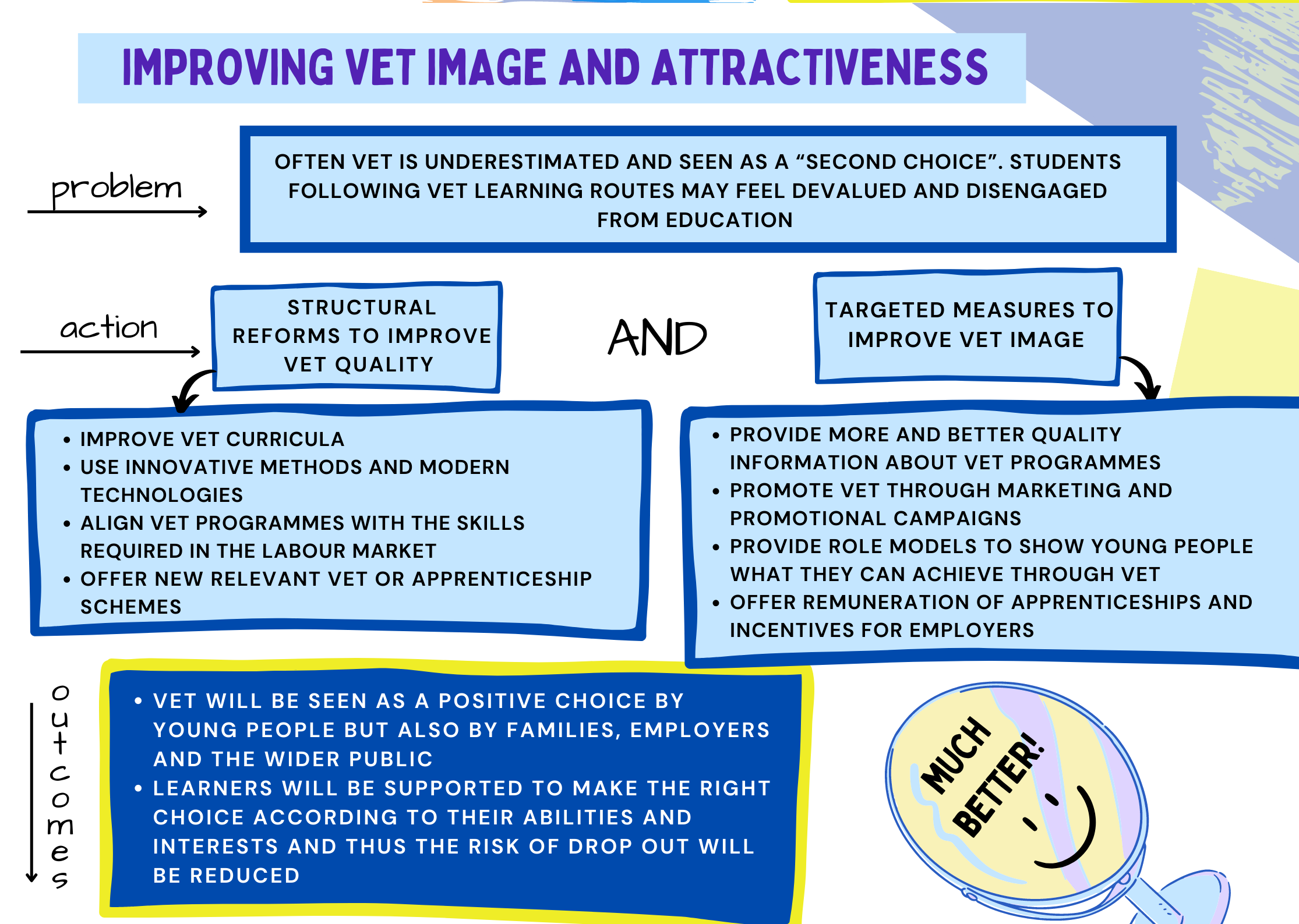
There are multiple ways to improve the image and attractiveness of VET, ranging from structural reforms aimed at enhancing its quality and relevance to more targeted measures addressing perceptions and awareness. While reducing early leaving may not always be an explicit objective, it is often an anticipated outcome of such reforms. Structural improvements may include the continuous refinement of VET curricula, the provision of high-quality qualifications, the use of modern technologies and innovative teaching and learning methods, stronger alignment with labour market skill needs, and the development of new, relevant VET and apprenticeship schemes.
However, improvements in quality alone are not sufficient to change perceptions of VET. Targeted measures are also needed to strengthen its image, particularly through information provision, promotional activities, and the use of role models. These initiatives aim to reach young people and their families, as well as teachers, school staff, guidance and counsellors, employers, and the wider public, in order to position VET as a positive and equally valuable choice alongside general education.
Enhancing the attractiveness of VET also requires clearly communicating that VET pathways can lead not only to employment, but also to further education, higher qualifications, entrepreneurship, and long-term career development.
The following tips are given as advice to policy-makers and practitioners involved in the design and delivery of such measures. The information is based on Cedefop research into successful measures as well as other relevant evidence.
Providing accessible, user-friendly and impartial information on VET is important to ensure that young people can make informed choices. This information could cover, for example the content, level, and duration of programmes, entry requirements, and the way in which they are delivered. Providing information about the quality and relevance of programmes to the labour market, e.g. labour market destinations, employability and income levels of former students, is also important. If VET is seen to lead quickly to meaningful and in-demand jobs, it will be more attractive to young people.
Information provision should not just focus on young people. It is also important for parents, school staff, and employers to have access to clear, accessible and relevant information about VET options. Parents and school staff can then support young learners to make informed choices. Employers will have a better understanding of what graduates of VET programmes will be able to offer as potential employees.
Guidance and counselling is also vital to improve young people’s understanding of VET and to improve its image, both through paper, web-based and face-to-face formats. These services play a key role in supporting informed decision-making and reducing the risk of early leaving.
Digital tools can strengthen information provision. Online career platforms, virtual tours of VET schools and workplaces, skills assessments, labour market information dashboards and videos featuring learners and employers can make VET options more visible and easier to understand.
Marketing and promotional campaigns can help raise awareness of VET and counter any negative associations it may have. The internet and social media can be a good way of engaging and involving young people in such campaigns, which could involve promoting success stories, for example.
Events such as annual ‘skills competitions’ may also help to raise the image of VET routes by celebrating the achievements of young people who study in VET. ‘VET weeks’ can present an opportunity to focus attention on VET as a study option. At a more local level, visits by learners in general tracks to VET schools and companies offering apprenticeships may help to raise awareness and understanding of VET options.
There is also a role for employers to play in promoting VET as a positive choice. Employers can show young people that VET routes can lead to career success, through participation in careers fairs for example, and by developing their own promotional materials.
Promotional activities should avoid presenting VET only as an option for low-performing students. Instead, they should highlight high-quality learning, strong employment outcomes, innovation, creativity, entrepreneurship, digital skills, and progression opportunities.
Role models are important to show young people the potential benefits of taking up a VET programme. VET ambassadors - current and former VET students who share their experience – can be a helpful way for young people to learn about VET options from their peers.
It is also important to create a positive image of the occupation that the training is leading to. Here there is a key part for the teachers and trainers to play. If a VET teacher or trainer is not proud of their professional identity, they might risk transferring this to the students. It is therefore important that the teachers and in-company trainers express that they are proud of their profession.
Role models should be diverse and reflect different genders, backgrounds, ethnicities, abilities and career pathways. This can help to challenge stereotypes about who VET is for and what kinds of success it can lead to.
Social media, podcasts, short videos and alumni networks can be used to make role models more visible and relatable to young people.
Remuneration can be a powerful motivator for a young person to pursue a VET programme. Some measures may offer financial support for learners who take part, to prevent their financial circumstances from being a barrier to participation and to increase motivation to take part. This may be particularly important for second-chance programmes. Financial support might take the form of allowances, grants, training vouchers, or combined work–training arrangements in which learners receive payment for the work-based component. Payment of grants / allowances may be linked to attendance.
In the case of apprenticeships, the company can provide a small wage to learners. For this to happen, it is important that the company sees the benefits of receiving learners and the contribution they can make to the business.
Public authorities can also provide financial incentives to companies. It is a long-standing tradition for some countries to offer a wage subsidy to employers who take on an apprentice. Such incentives can be particularly helpful for small businesses in hosting apprenticeships. Also, incentives can be used to encourage employers to consider applicants they would not have considered otherwise, due to the additional time and support they may need.
Additional support may also be needed to cover transport, meals, accommodation, equipment, digital devices or internet access, particularly for disadvantaged learners.
VET becomes more attractive when learners and families can clearly see that it does not limit future opportunities. Learners should be able to understand how VET can lead to further study, higher education, professional specialisation, entrepreneurship, and long-term career progression.
Clear progression routes between VET and general education pathways can help reduce the perception that VET is a terminal or limiting option. Flexible pathways, credit transfer arrangements, and opportunities to move between vocational and academic routes can make VET more attractive and inclusive.
Strengthening permeability between VET and general education systems is essential to improving parity of esteem, ensuring that VET is recognised as a pathway that enables access to higher education, professional specialisation, entrepreneurship, and lifelong learning opportunities.
Expected outcomes
Efforts to improve the image and attractiveness of VET aim to influence perceptions among young people, as well as parents, school staff, employers, and the wider public. By promoting a better understanding of VET as a positive and high-quality choice rather than a ‘second choice’, learners can be supported to make informed decisions aligned with their interests and abilities, thereby reducing the risk of early leaving. Those already enrolled in VET may also experience increased self-esteem and motivation, which can further lower the likelihood of disengagement.
At the same time, promoting VET must be underpinned by a strong commitment to excellence in provision. Awareness-raising and image-building measures are unlikely to be effective if the quality of VET is weak or not aligned with labour market needs. It is therefore essential to ensure that VET provision is relevant to both learners and employers and maintains a clear and positive link to labour market outcomes. Without this foundation, efforts to enhance the image of VET will have limited impact.
The following outcomes can be expected at different levels:
 |  |  |
|---|---|---|
| INDIVIDUAL | INSTITUTIONAL | SYSTEM |
|
|
|