
Please cite as:
Cedefop; Swedish National Agency for Education (2019). Vocational education and training in Europe: Sweden [From Cedefop; ReferNet. Vocational education and training in Europe database]. https://www.cedefop.europa.eu/en/tools/vet-in-europe/systems/sweden
General themes
VET in Sweden comprises the following main features:
- a highly decentralised system in which education providers are fully responsible for the provision of VET programmes;
- the high number of recently arrived migrants caused the introduction many new VET study paths, allowing for partial qualifications;
- participation in lifelong learning was above 30%
In 2017, making it the highest in the European Union (Eurostat). It is provided in many forms and learners can also acquire an upper secondary
vocational diploma.
Distinctive features 1 :
Modularised structure of upper secondary education
Modularised programmes allow learners in upper secondary school to transfer one or more courses to another programme, for example when changing study route. Municipal adult education at upper secondary level provides the same courses as secondary school, with a few exceptions, allowing learners to build on their earlier studies and, for example, gain higher education access.
Validation in adult education
Validation is possible in all municipal adult education courses at upper secondary level. A learner who has validation for part of a course does not have to attend classes in that part of the course. Even within higher vocational education, knowledge, skills and competences acquired through training, job experience or otherwise may be validated and recognised for part of a programme. Education providers are responsible for the process.
National programme councils with strong social partner involvement
To strengthen cooperation between education and the world of work, national programme councils include social partners for each of the national vocational programmes in upper secondary schools. The councils are a permanent platform for dialogue on quality, content and organisation of VET between national agencies and stakeholders.
Social partners and representatives from the public employment service are members of the Labour Market Council 2 , an advisory body linked to the Swedish National Agency for Higher Vocational Education.
Sweden must strengthen efforts to ease the transition from education to the labour market
It is important to provide support for those furthest from the labour market. The government has focused on strengthening the link between education and the world of work, within both upper secondary and tertiary VET. An apprenticeship centre has been established to promote and increase provision of apprenticeships. The government has also adopted regulations on a professional introductory period of employment, including vocational training and the possibility of having an apprenticeship contract when in upper secondary school. Education contracts, agreements between young people, the employment services and the home municipality were introduced in 2015; these encourage unemployed young people aged 20 to 24 to start or return to studies to acquire an upper secondary qualification. Studies within the contract can be combined with work or practical work experience.
Investments for quicker introduction of newly arrived immigrants
Many newly arrived immigrants have training and experience in occupations in which there is a shortage of trained and experienced labour in Sweden. To reduce the time from arrival to first job entry, the government has started consultations with the social partners, the Swedish public employment service and other relevant government agencies on measures for creating ‘fast tracks’ into the labour market. The initiatives may include, for example, Swedish language training specific to the vocational field, quicker validation of skills and competences, assessment of foreign qualifications, and supplementary training.
Data from VET in Sweden Spotlight 2016 3 .
Population in 2018: 10 120 242 4
It increased by 5.9% since 2013 due to high natural growth and migration 5 .
As in other parts of Europe, Sweden has an increasing proportion of elderly people in the population. The 15-64 age group made up 63.1% of the population in 2015. By 2060 this proportion is anticipated by Eurostat to fall to 57.8%. In 2015 the elderly (65+) already outnumbered those under the age of 14 by 2.3 percentage points This difference is foreseen to increase further until 2060, when the elderly will make up 24.6% and the young 17.6% of the population.
The old-age dependency ratio is expected to increase from 31 in 2015 to 43 in 2060 6 .
Population forecast by age group and old-age-dependency ratio

Source: Eurostat, proj_15ndbims [extracted 16.5.2019].
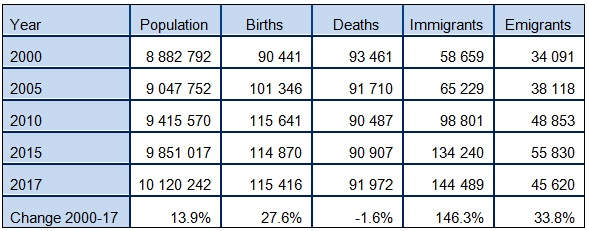
Demographic changes have an impact on VET. Since 2000, the population has increased by more than one million or 13.9% 7 , due to high nativity rates and immigration (see table below).
The high number of immigrants required introduction of measures to integrate them into society. Some of these measures were an increased offer of the Swedish language introduction programme (Språkintroduktion), as well as introduction of study paths leading to partial VET qualification.
Net population change 2000-17
Source: Statistics Sweden.
The country is multicultural and has a high number of immigrants asking for an increase in the offer of Swedish language classes and for VET qualification programmes. The importance of recognising prior learning has also increased. The National Agency for Education launched in March 2018 a skills mapping web-based tool 8 for people who have professional work experience from other countries. The tool assists individuals to become aware of their skills, which can shorten their study time and contribute to improved integration through access to the labour market 9 .
Most companies are small in Sweden. One-person enterprises without any employees dominate with almost one quarter of all enterprises. Only 0.1% of all Swedish enterprises are large, having 250 employees or more 10 .
Sweden has a long and successful industrial tradition and is an export-dependent country that competes in a global market. Manufacturing industry is dominant, with products like machinery, telecommunications, electronics, vehicles, medications, as well as iron, steel and paper products. Another important part of the Swedish export market is knowledge-intensive services such as research and development, ICT-services and intellectual property like patents or licences.
The labour market is considered flexible and only 41 professions are regulated in 2018, mostly in education and medicine.
Total unemployment 11 (2018): 5.0% (6.0% in EU-28); it has increased by 0.9 percentage points since 2008 12 .
Unemployment rate (aged 15-24 and 25-64) by education attainment level in 2008-18

NB: Data based on ISCED 2011; breaks in time series.
ISCED 0-2 = less than primary, primary and lower secondary. Education.
ISCED 3-4 = upper secondary and post-secondary non-tertiary education.
ISCED 5-8 = tertiary education.
Source: Eurostat, lfsa_urgaed [extracted 16.5.2019].
The unemployment rate for graduates aged 25-64 with ISCED level 5-8 qualifications, has been below 5% from 2008-18. Graduates with medium-level qualifications (ISCED levels 3 and 4), including most VET graduates, faced a slightly higher risk of unemployment but also had in 2018 only a risk of 3.6% of being unemployed. However, the unemployment rates of graduates at ISCED level 0-2 was much higher, and reached its peak in 2018 at 16.1%.
A characteristic feature of Swedish working life is that many professions are skills-intensive, requiring constant upskilling and lifelong learning. The unemployment rate is higher among persons born outside of Sweden, than among Swedish-born, and the increase among low-skilled adults is partly due to the large migration flows that peaked in late 2015.
The employment rate of VET graduates aged 20 to 34 increased from 88.0% in 2014 to 92.3% in 2018 and was always higher than the EU average (2014: 76.9% and 2018: 80.5%).
Employment rate of VET graduates (20 to 34 years old, ISCED levels 3 and 4)

NB: Data based on ISCED 2011; breaks in time series.
ISCED 3-4 = upper secondary and post-secondary non-tertiary education.
Source: Eurostat, edat_lfse_24 [extracted 16.5.2019].
The increase in employment of 20-34 year-old VET graduates in 2014-18 (+4.3 pp), was higher compared to the increase in employment of all 20-34 year-old graduates (+2.3 pp) in the same period in Sweden 13 .
Education traditionally has high value in Sweden. In 2018 the share of the population aged 25 to 64 with higher education (43.1%) was higher than in most EU Member States (32.2%). The share of those with upper secondary and post-secondary non-tertiary education (ISCED 3-4) was 42.2%, lower than the EU average of 45.7%. The same applies also to the percentage of those holding an ISCED 0-2 level qualification (14.3%), which was lower than the EU average (21.8%).
Population (aged 25 to 64) by highest education level attained in 2018
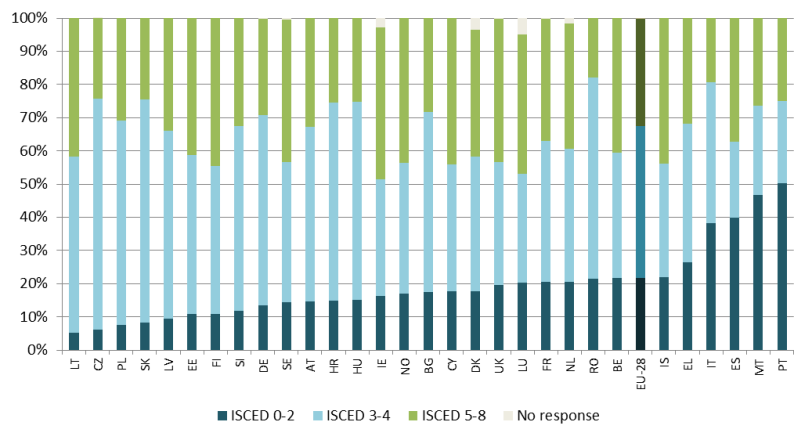
NB: Data based on ISCED 2011. Low reliability for ‘No response’ in Czechia, Iceland, Latvia, and Poland. ISCED 0-2 = less than primary, primary and lower secondary education.
ISCED 3-4 = upper secondary and post-secondary non-tertiary education.
ISCED 5-8 = tertiary education.
Source: Eurostat, lfsa_pgaed [extracted 16.5.2019].
Share of learners in VET by level in 2017
|
lower secondary |
upper secondary |
post-secondary |
|
Not applicable |
34.1% |
71.4% |
Source: Eurostat, educ_uoe_enrs01, educ_uoe_enrs04 and educ_uoe_enrs07 [Extracted 16.5.2019].
Share of initial VET learners from total learners at upper-secondary level (ISCED level 3), 2017

NB: Data based on ISCED 2011.
Source: Eurostat, educ_uoe_enrs04 [extracted 16.5.2019].
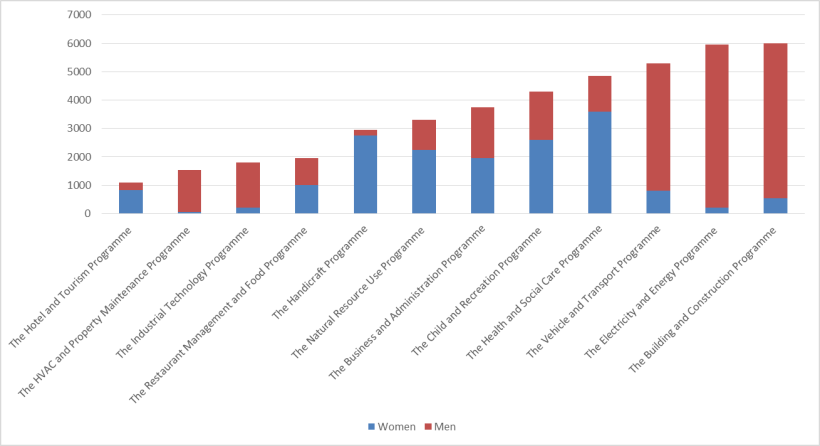
The vocational programmes which most applicants put as their first choice in 2017 were building and construction, electricity and engineering and vehicle and transport. These programmes are highly male-dominated, which means that VET-programmes as a whole had a larger proportion of male than female applicants, 60 and 40 % respectively (see figure below) 14 .
Number of applicants, and gender distribution of VET programmes in 2017
Source: Skolverket (2017). Sökande och antagna till gymnasieskolan läsåret 2017/18.
The percentage of early leavers fell slightly from 2009 to 2018 from 7.0% to 9.3%; this is still above the national target of no more than 7%. However, throughout the years it was always better than the EU average, which decreased from 14.2% in 2009 to 10.6% in 2018.
According to the Education Act 15 the municipalities are responsible for tracking and engaging early school leavers in activities. They mainly target young people under 20 without a completed upper secondary school diploma. Statistical data show that more than 106 000 learners reported by municipalities 2017/18 but that also more than 45 000 learners were deregistered the same year. One third of the deregistered learners had resumed or completed their studies 16 .
Early leavers from education and training in 2009-18

NB: Share of the population aged 18 to 24 with at most lower secondary education and not in further education or training; break in series.
Source: Eurostat, edat_lfse_14 [extracted 16.5.2019] and European Commission: https://ec.europa.eu/info/2018-european-semester-national-reform-programmes-and-stability-convergence-programmes_en [accessed 14.11.2018].
Participation in lifelong learning in 2014-18

NB: Share of adult population aged 25 to 64 participating in education and training.
Source: Eurostat, trng_lfse_01 [extracted 16.5.2019].
Participation in lifelong learning was already at a high level in 2014, at 29.2%, and came back to this level in 2018 after a slight increase in between. It is the highest participation rate in the European Union; the EU-28 average in 2014-18, was close to 11%.
Lifelong learning is provided in many forms. Municipalities offer formal adult education where learners can also acquire an upper secondary vocational diploma. Individual modularised pathways for adults, set up according to specific needs, are the most common way to gain a qualification in a new field or study the courses required to access higher vocational or higher general education. At a non-formal level, folk high schools and private training providers offer various courses for adults. Several active labour market policy programmes (ALMP) for the unemployed are also vocationally oriented or feature different forms of work placement. Courses and programmes are financed through fees or by companies and organisations, with public grants also provided.
The Swedish Government has been implementing a major education initiative for lifelong learning and higher employment since 2015. The initiative involves state-funded training places in vocational adult education programmes at upper secondary level, higher vocational education, education at folk high schools and at universities and colleges. The objective of the initiative is mainly reskilling and upskilling the unemployed and reaching out to adults lacking upper secondary education, or with secondary vocational education needing completion 17 .
Learners in municipal adult education study courses which can be combined in various ways. Therefore, the data for adult VET is not comparable to that of upper secondary school and, due to a lag in official data, the latest analytical report on adult learners’ becoming established on the labour market is based on data for courses in 2011-13 18 .
The data available provide information on the number of learners who have studied vocational courses of more than 800 credits, which corresponds to one year in upper secondary education. Of all learners in municipal adult education that completed their studies in 2013, nearly 16% (9 745 individuals), studied more than one year of VET courses, and nearly 10% studied between six months and one year. In comparison, there were almost 106 000 learners enrolled in one of the three years of upper secondary VET education for the youth.
The education and training system comprises:
• preschool education (ISCED level 0);
• primary and lower secondary education (ISCED levels 1 and 2, EQF level 2);
• upper secondary education (ISCED level 3, EQF level 4);
• post-secondary non-tertiary education (ISCED level 4, EQF levels 5-6);
• higher education (ISCED levels 5, 6, 7 and 8, EQF levels 6-8);
• municipal adult education.
From 2018/19, attending pre-school is mandatory for all children from the year they turn six. Compulsory school begins then at age seven and lasts nine years. VET starts after compulsory education before the age of 20. Learners can choose among one of the 12 vocational programmes (yrkesprogram) or six general preparatory programmes for higher education (högskoleförberedande program) in the upper secondary school (gymnasieskola). A diploma from completed upper secondary education is placed at EQF level 4.
Adults aged 20 and older, without upper secondary education who wish to change career paths can enrol in upper secondary VET courses in municipal adult education institutions (kommunal vuxenutbildning). If an upper secondary education diploma is achieved, the qualification is placed at EQF level 4.
At tertiary level, there are higher vocational education programmes (yrkeshögskoleutbildningar) leading to first or second cycle VET qualifications placed at EQF levels 5 and 6. This applies to education for professions requiring specific knowledge or certification to work in the profession. Many of these programmes are in health care and agriculture as well as in the education sectors 19 .
There are several VET learning options:
Initial VET at upper secondary level leading to EQF 4 is available in the formal education system as:
- school-based learning for the young and adults;
- work practice (practical training at school and in-company practice) is mandatory in VET for the young, and encouraged through state grants in municipal adult VET;
- distance learning, which is available in municipal adult VET-education.
Municipal adult education is flexible and based on the individual's needs as part- or full-time studies. Learners aged 20 or older can enter municipal adult education directly after graduating from upper secondary education, e.g. to study for eligibility to access tertiary education. A learner may also resume studies after being employed. For some, municipal adult education may be a CVET path; for others, it may be a continuation of the upper secondary IVET or GE-programme.
Formal VET is offered at EQF level 4 to 5. Apart from formal education, Sweden has a long tradition of liberal adult education (folkbildning), a type of non-formal learning which is typified by being ‘free and voluntary’, offered outside the school system. Liberal adult education covers education in folk high schools (folkhögskolor) and adult education associations (studieförbund) that are not restricted to state-determined curricula or syllabuses. Each folk high school or adult education association decides on the content and organisation of their own educational offerings. The folk high schools provide shorter and longer special courses. One- to three-year VET programmes are special courses for specific professions, e.g. journalist, recreation leader, treatment assistant, cantor or sign language interpreter. Both shorter and longer courses in crafts as well as art, music and drama are also common. Some vocational education is at post-secondary level and has special admission requirements, while some is at upper secondary level. 20
Apprenticeship is, next to school based education, a possible pathway to studying a vocational programme at upper secondary school, aiming to prepare learners for the labour market. Upper secondary apprenticeship education can start in the first, second or the third year. From the moment apprenticeship education starts, half of it should consist of work-based learning (WBL). An education contract or learning agreement is obligatory for every apprentice; this should specify the content and scope of the WBL. The apprentice, the education organiser and the workplace should sign the contract and a contact person and/or a trainer/supervisor should be appointed. The school is responsible for the establishment of an education contract or learning agreement. In both pathways, the same syllabuses are applicable and successful completion leads to a vocational diploma.
Swedish upper secondary education is organised in 18 three-year national programmes, of which 12 are vocational programmes covering most vocational fields. The programmes are modular and organised in courses where one course is usually 100 credits. All programmes include foundation subjects, for example Swedish, English and mathematics, and programme- specific subjects, for example retailing and vehicle technology. The schools decide if a vocational programme should be provided as apprenticeship education and when the apprenticeship starts. The learner chooses between the pathways offered.
Apprenticeship education as part of formal IVET was only introduced in 2011. The development of apprenticeship education within the frame of the upper secondary school includes a broad spectrum of initiatives such as changes in upper secondary school regulations, financial incentives and support to schools and workplaces. Regulations steering apprenticeship education were introduced in the Education Act and in the Upper Secondary School Ordinance following the reform in 2011. Steering documents in the form of curricula, diploma goals and syllabuses are drawn up by the Swedish government and by the Swedish National Agency for Education.
In 2014, an apprenticeship centre (Lärlingscentrum) 21 was created under the auspices of the Swedish National Agency for Education to promote apprenticeship, provide advice to VET institutions and employers, train supervisors at workplaces, and stimulate cooperation at regional level between schools and businesses 22 .
Unlike VET as a whole, the number of upper secondary VET learners enrolled in an apprenticeship programme 23 has grown steadily since its introduction in 2011, with an average annual increase of over 1 000 learners, from 5 600 in 2013/14 to 12 280 in 2018/19 24 . For the school year 2018/19 this meant that 12.5% of all VET learners followed an apprenticeship programme. Despite the positive trend, apprenticeship participation remains below expectations; there are also significant challenges in relatively low completion rates and high drop-out rates. The government ambition is to increase both participation and apprenticeship quality 25 .
Learn more about apprenticeships in the national context from the European database on apprenticeship schemes from Cedefop: http://www.cedefop.europa.eu/en/publications-and-resources/data-visualisations/apprenticeship-schemes/scheme-fiches
Governance for upper secondary VET
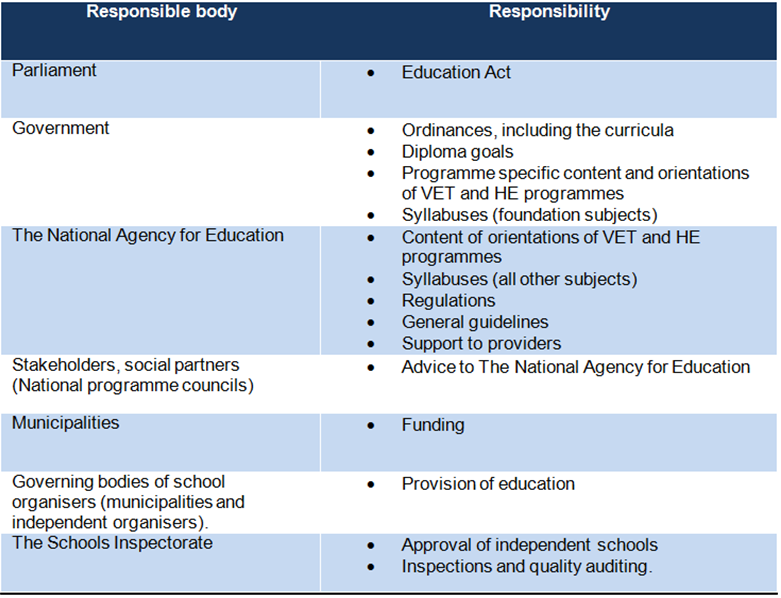
A distinct feature of the Swedish education system is that primary and secondary education is a goal-steered system with a high degree of local responsibility. The Swedish Parliament, the Government and the National Agency for Education draw up the overall national goals in legislation, but the main responsibility of funding lies with the municipalities, and provision is the responsibility of the municipalities and the organisers of independent schools (see table below for a summary of governance and responsibilities).
In addition to the public municipal bodies, private entities may also be approved as organisers and run independent upper secondary schools after approval from the Swedish Schools Inspectorate. Independent schools are regulated by the same legislation and governing documents as municipal schools and may offer both VET and higher education preparatory programmes. School organisers have a primary responsibility for distributing resources and organising activities so that learners attain the national goals.
Summary of governance and distribution of responsibilities in Swedish upper secondary education (including IVET)
Source: Skolverket.
Within the framework of national vocational upper secondary programmes, there is scope for flexibility and local adaptation. The core content, which consists of foundation subjects, programme-specific subjects and orientations, is nationally determined by the Government. The foundation subjects are the same for all VET learners, the programme specific subjects are the same for all learners in one of the programmes, and the courses in orientations are the same for learners in an orientation within a programme.
There are also programme specialisations. The National Agency for Education determines which courses and subjects adhere to the diploma goals of the programmes and makes these available for each programme specialisation. Schools can combine these different courses to create programme specialisations that meet the regional and local needs of the labour market and enable learners to focus their studies on a specific vocational outcome. Formally, the local adaptations in programme specialisations are decided by the organiser’s governing board, i.e. the local government for state schools, and by the school organiser for independent schools.
General programme structure for vocational programmes in upper secondary school

Source: Skolverket.
Governance for higher VET
Employers and industry representatives play a significant role in the planning of a higher VET programme and have an influence on its content. In contrast to upper secondary vocational education, education providers determine the content of the programmes in higher vocational education. The goals and orientation of the education and training programmes are expressed in terms of knowledge, skills and competences which learners are to have attained on completion. Information about the courses included and assessment criteria must also be given. In their applications, education providers also include information about the companies or organisations which have actively participated in developing and planning the programme. The Swedish Agency for Higher Vocational Education independently determines, following an application procedure, the programmes to be included as higher vocational education.
One important element in higher vocational education is learners' involvement in, and their opportunities to influence, the structure and delivery of the education. Each programme must have a plan to ensure that this is achieved. Teaching and teaching materials are determined by the governing group of the education provider, which is also responsible for carrying out systematic quality monitoring. The Agency of Higher VET also supervises the programmes through inspections and quality auditing.
Employers and industry contribute to and influence programme content by participating as lecturers, joining in projects, hosting study visits and offering work placements. Higher vocational education must also contribute to developing learner competences in entrepreneurship. Higher vocational education may also be run in the form of distance courses 26 .
Funding of upper secondary VET
Municipalities in Sweden are responsible for providing primary and secondary education to their residents, but residents are free to choose an education provider. Municipal and central government tax revenues provide the funding for primary and secondary education; they are equally entirely financed by public funds. The major part of school funding comes from municipal tax revenues, but parts also come from central government state grants to municipalities. Almost SEK 43 billion (EUR 4.2 billion) 27 was spent on upper secondary education in 2017. Almost 70% of the funding is provided by the municipal tax revenues 28 .
Since access to education should be equal regardless of where in Sweden one lives, several state grants and other equity measures are available to ensure that all residents have access to education of the same quality.
All municipalities are guaranteed equivalent financial conditions in accordance with a special equalisation system. The general central government grant is, therefore, based on a number of different parameters such as population, population structure, social structure and the number of immigrants. Each municipality determines how it will allocate resources as this general central government grant is not earmarked and is supplemented by targeted central government grants for specific initiatives, such as apprenticeship education, adult vocational education and projects to develop the quality of work-based learning.
There are considerable differences in calculated cost between the different programmes, with vocational programmes being both the most diverse and also on the more costly end of the spectrum. The National Agency for Education has developed a system of calculating how much a learner should cost on average for a particular programme (riksprislistan). For some programmes there are differences in cost between orientations. This system is used by municipalities when financing education through the voucher system in independent schools. The most costly VET programme generates a voucher of more than twice as much as the least costly (see figure below).
Regardless of the governing body, both upper secondary school and municipal adult education at upper secondary level are free of charge for the learner. In adult education, however, learners must pay for their teaching materials themselves.
Average voucher cost per upper secondary VET programme per year as determined by the National Agency for Education, 2018

Source: National Agency for Education - Average cost per upper secondary VET programme. ( https://www.skolverket.se/skolutveckling/statistik/om-skolverkets-statistik/riksprislistan)
NB: EUR 1 was equivalent to SEK 10.33 on August 7, 2018.
Funding and state grants to adult municipal VET education
Municipalities are responsible for adult upper secondary education, but usually outsource to providers, public or private, in the education market. The Swedish Government has a goal to lower unemployment rates and provides a large share of the municipal funding for adult education through state grants. One part of the governmental strategy is to invest in vocational education and apprentice education for adults in order to counter a shortage of skilled labour, while giving people the opportunity to retrain for a new profession. The strategy also aims to reach groups who have not completed upper secondary education or who have vocational upper secondary education that needs to be supplemented.
On January 1, 2017 state grants for regional training of adults came in force 29 . Regional vocational adult education (regionalt yrkesvux) aims to strengthen regional cooperation to meet labour market needs better. The regulation contains provisions on government grants for such training at secondary level in municipal adult education, if it is carried out in cooperation between a number of municipalities and employers and can include combined studies in Swedish as a second language and VET. SEK 5.5 billion 30 (corresponding to EUR 532 million) was spent by the municipalities on adult education in 2017. The total state grant to municipal adult VET for 2018 is SEK 1.989 billion (corresponding to EUR 192.5 million) for 37 800 full-time learners 31 .
Funding of higher VET
Higher vocational education programmes may be organised by state higher education institutions, municipalities, county councils and individuals or legal entities. These programmes are partially financed through public funding and are free of charge for the learner, with an exception for minor costs for a particular reason like a study visit and for teaching materials. Learners who attend publicly-funded programmes are eligible for student aid.
The Swedish National Agency for Higher Vocational Education (Myndigheten för yrkeshögskolan) approves and allocates state grants in response to applications from education providers. In 2018, almost SEK 2 billion (corresponding to EUR 194 million) of state grants was used for higher vocational education 32 . A programme that has been approved may be offered a limited number of times as determined by the agency. Then a new application must be made to the agency to ensure that the competences provided by the programme meet the needs of the labour market.
Funding of liberal (non-formal) adult education
Today there are approximately 150 folk high schools (folkhögskolor) in Sweden. The majority of these are run by non-governmental organisations, non-commercial organisations, foundations or associations, and trade unions but county councils and regions can also be their governing bodies. The 10 largest adult education associations are also run by non-governmental organisations, associations and other organisations. Study circles and other activities are often provided by local or regional associations.
Liberal adult education is largely financed through support from the state, regions and municipalities. State support makes up around 70% of the grants to adult education associations and to folk high schools. Conditions for state grants to folk high schools and adult education associations are regulated in the State Grants for Adult Education Ordinance 33 . The Swedish National Council of Adult Education (Folkbildningsrådet), a non-profit association, has been tasked by the Government to distribute grants, and also to follow up and evaluate activities. Tuition in folk high schools is free of charge and, in certain cases, gives the right to student aid. However, participants are required to pay for course literature, study material, lunch and any eventual residential costs. Study circles and other activities run by adult education associations are subject to fees and do not qualify for student aid 34 .
In 2015, there were two categories of teacher and trainer in VET programmes:
- vocational teachers;
- general subject teachers.
In addition, there were trainers (practical training instructors at the workplaces supporting and monitoring students’ learning) deemed suitable for the task by the employer but without any formal qualification.
The Education Act of 2010 defines the educational requirements for being a teacher. Teachers of upper secondary education need to have a tertiary teaching degree. Teachers of vocational programmes need to have a vocational qualification at least at SeQF level 5, one SeQF level above the level s/he will teach (upper secondary VET programmes lead to SeQF level 4). The qualification is a vocational basic diploma awarded after 90 ECTS credits, out of which 30 ECTS credits comes from teacher induction.
In autumn 2011, four different programmes in teacher education were set up, one of which was designed specifically for vocational education teachers. Vocational teacher education included a core of education methodology, particularly general teaching knowledge and skills, as well as induction. Teachers of general subjects in VET programmes had to meet the same requirements as teachers in higher education preparatory programmes. According to the Education Act, teachers have to go through a certification process carried out by the National Agency for Education.
Entry requirements for vocational teacher training are graduation from upper secondary school and mastery of the relevant vocation. The Swedish Council for Higher Education (Universitets- och Högskolerådet, UHR) has specified, through an ordinance, entry requirements for each vocational subject for vocational teacher training. The ordinance states that specialised knowledge, obtained by experience and theory in the field, is required.
Due to the lack of qualified teachers, non-qualified, non-certified teachers can be also temporarily employed for a maximum of one year. The duration of their employment is restricted, to allow formally qualified teachers to take over this position. The legislation states that non-certified teachers have to be supervised by a certified teacher to assess and grade learners 35 .
The Education Act of 2010 states the educational requirements for being a teacher in the Swedish school system and that continuous professional development (CPD) is the responsibility of the head teacher and school founder. The legislation does not, however, give any specific information on how CPD should be carried out; this is regulated by the agreements of the labour market’s social partners.
CPD for teachers is regulated by agreements between the social partners. A supplement to the general labour standards regulated in an agreement between the Swedish Association of Local Authorities and Regions (SALAR), the employers’ organisation for municipalities and local governments, and the employee organisations, regulates the conditions that apply to teachers. The supplement defines the time allocation during the academic school year for teachers employed by municipalities. Some independent, private actor governing boards of VET schools use the same agreements as publicly-organised schools; other independent governing boards do not.
The agreement sets teachers’ total worktime, and the regulated time that the employer controls, over one year. CPD is part of the regulated time and, as such, the time that the employer should allocate and plan for. The time allocated for CPD is on average 104 hours, or nearly 6% of the total worktime for teachers in one year. Many adult education teachers are employed according to the same annual framework but with a different time allocation, as adult education does not follow an academic year with school holidays and summer recess. The agreement states that the time spent for teacher CPD should be distributed for teachers to develop good conditions for students’ learning. It is at the discretion of the head teacher to distribute the CPD time and resources to optimise the learning outcomes locally. The allocation of CPD time, resources and focus areas is often negotiated with the employees. The provision for CPD is decentralised, meaning that each founder and school is responsible for CPD within the framework defined by the legislation and the labour agreements. As a consequence of the decentralised system, there is no systematically collected nationwide data on CPD for teachers in general or for vocational teachers in particular 36 .
More information is available in the Cedefop ReferNet thematic perspective on teachers and trainers 37 .
State agencies, like Statistics Sweden (SCB) and the public employment services, PES (Arbetsförmedlingen) monitor the Swedish labour market and publish their analyses regularly. The public employment service also offers Yrkeskompassen 38 , a search engine for predicting future employment prospects for various professions and a list 39 of professions in demand in the various regions of Sweden.
However, skill needs and the provision of VET are not interlinked in Sweden. The provision of VET (and other upper secondary) programmes in upper secondary school 40 is largely determined by the preferences of the learners, who choose their education. Since providers operate in a competitive market they adjust supply according to the learners’ demands. Ideally there would be a balance between the demand for education, the need for competence among the different business sectors on the one hand, and the supply, the provision of educated and skilled workers on the other. There appears to be a gap between demand and supply: there is a shortage of competence in some sectors and too many people educated in upper secondary school in fields in which there is no shortage. Guidance, information and similar incentives are the ‘soft’ means by which learners can be attracted and steered to specific vocational education programmes.
There are also structural challenges in the Swedish VET system when it comes to the municipalities’ potential to offer a broad supply of programmes and specialisations at upper secondary level. Municipalities are sometimes too small entities to be able to offer a wide range of different upper secondary programmes and orientations.
Municipalities can cooperate in confederations to coordinate the supply of upper secondary programmes, but challenges remain in this field, particularly in IVET, due to decreasing interest in VET paired with high costs for organising some VET programmes. Therefore, a commission of enquiry 41 has been appointed to develop a regionally-based model for financing and steering of education at upper secondary level (including municipal adult education). The commission will present its proposal to the Government in February 2020 42 .
For further information please see also the national country reports on skills anticipation 43 .
See also Cedefop’s skills forecast 44 and European Skills Index 45
Government design of the IVET structure
Since few professions are regulated in Sweden, most qualifications are determined by stakeholders and social partners. The Parliament, the Government and State agencies are responsible for education and have set up a structure for education provision to meet the needs of the individual, society and the labour market.
Consultation rounds and open consultation through meetings and websites are examples of methods used to collect views and proposals. If a revision is seen as necessary, the National Agency for Education 46 organises an extensive review to inform the relevant parties of the decision on a new subject or course. Focus groups of teachers and learners are consulted; the work in progress is published on the agency’s website for teachers and stakeholders to express their opinions; proposals are written and quality assured in the agency to ensure that the curricula align with the legislation. Before the National Agency decides on a new subject or course, other national agencies, interest groups, social partners and stakeholders (including school organisers) receive a copy of the proposed changes and have a chance to comment. If a large section of the consultees or a single influential group is opposed to the proposal, the National Agency for Education may decide not to proceed or to revise the proposal. The same process is used for core and foundation courses which are decided by the Government. In these instances, the National Agency for Education acts on behalf of the Government and makes proposals to the Government after following the same review process.
When the quality assurance of the design, assessment, certification and review of the process is thorough and transparent, it is more likely that the final proposals will be accepted. If everyone concerned has a chance to express their opinions, the proposed education standards expressed in the documents are more likely to be adjusted to suit the needs of social partners and stakeholders and to be of a higher quality.
So, for example, in 2015 a government commission of enquiry 47 (Gymnasieutredningen) was launched, which included the aims of studying how VET programmes can provide eligibility for tertiary education and analysing if it would be necessary to adjust the upper secondary programmes and orientations. Proposals from the enquiries are presented to the Government and frequently guide the Government in upcoming objectives for the education agencies aiming to develop curricula, syllabuses or to make amendments to the education structure. The drawing up of governing documents takes place for the most part at the National Agency for Education in close collaboration with different actors and stakeholder groups.
Learning outcomes
Learning outcomes 48 in upper secondary education are expressed in the curricula, diploma goals and subject syllabuses which describe the aim and long-term goals of the subject, the core content, and assessment criteria in the knowledge requirements for each of the courses. Learning outcomes in Swedish upper secondary education are expressed as the learners’ ’ability to’, ’knowledge about’, ’understanding of’ and ’skills in’. Knowledge requirements relate to these outcomes and are expressed using active verbs.
Gap between diplomas and expected qualifications in upper secondary VET
Within the structural framework it is foreseen that all VET programmes should cover 2 500 credits and last three years. Typically, 1 600 credits are allocated to VET-subjects, whereas the remaining credits are allocated to foundation subjects (Swedish, English, maths, physical health, natural science, and social science), diploma project and to individual options. There are, however, some industries that argue that there is too little vocational training in upper secondary education to reach a qualification needed in their sector. For traditional handicrafts like hairdressers, for example, graduates must work as employees for 3 000 hours before being able to take the exam leading to a journeyman certificate. Therefore, the vocational outcome of the hairdresser orientation of the handicrafts programme only leads to the informal title 'aspiring hairdresser.' Final examinations are performed by the hairdressers’ association but the qualification is still placed at the SeQF level 4 (EQF level 4) based on the level of acquired knowledge, skills, and competences 49 .
Designing education in dialogue with stakeholders in upper secondary VET
In structured consultation, the National Agency for Education meets with schools and stakeholders to ensure that subjects and courses can be used to build qualifications which meet the needs of working life. For each vocational programme there is a national programme council with a broad cross-section of industry representatives and social partners in the vocational area for which the programme provides education and training. Some programme councils include representatives from public authorities like the Swedish public employment service (PES). One of the tasks of each programme council is to advise and support the National Agency for Education in relation to the adaptation, development and modernisation of the supply of education and the content of vocational education. This helps to ensure that the competences required by the labour market are met. The programme councils fulfil a consultative function and can suggest revisions but are not decision-making bodies.
At local level, there must be one or several local programme councils (lokala programråd) for cooperation between school and working life; they cover all vocational programmes in every upper secondary school. How these councils are organised and what their tasks are is not regulated. Possible tasks could be assisting the provider in arranging placements of work-based learning, and participating in organising and assessing diploma projects. A local programme council may also advise the school about skills needed locally and which courses the school could use in programme specialisations to meet the local needs.
Other forms of cooperation with stakeholders
There are many initiatives for cooperation at the regional level between school and working life, unregulated by the State. For example, actors on the labour market have initiated Teknikcollege 50 (Technical College) and Vård- och omsorgscollege (Health and Medical Care College), a form of cooperation within the framework of upper secondary and tertiary education. Behind the Teknikcollege is the Industrial Council (Industrirådet) and different employer and employee organisations in the technology and industrial sectors. The Teknikcollege wishes to be a long-term competence provider that also works actively to promote quality in VET at upper and post-secondary levels. The Swedish Association of Local Authorities and Regions, (SKL) together with a trade union, the Swedish Municipal Workers' Union (Kommunal) and the Association of Private Care Providers (Vårdföretagarna), started a similar initiative in a college for health and medical care, with a focus on ensuring the supply of skilled workers and further training for existing staff, as well as increasing quality in work-based learning for young people and adults.
Partial qualifications in VET
In October 2016 the Government commissioned the National Agency for Education to recommend vocational training 'packages' for adults. These 'packages' are clusters of courses agreed with the industry as entry points into the labour market. They will not only consist of partial qualifications, but will also include building blocks that may be transferred and accumulated towards a full qualification. In April 2017 the objective was amended to include the introduction programmes aimed at young, mostly recently arrived immigrants, who are not eligible for admission to an upper secondary VET programme. Fifty-eight packages covering a wide range of vocational areas had been developed by February 2018 but more are being continuously developed.
Designing qualifications in higher VET
In accordance with legislation and within the restrictions of funding allocations for higher vocational education programmes (yrkeshögskoleutbildningar) the Swedish National Agency for Higher Vocational Education (Myndigheten för yrkeshögskolan) independently determines, following an application procedure, the programmes to be included as higher vocational education. In contrast to upper secondary vocational education, it is the education providers who design the programmes in higher vocational education.
Programmes in higher vocational education must correspond to the needs of the labour market. For this reason, the Swedish National Agency for Higher Vocational Education analyses and collects information about the skills in short supply in different industries and regions. The information is then used, together with the VET provider’s application, as a basis for assessing the programmes that are to be available in higher vocational education. External stakeholders such as employers and industry organisations, as well as central and regional authorities, also play an important contributory role in supplying information to the assessment and decision-making processes. The qualification demands imposed by employers and industries thus determine the programmes to be approved, where in Sweden they are offered, and how many study places are allocated to each programme.
The Labour Market Council (arbetsmarknadsråd) is a special body linked to the Swedish National Agency for Higher Vocational Education. The task of the council is to support the agency with information about the labour market: the vocational areas under development, the new qualifications that may be required, and the qualifications that need to be phased out. The members of the council, which is chaired by the head of the agency, are representatives of the public employment service and the social partners. The council members also function as a channel to their respective organisations in terms of synchronising the analyses.
For education and training programmes that require nationally equivalent content, the Swedish National Agency for Higher Vocational Education issues regulations on what knowledge, skills and competences all learners must have attained on completion.
Designing qualifications outside the formal education system
The Swedish National Agency for Higher Vocational Education (Myndigheten för Yrkeshögskolan) has been appointed by the Swedish Government as the national coordination point for the Swedish national qualifications framework, the SeQF. All government regulated education is referred to the SeQF in an ordinance 51 , but qualification awarding bodies outside the formal education system may apply to the agency to refer their qualification to the SeQF. A precondition is that the awarding body conducts systematic quality assurance of the qualification. A group of experts reviews the application and serves as an advisory body to the Director General who determines the SeQF-level of the qualification. These decisions are valid for ten years 52 .
The extent to which the state governs the goals and contents of formal VET varies between different education forms. The following table shows the various responsibilities of agencies and governing bodies for controlling VET provision and assuring its quality.
Responsibility of goals, contents, diplomas and quality assurance in VET

Quality assurance for upper secondary VET
All school organiser governing bodies in Sweden are required by law to have a systematic quality assurance process in place. Quality assurance arrangements are not regulated in detail but it is common for schools to use indicators such as average grades, participation rates, completion rates and placement rates in their analysis. Most organisers also survey their learners' opinions on the education, facilities and their well-being.
Responsibility for supervision and quality auditing of both upper secondary school and municipal adult education rests with the Swedish Schools Inspectorate (Skolinspektionen). Regular supervision of schools is carried out on the basis of a number of assessment areas and points; quality auditing follows up a specific area. Vocational education, and especially apprenticeship education, is very much in focus within both regular supervision and quality auditing. Structured cooperation between education providers and the workplace has been shown to be an important factor for success in work-based learning.
Even though the education providers are responsible for carrying out systematic quality assessment, the Government supports and stimulates the development of quality in VET via different initiatives and specific funding schemes. This may include specific tasks delegated to the Swedish National Agency, e.g. to develop guidelines for work-based learning. Also, the Government has decided on an extensive funding scheme consisting of grants to schools wishing to develop the quality of work-based learning.
Quality assurance for tertiary VET
Programmes in higher vocational education are supervised by the Swedish National Agency for Higher Vocational Education (Myndigheten för yrkeshögskolan) through inspections and quality auditing. Programmes are checked for compliance with existing legislation and other provisions. The agency performs three different types of inspection: introductory, regular and ad-hoc inspections following up particular issues or problems.
Introductory inspection is carried out for new programmes that start or have just started. The aim of such inspections is to determine whether there are the preconditions in place to deliver new, good quality programmes. Ad hoc inspections are carried out if there are complaints from a learner about the education programme itself or the education provider. The ad hoc inspections only examine the complaint area.
Quality assurance for qualifications outside the formal education system
Bodies outside the formal education system that have their qualifications placed in the national qualifications framework must apply systematic quality assurance processes in their education programmes. Their quality assurance process must be described in their application according to the EQAVET system 53 .
Validation in municipal adult education at upper secondary level is possible within all courses and must be based on the learner's circumstances and needs. The validation is mainly used to allow customising the content of the studies according to learner’s needs and shorten education duration, or to assess knowledge and skills that are required for eligibility for a particular education. The learner receives a certificate through validation, instead of a grade or diploma.
If the learner wishes to obtain a formal grade, he or she must pass an extended test covering all the content of the particular course. A 16 to 20 year-old learner in upper secondary education may also validate his or her knowledge and skills through an extended test. The purpose of this test, however, is not to individualise the learning to progress more rapidly through the education programme; it lets the learner have a second chance, if he or she has received a failing grade, or cover courses not previously studied if the learner changes programme or orientation. Documented knowledge and skills achieved by studies abroad, or through other means, may be credited to the learner at a pass level without the extended tests 54 .
Incentives for VET learners
Individuals with different backgrounds and in different life situations are given the possibility to study, thanks to a system of study allowances and student aid. Students have the right to different forms of financial support for both upper secondary and tertiary studies. Also, employees have the right to take leave of absence to attend education.
Swedish study support gives everyone the opportunity to study, irrespective of their financial background. The form and the size of the support vary depending on age and life situation and also on the scope and level of studies. The Swedish Board for Study Support (Centrala Studiestödsnämnden, CSN) is responsible for and administers most of the learner support. The education programmes entitled to support are determined by the Swedish Government through the Study Support Ordinance 55 . Special investments in higher levels of grant are used as an incentive for further studies. This applies, for instance, to the initiative for higher grants to learners in vocational education, where one aim is to encourage more unemployed people over the age of 25 to apply for vocational education.
The support is part of education policy and aims to increase social justice. It grants equal access to education for both men and women, and levels out differences between individuals and groups in the population. In 2018 more than 475 000 individuals aged 20 and above received financial support. Of these, almost 60% were women and 23% received support for studies at upper secondary level. Of all adults studying at post-secondary level and receiving support, 12% were studying in a HVET programme 56 .
Studiestöd is the umbrella term for all study aid in the Swedish education system which includes grants and loans for different age groups. In 2018, the total support handed out was SEK 34.3 billion (EUR 3.3 billion) and the total debt the Swedish population has to the government is SEK 224.6 billion (EUR 21.74 billion). A total of 1 557 410 persons (almost 15% of the population) have studiestöd which include loans from the State, as reported in the reference above.
Study allowance for learners under the age of 20
Study allowance (studiehjälp) in the form of grants, supplementary allowance and boarding supplement can be paid to learners under the age of 20 who are studying in upper secondary school, municipal adult education or folk high schools. Under certain circumstances the grant can also be awarded for studies abroad. One prerequisite for receiving this grant is that the learner studies full-time and participates in the relevant courses. This means, for example, that a learner who is frequently absent runs the risk of losing the support and may be liable for repayment. The school has an obligation to report to the Swedish Board for Study Support when a learner is absent without a valid reason.
Learners who wish to live and study in a place other than their home municipality may apply for a boarding supplement from the Swedish Board for Study Support or from the municipality. This applies in cases where the specific education is not provided by the home municipality, or where the education programme is open to national admission. The grant makes it possible for learners to participate in specialist vocational education that is provided at only a few places in the country. In 2014 a supplement was introduced for learners attending apprenticeship education (lärlingsutbildning) in upper secondary school. The supplement is designed to cover extra living costs, for example travel to the workplace and lunch.
As of July 2014, learners attending apprenticeship education in upper secondary school may be employed in what is called an upper secondary apprentice position (Gymnasial lärlingsanställning, GLA). As a result, upper secondary apprentices can be offered employment while still in education, in accordance with adapted labour law provisions. An apprentice employed in such a position is remunerated by the employer and not entitled to the supplement.
Student aid for learners aged 20 and above
Student aid (studiemedel) can be granted to learners in post-secondary education, such as higher vocational education, supplementary education, and vocational education in folk high schools. Learners studying at upper secondary level who have reached the age of 20 are also entitled to student aid. They can apply for grants and loans and also for certain supplementary allowances. Parents of minors, for example, can receive a supplementary allowance. To be eligible for further funding learners must demonstrate satisfactory results in previous studies. The contribution for full-time learners is at most SEK 723 (EUR 69.25 as of April 10, 2019) per week and the loan at most SEK 2 720 (EUR 260.50 as of April 10, 2019) per week. The loan has a low interest rate (at 0.16 percent in 2019).
Despite the generous study support system there is still a part of the population refraining from education due to economic reasons. The Government has therefore introduced a new study allowance, the education entry grant 57 , that the municipalities have been able to distribute since mid-2017. The education entry grant is designed to recruit unemployed people, aged 25-56, with short previous education who need education at the primary or upper-secondary level to strengthen their ability to establish themselves on the labour market.
Current initiatives of State-funded adult education and training
The Swedish Government has been implementing a major education initiative for lifelong learning and higher employment since 2015. The initiative involves state-funded training places in vocational adult education programmes at upper secondary level, higher vocational education, education at folk high schools as well as at universities and colleges. The objective of the initiative is mainly reskilling and upskilling unemployed people; it also reaches out to adults lacking upper secondary education, or having secondary vocational education needing to be completed. Expanding the number of training places also provides adults with a general education increased opportunity to enrol in vocational education and training (VET). A substantial part of the initiative has been targeted towards upper secondary VET and apprenticeships for adults.
VET has traditionally been organised by each municipality. To stimulate development towards a broad supply of education and training corresponding to the needs in the different regions, the Government altered the conditions and introduced a new state grant in 2017, replacing previous state grants targeting vocational training and apprenticeships. The current state grant requires cooperation between at least three municipalities on the planning and supply of education and training at the regional level. The needs of the labour market should be met and planning should therefore be done in consultation with the public employment services and with different actors responsible for regional development.
Since 2009, Sweden's municipalities have had the opportunity to apply for state subsidies for an expanded implementation of VET for adults. In January 2016, the number of available places was expanded for the target group in need of vocational training, combined with studies in Swedish for immigrants or Swedish as a second language.
As of January 2017, constellations of three municipalities or more have been able to apply for state subsidies for adult VET to cover a broader range of potential learners. These subsidies can be combined with courses in Swedish for immigrants or Swedish as a second language at compulsory school level. The aim is to provide newly arrived adults with the opportunity to enrol in vocational education, thereby contributing to improved integration through access to the labour market.
Financial support for migrants in VET
For the past few years, employer and employee organisations in several sectors have signed work introduction agreements (yrkesintroduktionsanställningar). These aim at facilitating young (age 15-24) people’s transition from school to working life and safeguarding the long-term skills supply for companies. Most of these agreements are based on the principle that young people lacking professional experience are offered coaching and training during part of their working time. Normally the young person will hold a full-time position but the salary will amount to 75% of a full-time job, as part of the time will consist of vocational training. The training content has to be clearly defined and have a supervising trainer appointed by the enterprise. Interest in such positions has increased slowly since the introduction of financial incentives at the beginning of 2014. From 1 June 2016 the introduction agreements are also open to the long-term unemployed and newly arrived immigrants who are older than 25 58 .
A minimum wage, according to the collective agreement between the social partners of the employment sector, is paid by the employer to the employee 59 .
State grants are predominately given to the governing board of education providers, even though the grants are intended to finance support activities in the enterprises. Some state grants, however, are directed to enterprises; examples are the regional funds available to stakeholder organisations to support quality improvement in WBL, or for measures intended to promote an interest in becoming a VET teacher 60 .
For employers who are offering work places in the scope of introduction agreements, the public employment services pays employment taxes of 31.42% as well as a compensation of SEK 115 (EUR 11 as of April 10, 2019) per day for the trainer in the workplace 61 .
Decreasing interest in upper secondary vocational programmes has led to an increased focus on, and investment in, information activities and study and career guidance. Ongoing changes in Swedish VET create the need for information and guidance to provide everyone with an overall view of the available study paths and what they can lead to. Increasing the attractiveness and quality of VET is an important priority for the Swedish Government.
Information and guidance about study and career paths in Sweden is integrated into different activities. The curriculum 62 for upper secondary education states that the head teacher is responsible for ensuring that ‘study and guidance counselling is organised in such a way that learners receive information and guidance prior to making study choices in the school, and before choosing their future education paths and professions’; one of the explicit goals of the curriculum is that all learners ‘are familiar with the conditions of working life, especially within their study area, as well as the opportunities for further education, work placement and work in Sweden and other countries.’ The curriculum for compulsory school mirrors the curriculum in upper secondary school regarding study and guidance counselling; new legislation to provide practical vocational orientation (Praktisk yrkesorientering, PRAO) in compulsory school came into effect in 2018 63 . The vocational orientation is compulsory and requires that learners in years 8 and 9 spend a minimum of 10 days in a workplace or, if the school cannot provide sufficient work-placements, in a vocational programme in upper secondary school.
The governing body or education provider has the main responsibility for guiding and recruiting learners for VET. General information on study and career paths, and on the labour market for different professions, is supplied by national authorities and industry organisations. Both the National Agency for Education and the Swedish National Agency for Higher Vocational Education are tasked to inform and disseminate knowledge about their respective areas. The National Agency for Education also functions as a national reference point for information on VET in Sweden and other EU countries, as well as countries in the EEA area.
Many national websites provide information and guidance for young people and adults. The portal Utbildningsinfo.se 64 includes search tools for education paths and providers. The site contains information about possible vocational outcomes, the situation on the labour market in the field, and funding and information on other important considerations when choosing a study path.
Information provided by the Swedish Public Employment Service focuses on finding jobs in different professions. The portal Yrkeskompassen (The Occupational compass) 65 shows the labour market situation and future prospects for about 200 professions and contains information about national forecasts for one, five and 10-year periods. One-year forecasts are also available at regional level. The Occupational compass also provides descriptions of different professions and possible education paths.
The Swedish National Council of Adult Education (Folkbildningsrådet) is responsible for the information services of the Swedish folk high schools (Folkhögskolornas informationstjänst), whose tasks include contributing to the recruitment of course participants. The portal Folkhögskola.nu 66 provides general information on vocational education and other courses given by folk high schools.
Vocational boards (yrkesnämnder) and other industry organisations supply information about professions and career paths through different means, and also about formal and non-formal education in their fields 67 . This may cover websites, participation in industry specific trade fairs or inspiration days.
All these activities and web portals must also function to support study and vocational guidance counsellors in their work. Euroguidance Sweden is a national resource centre for counselling, which supports counsellors in their role of providing information about opportunities for studying and work placement abroad.
The municipalities are responsible for ensuring that young people and adults are offered education at upper secondary level. Before learners choose upper secondary school, many municipalities and regions take part in upper secondary fairs and open houses where schools and programmes are presented. Information meetings and guidance counselling are offered to those who wish to study in municipal adult education at upper secondary level. Education providers frequently market their education and courses via advertisements, web sites and direct marketing.
The Swedish National Agency for Education has developed the following web-based tools as a service to learners, teachers, guidance counsellors and other stakeholders in upper secondary education. The web-based system was launched on March 1, 2018. The Skills mapping tool can be used to assist learners and other stakeholders in planning an upper secondary education diploma within the framework of municipal adult education. The target group is people who have experience in professional work, or equivalent experiences, and need to have their vocational skills and competences validated. The tool is specifically adapted to newly arrived individuals and aims to assist in making more individuals aware of their skills; this, in turn, can shorten their study time and contribute to improved integration through access to the labour market. The Skills mapping tool is useful both in adult education and in upper secondary school, and for young new arrivals with work experience; it can also contribute to improved transitions between upper secondary school and municipal adult education.
Guidance counselling is also an important task of the public employment service (Arbetsförmedlingen) aimed at improving matching between job seekers and working life. In addition to the Occupational compass, job seekers are offered study and vocational guidance through brief telephone coaching sessions, or personal meetings with a counsellor at drop-in sessions. The public employment service is also responsible for what are called preparatory activities (förberedande insatser) aimed at aiding job seekers’ choice of work. The initiatives are tailored to the individuals and may be of a counselling, rehabilitation or orientation nature. They are intended for job seekers who need to prepare themselves for a labour market policy programme or a job.
The Higher Vocational Education Ordinance (Förordningen om yrkeshögskolan) lays down the responsibility of the governing bodies of education providers for ensuring that there is guidance and counselling concerning alternative study paths, admissions and entry, as well as vocational guidance. In their application to deliver education within the framework of higher vocational education, education providers must describe how this counselling will be provided. Student fairs, where information on higher vocational education providers, universities and university colleges is presented, are held regionally and in cooperation with education providers and the social partners. There are also industry-specific trade fairs, where education at both upper secondary and tertiary level is presented.
General information about higher vocational education is available through the web site of the Swedish National Agency for Higher Vocational Education 68 . The agency also provides a web site intended for potential learners 69 . Besides general information about higher vocational education, this web site contains information about current higher vocational education programmes and links to various education provider web sites. Information about higher education studies is made available through the portal studera.nu 70 .
Study and career guidance is readily available for learners at all levels of the education system. There is, however, a challenge to reach those individuals who do not actively participate in education. Outreach and guidance measures to youths and young adults who are not in employment, education or training is further discussed in the ReferNet national report on guidance and outreach for the inactive and unemployed 71 72 .
Please see also :
- Cedefop’s labour market intelligence toolkit 73 ;
- Cedefop’s inventory of lifelong guidance systems and practices A1 .
Vocational education and training system chart
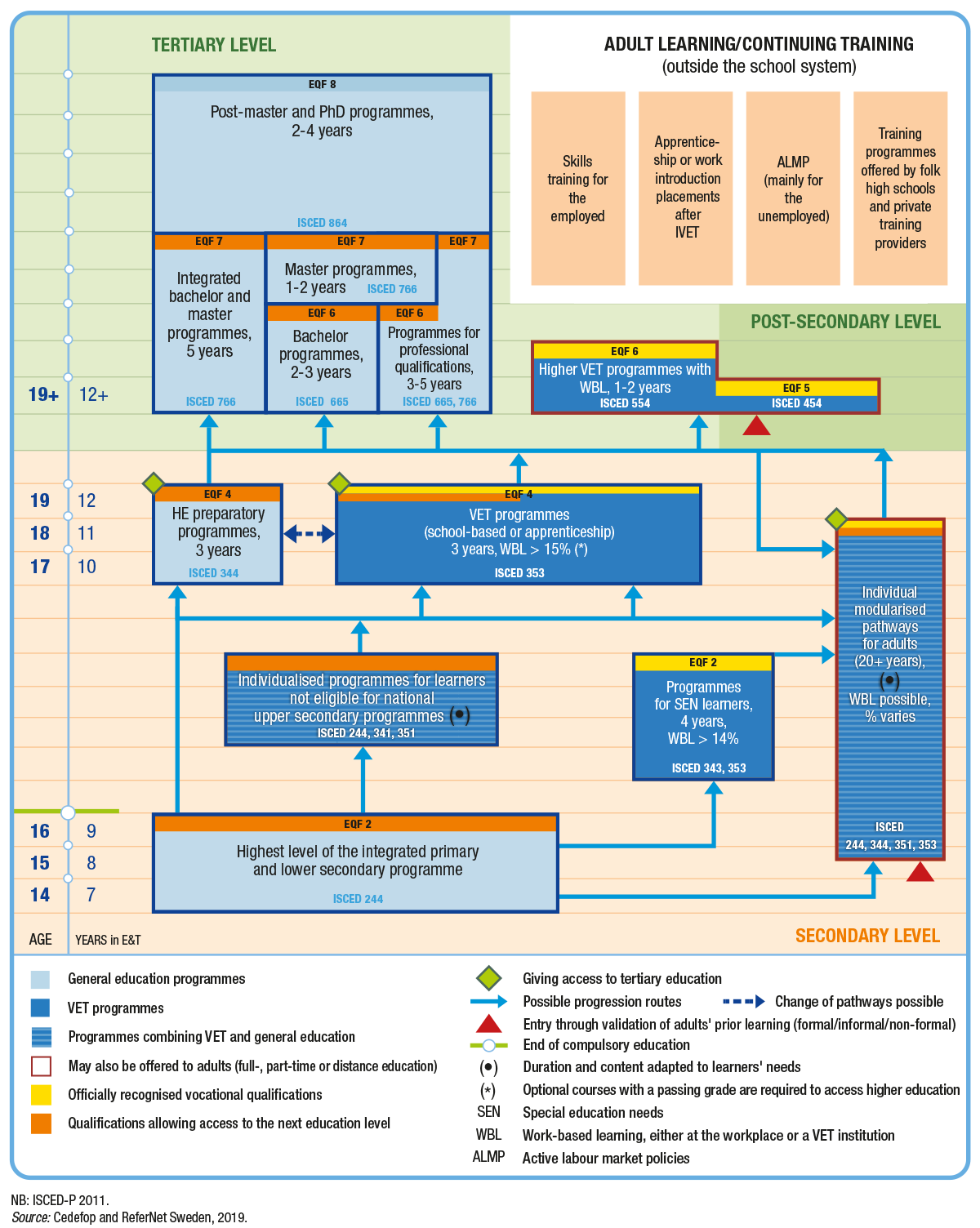
Programme Types
| ECVET or other credits | The introduction programmes are intended to make learners eligible to apply for a national programme at upper secondary level or prepared for a vocation. As such the education is not credit-based. Courses from upper secondary education can, however, be included and these courses will generate credits in accordance with upper secondary education. |
|---|---|
| Learning forms (e.g. dual, part-time, distance) |
|
| Main providers | In addition to the public municipal bodies, private entities may also be approved as VET providers and organise and run independent upper secondary schools after approval from the Swedish Schools Inspectorate. Independent schools are regulated by the same legislation and governing documents as municipal schools. |
| Share of work-based learning provided by schools and companies | WBL is possible, but not mandatory. |
| Work-based learning type (workshops at schools, in-company training / apprenticeships) | In-company practice. |
| Main target groups | Learners who are not eligible for an upper secondary school national programme may, until they turn 20, apply for one of the four 74 introductory programmes (introduktionsprogram). These programmes offer learners an individually-adapted education, which satisfies their varying educational needs and provides clear educational paths. These paths may lead to entrance into the labour market, but also provide a foundation for further education by giving access to upper secondary programmes. |
| Entry requirements for learners (qualification/education level, age) | The learner is eligible for a national programme in upper secondary education if he or she has passing grades in Swedish, English, maths and five more subjects from compulsory school. The maximum age to begin the programme is 20, if a learner is older, he or she will be referred to municipal adult education. |
| Assessment of learning outcomes | The teacher assesses the learning and grades the learner according to criteria of the knowledge requirements for each course. |
| Diplomas/certificates provided | After an introductory programme has been completed, the headteacher issues an upper secondary school certificate (Gymnasieintyg) specifying the education the learner has received 75 . |
| Examples of qualifications | The learner may study upper secondary courses leading to a partial qualification 76 . |
| Progression opportunities for learners after graduation | Those who successfully complete the individualised programme can access general and vocational upper secondary programmes. |
| Destination of graduates | In one out of the four introduction programmes that mainly focus on vocational content, 50% of the learners that began the programme in 2013 had completed a full upper secondary VET education in five years. Of these, 34% and 15% respectively, completed all requirements for an upper secondary VET diploma in five years 77 . |
| Awards through validation of prior learning | Yes The teacher validates the knowledge. The introduction programme is predominantly aimed to fill in the 'gaps' for a completed compulsory education to make learners eligible for upper secondary education. |
| General education subjects | Yes Most of the time general education subjects are part of this programme to ensure that graduates will have the necessary qualifications to enter upper secondary programmes. Eligibility criteria for upper secondary education are passing grades in Swedish, English, maths and five more subjects from compulsory education. In theory, a learner may have passed Swedish, English, maths but not the other five required subjects. However, that is quite rare. |
| Key competences | Yes The curriculum of upper secondary education applies and contains all key competences. |
| Application of learning outcomes approach | Yes The same course construction as in compulsory school and upper secondary school. |
| Share of learners in this programme type compared with the total number of VET learners | Information not available |
| ECVET or other credits | 2500 credits during four years and 3600 hours. |
|---|---|
| Learning forms (e.g. dual, part-time, distance) |
|
| Main providers | In addition to the public municipal bodies, private entities may also be approved as VET providers and organise and run independent upper secondary schools after approval from the Swedish Schools Inspectorate. Independent schools are regulated by the same legislation and governing documents as municipal schools. |
| Share of work-based learning provided by schools and companies | > 14% |
| Work-based learning type (workshops at schools, in-company training / apprenticeships) | In-company practice. |
| Main target groups | Programmes are available to young people with special educational needs. An equivalent education is available for adults with special needs, but based on courses instead of programmes. |
| Entry requirements for learners (qualification/education level, age) | Special needs upper secondary schools offer national and individual programmes to learners with intellectual disability. Learners with special needs are individually assessed and placed in a national programme or individualised programme; the latter targets learners with more special demanding needs. |
| Assessment of learning outcomes | The teacher assesses the skills and knowledges and grades the learner according to set criteria required for each course. Grades are awarded for each course completed in the national programmes. If a learner passes, he/she is awarded grade E, D, C, B or A. The highest grade is A and the lowest is E. If a learner does not achieve the standard required for grade E, he/she receives no grade. |
| Diplomas/certificates provided | When learners have completed their education in national or individual programmes, they receive a special needs upper secondary school certificate (Gymnasiesärskolebevis) 78 . The certificate describes which skills and experiences the learner has acquired from the special needs upper secondary school and contains details of:
|
| Examples of qualifications | Information not available. |
| Progression opportunities for learners after graduation | Learners can continue in SEN education for adults; this is not considered as progression. |
| Destination of graduates | Information not available. |
| Awards through validation of prior learning | Information not available. |
| General education subjects | Yes Apart from the same general foundation subjects as in upper secondary education, an aesthetic subject is included. The courses are adjusted to the learner's preconditions and needs. |
| Key competences | Yes The curriculum of upper secondary education applies and contains all key competences. |
| Application of learning outcomes approach | Yes The same course construction as in compulsory school and upper secondary school. Grade F, (not passing) is not applicable. |
| Share of learners in this programme type compared with the total number of VET learners | Information not available. |
| ECVET or other credits | A learner in municipal adult education must accumulate 2 400 credits to obtain a diploma. 2 250 of these credits must be passed. |
|---|---|
| Learning forms (e.g. dual, part-time, distance) |
|
| Main providers | Municipal adult education is funded by the municipality and state grants to the municipalities. The municipalities either provide education or procure education from different providers. |
| Share of work-based learning provided by schools and companies | WBL is not compulsory, but there are incentives through state grants available for providers if 70% of the education is provided though WBL in IVET for adult apprentices. For adults with learning disabilities following special education, 50% of the education has to be provided as WBL for receiving state grants. |
| Work-based learning type (workshops at schools, in-company training / apprenticeships) | In-company practice. |
| Main target groups | Programmes are available for adults without compulsory education, not having enough knowledge of Swedish, or who are not eligible to access tertiary education. |
| Entry requirements for learners (qualification/education level, age) | All adults are entitled to free education to complete compulsory education as well as Swedish for immigrants, as well as the upper secondary courses to gain eligibility to tertiary education. But there is a distinction between eligibility and the right to education. In short, there is no right for adults to study a VET programme. An adult with a qualification at EQF 4 is not entitled to adult municipal VET education (but not prevented if the municipality is willing to finance it). However, all adults are entitled to study Swedish or English for eligibility to higher education. |
| Assessment of learning outcomes | The teacher assesses the learning and grades the learner according to criteria of the knowledge requirements for each course. |
| Diplomas/certificates provided | Municipal adult education at upper secondary level aims at providing adults with knowledge up to the upper secondary leaving certificate, granting them access to tertiary education. Nationally determined programmes do not exist in municipal adult education; instead courses are offered based on the needs and circumstances of the adult learner. |
| Examples of qualifications | Information not available. |
| Progression opportunities for learners after graduation | Depending on the chosen programmes, graduates can acquire an upper secondary leaving certificate granting them access to tertiary education. They can also acquire vocational qualifications equivalent to IVET diplomas for the young or partial IVET qualifications 79 . |
| Destination of graduates | Information not available. |
| Awards through validation of prior learning | All learners should be individually assessed and their previous knowledge validated to provide individualised education. A learner who has validated part of a course does not have to attend classes for that part of the course. If a learner wishes to receive grades in the validated courses, he or she will need to complete an extended test in the course. |
| General education subjects | Yes |
| Key competences | Yes The curriculum of adult municipal education applies and contains all key competences. However, not all key competences are applicable to all individuals since a learner may only study one subject or course. |
| Application of learning outcomes approach | Yes The same course construction as in compulsory school and upper secondary school. |
| Share of learners in this programme type compared with the total number of VET learners | Learners in municipal adult education do not study a programme, but courses which can be combined in various ways. Therefore, the data for adult VET are not comparable to those of upper secondary VET and, due to a lag in official data, the latest analytical report on how fast adult learners found a job on the labour market is based on data for learners courses in 2011-13 80 . The data available provide information on the number of learners who have studied vocational courses of more than 800 credits, and of those who have studied 400-799 credits, and in which upper secondary programme these courses belong. Two thirds of all learners in adult education for which there are available data studied courses in health and social care. |
| ECVET or other credits | A learner in upper secondary school should accumulate 2 500 upper secondary credits. 2 250 of these credits must be passed to receive an upper secondary qualification and diploma. |
|---|---|
| Learning forms (e.g. dual, part-time, distance) |
|
| Main providers | In addition to the public municipal bodies, private entities may also be approved as VET providers and organise and run independent upper secondary schools after approval from the Swedish Schools Inspectorate. Independent schools are regulated by the same legislation and governing documents as municipal schools. |
| Share of work-based learning provided by schools and companies | <15% Or a minimum of 15 weeks, 23 hours per week, out of 2 430 hours. |
| Work-based learning type (workshops at schools, in-company training / apprenticeships) |
|
| Main target groups | Programmes are accessible to young people under the age of 20. |
| Entry requirements for learners (qualification/education level, age) | Learners need to have completed compulsory school, with passing grades in Swedish, English, maths and five more subjects before they turn 20 years of age. |
| Assessment of learning outcomes | The teacher assesses the learning and grades the learner according to criteria of the knowledge requirements for each course. |
| Diplomas/certificates provided | After completing upper secondary education, learners receive ’gymnasieexamen’ (upper secondary diploma). In VET, the diploma is ’Yrkesexamen’ (vocational diploma). |
| Examples of qualifications | Information not available. |
| Progression opportunities for learners after graduation | Depending on the chosen individual modularised pathway, learners can progress to programmes at tertiary level. |
| Destination of graduates | Graduates can directly enter the labour market, or progress to HVET studies or other tertiary education. |
| Awards through validation of prior learning | A learner may take an extended exam to receive a grade instead of participating in a course. The procedure also applies for learners that have a fail grade or wish to gain a higher grade. |
| General education subjects | Yes |
| Key competences | Yes |
| Application of learning outcomes approach | Yes Subjects are modularised in courses and learning outcomes are defined though core content and knowledge requirements for each course. |
| Share of learners in this programme type compared with the total number of VET learners | Of all upper secondary learners in national programmes, 28% are taking part in a VET programme in 2018/19. Of all learners in introduction programmes, 30% are in the VET-oriented vocational introduction (yrkesintroduktion) and programme-oriented individual option (programinriktat individuellt val). |
| ECVET or other credits | The duration is calculated in HVET points; 200 points correspond to one year of full-time studies. |
|---|---|
| Learning forms (e.g. dual, part-time, distance) |
|
| Main providers | Higher vocational education programmes may be organised by state higher education institutions, municipalities, county councils and individuals or legal entities. |
| Share of work-based learning provided by schools and companies | WBL is not mandatory, but encouraged, in the one-year HVET programme. |
| Work-based learning type (workshops at schools, in-company training / apprenticeships) | In-company training. |
| Main target groups | Programmes are available to all young people and adults who have successfully completed the upper secondary school leaving exam or who have the informal or non-formal training that provides prerequisite competence for completing the programme. |
| Entry requirements for learners (qualification/education level, age) | Entry requirement for leaners is the upper secondary school leaving certificate. The VET provider decides on specific entry requirements and many programmes also impose specific entry requirements including, for example, credit for specific courses in upper secondary school or work experience in the field. The provider may also declare an applicant eligible following what is known as an open assessment of qualifications, despite not fulfilling general and/or specific entry requirements. Within higher vocational education, validation may be used to provide a basis for decisions regarding admission to programmes. Knowledge, skills and competences acquired through training, job experience or otherwise may also be validated and recognised as part of a programme. The education provider is responsible for the validation process. |
| Assessment of learning outcomes | The higher VET graduate receives a diploma in higher vocational education (yrkeshögskoleexamen) if the learner has received at least the lowest passing grade in all courses of the programme, knowledge, skills and competences at a SeQF level 5, and has accumulated at least 200 higher vocational education credits. The credit system differs from that of academic education and credits cannot automatically be transferred from higher VET to an academic institution. Each university, however, has the right to validate and transfer the credits from higher VET if it is deemed appropriate. |
| Diplomas/certificates provided | The VET graduate receives a diploma in higher vocational education (yrkeshögskoleexamen), which is recognised as part of the formal education system and allows learners to enter the labour market. Graduation from this programme, does not offer learners access to any additional progression pathways. |
| Examples of qualifications | Information not available. |
| Progression opportunities for learners after graduation | The credit system of these higher VET programmes differs from that of academic education and credits cannot automatically be transferred from higher VET to an academic institution. Each university, however, has the right to validate and transfer the credits from higher VET if it is deemed appropriate. |
| Destination of graduates | The programmes are intended to enter the labour market. |
| Awards through validation of prior learning | The education provider has a possibility to accept learners without the formal eligibility requirements if it is estimated that the applicant will be able to fulfil the programme. The education provider validates and decides in each individual case. |
| General education subjects | Yes Approximately 90% of the programmes in higher vocational education also offer training in Swedish specific to the vocational field as additional support |
| Key competences | Yes Approximately 90% of the programmes in higher vocational education also offer training in Swedish specific to the vocational field as additional support |
| Application of learning outcomes approach | Yes The education provider has to define the learning outcomes in the application to the Agency for Higher Vocational Education to have the programme accepted. |
| Share of learners in this programme type compared with the total number of VET learners | Information not available. |
| ECVET or other credits | The duration is calculated in HVET points; 200 points correspond to one year of full-time studies. |
|---|---|
| Learning forms (e.g. dual, part-time, distance) |
|
| Main providers | Higher vocational education programmes may be organised by state higher education institutions, municipalities, county councils and individuals or legal entities. |
| Share of work-based learning provided by schools and companies | All programmes of 400 points (two years full-time studies) have a minimum of 25% WBL. |
| Work-based learning type (workshops at schools, in-company training / apprenticeships) | In-company training. |
| Main target groups | Programmes are available to all young people and adults, who have successfully completed the upper secondary school leaving exam or who have the informal or non-formal training that provide prerequisite competence for completing the programme. |
| Entry requirements for learners (qualification/education level, age) | Entry requirement for leaners is the upper secondary school leaving certificate. The VET provider decides on specific entry requirements and many programmes also impose specific entry requirements including, for example, credit for specific courses in upper secondary school or work experience in the field. The provider may also declare an applicant eligible following what is known as an open assessment of qualifications, despite not fulfilling general and/or specific entry requirements. Within higher vocational education, validation may be used to provide a basis for decisions regarding admission to programmes. Knowledge, skills and competences acquired through training, job experience or otherwise may also be validated and recognised as part of a programme. The education provider is responsible for the validation process. |
| Assessment of learning outcomes | The graduate receives an advanced diploma in higher vocational education (kvalificerad yrkeshögskoleexamen) if the learner has received at least the lowest passing grade in all courses included in the programme, has attained knowledge, skills, and competences at a SeQF Level 6, has accumulated at least 400 higher vocational education credits and has completed a diploma project. A minimum of 25% workplace training must also have been included in the programme 81 . The credit system differs from that of academic education and credits cannot automatically be transferred from higher VET to an academic institution. Each university, however, has the right to validate and transfer the credits from higher VET if it is deemed appropriate. |
| Diplomas/certificates provided | The VET graduate receives an advanced diploma in higher vocational education (kvalificerad yrkeshögskoleexamen) allowing them to enter the labour market. Graduation from this programme, does not offer access to any additional progression pathways. |
| Examples of qualifications | Information not available. |
| Progression opportunities for learners after graduation | The credit system of these higher VET programmes differs from that of academic education and credits cannot automatically be transferred from higher VET to an academic institution. Each university, however, has the right to validate and transfer the credits from higher VET if it is deemed appropriate. |
| Destination of graduates | The programmes are intended to lead to a working position. |
| Awards through validation of prior learning | The education provider has the option to accept learners without the formal eligibility requirements if it is estimated that the applicant will be able to fulfil the programme. The education provider validates and decides in each individual case. |
| General education subjects | Yes Approximately 90 % of the programmes in higher vocational education also offer training in Swedish specific to the vocational field as additional support. |
| Key competences | Yes Approximately 90 % of the programmes in higher vocational education also offer training in Swedish specific to the vocational field as additional support. |
| Application of learning outcomes approach | Yes The education provider has to define the learning outcomes in the application to the Agency for Higher Vocational Education to have the programme accepted. |
| Share of learners in this programme type compared with the total number of VET learners | Information not available. |