
Please cite as:
Cedefop; University College Copenhagen (2019). Vocational education and training in Europe: Denmark [From Cedefop; ReferNet. Vocational education and training in Europe database]. https://www.cedefop.europa.eu/en/tools/vet-in-europe/systems/denmark
General themes
VET in Denmark comprises the following main features:
- a mainstream system providing qualifications at all levels, from compulsory schooling to doctoral degrees;
- a parallel adult education and continuing training (CVT) system.
Adult education and continuing training are designed to meet the needs of adult learners, for example through part-time courses. The two systems offer equivalent qualifications at various levels, enabling horizontal permeability.
Distinctive features 1 :
The Danish VET system is characterised by a high level of stakeholder involvement. Social partners, vocational colleges, teachers and learners are all involved in developing VET based on consensus and shared responsibility. Stakeholders play a key role in advising the Ministry of Education on overall VET policy and determining the structure and general framework for training programmes within their field, cooperating in national trade committees. At local level, stakeholders cooperate in developing curricula to respond to local labour market needs.
Denmark has the highest participation in adult education and continuing training in the EU. High participation rates reflect the national strategy to focus on knowledge-intensive specialist sectors and lifelong learning, the large public sector and a tradition of strong ties between education institutions and social partners.
An integrated lifelong learning strategy was introduced in 2007 and supported by the implementation of a national qualifications framework. This improved horizontal and vertical permeability within education and training. It also improved guidance services and provided better opportunities for recognition of non-formal learning and qualifications through standardised procedures for validation of prior learning.
Public financing is central to the VET system, with colleges receiving performance-based block grants. Apprenticeships and employee further training are subsidised according to a solidarity principle, coordinated in the AUB system (Arbejdsgivernes Uddannelses Bidrag). Within this system, all enterprises, regardless of their involvement in VET, contribute a fixed amount per employee to a central fund. Enterprises are then partially reimbursed for providing training placements and for employee participation in continuing training.
Education and training are considered a key area. As demand for skilled labour continues to increase, IVET is expected to accommodate an increasingly heterogeneous learner population. Two reforms have had significant influence on VET development. The VET reform (2014) established VET learners’ minimum entrance requirements. Requirements for VET teachers were strengthened in 2010, since when all VET teachers must have a pedagogic diploma (60 ECTS) at EQF level 6. Both initiatives are expected to increase VET quality. Social assistance reform (2014) makes it mandatory for unemployed people under 30, receiving social benefits, to participate in education and training. This will increase the number of weaker learners entering VET.
The 2014 VET reform has four main objectives for improving VET quality:
- more learners must enter VET directly from compulsory schooling: from 18% in 2015 to 30% by 2025;
- completion rates in VET must be improved: from 52% in 2012 to 67% in 2025;
- VET must challenge all learners so they reach their full potential;
- employer and learner satisfaction with VET must gradually be increased by 2020.
A lack of suitable training placements in enterprises is frequently cited as a primary reason for learner dropout. Several policy initiatives seek to address the problem, but the global financial crisis has further widened the gap between training place supply and demand. Implementation of 50 practical training centres (2013) and the planned 1 000 new placements in Vækstplan 2014 (growth plan, 2014) are expected to alleviate this problem.
Unemployment, and particularly long-term unemployment, among young people with little or no work experience poses challenges for adult education and continuing training. Substantial upskilling and reskilling is necessary to avoid a considerable part of the workforce becoming permanently excluded from the labour market. The 2014 growth plan includes funding for the unskilled to become skilled workers through targeted adult VET programmes.
Data from VET in Denmark Spotlight 2016 2 .
Population in 2018: 5 781 190 3
It increased since 2013 by 3.2% due to positive natural growth and a higher immigration than emigration rate 4 . The fertility rate of 1.75 in 2017 is well above the EU average.
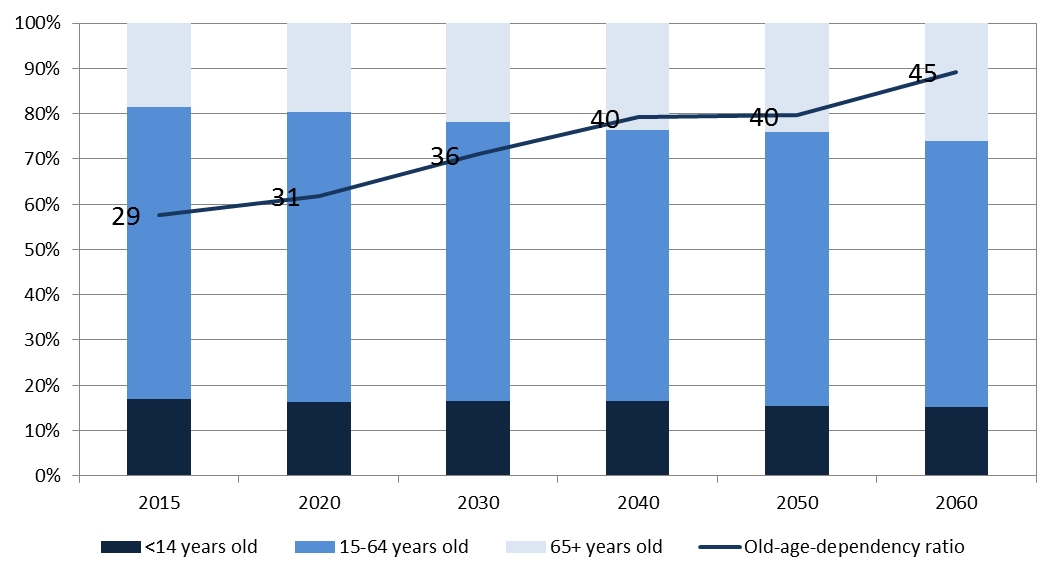
As in many EU countries, the Danish population is ageing.
The old-age dependency ratio is expected to increase from 29 in 2015 to 45 in 2060 5 .
Population forecast by age group and old-age-dependency ratio
Source: Eurostat, proj_15ndbims [extracted 16.5.2019].
An increasing proportion of the total population is made up of foreign immigrants and their descendants. In January 2018, this group accounted for 13.4% of the Danish population.
Providing education and training opportunities to those with a non-Danish ethnic background in order to ensure their integration into the labour market is a policy focus. At the beginning of 2016 the government launched a new VET training programme for immigrants 6 .
Denmark is increasingly becoming a multicultural society. Currently, 13.4 % of the population has an immigrant background.
Consequently, there are a growing number of VET-related programmes for immigrants.
Most companies are micro- and small-sized.
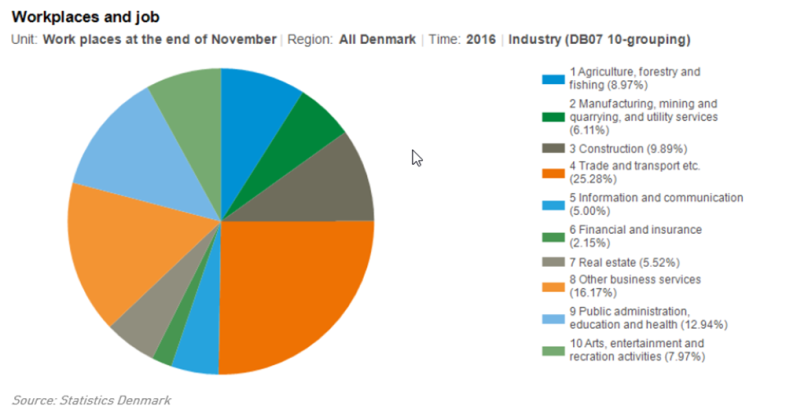
Employment by sector/main economic sectors in 2016:
- trade and transport;
- other business services;
- public administration, education and health;
- agriculture, forestry and fishing.
Exports comprise mainly agricultural products, food, medicine and green tech.
Source: Statistics Denmark [extracted 6.11.2017].
The Danish labour market is highly regulated. Only low skilled jobs are available without a diploma.
Total unemployment 7 (2018): 4.2% (6.0% in EU-28); it increased by 1.6 percentage points since 2008 8 .
Unemployment rate (aged 15-24 and 25-64) by education attainment level in 2008-18

NB: data based on ISCED 2011; breaks in time series; low reliability for ISCED 5-8, age 15-24.
ISCED 0-2 = less than primary, primary and lower secondary education. ISCED 3-4 = upper secondary and post-secondary non-tertiary education. ISCED 5-8 = tertiary education.
Source: Eurostat, lfsa_urgaed [extracted 16.5.2019].
Unemployment rates of people aged 15-24 are higher than among people aged 25-64 for all education levels, with low qualified (or not qualified) people scoring the highest unemployment rates.
Among 25-64 year olds, economic crises had hit more low-qualified and high-qualified people than those with medium-level qualifications, including most VET graduates (ISCED levels 3 and 4).
Employment rate of 20 to 34-year-old VET graduates remained stable from 2014 (86.1%) to 2018 (88.6%) 9 , which was above the EU-28 average.
Employment rate of VET graduates (20 to 34 years old, ISCED levels 3 and 4)

NB: Data based on ISCED 2011; breaks in time series.
ISCED 3-4 = upper secondary and post-secondary non-tertiary education.
Source: Eurostat, edat_lfse_24 [extracted 16.5.2019].
The employment rate of all ISCED level graduates has increased to 81.2% (+2.3 percentage points) in 2014-18. In the same period, the employment rates of 20 to 34-year-old VET graduates increased by 2.5 percentage points 10 .
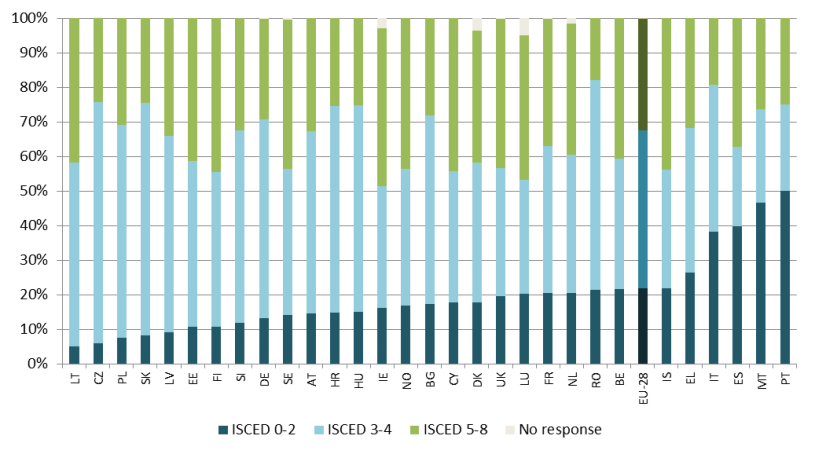
The share of the Danish population aged 25 to 64 with higher education (ISCED 5-8) is 38.3%, which is above the EU-28 average of 32.2%. The share of people holding medium-level qualifications (ISCED 3-4) is also high (40.4%).
Population (aged 25 to 64) by highest education level attained in 2018
NB: Data based on ISCED 2011. Low reliability for ‘No response’ in Czechia, Iceland, Latvia, and Poland.
ISCED 0-2 = less than primary, primary and lower secondary education.
ISCED 3-4 = upper secondary and post-secondary non-tertiary education.
ISCED 5-8 = tertiary education.
Source: Eurostat, lfsa_pgaed [extracted 16.5.2019]
Share of learners in VET by level in 2017
|
lower secondary |
upper secondary |
post-secondary |
|
Not applicable |
38.9% |
Not applicable |
NB: Data based on ISCED 2011. Source: Eurostat, educ_uoe_enrs01, educ_uoe_enrs04 and educ_uoe_enrs07 [extracted 16.5.2019].
Share of initial VET learners from total learners at upper secondary level (ISCED level 3), 2017

NB: Data based on ISCED 2011.
Source: Eurostat, educ_uoe_enrs04 [extracted 16.5.2019].
With a 38.9% share of IVET learners in the total population of upper secondary learners in 2016, Denmark is below the EU-28 average of 47.2%.
In general, there are more male than female learners in VET: 68% and 32% in 2017.
However, the distribution is uneven in various branches. In commercial training and social and healthcare training, for example, there are more female apprentices, while the opposite applies to technical training 11 .
The share of early leavers from education and training has decreased significantly from 11.3% in 2009 to 10.2% in 2018. It is above the national objective for 2020 of not more than 10%, and below the EU-28 average of 10.6%.
Early leavers from education and training in 2009-18

NB: Share of the population aged 18 to 24 with at most lower secondary education and not in further education or training; break in series.
Source: Eurostat, edat_lfse_14 [extracted on 16.05.2019] and European Commission, https://ec.europa.eu/info/2018-european-semester-national-reform-programmes-and-stability-convergence-programmes_en [accessed 14.11.2018].
In 2012, the completion rate in VET was only 52%. The proposal for a reform of the Danish VET system was ratified by Parliament in 2014, with one of its objectives being to improve completion rates to at least 60% by 2020 and at least 67% by 2025.
Lifelong learning offers training opportunities for adults, including early leavers from education.
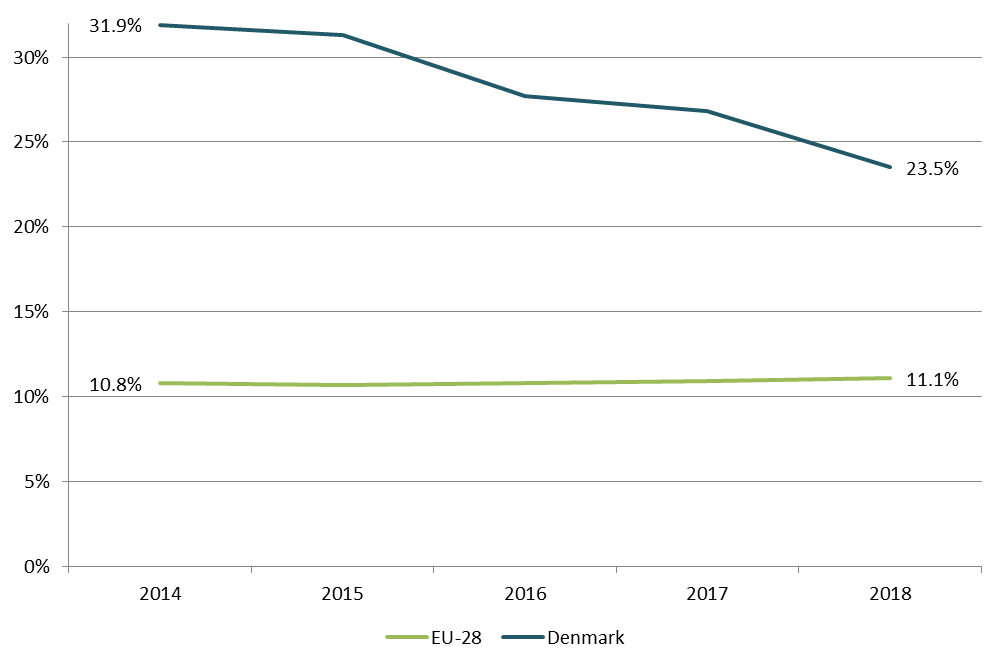
Participation in lifelong learning in 2014-18
NB: Share of adult population aged 25 to 64 participating in education and training; break in series. Source: Eurostat, trng_lfse_01 [extracted 16.5.2019].
Denmark has the highest participation in adult education and continuing training in the EU, regardless of levels of educational attainment. In 2017, the share of participation in education and training among the population aged 25-64 was 26.8% compared with EU-28 average of 10.9%. These figures refer to all forms of education and training activity, both formal and non-formal.
The high participation rate reflects several specific characteristics, such as the national strategy to focus on knowledge-intensive specialist sectors and lifelong learning, a large public sector and a tradition of strong ties between education institutions and social partners. Adult vocational training programmes (Arbejdsmarkedsuddannelser, AMU), offering short vocational training programmes to skilled and unskilled workers, as well as to the unemployed, have a significant role to play in this regard.
Learners in mainstream education, October 2017
The main age group in VET is 18-20, but there is a significant group of VET-learners aged 30-40.

Source. Statistics Denmark [accessed 8.4.2019].
The education and training system comprises:
- primary and lower secondary education (basic schooling); (ISCED levels 1-2);
- upper secondary education; (ISCED level 3);
- post-secondary education (ISCED levels 4-5);
- higher education;(ISCED levels 6-8).
Children participate in mainstream education from the age of six and progress through the system during their youth into adulthood. Adult education and continuing training (CVT) mirrors the qualifications provided within the mainstream system but is designed specifically for adults. It also provides opportunities to acquire supplementary qualifications. As such, the two parallel systems combined provide a framework for lifelong learning.
Basic schooling is compulsory from the ages of 6 to 16, that is, from pre-school class to ninth grade. In 2017 12 , 46.2% of the youth cohort decided to continue to the optional 10th grade rather than enter an upper secondary programme directly. The 10th grade is an option for young people to acquire academic competence and clarity about their choices before entering youth education (either general or vocational upper secondary education). 2015 VET reform combines the 10th grade and VET programmes into a programme called EUD10.
Primary and lower secondary education is generally integrated into, and located within, the comprehensive Danish Folkeskole 13 , although other types of institution, such as private independent schools, also exist. Of the youth cohort, 80.0% attended the comprehensive Danish Folkeskole in the school year 2016/17. There is a tendency to move towards private compulsory schooling. In the same school year (2016/17), 15.9% attended a private school. Of the rest of the youth cohort, 4.1% attended special programmes. Primary and lower secondary education is completed by taking an examination providing access to upper secondary (youth) education.
Within the adult education and continuing training system, there are two programmes at EQF level 2. Preparatory adult education (FVU) provides courses in basic literacy and mathematics, as well as courses for those with learning difficulties or with Danish as their second language. General adult education (AVU) is provided to adults who, for whatever reason, did not complete lower secondary education or need supplementary education in particular subjects. Qualifications at this level are equivalent to the ninth or 10th grade leaving examination.
Upper secondary education consists of both general upper secondary education and vocational upper secondary education and training (erhvervsuddannelse, EUD). General upper secondary education programmes usually last three years and prepare learners for higher education at tertiary level. Five different qualifications result from five corresponding programmes:
- upper secondary leaving qualification (studentereksamen, STX) (EQF 4);
- higher preparatory examination 14 (højere forberedelseseksamen, HF) (EQF 4);
- higher commercial examination (højere handelseksamen, HHX) (EQF 4);
- higher technical examination (højere teknisk eksamen, HTX) (EQF 4);
- combined vocational (journeyman’s test) and general upper secondary leaving qualification (EUX) (EQF 5).
The adult education (age 25 and above) and continuing training system includes three types of programme at upper secondary level:
- higher preparatory single subjects (enkeltfag, HF) (EQF 4);
- basic (vocational) adult education (Erhvervsuddannelse for voksne, EUV) (EQF 3-5), which is equivalent to EUD;
- and adult vocational training programmes (Arbejdsmarkedsuddannelser, AMU) (EQF 2-5).
In broad terms, higher education comprises:
- professionally oriented short- and medium-cycle programmes where the short-cycle programmes lead to an academy profession degree and are offered at academies of professional higher education, while the medium-cycle programmes lead to a professional bachelor degree and are offered by university colleges;
- research-based long-cycle programmes offered at universities where most learners continue to a master degree programme after completing a bachelor degree. The former can then provide access to doctoral programmes.
There are corresponding programmes within the adult education and continuing training system: short-cycle further (vocational) adult education (VVU), medium-cycle diploma programmes, and long-cycle master programmes. As part-time courses, these programmes allow participants to combine education with a working career, as well as improving the integration of the individual’s professional and life experience.
The Danish VET system is divided into IVET and CVT.
The IVET system is for learners aged up to 25 and the CVT for learners aged 25 and above.
Danish education and training features a mainstream system providing qualifications at all levels, from compulsory schooling to doctoral degrees, and a parallel adult education and continuing vocational training (CVT) system. CVT is designed to meet the needs of adult learners, for example through part-time courses. The two systems offer equivalent qualifications at various levels, enabling horizontal permeability.
VET programmes are organised according to the dual principle, alternating between periods of college-based and work-based learning (apprenticeship training) in enterprises. The college-based learning will typically comprise practice based learning in workshops.
When learners complete a VET programme they can enter the labour market as skilled workers, or can apply for CVT in the form of professional academy programmes (Erhvervsakademier).
Learn more about apprenticeships in the national context from the European database on apprenticeship schemes by Cedefop: http://www.cedefop.europa.eu/en/publications-and-resources/data-visualisations/apprenticeship-schemes/scheme-fiches
The Danish VET system can best be characterized as a unified VET system based on the dual principle.
Although VET programmes are offered in several variations in Denmark, building on different legal frameworks, there is no doubt that the main pathway through VET is the dual-based apprenticeship programme, founded and developed from the beginning of VET education and training in Denmark.
More than 95% of participants in Danish VET are involved in this kind of VET programme, leaving only a small percentage for “alternative” VET pathways, such as the ‘new master apprenticeship programme’ (ny mesterlære), in which the dual system is normally put in parentheses, or the few college-based VET programmes without work-based learning in a company.
VET programmes organised according to the dual principle, alternate between periods of college- based and work-based learning (apprenticeship training) in enterprises. A typical initial VET programme (EUD) lasts three-and-a-half years with a 2:1 split between workplace and college- based training, although there is considerable variation among programmes. Individual study plans are compiled for all students. VET colleges and social partners share the responsibility for developing curricula to ensure responsiveness to local labour market needs. Qualifications at this level provide access to relevant fields in academy profession (KVU) programmes and professional bachelor programmes at tertiary level.
Adopted from the Spotlight on VET – 2018 compilation 15
Parliament sets out the overall framework for VET, which is administered by the Ministry of Education. The Ministry has overall parliamentary, financial and legal responsibility for VET, laying down the overall objectives for programmes and providing the legislative framework within which stakeholders, social partners, colleges and enterprises are able to adapt curricula and methodologies to the needs of both learners and the labour market.
Social partners play an institutionalised role at all levels of VET, from the national advisory council on vocational upper secondary education and training (Rådet for de grundlæggende Erhvervsrettede Uddannelser), which advises the Ministry of Education on principal matters concerning VET, to playing an advisory role at the local level through local training committees comprising representatives of the social partners who advise colleges on local adaptations of VET. Their most important role is to ensure that VET provision is in line with the needs of the labour market.

The national advisory council consists of 31 representatives from the social partners. In its advisory capacity, the council monitors developments in society and highlights trends relevant to VET. The council makes recommendations to the Ministry regarding the establishment of new VET programmes and the adaptation, amalgamation or discontinuation of others.
National trade committees (faglige udvalg) are the backbone of the VET system. Approximately 50 trade committees are responsible for 106 main programmes. The committees normally have between 10 and 14 members and are formed by labour market organisations (with parity of membership between employer and employee organisations). They are financed by participating organisations.
Among their core responsibilities, national trade committees:
- perform a central role in the creation and renewal of VET courses by closely monitoring developments in their particular trade. They also have a dominant position in formulating learning objectives and final examination standards based around the key competences that are deemed to be required in the labour market;
- conduct relevant analyses, development projects, etc., and maintain close contact with relevant stakeholders;
- decide the regulatory framework for individual courses within boundaries set by the legislative framework. They decide which trade is to provide the core of the training, the duration of the programme and the ratio between college-based teaching and practical work in an enterprise;
- approve enterprises as qualified training establishments and rule on conflicts which may develop between apprentices and the enterprise providing practical training;
- function as gatekeepers to the trade, as they are responsible for issuing journeyman’s certificates in terms of content, assessment and the actual holding of examinations.
Local training committees are affiliated to each vocational college and ensure close contact with the local community, thus improving responsiveness to particular local labour market needs. They consist of representatives of local employers and employees appointed by national trade committees, as well as representatives of staff, management and learners appointed by colleges. Training committees work closely alongside colleges in determining the specific curriculum of colleges, including which optional subjects are available. They assist and advise national trade committees in approving local enterprises as qualified training establishments and in mediating conflicts between apprentices and enterprises. Finally, training committees help to ensure that enough suitable local training placements are available.
117 VET colleges offer basic vocationally oriented education programmes. 97 of these are technical colleges, commercial colleges, agricultural colleges or combination colleges. In addition, 20 colleges offer social and healthcare training programmes. A number of the colleges offer their programmes through local branches at locations other than the main college. As self-governing institutions, vocational colleges are led by a governing board with overall responsibility for the administrative and financial running of the college and educational activities in accordance with the framework administered by the education ministry. The board consists of teachers, learners and administrative staff representatives, as well as social partner representatives. The board takes decisions regarding which programmes are offered at the college and their capacity, imposes local regulations and guidelines, guarantees responsible administration of the college’s financial resources, including approval of budgets and accounts and hires and fires the operational management (director, principal, dean or similar). The operational management, meanwhile, is responsible for implementing the overall objectives and strategies set out by the governing board.
A publicly financed system of basic, secondary and further education and training that recognises relevant non-formal and informal competences and practical work experience is a fundamental characteristic of the system.
Mainstream (‘youth’) VET is based on alternative models where training takes place in turn at college and in an enterprise. The state finances training at colleges, while enterprises finance on-the-job training; apprentices receive an apprentice’s salary while in the company, as laid down in the collective agreements.
In 2018, the state spent a total of DKK 7 173 3 million (EUR 963 million) on VET basic courses and main programmes (see table below). A considerable proportion of these funds was distributed to colleges in accordance with the ‘taximeter’ principle, whereby funding is linked to some quantifiable measure of activity, for example, the number of full-time equivalent learners, with a set amount awarded per unit. Among other things, this system provides an incentive for colleges to increase retention within the system.
Besides the ‘taximeter’ rate, VET providers also receive an annual fixed grant for the maintenance of buildings, salaries, etc. The total state grant is provided as a block grant which institutions use at their own discretion within the boundaries of the legislative framework and specific institutional objectives.
Expenditure on main youth education pathways (2018)
|
VET youth education |
EGU and production schools |
Upper secondary education ([ 16 ]) |
|
DKK 7 173.3 million (EUR 963 Million) |
DKK 1 263.3 million EUR 170 Million) |
DKK 12 178 million (EUR 1 635 million) |
|
Upper Vocational Education |
||
|
DKK 3 085.4 million (EUR 414 million) |
Source: National budget 2018.
When it comes to financing training in companies, all employers, both public and private, pay a sum into the ‘employers' reimbursement scheme’ (Arbejdsgivernes Uddannelsesbidrag), regardless of whether or not they provide apprenticeship placements. This fund finances VET both for young people and adults. From 2018, all employers will be obliged to pay an annual contribution of DKK 2 702 (EUR 362) per full-time employee. These funds are then allocated to workplaces that take in apprentices so that they do not bear the cost of training alone. These employers receive reimbursement for wages paid during apprentices’ periods of college-based training.
VET for adults (AMU) is largely publicly financed. Providers receive ‘taximeter’ funding and must negotiate budgets and targets with the Ministry of Education annually.
In VET, there are:
- general subject teachers;
- vocational subject teachers;
- in-company trainers;
- mentors.
General subject teachers are usually university graduates with a professional bachelor degree in teaching.
Vocational subject teachers usually have VET education background and substantial experience in the field (normally, at least five years is required).
The job of a VET teacher is considered demanding, and the motivation for applying for these jobs is of the highest level, when jobs in the private sector are hard to find.
Colleges and training centres have autonomy in staff recruitment. The Ministry of Education is not involved in teacher recruitment procedures, and teachers are not civil servants entering the system through tests.
There are no requirements for teachers to have a pedagogical qualification prior to their employment.
Pedagogical training (Diplomuddannelsen i Erhvervspædagogik) is part-time in-service training based on interaction between theory and practice. This programme was introduced for all teachers employed in VET and adult education (AMU) recruited after 15 January 2010 and replaces the previous teacher training course (Pædagogikum). The objective is to improve teaching skills to a level equivalent to teachers in compulsory education with a professional bachelor degree. The programme is the equivalent of one year of full-time study (60 ECTS) and the acquired qualification is placed at EQF level 6. It is, however, generally conducted as a part-time study to root training in practical teaching experience. New teachers must enrol in the programme within one year of gaining employment at a VET college or AMU centre. The programme must be completed within a period of six years. The programme was developed by the Danish National Centre for the Development of Vocational Education and Training (Nationalt Center for Erhvervspædagogik, NCE), a centre of excellence collecting, producing and disseminating knowledge on VET based at University College Copenhagen (UCC). The programme was developed in cooperation with an advisory group consisting of representatives of teacher associations and college management organisations, as well as the Ministry of Education. There are three compulsory and five optional modules, as well as a final examination project. Both NCE and other providers at different university colleges offer the programme 17 .
In-company trainers play an important role in VET, given the dual training principle characteristic of all VET. There are different types of trainers with different responsibilities: planners, training managers and daily trainers. However, there are very few legal requirements to become a trainer.
Trainers in enterprises who are responsible for apprentices must be craftsmen. They must have completed a VET programme, for which they have received a ‘journeyman’s certificate’, and have work experience.
Once qualified to teach in VET, there is no general legislation on in-service training. Individual teachers are obliged to keep their subject-specific and pedagogical knowledge up-to-date. The college is required to draw up a plan for the competence development of the teachers at the college. On this basis, and in cooperation with the teacher, the college determines the individual’s professional in-service training plan. Courses are offered locally by many providers in accordance with market conditions. A certificate is normally awarded to participants, but a recognised qualification is not generally awarded. The new VET reform requires skills updating for teachers and leaders in VET institutions at a level equivalent to 10 ECTS points. The updating will continue until 2020, and DKr 400 million (EUR 53 million) has been granted for it.
There are also no in-service training requirements or control mechanisms for in-company trainers. Quality assurance, beyond that undertaken voluntarily by the enterprise, is restricted to informal contacts between the VET college and the enterprise. The adult education (AMU) systems provide a number of courses of one to two weeks duration to support the training of trainers. The courses are not mandatory and are mostly used by the social care and healthcare professions.
More information is available in the Cedefop ReferNet thematic perspective on teachers and trainers 18 .
Social partners play an institutionalised role at all levels of VET, from the national advisory council on vocational upper secondary education and training (Rådet for de grundlæggende Erhvervsrettede Uddannelser), which advises the Ministry of Education on principal matters concerning VET, to playing an advisory role at the local level through local training committees comprising representatives of the social partners who advise colleges on local adaptations of VET. Their most important role is to ensure that VET provision is in line with the needs of the labour market.
Among their core responsibilities, national trade committees:
- perform a central role in the creation and renewal of VET courses by closely monitoring developments in their particular trade. They also have a dominant position in formulating learning objectives and final examination standards based around the key competences that are deemed to be required in the labour market;
- conduct relevant analyses, development projects, etc., and maintain close contact with relevant stakeholders;
- decide the regulatory framework for individual courses within boundaries set by the legislative framework. They decide which trade is to provide the core of the training, the duration of the programme and the ratio between college-based teaching and practical work in an enterprise;
- approve enterprises as qualified training establishments and rule on conflicts which may develop between apprentices and the enterprise providing practical training;
- function as gatekeepers to the trade, as they are responsible for issuing journeyman’s certificates in terms of content, assessment and the actual holding of examinations.
Local training committees are affiliated to each vocational college and ensure close contact with the local community, thus improving responsiveness to particular local labour market needs. They consist of representatives of local employers and employees appointed by national trade committees, as well as representatives of staff, management and learners appointed by colleges. Training committees work closely alongside colleges in determining the specific curriculum of colleges, including which optional subjects are available. They assist and advise national trade committees in approving local enterprises as qualified training establishments and in mediating conflicts between apprentices and enterprises. Finally, training committees help to ensure that enough suitable local training placements are available.
See also Cedefop’s skills forecast 19 and European Skills Index 20 .
Social partners play an institutionalised role at all levels of VET, from the national advisory council on vocational upper secondary education and training (Rådet for de grundlæggende Erhvervsrettede Uddannelser), which advises the Ministry of Education on the main issues concerning VET, to playing an advisory role at the local level through local training committees comprising representatives of the social partners who advise colleges on local adaptations of VET. Their most important role is to ensure that VET provision is in line with the needs of the labour market.
The national advisory council consists of 31 representatives from the social partners. In its advisory capacity, the council monitors developments in society and highlights trends relevant to VET. The council makes recommendations to the Ministry regarding the establishment of new VET programmes and the adaptation, amalgamation or discontinuation of others.
National trade committees (faglige udvalg) are the backbone of the VET system. Approximately 50 trade committees are responsible for 106 main programmes. The committees normally have between 10 and 14 members and are formed by labour market organisations (with parity of membership between employer and employee organisations). They are financed by participating organisations.
Among their core responsibilities, national trade committees:
- perform a central role in the creation and renewal of VET courses by closely monitoring developments in their particular trade. They also have a dominant position in formulating learning objectives and final examination standards based around the key competences that are deemed to be required in the labour market;
- conduct relevant analyses, development projects, etc., and maintain close contact with relevant stakeholders;
- decide the regulatory framework for individual courses within boundaries set by the legislative framework. They decide which trade is to provide the core of the training, the duration of the programme and the ratio between college-based teaching and practical work in an enterprise;
- approve enterprises as qualified training establishments and rule on conflicts which may develop between apprentices and the enterprise providing practical training;
- function as gatekeepers to the trade, as they are responsible for issuing journeyman’s certificates in terms of content, assessment and the actual holding of examinations.
Local training committees are affiliated to each vocational college and ensure close contact with the local community, thus improving responsiveness to particular local labour market needs. They consist of representatives of local employers and employees appointed by national trade committees, as well as representatives of staff, management and learners appointed by colleges. Training committees work closely alongside colleges in determining the specific curriculum of colleges, including which optional subjects are available. They assist and advise national trade committees in approving local enterprises as qualified training establishments and in mediating conflicts between apprentices and enterprises. Finally, training committees help to ensure that enough suitable local training placements are available.
Various approaches to quality assurance of vocational colleges are implemented. Self-assessment remains the primary mechanism, but external monitoring is increasing in importance. Since the 1980s, a shift has taken place from detailed regulation of input to framework regulation of output. The aim of output regulation is to increase the focus on results and quality so that institutional practices meet political objectives, including adaptation to the needs of regional and local business sectors for education and competence development 21 .
Monitoring is conducted at two levels:
- system level: the assessment is on the effectiveness of the more than 100 different main programmes in terms of employment frequency among graduates. The education ministry then enters into dialogue with national trade committees about any programmes which fail to reach their targets in order to assess their relevance in terms of labour market needs and possible steps for improvement;
- institutional level: at this level, monitoring can be divided into content monitoring and financial monitoring. The first concerns the degree to which a vocational college is providing its programmes in accordance with the legislative framework. The second monitors the college’s compliance with budgetary constraints as laid down by the education ministry.
Completion, dropout and examination pass rates also form part of the quality appraisal of a vocational college. Within companies, the social partners supplement ministerial monitoring through national trade committees and local training committees, appraising the quality of graduates, curricula, apprenticeships within enterprises, etc.
Quality assurance mechanisms are also part of the
validation process when it comes to including new qualifications in the Danish qualification framework. Only officially recognised, validated and quality-assured programmes are included in the qualifications framework. Informal and non-formal learning are only recognised to the extent that they are formalised though a process of validation of prior learning corresponding to one of the qualifications included.
In terms of VET, trade committees (at the upper secondary level) and further education and training committees (adult VET) assess programmes and make recommendations for their placement in the framework to be approved by the education ministry. For each educational field, guidelines have been produced to aid committees in their assessment and are quality-assured through consultation with independent experts. Procedures and criteria for including VET qualifications in the framework are the subject of an evaluation report compiled by the Danish Evaluation Institute 22 .
Competence assessment for young people
A young person participating in VET will have his or her competence assessed in the initial period of the education. The competence assessment should clarify what is required by the learner in relation to the education they want. The competence assessment is based on previous education or employment. The goal is to ensure that the education programme that the college offers the learner allows him or her to start at the right level and to avoid duplicating education. The college should allow the competence assessment to be included in the preparation of the learner’s individual education plan, so that the learner is credited with relevant parts of the programme 23 .
Competence assessment for adults
Adults can have their competences assessed in relation to adult vocational courses and adult vocational education. In respect of short courses, this is an option known as Individual Competence Assessment (Individuel Kompetence Vurdering, IKV). Individual citizens have a right to this assessment and can even obtain financial compensation from the job centre for the time spent in this process, which takes between half a day and five days, provided by the relevant educational institution.
Recognition of prior learning results in an individual plan for education and a competence document listing formal qualifications, the individual’s prior experiences and learning equivalents, or a course certificate depending on the relevance and validity of his or her former experiences 24 . When applying for adult vocational education, it is compulsory to have one’s prior learning and experiences assessed before enrolment, which means that every adult above 25 years of age who intends to embark on vocational education should participate in Recognition of Prior Learning (so-called realkompetencevurdering, RKV, or RPL). This process takes between half a day and five days and leads the participant to one of three learning options:
- adult vocational education 1 (EUV 1): the learner has at least two years of relevant workplace experience. This means that the practice-based periods of the course and its initial part/ introductory basic programmes are left out (Basic Course 1; Grundforløb 1). In the case of mercantile vocational education, the primary part is included in the adult version;
- adult vocational education 2 (EUV 2): the learner has less than two years of relevant workplace experience. An education plan should be drawn up reflecting the participant’s experiences, which will usually exclude the initial part and shorten the other parts;
- adult vocational education 3 (EUV 3): the learner has no relevant workplace experience. Adults should follow the same education plan as young people, but should not have the initial part (Basic Course 1; Grundforløb 1, GF 1) 25 .
For more information about arrangements for the validation of non-formal and informal learning please visit Cedefop’s European database 26 .
Salary for apprentices
Danish VET learners are entitled to receive financial support during their education and training. If the VET learner signs a contract with a company, he or she will receive a salary during the education and training period. The salary is DKK 9 500 -12 500 per month (EUR 1 275 - 1 675) and increases each year.
If the VET learner does not have a contract with a company, he or she is entitled to receive financial support from the Danish learners' grants and loans scheme (Statens Uddannelsesstøtte, SU) when the learner is enrolled in the basic course (GF1 and GF2).
If the learner is living with his or her parents, the monthly amount is DKK 946 (EUR 125). If the learner is living away from his or her parents and is 20 years of age, the monthly amount is DKK 6 090 (EUR 800).
Loans and grants
A learner receiving financial support from the SU is also entitled to take out a loan with the SU. The monthly amount of the loan is normally DKK 3 116 (EUR 420). Loans must be repaid at 4% interest during the period of education and at the national discount rate of +1% after finishing that period.
Participants of VET for adults (AMU) are entitled to a fixed allowance: the State grant system for adult training (godtgørelse, VEU). In 2018, the amount available was DKK 4 300 (EUR 578) per week, corresponding to the maximum unemployment insurance benefit rate. As most participants are employed and receive a full salary during the training period, this allowance is primarily paid to employers as partial reimbursement of wages. As with apprenticeship training (EUD), expenditure for the allowances is covered by the employers’ reimbursement scheme, to which all enterprises contribute a fixed amount regardless of levels of participation in adult education and continuing training activities.
Participants may also receive a transport allowance and financial support for board and lodging 27 if programmes are offered at a considerable distance from the participant’s home.
Employers’ reimbursement scheme
All employers, both public and private, pay a sum into the ‘employers' reimbursement scheme’ (Arbejdsgivernes Uddannelsesbidrag), regardless of whether or not they provide apprenticeship placements. This fund finances VET for both young people and for adults (AMU). From 2018, all employers will be obliged to pay an annual contribution of DKK 2 702 (EUR 362) per full-time employee. These funds are then allocated to work places that take apprentices so that they do not bear the cost of training alone. These employers receive reimbursement for wages paid during apprentices’ periods of college-based training.
The latest tripartite agreement of August 2016 has launched a couple of new incentives for Danish companies aiming to establish more contracts with apprentices. The overall goal is to establish 10 000 new contracts in 2025.
Primarily, companies will be able to provide a much clearer picture of themselves as education operators, giving them the option of assessing whether they are in line with political expectations.
Fines and stimulations for companies
Companies that fail to sign the necessary number of contracts must pay a fine of DKK 27 000 (EUR 3 620) for each missing contract relative to the size of the company. On the other hand, companies that meet the standard number of contracts will receive a 7.4% higher refund from AUB (Arbejdsgivernes Uddannelsesbidrag, the employers reimbursement scheme,) to motivate them to sign the expected number of contracts.
In some Danish regions, public employers have laid down rules concerning the involvement of private companies in projects, underlining that the company cannot be engaged in public activities if the number of apprentices is below the standard.
Wage compensation scheme
Among the incentives promoting companies’ interest in having their low-skilled workers participate in adult vocational education is the wage compensation scheme. Companies are partly compensated for the wages they pay to their employees who are participating in education at a rate, in 2018, of DKK 4 300 (EUR 4 300) a week, equivalent to the highest level of unemployment benefit 28 . The companies should pay for the courses. In 2018 the payment will be between 590 DKK (EUR 79) and DKK 950 (EUR 127) per person per week 29 .
Please see:
- guidance and outreach Denmark national report 30 ;
- Cedefop’s labour market intelligence toolkit 31 ;
- Cedefop’s inventory of lifelong guidance systems and practices .
Vocational education and training system chart
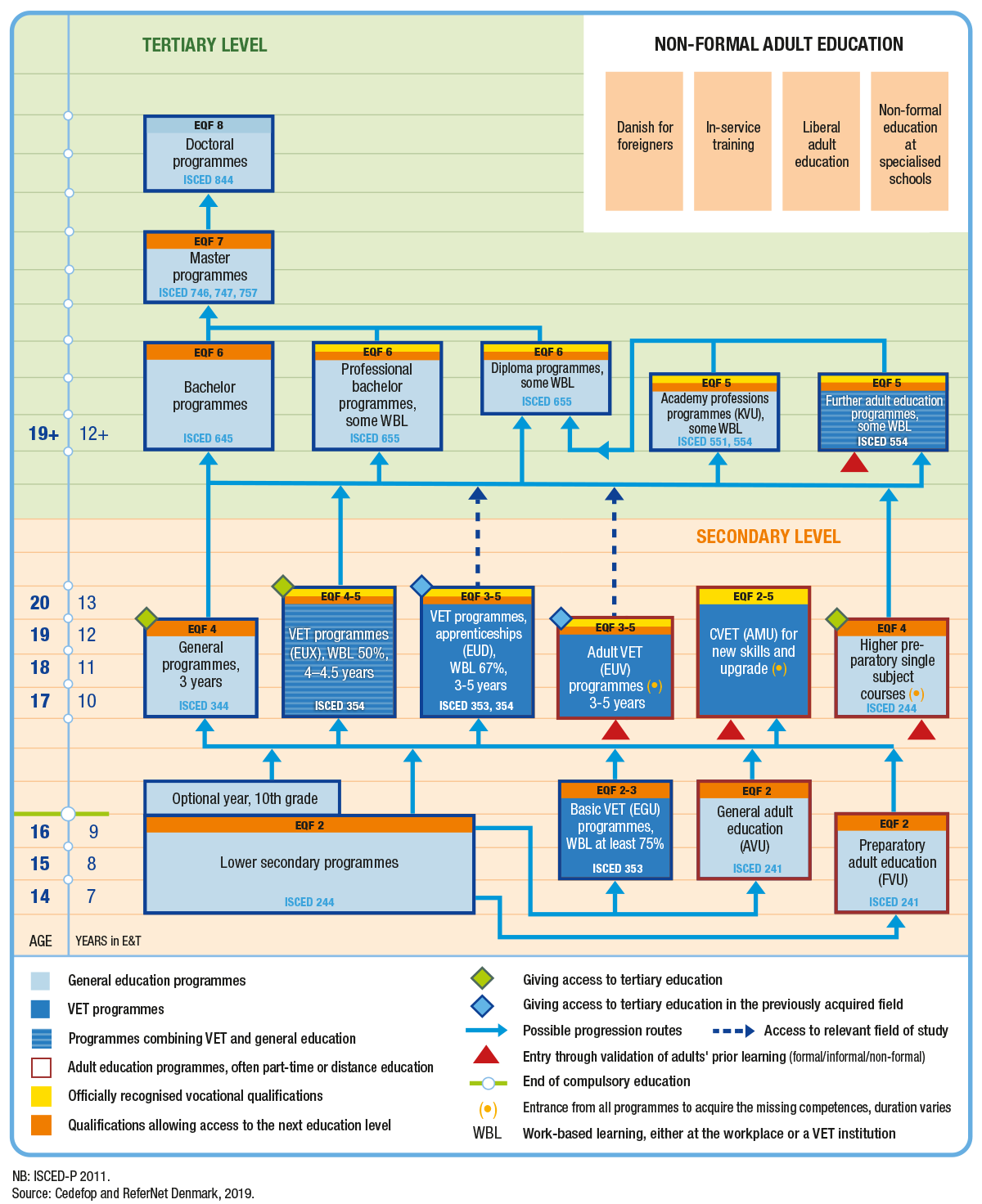
Programme Types
| ECVET or other credits | The education ministry has decided that ECVET points should not be used in the Danish vocational training system. In Denmark, it has been decided not to split up education programmes into modules to which ECVET, or other credit points, might be assigned. However, there are other countries in the EU that have introduced a credit points system. Therefore, there may be a need for a school receiving foreign pupils in mobility programmes to decide how many ECVET/other credit points the course corresponds to. In Denmark, the course of study is awarded ECVET points in relation to time. A full-time equivalent programme corresponds to 60 points. |
||||||||
|---|---|---|---|---|---|---|---|---|---|
| Learning forms (e.g. dual, part-time, distance) | Training is full-time. It is primarily practical, with little theoretical content, and combines alternating school-based (one third) and workplace-based training (two-thirds). |
||||||||
| Main providers | Vocational colleges, agricultural colleges, social and healthcare colleges, etc. |
||||||||
| Share of work-based learning provided by schools and companies | >=75% |
||||||||
| Work-based learning type (workshops at schools, in-company training / apprenticeships) |
|
||||||||
| Main target groups | Basic vocational training is aimed at unemployed young people aged below 30 who are unable to complete another form of education or training, which might equip them with qualifications to enter the labour market. The goal is to improve their vocational and personal skills and inspire them to enter the labour market or pursue further training possibilities. |
||||||||
| Entry requirements for learners (qualification/education level, age) | There are no minimum entry requirements concerning age. |
||||||||
| Assessment of learning outcomes | The training programme is set on an individual basis and may contain elements from the main programmes. Each training period should be concluded as an individual training element, which may be accredited through other training programmes. Statements are issued giving details of training content, job function, marks, etc. |
||||||||
| Diplomas/certificates provided | On completion of the entire training programme, a certificate is issued by the college. Any completed elements from a main programme can later be transferred as credit if entering the relevant programme. |
||||||||
| Examples of qualifications | Low-skilled pedagogical assistant, low-skilled carpenter, low-skilled chauffeur |
||||||||
| Progression opportunities for learners after graduation |
|
||||||||
| Destination of graduates | Graduates from EGU progress to 32 :
|
||||||||
| Awards through validation of prior learning | Yes Learning outcomes obtained in companies and different education institutions are assessed and validated and can be recognised as part of IVET. |
||||||||
| General education subjects | Yes General education subjects (for example Danish or Mathematics) can be a part of the educational plan. |
||||||||
| Key competences | Yes Key Competences can be a part of the programme. |
||||||||
| Application of learning outcomes approach | Yes The school-based part of the programme will typically be based on learning outcomes. |
||||||||
| Share of learners in this programme type compared with the total number of VET learners | Students within EGU ([ 33 ])
Source: Statistics Denmark, 2018. |
| ECVET or other credits | The education ministry has decided that ECVET points should not be used in the Danish vocational training system. In Denmark, it has been decided not to split up education programmes into modules to which ECVET, or other credit points, might be assigned. However, there are other countries in the EU that have introduced a credit points system. Therefore, there may be a need for a school receiving foreign pupils in mobility programmes to decide how many ECVET/other credit points the course corresponds to. In Denmark, the course of study is awarded ECVET points in relation to time. A full-time equivalent programme corresponds to 60 points. |
|---|---|
| Learning forms (e.g. dual, part-time, distance) |
|
| Main providers | Vocational colleges in cooperation with companies |
| Share of work-based learning provided by schools and companies | 50% |
| Work-based learning type (workshops at schools, in-company training / apprenticeships) |
|
| Main target groups | In 2012, the EUX programme was introduced with the aim of bridging the gap between general upper secondary education and vocational upper secondary education and training. It also offers highly motivated young people the opportunity to gain both vocational qualifications providing direct access to the labour market and general qualifications providing similar opportunities to continue into higher education as students in the four general upper secondary programmes. |
| Entry requirements for learners (qualification/education level, age) | There are no minimum or maximum entry requirements concerning age. EUX students must fulfil the requirements for IVET programmes, including a minimum grade 2 in Danish and mathematics. |
| Assessment of learning outcomes | To complete an EUX programme the student must pass a journeyman’s test concerning the vocational part of the programme and an examination in 6 upper secondary subjects (including Danish at level A) concerning the non-vocational part of the programme. If a learner fails the journeyman test or an examination in one of the 6 subjects, it is possible to have a re-examination. |
| Diplomas/certificates provided | VET learners achieve both general and vocational upper secondary qualifications. |
| Examples of qualifications | Carpenter, blacksmith, electrician |
| Progression opportunities for learners after graduation | EUX graduates gain both vocational qualifications providing direct access to the labour market and general qualifications providing similar opportunities to continue into higher education as graduates of the four general upper secondary programmes. |
| Destination of graduates | Since EUX was only introduced in 2012, there are only a small number of EUX graduates so far. It is, therefore, too early to predict their progress in continuing education and training or the labour market. However, there is no doubt that the EUX programme has succeeded in attracting a more motivated and dedicated type of student to VET 34 . |
| Awards through validation of prior learning | Yes If the learner has obtained certain parts of IVET or upper secondary education, it is possible to acquire awards through validation. |
| General education subjects | Yes |
| Key competences | Yes Key competences are part of the subjects in vocational colleges. |
| Application of learning outcomes approach | Yes |
| Share of learners in this programme type compared with the total number of VET learners | Since its introduction in 2012, the EUX programme has become quite popular. In 2019, 32.2% of all students choosing VET wanted an EUX programme in order to obtain a full VET qualification and a study preparatory qualification as well. Consequently, Danish VET institutions are working intensively to develop new learning arrangements combining learning outcomes from VET and general upper secondary institutions. |
| ECVET or other credits | The education ministry has decided that ECVET points should not be used in the Danish vocational training system. In Denmark, it has been decided not to split up education programmes into modules to which ECVET, or other credit points, might be assigned. However, there are other countries in the EU that have introduced a credit points system. Therefore, there may be a need for a school receiving foreign pupils in mobility programmes to decide how many ECVET/other credit points the course corresponds to. In Denmark, the course of study is awarded ECVET points in relation to time. A full-time equivalent programme corresponds to 60 points. |
|---|---|
| Learning forms (e.g. dual, part-time, distance) | EUD, as the main upper secondary VET option, is organised according to a dual principle, alternating between a training placement, generally in an enterprise, and periods of college-based training. EUD consists of:
College-based teaching in the main programmes can be divided into four types of subject:
College-based teaching in the main programmes is organized through an integrated approach, and students frequently work on projects where they are expected to incorporate what they have learned in different subjects and combine both general and more specialised competences. |
| Main providers | VET colleges |
| Share of work-based learning provided by schools and companies | >=60% |
| Work-based learning type (workshops at schools, in-company training / apprenticeships) | Apprenticeships with:
|
| Main target groups |
|
| Entry requirements for learners (qualification/education level, age) | Admission to basic programmes Admission is offered to anyone who has completed compulsory schooling at Folkeskole or equivalent and obtained the pass mark in Danish and mathematics in the leaving examination from the ninth or 10th grade respectively, unless they have an apprenticeship contract with a company. Young people attending the first part of the basic programme just after compulsory school must be declared ‘study-ready’, based on an assessment of their academic, personal and social competences conducted by either the college or the local youth guidance centre (Ungdommens Uddannelsesvejledning). These assessments consider a broad range of factors such as grades, motivation and conflict management skills and are used in compiling individual education plans (Elevplan). Admission to main programmes All students completing a basic programme are entitled to complete one of the associated main programmes. These programmes generally commence with an on-the-job training placement. As such, the student must not only have completed the relevant basic programme, but also have an apprenticeship contract with an approved training company prior to being admitted to the main programme. The students are duty-bound to seek out suitable placements. When no suitable placements are available in a desired programme, students are offered admission to another associated main programme where placements are available. Another possibility is for the student to enter a training agreement with the college itself, where practical training also takes place in a Placement Centre. For some programmes (32), admission to the second of the two basic courses is limited. This is to ensure that the number of students is aligned with labour market needs. In these cases, all students are either admitted in accordance with a quota or are required to have a training agreement with an enterprise prior to commencing the second part of the relevant foundation course. |
| Assessment of learning outcomes | Basic programmes are completed with a project which forms the basis of an externally graded examination. This is done by an external examiner appointed by the school and validated by the education ministry. In the main programmes, there are various forms of assessment throughout the course, including both oral and written examinations, and both theoretical and practical project work. The exact form of assessment can differ from programme to programme. Programmes include both subject-specific examinations (for example, in English or mathematics) and broader assessments to evaluate students’ abilities to combine the knowledge, skills and competences acquired from the programme as a whole. The final examination, which generally takes place during the final period of college-based learning, also varies from programme to programme. In some cases, it consists entirely of a college-based examination; in others it comprises a combination of a college-based examination and a journeyman’s test (svendeprøve); in others it involves only the journeyman’s test conducted by local training committees. However, most common is a combination of an assessment of project-based practical assignments and a theoretical examination, either oral, written or both. The relevant local trade committee nominates external examiners. Generally, two external examiners assess individual students in cooperation with the teacher. The training college, in consultation with the trade committees, develops the content of examinations. After passing the journeyman’s certificate, the graduate acquires a qualification at skilled-worker level and is able to enter the labour market 35 . |
| Diplomas/certificates provided | The basic course examination leads to a certificate documenting the subjects and levels they have achieved; this certificate forms the basis for entering the main programme. At the end of each training placement, the company issues a certificate to the college, the student and the trade committee listing the student’s achievements. The successful passing of the final examination leads to a journeyman’s certificate; the graduate acquires a qualification at skilled-worker level and is able to enter the labour market 36 . |
| Examples of qualifications | Flight mechanic, event coordinator, fitness instructor, multimedia animator, veterinary nurse: ‘small animals’, veterinary nurse: ‘horses’, veterinary nurse: ‘aide’, etc. |
| Progression opportunities for learners after graduation | Graduating from EUD main programmes gives access to tertiary education in the previously acquired field. Additional general subject qualifications 37 are required at higher levels in order to gain access to higher education. |
| Destination of graduates | The most recent figures for students completing an EUD programme in 2015 show that, 6 months later, only 8% were continuing in higher education 38 ] ). Improving pathways from VET to higher education is currently a political priority. |
| Awards through validation of prior learning | Yes It is possible to acquire awards through validation of prior learning, and the education institution receiving the student is responsible for this. |
| General education subjects | Yes College-based teaching in the main programmes includes general education subjects, including English, mathematics, Danish, etc. However, in VET, the content of these subjects is adapted to the particular programme so that, for example, mathematics for carpenters will concentrate on areas relevant to working as a carpenter and will be quite different from mathematics for veterinary nurses. General subjects also include other broad subjects such as product development and basic materials science. College-based teaching also includes optional subjects that might help them gain competences, which provide access to further education, such as qualifications in general subjects at a higher level. |
| Key competences | Yes Key competences are included in the subjects in the college-based part of VET, but are not taught as specific subjects. |
| Application of learning outcomes approach | Yes All educational orders, defining the framework of a VET programme are described in terms of learning outcomes. |
| Share of learners in this programme type compared with the total number of VET learners | After completing ninth (compulsory) or 10th grade in 2018, 93% of all students chose some form of further education or training activity, either general upper secondary education (73.1%), or EUD vocational upper secondary education and training (19.4%). As suggested by the discrepancy in these two sets of figures, students in VET are generally older. While the average age for young people commencing general upper secondary education is 16.6, the equivalent for those entering VET is 22. Young people also take longer to complete VET programmes: the average age for those completing a general upper secondary qualification in 2017 was 19.5; in VET it was 28.9. In 2019, 32.2% of young people applying for a VET programme chose the EUX programme. Students entering VET basic programmes (EUD and EUX) 2019
|

| ECVET or other credits | The education ministry has decided that ECVET points should not be used in the Danish vocational training system. In Denmark, it has been decided not to split up education programmes into modules to which ECVET, or other credit points, might be assigned. However, there are other countries in the EU that have introduced a credit points system. Therefore, there may be a need for a school receiving foreign pupils in mobility programmes to decide how many ECVET/other credit points the course corresponds to. In Denmark, the course of study is awarded ECVET points in relation to time. A full-time equivalent programme corresponds to 60 points. |
|---|---|
| Learning forms (e.g. dual, part-time, distance) | It is a dual system consisting of:
|
| Main providers | Vocational colleges in cooperation with companies |
| Share of work-based learning provided by schools and companies | 60% |
| Work-based learning type (workshops at schools, in-company training / apprenticeships) |
|
| Main target groups | EUV programmes target low-skilled workers with at least two years of relevant work experience and allow acquisition of qualifications equivalent to EUD, which incorporate validation of prior learning. |
| Entry requirements for learners (qualification/education level, age) | Adults aged 25 and above |
| Assessment of learning outcomes | To complete a VET programme, learners need to pass a journeyman’s test (practical), organised by a professional committee. Some examinations in the school-based part of the programme are compulsory. If a learner fails a journeyman’s test or an examination in a subject, re-examination is possible. Normally, three attempts are possible. |
| Diplomas/certificates provided | The basic course examination leads to a certificate documenting the subjects and levels they have achieved; this certificate forms the basis for entering the main programme. At the end of each training placement, the company issues a certificate to the college, the student and the trade committee listing the student’s achievements. The successful passing of the final examination leads to a journeyman’s certificate; the graduate acquires a qualification at skilled-worker level and is able to enter the labour market 39 . |
| Examples of qualifications | Carpenter, blacksmith, electrician |
| Progression opportunities for learners after graduation | Those who complete VEU can enter the labour market or continue their studies at professional Academies. |
| Destination of graduates | Information not available 40 |
| Awards through validation of prior learning | Yes The validation process in conducted by the vocational school and the relevant vocational teacher is responsible for the specific validation of prior learning. The process is a combination of validation of formal learning and practical assessment. Prior to enrolment into adult vocational education, it is compulsory to have one’s prior learning and experiences assessed. Every adult above 25 years of age who intends to embark on vocational education should participate in Recognition of Prior Learning (so-called realkompetencevurdering, RKV, or RPL). This process takes between half a day and five days and leads the participant to one of three models:
|
| General education subjects | Yes Depending on the specific education programme, a number of subjects are included in the programme – for example Danish, mathematics. |
| Key competences | Yes Key competences are included in the subjects in the college-based part of VET, but are not taught as specific subjects. |
| Application of learning outcomes approach | Yes All education orders, defining the framework of a VET programme, are described in terms of learning outcomes. |
| Share of learners in this programme type compared with the total number of VET learners | The share of people aged 25 or more is 32% of the total VET learners. |
| ECVET or other credits | The education ministry has decided that ECVET points should not be used in the Danish vocational training system. In Denmark, it has been decided not to split up education programmes into modules to which ECVET, or other credit points, might be assigned. However, there are other countries in the EU that have introduced a credit points system. Therefore, there may be a need for a school receiving foreign pupils in mobility programmes to decide how many ECVET/other credit points the course corresponds to. In Denmark, the course of study is awarded ECVET points in relation to time. A full-time equivalent programme corresponds to 60 points. |
|---|---|
| Learning forms (e.g. dual, part-time, distance) | Depending on what best corresponds to the needs of enterprises and participants, courses can take the form of traditional classroom teaching, training in open workshops, distance learning or training at the workplace and be spread over several consecutive days, over a longer period or conducted as evening classes. Programmes can be combined both within and across qualification areas and alternate between theory and practice. |
| Main providers | Vocational colleges, AMU training centres and private providers |
| Share of work-based learning provided by schools and companies | 75% |
| Work-based learning type (workshops at schools, in-company training / apprenticeships) | According to the needs of participants and enterprises, individual training maps are developed and followed and a range of learning types can be included. |
| Main target groups | AMU programmes target both low-skilled and skilled workers, but they are open to all citizens who are either resident or employed in Denmark, irrespective of educational background. Some AMU courses are also targeted at the unemployed. The objectives are threefold:
|
| Entry requirements for learners (qualification/education level, age) | Adults aged 25 and above |
| Assessment of learning outcomes | Examination of AMU courses is practical-based and, depending on the context, may include some theoretical elements. All courses are finalised with an examination. |
| Diplomas/certificates provided | Upon completion, participants receive a certificate. In around 120 programmes, this certification is a formal requirement for fulfilling certain job functions (such as operating certain machinery). AMU certificates are also included in the Danish qualifications framework for lifelong learning, at any point from level 2 to level 5. |
| Examples of qualifications | Truck driver, scaffolder, team leader |
| Progression opportunities for learners after graduation | AMU certificates do not provide direct access to further education and training, although they can be included in an assessment of prior learning resulting in credit transfer, for example, if entering a mainstream VET programme in the same field. |
| Destination of graduates | Information not available 42 |
| Awards through validation of prior learning | Yes The validation process in conducted by the AMU Centre and the relevant teacher is responsible for the specific validation of prior learning. The process is a combination of validation of formal learning and practical assessment. Prior to enrolment into adult vocational education, it is compulsory to have one’s prior learning and experiences assessed. Every adult above 25 years of age who intends to embark on vocational education should participate in Recognition of Prior Learning (so-called realkompetencevurdering, RKV, or RPL). This process takes between half a day and five days and leads the participant to one of three models:
|
| General education subjects | Yes such as reading, writing and mathematics courses |
| Key competences | Key competences can be included |
| Application of learning outcomes approach | Yes All AMU courses are described in terms of learning outcomes. |
| Share of learners in this programme type compared with the total number of VET learners | In 2018 the share of AMU participants among all VET participants was 6.5%. In 2018, there were approximately 463 327 participants in AMU courses, a significant drop since 2010 when there were almost 590 000 participants in AMU. This could partly be explained by the high pace and bustle of industry during this period, and partly by the rigidity and formal structures of the education system. However, as many of these courses are of very short duration (as little as half a day), the figures for full-time equivalent students are much lower at just 7 406 in 2018 43 . This again represents a significant fall in comparison with 2010 figures. Most participants in the programmes either have VET as their highest level of education (51%) or compulsory schooling (25%) 44 . |
| ECVET or other credits | The education ministry has decided that ECVET points should not be used in the Danish vocational training system. In Denmark, it has been decided not to split up education programmes into modules to which ECVET, or other credit points, might be assigned. However, there are other countries in the EU that have introduced a credit points system. Therefore, there may be a need for a school receiving foreign pupils in mobility programmes to decide how many ECVET/other credit points the course corresponds to. In Denmark, the course of study is awarded ECVET points in relation to time. A full-time equivalent programme corresponds to 60 points. |
|---|---|
| Learning forms (e.g. dual, part-time, distance) | VVU programmes are specifically tailored to the needs of adults, for example, by providing courses over a longer duration on a part-time basis, largely during evenings and weekends, to allow ongoing employment. |
| Main providers | Business and technical academies |
| Share of work-based learning provided by schools and companies | 25% |
| Work-based learning type (workshops at schools, in-company training / apprenticeships) |
|
| Main target groups | Programmes are available for young people and adults. People with job experience are the main group. Unemployed people can receive grants for participation (SVU). |
| Entry requirements for learners (qualification/education level, age) | In addition to an appropriate VET qualification or a general upper secondary qualification, two to three years of relevant work experience is required. |
| Assessment of learning outcomes | To complete a programme, learners need to pass a final examination. Each module in the flexible programme is finalised with an examination and the learner has to pass a final examination as well. |
| Diplomas/certificates provided | Award of an academy profession degree (erhvervsakademigrad, AK) |
| Examples of qualifications | Retail, interpreter, international transport and logistics, and information technology |
| Progression opportunities for learners after graduation | Adult VVU) qualifications, like the mainstream KVU, can provide access to a supplementary diploma degree programme, allowing graduates to build on an academy profession degree to bachelor-equivalent level within the same field, while VVU qualifications also provide access to relevant full-time professional bachelor programmes. As such, there is full horizontal permeability between the mainstream and adult education and continuing training systems. |
| Destination of graduates | Most participants (66%) finalise only a part of VVU and return to their jobs. Of this group, 50% continue into other forms of education (3-4 years after VVU.) Of the group of participants who finalise a full VVU, 9% participate in further education (3-4 years after VVU) 45 . |
| Awards through validation of prior learning | Yes |
| General education subjects | Yes The programme is flexible and the learner can choose general education subjects as part of the programme. |
| Key competences | Yes |
| Application of learning outcomes approach | Yes Each module in the programme is based on learning outcomes. |
| Share of learners in this programme type compared with the total number of VET learners | 9% 46 |
| ECVET or other credits | A programme can be 90, 120 or 150 ECTS credits. |
|---|---|
| Learning forms (e.g. dual, part-time, distance) | School-based learning and practical training at school (and in-company practice) |
| Main providers | 10 business and technical academies (erhvervsakademier) |
| Share of work-based learning provided by schools and companies | 50% |
| Work-based learning type (workshops at schools, in-company training / apprenticeships) | Workshops at schools Practical training at schools |
| Main target groups | The main target groups are young people and adults who have completed their initial education. |
| Entry requirements for learners (qualification/education level, age) | Admissions requirements for academy profession and professional bachelor programmes are either relevant vocational upper secondary education and training (EUD) or general upper secondary education combined with relevant labour market experience. There may be more specific requirements regarding certain attainment levels within particular general subjects for some programmes (applicants with a VET background may have to take additional general education qualifications as a supplement). |
| Assessment of learning outcomes | Apart from theoretical subjects, programmes are usually completed by a project examination and always contain a degree of workplace training. |
| Diplomas/certificates provided | Award of an academy profession degree (erhvervsakademigrad, AK) |
| Examples of qualifications | Dental hygienist, installation electrician, multimedia designer, laboratory technician, marketing manager, etc. |
| Progression opportunities for learners after graduation | An academy profession degree can provide access to a supplementary diploma degree programme. The latter allows graduates to build on an academy profession degree to bachelor-equivalent level in the same field. |
| Destination of graduates | Most graduates (65%) enter the labour market after they finish their KVU. Some progress to further education. |
| Awards through validation of prior learning | Yes |
| General education subjects | Yes a few general education subjects are part of this programme. |
| Key competences | Yes |
| Application of learning outcomes approach | Yes The programme is based on learning outcomes. |
| Share of learners in this programme type compared with the total number of VET learners | In 2017, 36 272 students were enrolled in KVUs and professional bachelor programmes. This figure indicates a significant increase over previous years of more than 50%. To strengthen cohesion at the tertiary level, since autumn 2011 all higher education from KVU to PhD level has been placed under the jurisdiction of the Ministry of Higher Education and Science. |
| ECVET or other credits | 30 ECTS credits per semester. A full programme is normally 210 credits. |
|---|---|
| Learning forms (e.g. dual, part-time, distance) | School-based learning and practical training at school. |
| Main providers | Seven university colleges |
| Share of work-based learning provided by schools and companies | 25% |
| Work-based learning type (workshops at schools, in-company training / apprenticeships) | Workshops and practical training at schools as a part of general education subjects. |
| Main target groups | Young people and adults who have completed their initial education. |
| Entry requirements for learners (qualification/education level, age) | Admissions requirements for professional bachelor programmes are either relevant vocational upper secondary education and training (EUD) or general upper secondary education combined with relevant labour market experience. There may be more specific requirements regarding certain attainment levels within particular general subjects for some programmes (applicants with a VET background may have to take additional general education qualifications as a supplement). |
| Assessment of learning outcomes | Apart from theoretical subjects, programmes are usually completed by a project examination and always contain a degree of workplace training. |
| Diplomas/certificates provided | Professional bachelor degree |
| Examples of qualifications | Teacher, social educator, midwife, radiographer, occupational therapist, biomedical laboratory scientist, nurse, leisure manager, journalist, social worker, a wide range of engineering programmes. |
| Progression opportunities for learners after graduation | A professional bachelor degree can provide access to certain university-based master programmes. |
| Destination of graduates | Most graduates (75%) enter the labour market after they finish their professional bachelor programme. |
| Awards through validation of prior learning | Yes |
| General education subjects | Yes General education subjects are a major part of a professional bachelor education. |
| Key competences | Yes |
| Application of learning outcomes approach | Yes The programme is based on learning outcomes. |
| Share of learners in this programme type compared with the total number of VET learners | In 2017, 36 272 students were enrolled in KVUs and professional bachelor programmes. This figure indicates a significant increase over previous years of more than 50%. To strengthen cohesion at the tertiary level, since autumn 2011 all higher education from KVU to PhD level has been placed under the jurisdiction of the Ministry of Higher Education and Science. The total number of students enrolled in KVUs and professional bachelor programmes was about 60% of the number of students who were enrolled in VET in 2017. |