bring to the forefront the discussion and strategic direction of career guidance services on a national scale;
coordinate and enhance collaboration amongst career guidance stakeholders, including educational institutions, employment agencies, and industry partners, to ensure a unified national approach to career guidance;
equip career guidance practitioners with the knowledge and skills required to support career transitions in alignment with emerging labour market needs,...
Description
What/How/Who/For whom/When of the policy development in detail, explaining its activities and annual progress, main actors and target groups.
The National Career Guidance Network (NCGN) seeks to comprise the guidance offices of all institutions as to create synergies in the provision of guidance and information, securing a seamless experience to clients. The NCGN plans to:
work closely with the National Skills Council (NSC) to develop a national career guidance strategy
work closely with the National Skills Council (NSC) and existing service providers to promote VET pathways and to align career guidance services with national...
Bodies responsible
This section lists main bodies that are responsible for the implementation of the policy development or for its specific parts or activities, as indicated in the regulatory acts. The responsibilities are usually explained in its description.
The rationale underlying the MCAST strategic plan 2019-21 is the determination to adapt and grow as a well-functioning VET institution in a rapidly evolving modern world. MCAST considers itself fundamental to a strong and prosperous Maltese economy that delivers jobs industry needs. In the provision of its academic and training programmes, MCAST aims to be always relevant and responsive to industry’s needs, particularly with the advent of Industry 4.0, driven by cyber-physical systems....
Description
What/How/Who/For whom/When of the policy development in detail, explaining its activities and annual progress, main actors and target groups.
The MCAST Strategic blueprint 2030 underpins its strategic direction. This is informed by the college’s contextual challenges that include: meeting the ever- changing economic and industry needs, a drive towards boosting the esteem of vocational and professional education and training (VPET) in Malta and abroad, its physical infrastructure, and enhancing its autonomy and self-regulation. The college’s strategic horizon for the forthcoming years is informed, aligned and directed by...
Bodies responsible
This section lists main bodies that are responsible for the implementation of the policy development or for its specific parts or activities, as indicated in the regulatory acts. The responsibilities are usually explained in its description.
Malta College of Arts, Science and Technology (MCAST)
to provide a learner- centred curriculum which promotes creativity, innovation, self-reflection, and personal independence;
to develop specialised technical, leadership and entrepreneurial skills in line with tomorrow’s industry trends and requirements;
to promote an international outlook while embracing cultural diversity;
to promote professional development through lifelong learning opportunities;
to perform and solicit practices which are ethically correct and environmentally friendly;
to...
Description
What/How/Who/For whom/When of the policy development in detail, explaining its activities and annual progress, main actors and target groups.
The rationale for ITS international collaboration efforts and activities is that the cooperation with top international universities and institutions provides students with the possibility to graduate from a reputable institute and also get the opportunity to study for a period of time within these institutions in order to obtain wider experience and further develop their skills to meet international standards.
Bodies responsible
This section lists main bodies that are responsible for the implementation of the policy development or for its specific parts or activities, as indicated in the regulatory acts. The responsibilities are usually explained in its description.
To implement plans for action to carry out the recommended improvements and ensure that:
all vacant senior and middle management positions within ITS are reviewed for fitness for purpose and filled in;
the Internal Quality Assurance Committee (IQAC) or equivalent becomes a statutory entity with dedicated financial and human resources;
the statutory relationship between the board of governors, the board of studies, the programme quality validation board and the IQAC or equivalent is clarified...
Description
What/How/Who/For whom/When of the policy development in detail, explaining its activities and annual progress, main actors and target groups.
The QA procedures in ITS have undergone significant changes since 2015 when the first external audit took place. A law revising ITS regulation, coming into force in 2017, contributed to the review of the quality procedures. ITS reviewed its QA manual three times. This third version recognises the responsibility of the institute according to the new legislation and broadens the provision for engagement with external partners and industrial professionals. The processes in this QA manual are...
Bodies responsible
This section lists main bodies that are responsible for the implementation of the policy development or for its specific parts or activities, as indicated in the regulatory acts. The responsibilities are usually explained in its description.
Institute of Tourism Studies (ITS)
Malta Further and Higher Education Authority (MFHEA)
National Commission for Further and Higher Education (NCFHE) (until 2021)
The Investing in Skills (IiS) scheme is intended to promote access to the training of persons actively participating in the Maltese labour market, with a view to increasing productivity and enhancing adaptability. It seeks to increase and/or improve the knowledge and skills of employed persons through funds granted by this scheme.
Description
What/How/Who/For whom/When of the policy development in detail, explaining its activities and annual progress, main actors and target groups.
The IiS scheme allows for the payment of grants to employers who train their employees in areas not required by legislation. Training can be both on-the-job or off-the-job, including on-line training. It can also be accredited and non-accredited company specific or generic training.
Eligible applicants include all employers having an economic activity irrespective of their legal form. These include partnerships, companies, family businesses, associations, individual self-employed or other...
Bodies responsible
This section lists main bodies that are responsible for the implementation of the policy development or for its specific parts or activities, as indicated in the regulatory acts. The responsibilities are usually explained in its description.
to accredit and certify experiential and work-based learning;
to strengthen the links between the worlds of education, work and active citizenship.
Description
What/How/Who/For whom/When of the policy development in detail, explaining its activities and annual progress, main actors and target groups.
In 2019, Malta College of Arts, Science and Technology (MCAST) introduced the Community social responsibility (CSR) programme. CSR is a programme aiming at providing all learners with the opportunity to enrich their studies with experiences that add value to their knowledge base. Learners participating in the MCAST CSR have the opportunity to enhance their educational experience, profile and CV during their study period at MCAST. A diverse range of opportunities is provided by MCAST, in...
Bodies responsible
This section lists main bodies that are responsible for the implementation of the policy development or for its specific parts or activities, as indicated in the regulatory acts. The responsibilities are usually explained in its description.
Malta College of Arts, Science and Technology (MCAST)
The project aims to facilitate access to developing the knowledge, skills and competences of the working-age population. This is achieved by offering training assistance to jobseekers in need of improving their skills to enter the labour market, and to upgrade the existing skills of those individuals who wish to re-enter the labour market, find alternative employment and/or acquire new skills to meet the labour market demands.
Description
What/How/Who/For whom/When of the policy development in detail, explaining its activities and annual progress, main actors and target groups.
A 2016 ESF co-funded project entitled Training for employment covers several initiatives (the work placement scheme, the work exposure scheme, the traineeship scheme, the training pay scheme, and the development of an occupational handbook) to facilitate access to employment through the development of skills and competences of the working-age population.
Through the work placement, work exposure and the traineeship schemes, employers, in partnership with Jobsplus, are provided with an...
Bodies responsible
This section lists main bodies that are responsible for the implementation of the policy development or for its specific parts or activities, as indicated in the regulatory acts. The responsibilities are usually explained in its description.
Upskill adults with a low level of skills, knowledge and competences and ensure that actions are in place for adults to acquire a minimum level of literacy, numeracy and digital competences to stay employable in the labour market now and in the future.
to enable adults to identify their existing skills and any needs for upskilling;
to boost adults and empower them to acknowledge what skills they already have;
to provide value to their life experience and work experience that has allowed them...
Description
What/How/Who/For whom/When of the policy development in detail, explaining its activities and annual progress, main actors and target groups.
In 2017, the Directorate for Research, Lifelong Learning and Employability (DRLLE) within the education ministry secured funding to coordinate the implementation of the Council Recommendation on Upskilling pathways. DRLLE is the focal point for the implementation of the Council Recommendation on Upskilling pathways in Malta.
Aspects covered include:
coordination of the lifelong learning steering committee and stakeholder working groups comprising representatives of MEDE directorates and...
Bodies responsible
This section lists main bodies that are responsible for the implementation of the policy development or for its specific parts or activities, as indicated in the regulatory acts. The responsibilities are usually explained in its description.
Ministry for Education (MFED)(until 2022)
Ministry of Education and Employment (MEDE) (until 2020)
The Prince's Trust International (PTI) Achieve is a personal development and employability skills programme to support young people aged 13-19, with its main aims being:
to enhance the personal development and employability skills for students, emphasising careers and preparation for work with opportunities to link up with employers;
to provide young people with the space and attention they need to learn skills, develop confidence, raise aspirations and improve their attitude to learning as...
Description
What/How/Who/For whom/When of the policy development in detail, explaining its activities and annual progress, main actors and target groups.
In the school year 2015/16, the Prince’s Trust XL programme – from a UK-based charity founded in 1976 by the Prince of Wales – was introduced in lower and upper secondary schools in Malta. It aims to re-engage 13- to 16-year-olds at risk of exclusion or underachievement through informal learning to foster self-confidence.
The programme covers:
personal and social development;
life skills;
active citizenship;
preparation for work.
The programme leads to an award, certificate or diploma in...
Bodies responsible
This section lists main bodies that are responsible for the implementation of the policy development or for its specific parts or activities, as indicated in the regulatory acts. The responsibilities are usually explained in its description.
Ministry for Education (MFED)(until 2022)
HSBC (Malta foundation)
Malta College of Arts, Science and Technology (MCAST)
Institute of Tourism Studies (ITS)
Malta Further and Higher Education Authority (MFHEA)
Ministry of Education and Employment (MEDE) (until 2020)
National Commission for Further and Higher Education (NCFHE) (until 2021)
place the learner at the centre by optimising all possible types of innovative learning methods and environments;
improve skills sets that contribute to professional development, employment mobility and active citizenship;
develop support structures for adult learning;
improve governance in the lifelong learning sector.
Description
What/How/Who/For whom/When of the policy development in detail, explaining its activities and annual progress, main actors and target groups.
The Malta National Lifelong learning strategy 2020 consolidated ideas and processes that were already taking shape in different organisations and institutions in Malta, such as to ensure a single, coherent location to guide actions in lifelong learning. This strategy is not a stand-alone document but interrelates with other important national documents published in the same period whose recommendations dovetail with those in this strategy. It also builds on the recommendations of...
Bodies responsible
This section lists main bodies that are responsible for the implementation of the policy development or for its specific parts or activities, as indicated in the regulatory acts. The responsibilities are usually explained in its description.
Ministry for Education (MFED)(until 2022)
Ministry of Education and Employment (MEDE) (until 2020)
The objective of validation of informal and non-formal is to identify, assesses and formally certify the knowledge, skills and competences which individuals develop throughout their lives by means of participation in non-formal and informal learning. The validation process can result in an award recognising the skills, knowledge and competences an individual has obtained in her/his years of experience in a particular occupation. This award then provides the opportunity to further studies,...
Description
What/How/Who/For whom/When of the policy development in detail, explaining its activities and annual progress, main actors and target groups.
In 2015, the National vocational education and training policy highlighted the need for training programmes for staff involved in validation, and for validation for learners with disability or learning difficulties. The Malta national lifelong learning strategy 2020, also adopted in 2015, set a target for having in place a transparent and sustainable system of validation. Reflection on a national plan for recognition of the skills and competences of the whole labour force by 2024 has been...
Bodies responsible
This section lists main bodies that are responsible for the implementation of the policy development or for its specific parts or activities, as indicated in the regulatory acts. The responsibilities are usually explained in its description.
Malta Further and Higher Education Authority (MFHEA)
National Commission for Further and Higher Education (NCFHE) (until 2021)
ECVET allows learners to accumulate, transfer and use their learning in units as these units are achieved. ECVET principles are at the foundation of the Maltese VET system. ECVET credit points are integrated in VET qualifications at EQF levels 1 to 4. Through this project the NCFHE aims to promote ECVET through various events and the publication of various leaflets and information.
Description
What/How/Who/For whom/When of the policy development in detail, explaining its activities and annual progress, main actors and target groups.
The 2015 National vocational education and training policy proposed measures to:
mainstream modular structures (as they allow for unit transfer) by 2017;
use ECVET for MQF/EQF levels 1 to 4 and ECTS for VET and academic qualifications at levels 5 to 8;
base validation processes and assessment on ECVET.
All courses at EQF/MQF levels 1 to 4, including part-time ones, are modular-based on units and follow ECVET recommendations. Similarly, courses at EQF/MQF levels 5 to 8 are modular-based and...
Bodies responsible
This section lists main bodies that are responsible for the implementation of the policy development or for its specific parts or activities, as indicated in the regulatory acts. The responsibilities are usually explained in its description.
Malta Further and Higher Education Authority (MFHEA)
Malta College of Arts, Science and Technology (MCAST)
National Commission for Further and Higher Education (NCFHE) (until 2021)
It provides a strategic opportunity for an outlook on possible goals for the furthering and widening VET in Malta. Policy recommendations are two-pronged: addressing quality and attractiveness as well as ensuring labour market relevance. These notions are interlinked in providing and sustaining stronger vocational education in Malta.
Description
What/How/Who/For whom/When of the policy development in detail, explaining its activities and annual progress, main actors and target groups.
The National vocational and training policy mapped the VET sector in Malta and identified areas for future actions.
Bodies responsible
This section lists main bodies that are responsible for the implementation of the policy development or for its specific parts or activities, as indicated in the regulatory acts. The responsibilities are usually explained in its description.
Ministry for Education (MFED)(until 2022)
Ministry of Education and Employment (MEDE) (until 2020)
The objective of establishing the Malta qualifications framework (MQF) and its referencing to the EQF is to make the Maltese qualifications system framework easier to understand and review, and more transparent at national and international levels. The MQF is also a referencing tool that helps to describe and compare both national and foreign qualifications to promote their quality, transparency and mobility. The reference levels make it easier to understand what a learner with a...
Description
What/How/Who/For whom/When of the policy development in detail, explaining its activities and annual progress, main actors and target groups.
In 2016, the National Commission for Further and Higher Education (NCFHE) published the fourth revised edition of the referencing report that sets the parameters for all qualifications and awards that can be conferred in Malta. It reflects on the range of current reforms representing a move towards a more modular based concept as building blocks for qualifications. Such an approach is intended to allow for and promote lifelong learning for non-traditional learners. It calls for better...
Bodies responsible
This section lists main bodies that are responsible for the implementation of the policy development or for its specific parts or activities, as indicated in the regulatory acts. The responsibilities are usually explained in its description.
Malta Further and Higher Education Authority (MFHEA)
National Commission for Further and Higher Education (NCFHE) (until 2021)
The EQF and MQF learning outcome descriptors promote transparency and comparability of qualifications of different national systems. This shift towards a learning outcomes orientation in education and training aims to help learners to progress in learning by facilitating flexible learning pathways and transfer across different levels and types of education and training and across national borders; this enables learners to accumulate and transfer different learning outcomes acquired in...
Description
What/How/Who/For whom/When of the policy development in detail, explaining its activities and annual progress, main actors and target groups.
The compulsory education system has reviewed all its curricula in terms of learning outcomes and will be introducing them as from the academic year 2019-20.
Bodies responsible
This section lists main bodies that are responsible for the implementation of the policy development or for its specific parts or activities, as indicated in the regulatory acts. The responsibilities are usually explained in its description.
Ministry for Education (MFED)(until 2022)
Malta Further and Higher Education Authority (MFHEA)
Ministry of Education and Employment (MEDE) (until 2020)
National Commission for Further and Higher Education (NCFHE) (until 2021)
To give young people an opportunity to continue their education and/or find employment.
Description
What/How/Who/For whom/When of the policy development in detail, explaining its activities and annual progress, main actors and target groups.
To enable learners to explore different vocational areas, MCAST launched in October 2016 the Skills kits programme, an introductory level programme at MQF/EQF level 1. The kits cover various vocational areas (such as art, hairdressing, beauty, basic web design, caring for others, animal care, sport, installation of low voltage devices, and cultures) as well as personal and employability skills. Each kit comprises 20 hours of instruction. Learners can choose the number of kits to study (up to...
Bodies responsible
This section lists main bodies that are responsible for the implementation of the policy development or for its specific parts or activities, as indicated in the regulatory acts. The responsibilities are usually explained in its description.
Malta College of Arts, Science and Technology (MCAST)
The objective of this programme is to broaden and enrich the secondary school curriculum, provide initial VET certification and establish parity of esteem between IVET and general academic education.
Description
What/How/Who/For whom/When of the policy development in detail, explaining its activities and annual progress, main actors and target groups.
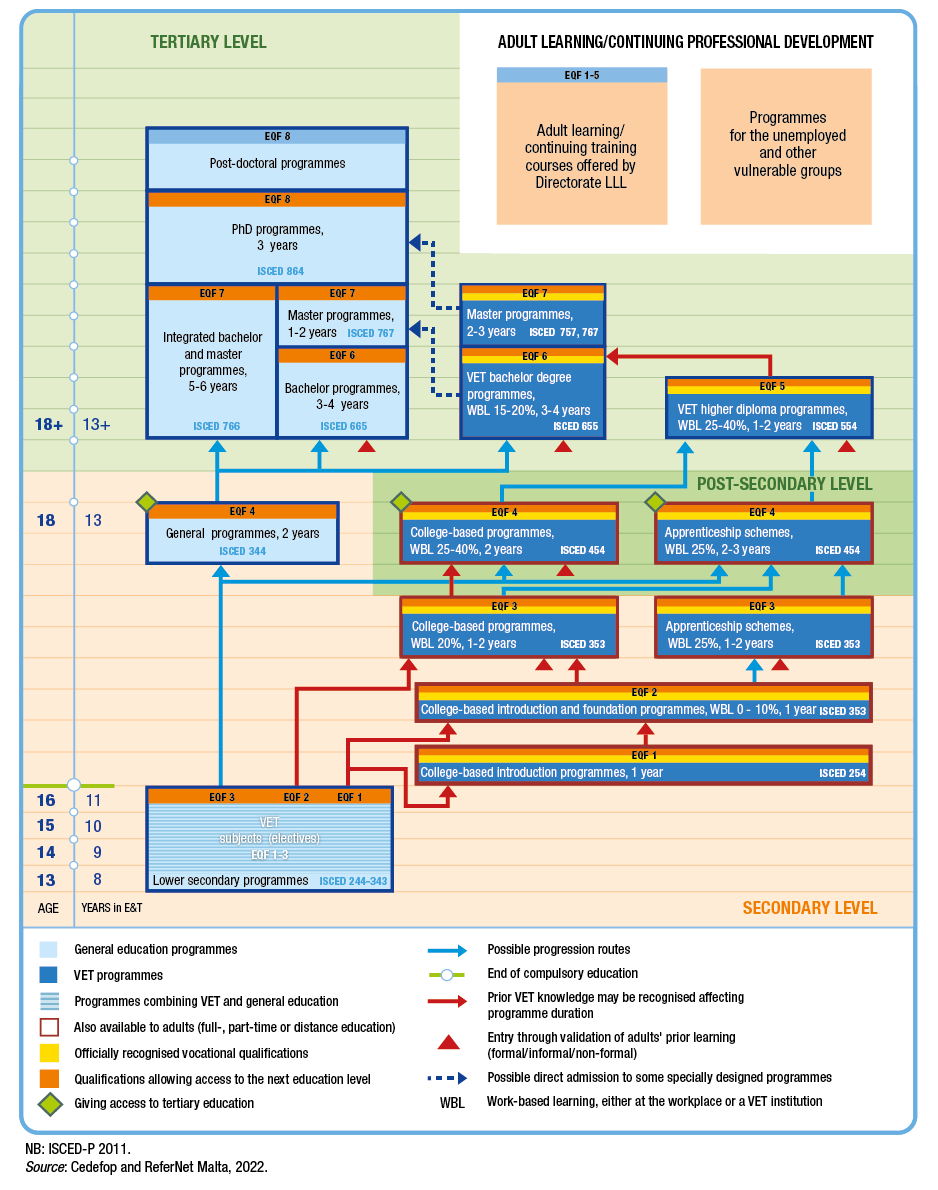
In 2015/16, VET subjects at Malta qualifications framework (MQF) level 3 (EQF level 3) were introduced in compulsory education in all lower secondary schools: the compulsory secondary education system in Malta comprises students from age 11 to age 16 (lower secondary) and two years of upper secondary education. The introduction of vocational subjects in secondary schools opens up opportunities for more learners to progress to further and higher education. This is a result of the MyJourney:...
Bodies responsible
This section lists main bodies that are responsible for the implementation of the policy development or for its specific parts or activities, as indicated in the regulatory acts. The responsibilities are usually explained in its description.
Ministry for Education (MFED)(until 2022)
Ministry of Education and Employment (MEDE) (until 2020)
To make the PES a modern, efficient and effective organisation, capable of successfully fulfilling its mission and to implement the Government’s programme, while meeting labour market needs falling within its remit.
Description
What/How/Who/For whom/When of the policy development in detail, explaining its activities and annual progress, main actors and target groups.
The board of directors restructured the executive management team of the PES under the direction of the chief executive officer. Six divisions replaced the existing three, so that Jobsplus operations and support services would be better managed.
The corporate planning division was re-dimensioned and became responsible for business planning and development, performance management, involvement of Jobsplus in activities of the European network of public employment services, people management and...
Bodies responsible
This section lists main bodies that are responsible for the implementation of the policy development or for its specific parts or activities, as indicated in the regulatory acts. The responsibilities are usually explained in its description.
increase in continuous professional development (CPD) including the introduction of management driven community of professional educators (CoPE) sessions;
implementation of reforms, including VET and applied subjects, the learning outcomes framework and continuous formative assessment;
increase in salary and better working conditions;
attract more young people to the profession and ensure that those in the profession do not leave.
Description
What/How/Who/For whom/When of the policy development in detail, explaining its activities and annual progress, main actors and target groups.
An agreement between the education ministry and the Malta Union of Teachers was signed in December 2017, covering the years 2018-22. The agreement gives greater emphasis to continuous professional development. This new agreement envisages the creation of a community of professional educators (CoPE), providing a forum of professional discussion such as school development planning sessions, CPD and links with industry and society. Several training sessions for teachers of all mainstream...
Bodies responsible
This section lists main bodies that are responsible for the implementation of the policy development or for its specific parts or activities, as indicated in the regulatory acts. The responsibilities are usually explained in its description.
Ministry for Education (MFED)(until 2022)
Ministry of Education and Employment (MEDE) (until 2020)
To give the opportunity to professionals at MCAST to keep abreast with latest developments in the industry sectors which are linked to their area of expertise in which they lecture.
The main learning outcomes (LOs) are:
LO 1. analyse the professional development achievements of own knowledge and competences;
LO 2. present own experiences and development ideas to colleagues and learners;
LO 3. develop content and methods of teaching relevant for the present and future generations of learners...
Description
What/How/Who/For whom/When of the policy development in detail, explaining its activities and annual progress, main actors and target groups.
Industry placements for teaching staff are presently taking place in following different forms:
a recently launched MVEAR, a CPD programme for MCAST industry;
Erasmus+ mobility programmes are offered to MCAST teaching staff, enabling them to visit industries abroad;
teaching staff voluntarily asks to carry out industry placements, particularly in the summer recess, to keep themselves abreast of developments in the industrial sector relative to their areas of teaching;
the activities of the...
Bodies responsible
This section lists main bodies that are responsible for the implementation of the policy development or for its specific parts or activities, as indicated in the regulatory acts. The responsibilities are usually explained in its description.
Malta College of Arts, Science and Technology (MCAST)
to provide a structured, coherent and comprehensive professional development system by moving away from traditional methodologies and adopting a more flexible and transformative stance, which leads educators to maximise on professional learning and take responsibility for their own development;
to provide various modes of continuing professional development to inject 21st century skills and competences into educators at all levels of leadership and infuse equity and social justice within...
Description
What/How/Who/For whom/When of the policy development in detail, explaining its activities and annual progress, main actors and target groups.
In 2015, the Institute for Education was set up to be responsible for continuing professional development (CPD) and training of educators. It was also set up to create flexible and accessible initial teacher training qualifications The Institute also acts as a platform for sharing experience and promoting education leadership. Its activities, which include developing a wide array of accredited teacher training opportunities and establishing international partnerships, are financed by the...
Bodies responsible
This section lists main bodies that are responsible for the implementation of the policy development or for its specific parts or activities, as indicated in the regulatory acts. The responsibilities are usually explained in its description.
Ministry for Education (MFED)(until 2022)
Ministry of Education and Employment (MEDE) (until 2020)
This policy development aims to improve the training provision within workplaces by ensuring the provision of the fundamental knowledge and skills to be able to train apprentices and contribute to the human capital development of an organisation as related to apprenticeships.
Description
What/How/Who/For whom/When of the policy development in detail, explaining its activities and annual progress, main actors and target groups.
The in 2018 Work-based Learning and Apprenticeship Act stipulates that the VET provider is responsible for identifying and supervising the suitability of sponsors and trainers and ensuring that trainers must have sufficient technical experience, technical qualifications and personal competences. The act specifies technical qualifications as a certification recognised by the Malta qualifications framework (MQF) or by international qualification structures recognised by industry in a technical...
Bodies responsible
This section lists main bodies that are responsible for the implementation of the policy development or for its specific parts or activities, as indicated in the regulatory acts. The responsibilities are usually explained in its description.
Ministry for Education (MFED)(until 2022)
Ministry of Education and Employment (MEDE) (until 2020)
Malta College of Arts, Science and Technology (MCAST)
The Master in teaching and learning (MTL) caters for different subject areas taught in compulsory education. The main driver behind this policy development was that of improving the quality of teachers through higher quality teacher-training programmes. The faculty of education felt that there was a need to revise its programmes such that it could provide initial teacher-training programmes which equipped teachers with competences which enable them to tackle the new challenges which teaching...
Description
What/How/Who/For whom/When of the policy development in detail, explaining its activities and annual progress, main actors and target groups.
Due to the requirement that teachers need to have completed a master degree to enter the teaching profession, several master degrees in teaching and learning (MTL) were introduced: in October 2016 the Faculty of Education at the University of Malta started a two-year Master in teaching and learning (MTL) for first-cycle degree graduates. From September 2017, the Faculty of Education introduced MTL initial teacher training courses in 11 vocational subjects. In order to ensure that it provides...
Bodies responsible
This section lists main bodies that are responsible for the implementation of the policy development or for its specific parts or activities, as indicated in the regulatory acts. The responsibilities are usually explained in its description.
University of Malta
Institute for Education (IfE)
Institute of Tourism Studies (ITS)
Malta College of Arts, Science and Technology (MCAST)
To help young children (six-year-olds) with literacy problems reach the level expected of them in reading and writing.
Description
What/How/Who/For whom/When of the policy development in detail, explaining its activities and annual progress, main actors and target groups.
In order to improve basic skills in IVET, the National Literacy Agency (NLA) launched in September 2018 the Reading recovery (RR) training programme in collaboration with the university college London. The programme consists of 100 hours of individual sessions over 20 weeks. The sessions are provided by teachers trained specifically in the methodology of RR. The programme lends itself to adaptations to meet the individual needs of each student.
The programme includes the training of teachers...
Bodies responsible
This section lists main bodies that are responsible for the implementation of the policy development or for its specific parts or activities, as indicated in the regulatory acts. The responsibilities are usually explained in its description.
The development of the econometric model by Jobsplus is expected to inform policy-makers of future skill requirements. At the same time, the model can be utilised as a tool for creating different scenarios based on changes in the underlying assumptions. The comparison of results between scenarios can support impact assessments of policies and in fields such as education systems policies and migration policies.
Description
What/How/Who/For whom/When of the policy development in detail, explaining its activities and annual progress, main actors and target groups.
During 2018, work started on the design of an econometric model to forecast labour market demand and supply in Malta. The development of this model was contracted to the Institute of Economic Studies at the Slovak academy of sciences, whose expertise lies expressly in this area. Jobsplus constantly kept in touch with experts from this institute to oversee various tasks, such as the transmission of data from domestic sources, and to delineate specific preferences about the intended model’s...
Bodies responsible
This section lists main bodies that are responsible for the implementation of the policy development or for its specific parts or activities, as indicated in the regulatory acts. The responsibilities are usually explained in its description.
Ministry for Education (MFED)(until 2022)
Ministry of Education and Employment (MEDE) (until 2020)
Jobsplus (Public Employment Service)
Ministry for Finance and Employment (MFE) (until 2024)
to minimise the skill gaps that exist in some of the in-demand sectors such as the digital, technical and financial sectors (main aim);
to recommend policy changes to the government that would reduce these gaps and equip the labour force with the right skills, to meet the future challenges.
Description
What/How/Who/For whom/When of the policy development in detail, explaining its activities and annual progress, main actors and target groups.
In November 2016, a National Skills Council (NSC) was set up to establish the institutional framework for the anticipation of skills needs in Malta. The NSC is made up of representatives from:
the Ministry for Education and Employment;
University of Malta;
the Malta College for Arts, Science and Technology (MCAST);
Jobsplus (PES);
the Institute for Tourism Studies;
the Malta Chamber of Commerce, Enterprise and Industry;
Malta Enterprise;
lifelong learning entities and the civil society.
One of...
Bodies responsible
This section lists main bodies that are responsible for the implementation of the policy development or for its specific parts or activities, as indicated in the regulatory acts. The responsibilities are usually explained in its description.
Ministry for Education (MFED)(until 2022)
Ministry of Education and Employment (MEDE) (until 2020)
Ministry for Education, Sport, Youth, Research & Innovation (MEYR)
The project objective was to collect evidence on the demands faced by employers in different sectors of the Maltese economy and undertake a skills forecast in terms of skills, qualifications and experience required, as well as the number of staff required/not required in the medium and long term.
Description
What/How/Who/For whom/When of the policy development in detail, explaining its activities and annual progress, main actors and target groups.
The NCFHE, together with Jobsplus (the successor to the Employment and Training Corporation (ETC)) and Malta Enterprise, embarked on a 2014-16 research project funded by Erasmus+ on skill needs and supply and the demand for workers in the labour market in Malta. The results of the research study were presented in a conference held in July 2016 and report was finalised and printed in 2017. The project objective was to collect evidence on the demands faced by employers in different sectors of...
Bodies responsible
This section lists main bodies that are responsible for the implementation of the policy development or for its specific parts or activities, as indicated in the regulatory acts. The responsibilities are usually explained in its description.
Malta Further and Higher Education Authority (MFHEA)
To develop processes, operating procedures and tools that impact the quality of service delivered to MCAST clients, the students, and lecturer appraisal and are in line with National QA framework requirements;
to comply with the various academic and administrative national and European legislative and regulatory requirements;
to develop and disseminate a manual of administrative procedures.
Description
What/How/Who/For whom/When of the policy development in detail, explaining its activities and annual progress, main actors and target groups.
MCAST internal quality reviews follow NCFHE’s internal QA standards and the National qualifications framework (NQF). MCAST also participates in all data collection processes carried out by NFCHE.
The main inputs contributing to the creation, maintenance and responsiveness of the college’s QA system are the NCFHE National QA framework-internal QA standards: these are influenced by the European standards and guidelines and the 2009 recommendation on the establishment of European quality...
Bodies responsible
This section lists main bodies that are responsible for the implementation of the policy development or for its specific parts or activities, as indicated in the regulatory acts. The responsibilities are usually explained in its description.
Malta College of Arts, Science and Technology (MCAST)
Malta Further and Higher Education Authority (MFHEA)
National Commission for Further and Higher Education (NCFHE) (until 2021)
To provide guidance to education institutions that adopt internal and external quality assurance (QA) in order to enhance the learning outcomes provided through their educational programmes.
Description
What/How/Who/For whom/When of the policy development in detail, explaining its activities and annual progress, main actors and target groups.
The National quality assurance framework for further and higher education was launched in 2015, covering upper secondary and higher VET (IVET) including work-based learning (WBL), CVET as well as other types of further, higher and adult formal education offered by State and private providers. The framework implements legal provisions on internal quality assurance and periodic external quality audits (every five years) and provides the conceptual context for this work. It is based on the...
Bodies responsible
This section lists main bodies that are responsible for the implementation of the policy development or for its specific parts or activities, as indicated in the regulatory acts. The responsibilities are usually explained in its description.
Malta Further and Higher Education Authority (MFHEA)
National Commission for Further and Higher Education (NCFHE) (until 2021)
pathways for learners are clear, and endorsed by industry;
VET study programmes are in line with the needs of industry and up to date with technological developments;
skills and competences are relevant and responsive to the requirements of the economy;
work-based learning and apprenticeship placements are supported;
collaboration, professional exchange and reflective practice between lecturing staff and work-place mentors is promoted.
Description
What/How/Who/For whom/When of the policy development in detail, explaining its activities and annual progress, main actors and target groups.
Measures have also been taken to strengthen the involvement of social partners and companies:
companies that participate in apprenticeship are awarded a testimonial in recognition of their contribution to the apprenticeship scheme. This third-party endorsement can be used by the companies as a logo to promote themselves and to trigger conformity bias by other companies;
social partners, particularly employers, participate in the governing board of the two state VET providers (MCAST and ITS)....
Bodies responsible
This section lists main bodies that are responsible for the implementation of the policy development or for its specific parts or activities, as indicated in the regulatory acts. The responsibilities are usually explained in its description.
Ministry for Education (MFED)(until 2022)
Ministry of Education and Employment (MEDE) (until 2020)
Malta College of Arts, Science and Technology (MCAST)
Institute of Tourism Studies (ITS)
Ministry for Education, Sport, Youth, Research and Innovation (MEYR)
setting definitions and operational parameters for work placements, apprenticeships and internships;
outlining responsibilities and governance structures (such as National Skills Council, sector skills units);
defining rights and obligations for VET providers, employers and learners;
highlighting the role of employers as responsible learning partners;
setting a compulsory minimum number of hours for all forms of work-based learning and linking remuneration to the minimum wage;
using...
Description
What/How/Who/For whom/When of the policy development in detail, explaining its activities and annual progress, main actors and target groups.
Following consultation in 2016, a draft act was proposed by the education ministry on a framework for developing quality work placements, apprenticeships and internships. It was enacted as a law on 6 March 2018, providing regulations, governance and administration of accredited training programmes for work placements, apprenticeships and internships in VET. The governance of the apprenticeship system was changed as a result of the reform. Subsequently, the system has since been governed at...
Bodies responsible
This section lists main bodies that are responsible for the implementation of the policy development or for its specific parts or activities, as indicated in the regulatory acts. The responsibilities are usually explained in its description.
Ministry for Education (MFED)(until 2022)
Ministry of Education and Employment (MEDE) (until 2020)
Malta College of Arts, Science and Technology (MCAST)