

Problem statement
Addressed problem: Risk of exclusion, dissatisfaction and early leaving in work-based learning
For many young people, an apprenticeship or work-based training as part of a vocational programme, is their first experience in the world of work. Finding a welcoming and supportive work environment, where there are good learning opportunities, can be very motivating and contribute to attaining a qualification.
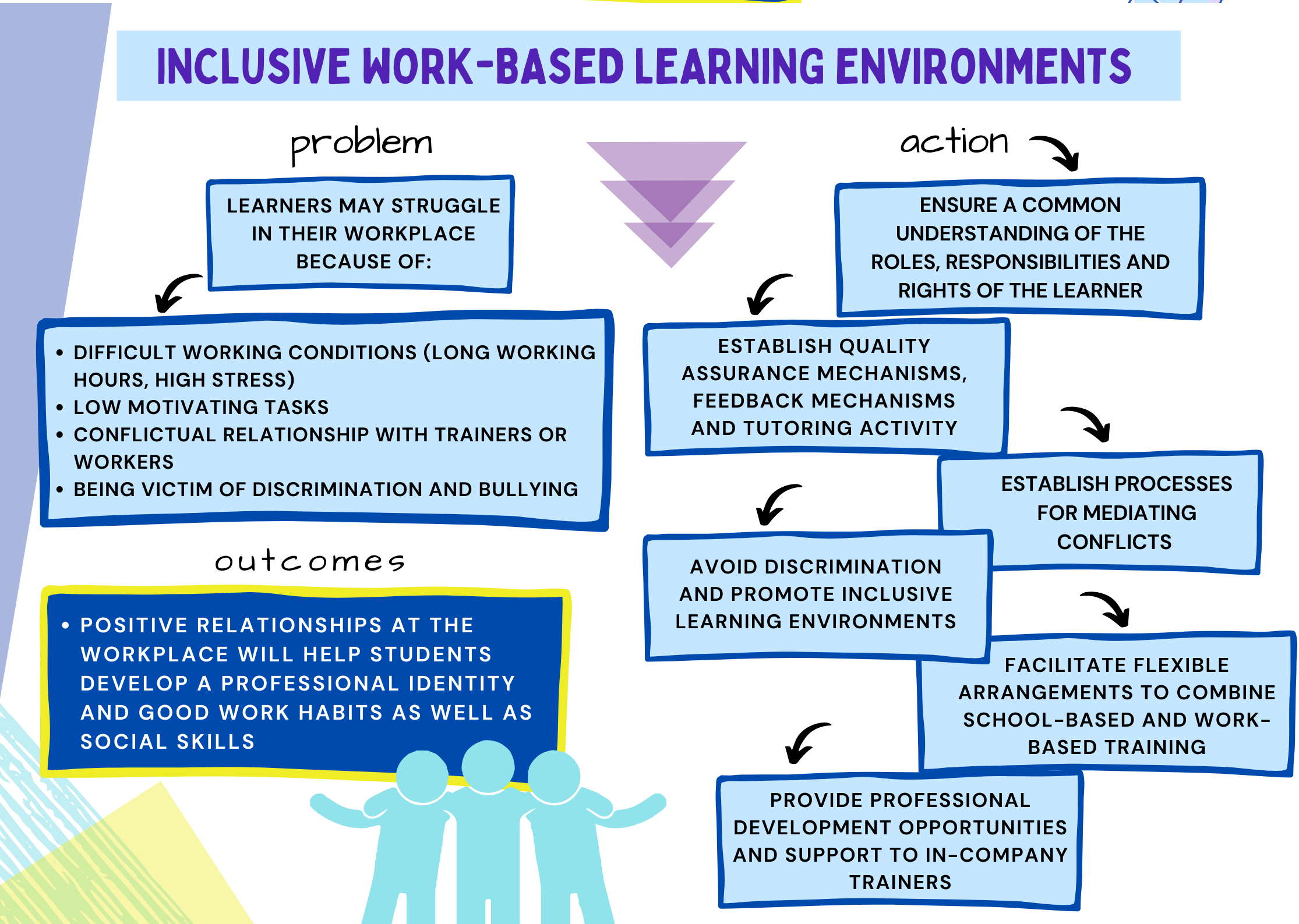
However, work-based training can also be discouraging and lead to drop-out. This may be due to a mismatch between the learners’ expectations and the reality of the profession, or to a lack of work readiness. For instance, some learners struggle to cope with tough working conditions such as long working hours, having to work on weekends, hard manual labour, or high levels of pressure and stress. Others are disappointed to have to do less motivating tasks (e.g. cleaning) in the beginning of their placement.
It can also be due to the low quality of the work-based placement and even the exploitation of trainees by employers. Conflictual relationships at the workplace either with trainers, other students, or other workers can also lead to demotivation and drop-out. In some cases, learners can be the victims of discrimination and bullying. Mental health difficulties, financial pressures, transport problems, family responsibilities, or a lack of belonging at the workplace can also increase the risk of early leaving.
In some cases, warning signs such as absenteeism, low motivation, poor performance, repeated lateness, or reduced engagement are visible before the learner leaves the programme. Training providers and employers can use regular communication, digital monitoring tools, and learner feedback to identify these signs early and provide support in time.
Beneficiaries
All apprentices and other vocational education and training students participating in work-based training. Particular sub-groups and vulnerable individuals might benefit even further, for instance: learners from disadvantaged backgrounds, including those with low socio-economic status, migrant or minority backgrounds, or special educational needs and disabilities; young women entering male-dominated occupational sectors; and learners with limited prior work experience or work readiness.
Addressing the problem
Tips: What makes a work-based learning environment inclusive and supportive?
The following tips are given as advice to policy-makers and practitioners involved in the design and delivery of vocational programmes. The information is based on Cedefop research into successful measures.
The transition into a work-based learning environment is a significant step for most young people, and many who disengage do so in the early weeks of a placement because they were not adequately prepared for what to expect. Investing in learner preparation before the placement begins is one of the most effective and cost-efficient interventions available to VET providers.
Effective pre-placement preparation of the young person should address several dimensions, including:
- Work-readiness, in terms of practical and soft skills, behaviours, and knowledge that employers will expect from day one.
- Building realistic expectations, that is preparing learners for the environment they will enter, the opportunities and challenges it entails, including understanding their rights and responsibilities in the context of the work-based learning experience.
- Preparing emotionally and psychologically, that is making the transition from a school-based to a work-based learning experience as smooth as possible.
Learners’ roles, responsibilities and rights should be clear for the company, the training provider, but also the learners themselves (and, where appropriate, their families or support networks). A written agreement between the training provider, the company, and the learner could be useful in specifying the details of training programme, the activities entailed, and the working conditions (including working hours). A code of conduct with clear rules and obligations for all three sides of the contract could also be integrated in the agreement and frame the relation between the parties. The agreement can also specify who the learner should contact in case of difficulties, absence, conflict, discrimination or physical or mental health and wellbeing concerns.
The match between a learner and their work-based placement is one of the most significant determinants of whether the placement succeeds or fails. A learner placed in an environment that is well-suited to their interests, learning style, personal circumstances and current skill level is far more likely to thrive and complete. A poor match can undermine even a motivated learner’s commitment.
VET providers and mentors should take the following factors into consideration before approving a match between a young person and an employer:
- The placement should offer tasks and learning challenges that are appropriate for the learner’s current skill level; neither too demanding nor too routine and unchallenging.
- Learners with disabilities or specific health conditions should be matched to workplaces that are physically accessible and able to make reasonable adjustments.
- Attention should also be given to the social and emotional demands of the workplace; some workplaces are high-pressure, fast-paced or socially intense environments that suit some learners well and others poorly. VET providers should try to avoid mismatches rooted in personality and working style differences.
- Geographical proximity, accessible transport links, and reasonable working hours relative to school-based commitments are practical factors that can determine whether a learner can actually attend reliably.
- VET providers should assess and review the welfare track record of employer partners, including any risks or reported cases of bullying, harassment, or exploitation.
There should be mechanisms in place to ensure that employers comply with their responsibilities regarding the provision of training. The type of mechanisms can vary significantly across countries and type of training scheme. While in some cases there could be an external agency in charge of quality assurance, in others trade unions might be involved in such quality checks. Also, training providers can have an important role in monitoring the development of the in-company training of their students.
Such mechanisms should also detect if the in-company trainer(s) need additional training or support to be able to adequately perform their role. Quality assurance processes can also include learner satisfaction surveys, digital reporting tools, and early warning indicators such as repeated absences, low engagement, or frequent changes in placement.
When the programme combines school-based and work-based learning, there is often a tutor or supervisor at the VET school. This professional can:
- accompany the learner to the workplace on the first day,
- be in charge of periodic discussions with the learner to assess the development of the work-based training,
- make regular visits to observe the workplace and the learning environment and ensure that any concerns raised by the individual are taken seriously and acted upon.
There should also be a tutor or designated contact person responsible for each trainee at the workplace. This professional should:
- Engage in regular discussions with the learner about the development of the apprenticeship or traineeship,
- Provide constructive feedback,
- Identify any changes in learner’s engagement, mood, or performance, or any other risk factors that could be associated with the non-completion of the work-based learning experience, and
- Coordinate with the VET provider and the specific tutor to ensure a consistent approach and up-to-date information on supporting the learner and addressing problems.
There should also be a tutor or designated contact person responsible for each trainee at the workplace. This professional should:
In some work-based learning systems, a mentor or coach, who is independent of both the learning provider and the company can provide additional support to the learner. This arrangement can be particularly valuable for learners facing more complex challenges, or in situations where the learner’s relationship with either the provider or the employer has become strained. The independence of the mentor from both institutions gives the learner a trusted space in which to discuss difficulties that they might not feel comfortable raising with either party.
Conflicts between a trainee/apprentice and their in-company trainer, supervisor or co-workers are not uncommon, and they can be a cause of dropout from such work-based placements. When a learner feels unable to raise a conflict or has no accessible way to resolution, disengagement is often the result. Effective conflict resolution processes are therefore a critical component of an inclusive work-based learning environment.
Intervention should take place early, before the conflict escalates. Feedback mechanisms are the first resort learners have in cases of conflict at the workplace environment. Contact points and safe people have to be made known from the beginning of the work-based placement and learners should be made aware of their rights, obligations, as well as available routes to follow.
The person who is designated as mediator must be perceived as genuinely independent of both the learner and the employer. In many cases the VET provider tutor can serve this role, if this condition is met. An independent coach or mediator (see Tip 5) can be more effective in cases where the conflict is serious and prolonged or where trust has broken down.
Placement transfer should be considered as a last resort, available when conflict cannot be resolved and the placement environment has become unbearable for the learner. The existence of this option can prevent a placement breakdown from becoming a programme dropout.
Being skilled in an occupation does not necessarily mean being prepared to teach it. Also, employers are often not used to working with young people and they expect them to behave like adults and workers from day one.
Trainers at the workplace should receive training and support to help them:
- manage their expectations about learners’ performance,
- adapt the training to the skills and knowledge of learners,
- support learners with multiple and intersecting disadvantages (e.g. learners with disabilities, learners from migrant or ethnic minority backgrounds, learners with mental health difficulties, or learners from very disadvantaged socio-economic backgrounds), in a timely manner, apprentices or trainees at risk of dropping out,
- manage conflicts constructively and deal with situations of discrimination and bullying at the workplace
Professional development for in-company trainers should be accessible, practically oriented, and not add excessive workload to the busy schedule of professionals. Short, modular training formats, peer learning networks among in-company trainers in the same sector, and online resources are all effective approaches. VET providers should take an active role in organising and facilitating this development, rather than leaving it to individual employers to arrange.
Recognition of the in-company trainer role, through formal accreditation, inclusion in professional development frameworks, or public acknowledgement, can further increase motivation and status for people who often perform this role as an add-on to their primary job and receive little recognition for it.
Digital tools offer opportunities to strengthen the quality and inclusiveness of WBL placements, particularly in relation to monitoring learner well-being and progress, facilitating communication between learners, providers and employers, and generating the data needed for quality improvement.
The use of digital learning logs and e-portfolios allows learners to record their daily or weekly activities, reflect on their learning, and track their progress against competency frameworks. This makes the work-based learning process more visible to both the in-company trainer and the VET provider tutor.
Moreover, secure messaging platforms or dedicated apps that facilitate three-way communication between the learner, the VET provider tutor and the in-company trainer can improve coordination and keep all parties informed of developments in real time.
Interactive digital modules covering workplace rights, health and safety, professional expectations and conflict resolution pathways can supplement face-to-face preparation of the learner for the work-based experience.
Lastly, AI-assisted early warning systems can identify patterns in digital log data, check-in responses or communication frequency and help identify learners showing early signs of disengagement, thus helping prompt timely intervention and support from both the in-company tutor and the VET provider tutor.
When learners can see themselves as professionals in the making, and when their growing competence is acknowledged and valued by those around them, even challenging working conditions become navigable. Professional identity develops through an engaging and motivating process, which enables young people to perceive the training as meaningful.
Work-based learning offers a good context for the development of a professional identity through the authentic interaction between the young person, their co-workers, as well as the trainer and the company leadership. Trainers who openly express pride in their profession, share their own career journey, and describe the meaning and the value of the work they do, act as powerful role models for young people. Through such role models, young people develop a clearer understanding of the occupation and begin to identify with its values, norms and practices.
Moreover, gradually increasing the complexity and autonomy of tasks assigned to the learner, with explicit acknowledgment of each step forward, builds confidence and reinforces the learner’s sense of growing professional competence. Feedback should explicitly connect the learner’s daily activities to the skills and values of the occupation.
Learners are more likely to persist through challenges when progression pathways are visible and they can clearly see where their current programme may lead, in terms of qualifications, career opportunities, and the trajectories of previous graduates.
Lastly, to build a strong sense of professional identity, competences developed during these placements should be made visible, should be valued and credited with formal qualifications and recognition. Assessment should also be transparent and reliable, and communicated to learners in due time. Digital learning portfolios and e-portfolios that document the competencies developed during WBL can serve both as recognition instruments and as valuable career tools that learners carry beyond the programme.
Discrimination, bullying, and harassment are serious risks for young learners and can affect their well-being, but also the completion of the programme. Addressing these risks requires both proactive prevention and responsive, effective action when incidents occur.
At entry, the standardisation of application and selection procedures for apprentices / trainees, particularly in small- and medium- sized enterprises, can ensure that the process does not leave room for discriminatory practices against minority groups and vulnerable learners.
During the work-based learning experience, the tutor or supervisor at the company, and at the training provider, have a responsibility to maintain vigilance for signs of discrimination, bullying or harassment, and to act swiftly and effectively when they are identified. Work placement programmes need to ensure that learners with physical disabilities have access to a fully accessible workplace, with appropriate equipment and adaptations. Moreover, learners from ethnic minorities and migrant backgrounds need to be able to access information easily and receive explanations and support when misunderstandings occur due to language barriers. Making learning environments more inclusive also implies using learner-centred pedagogies to adequately respond to the needs of the diverse learner population.
When discrimination, bullying or harassment is reported or identified, the response must be swift, serious and clearly communicated to the learner. The learner must be taken seriously, supported and protected from any form of retaliation or further harm while the situation is being investigated. Moreover, the employer must take clear and documented action in response to substantiated incidents, in line with their legal obligations, while the VET provider must maintain oversight and control, and, when necessary, be prepared to remove the learner from the placement and arrange for an alternative and equally rewarding experience for them.
Many VET learners combine school-based and work-based learning as part of the same programme. In such cases, poor coordination between the two sides can create confusion, exhaustion and a sense of institutional incoherence that may discourage and demotivate learners.
For these reasons, flexibility in scheduling and organisation is a key lever for making combined programmes sustainable and manageable for learners. Training providers may need to adapt the training hours to the business working hours. For instance, if a business undertakes most of the work in the morning, the training provider can move its training hours to the afternoon, or organise the training on alternate days (e.g. two days a week at the training provider and three at the company).
Transport to and from the workplace is a practical dimension that should not be treated as the learner’s sole responsibility. Providers and employers should work with local authorities and transport operators to ensure that learners have reliable and affordable access to their placement, particularly for early morning starts or locations not served by public transport.
For many young people, particularly those with limited prior work experience or from disadvantaged backgrounds, families and close support networks can play an important role in sustaining motivation and helping them cope with challenges encountered during work-based learning. Informing families about the objectives, expectations and potential difficulties associated with placements can help them provide practical and emotional support. In some cases, family members can also contribute to identifying early signs of disengagement and encourage learners to seek help when needed.
Expected outcomes
Positive and supportive workplace relationships can foster the development of a professional identity, strengthen work habits and social skills, and contribute to learners’ well-being and persistence in training. When learners’ achievements are recognised and valued by colleagues, this contributes to an increase in self-esteem and self-confidence.
The following outcomes can be expected at different levels:
 |  |  |
|---|---|---|
| INDIVIDUAL | INSTITUTIONAL | SYSTEM |
|
|
|