

Problem statement
Addressed problem: Closed doors and lack of choices
Flexible education systems enable learners to move within and across education, training and employment. Flexibility means that young people can adapt their learning pathway as they go along, to suit their interests and abilities.
In systems that lack flexibility, it is difficult for young people to make transitions from one learning pathway to another. They may find that they are restricted to their original choice, even if they have realised that this choice isn’t right for them. This can be a factor leading to drop out.
Barriers to flexibility:
- Repetition of learning: When previous learning experiences and credits are not validated, repetitions in learning may occur, which can be highly demotivating for young people. Learners who are able to switch courses, but are required to start from the beginning, can be discouraged by the need to repeat content they have already covered in their previous course. Cedefop evidence shows that limited recognition of prior learning and lack of credit transfer are key structural barriers to flexible pathways and increase the risk of early leaving.
- Delivery and timing: Flexibility in the delivery and timing of learning opportunities means that young people who have other demands on their time can continue to work towards their chosen qualification, or can return to learning if they have already dropped out.
Young people facing barriers to learning or who have had to interrupt their education may benefit from an extended period to complete their studies, the possibility to attend courses on a part-time basis, or an alternative teaching method (e.g. online or blended learning).
Moreover, the systematic use of grade retention as a means to reduce the educational delay of low-achieving pupils, and of suspension or expulsion from school as disciplinary measures for students with behavioural problems, can lead to early leaving. Research shows that students who repeat grades have higher chances of dropping out, generally do not improve performance, and have a more negative attitude towards school. Suspended students are more likely to drop out, to misbehave again, and to have poor academic performance. There are also strong links between school exclusion and social exclusion.
Furthermore, permeability means that young people can progress to programmes at higher level and take forward their long-term career, regardless of the pathway they have chosen. If systems are not permeable, progression (e.g. from VET to higher education) becomes difficult. This can reinforce negative perceptions of VET as a ‘second-class’ option.
Finally, it is essential to address the “return to learning” barrier. People who have dropped out before completing secondary education often face difficulties re-entering the system due to entry requirements or a lack of flexible provision. Cedefop research highlights that short, targeted learning opportunities, including micro-credentials, can play a key role in re-engaging early leavers by offering accessible entry points back into education.
Beneficiaries
All young people can benefit from flexibility and permeability in education and training systems. It is important for students who would like to change to a different programme, and for young people who are looking for an opportunity to re-enter the system. Young people facing external barriers to learning (e.g. they need to work to support their families or have caring responsibilities) may also need flexibility in the way a course is delivered.
Poor school performance and inappropriate behaviour are often associated with disadvantaged socio-cultural backgrounds. Measures that prevent or avoid repetition, suspension or expulsion can be particularly important for students from disadvantaged backgrounds.
Addressing the problem
Tips: Making education systems more flexible and permeable
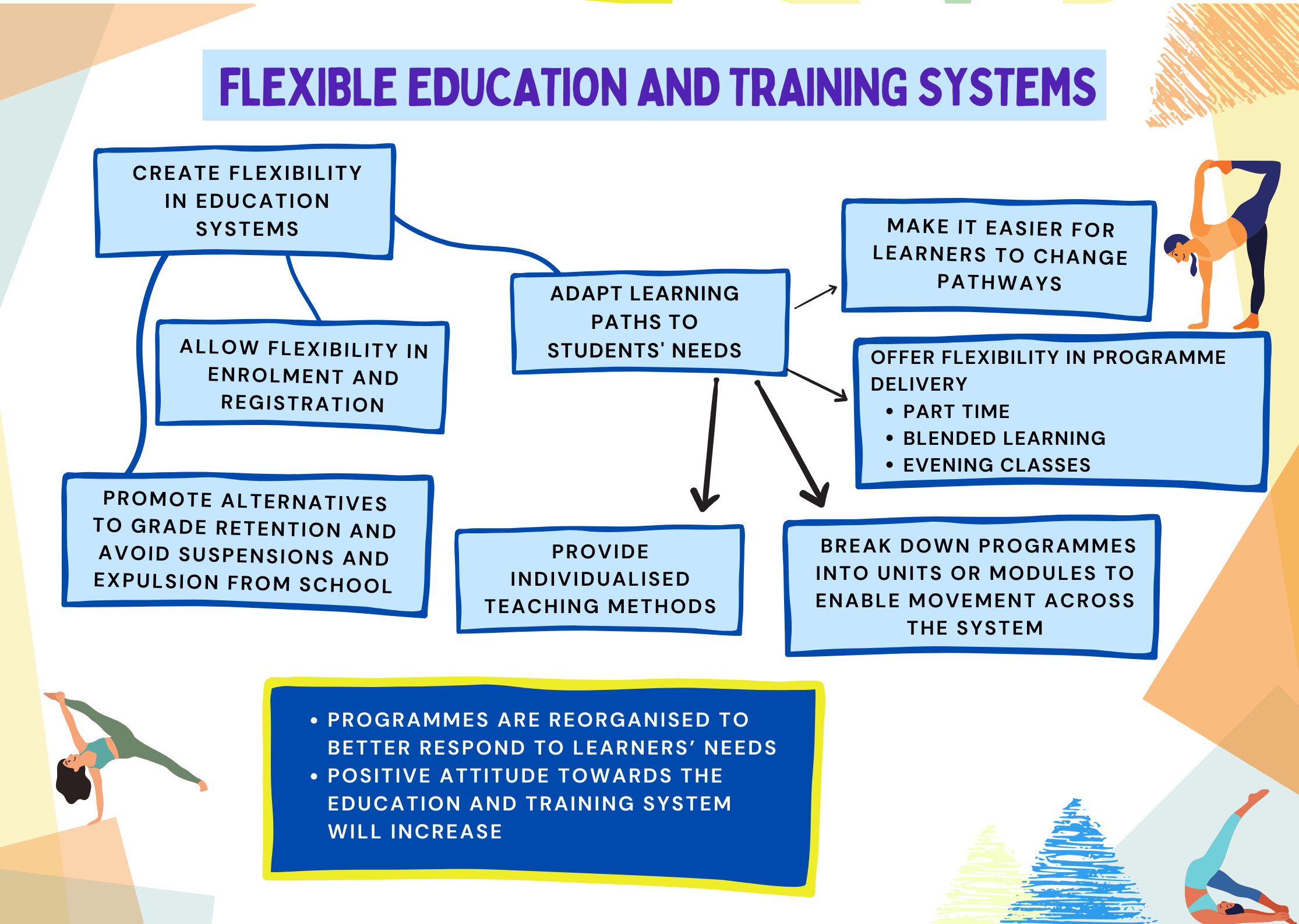
More flexible and permeable VET pathways can be achieved in a variety of ways. These include modularisation, credit transfer, recognition of prior learning, flexible delivery modes, and individualised teaching methods.
Cedefop evidence also highlights the growing role of micro-credentials as a complementary tool to support flexible, learner-centred pathways and lifelong learning.
The following tips are given as advice to policymakers and practitioners involved in the design and delivery of such measures. The information is based on Cedefop research into successful measures.
It should be possible, and relatively simple, for learners to move across to a different programme. Learners should not have to repeat curriculum content they have already successfully completed. Repetition can be avoided through modularisation, credit transfer, or recognition of prior learning. Micro-credentials can further support this by certifying specific learning outcomes in a transparent and portable way, allowing learners to accumulate and transfer achievements across institutions and systems.
Using interoperable digital platforms storing learners’ academic records can facilitate automatic recognition of validated knowledge and modules, reducing administrative burden and preventing demotivating repetition.
Modularisation or partial certification enable learners to certify their skills gradually. This can increase motivation and provide a sense of achievement. Micro-credentials operationalise this approach by offering short, targeted, and assessed learning experiences that can be “stacked” towards full qualifications.
This is particularly beneficial for:
- learners with low self-confidence,
- early leavers returning to education, and
- learners needing to update or complement specific skills.
Moreover, stackable micro-credentials and digital modules allow learners who have dropped out and wish to return to education or training to target specific skill gaps without restarting a full programme.
Grade retention should only be used in exceptional circumstances. It is important to assess the benefits of repetition and alternative measures on a case-by-case basis. Parents and students should be involved in the decision about grade repetition. Furthermore, students must not be simply held back. To ensure that repetition has a positive impact, specific measures should be in place to promote the academic achievement and social skills of students who repeat a grade. Evidence shows that grade retention is often associated with lower achievement, reduced motivation, and a higher risk of early leaving; therefore, preventive and supportive measures should be prioritised.
Alternatives to grade retention can include:
- One-on-one or small group support, tutoring or counselling
- Cooperative learning and peer tutoring
- Support with homework, such as school-based homework clubs or support by university students
- Parental involvement, including the development of routines and time management for homework and out-of-school activities
- Strengthening positive teacher–pupil relationships
- Organisational measures, such as grouping students by level of achievement in certain subjects, multi-age grouping, or smaller class groups
- Participation in extracurricular activities to increase motivation
- Increased instructional time at school, out of school, or during summer breaks
Alternatives to grade retention can be promoted at system level by giving schools autonomy to adapt curricula and assessment to individual needs. Cedefop evidence highlights that flexible, learner-centred approaches – including modular learning and personalised pathways – are more effective than repetition in supporting learner progression and preventing early leaving.
The use of digital technology and artificial intelligence (AI) can help tailor these alternatives to the individual needs of learners at risk of repeating a grade. AI-powered diagnostic tools can identify specific learning patterns and neurodivergent needs early on. These tools can provide timely feedback, help identify patterns in learning difficulties, and suggest tailored practice exercises and assistive learning strategies to address the root causes of underperformance before grade retention is considered.
Serious behavioural offences may require a student to be excluded from school. Nevertheless, suspension or expulsion should be used in very limited circumstances, and only after careful consideration of alternative measures, such as:
- Counselling and on-site support with multidisciplinary teams;
- Short courses (online or in-person) to promote social skill development, conflict resolution, and behavioural change. These can address specific topics such as discrimination, sexual harassment, alcohol or drug use, inappropriate language, among others;
- Parental involvement, including better communication between school and parents and a coordinated approach to behaviour change;
- Behaviour contracts that specify expected behaviour, consequences of misbehaviour, and incentives for appropriate behaviours. These contracts should be negotiated with the student;
- Behaviour monitoring, including the use of behaviour checklists for students, parents, and teachers, and feedback sessions focusing on positive behaviour when it occurs;
- Restitution, such as an oral or written apology or participation in activities to clean and improve the school environment.
In-school suspension should be preferred to out-of-school suspension and expulsion. It should be combined with measures to promote behavioural change and allow the student to continue academic instruction. Procedures must be clear for students and staff, and improved behaviour should be linked to the student’s return to the regular classroom.
VET schools and the education system should also promote preventive measures to reduce the use of suspension and expulsion. This includes introducing early warning systems to identify at-risk students (e.g. low attendance, declining grades) and address emerging issues before they become disciplinary problems. It is also important to promote a positive school climate. Evidence shows that exclusionary disciplinary measures are associated with a higher risk of early leaving and social exclusion; therefore, preventive and supportive approaches should be prioritised.
Research has shown that using AI and machine-learning analytics in early warning systems can improve their efficiency in identifying low-performing learners and those at risk of early leaving. By intervening before behavioural issues escalate, schools can shift from punitive measures to proactive support, maintaining a positive and inclusive school climate.
It is important that young people who have left the education and training system can return to mainstream education. This includes learners who have taken part in second chance or compensatory measures.
Maintaining links between these alternative opportunities and mainstream education is key to ensuring that all learners have the opportunity to complete upper secondary education. This includes finding ways to recognise the learning outcomes achieved through second chance and compensatory measures and tackling negative perceptions of this type of provision. Digital qualifications and micro-credentials can provide a transparent and flexible way to validate skills acquired in non-formal and informal learning contexts. Cedefop evidence highlights that micro-credentials can support re-entry into education by offering accessible, targeted learning opportunities, and by making prior learning more visible and portable across institutions and systems.
VET should not be a closed path. Opportunities to pursue lifelong learning should be available to all learners, and progression routes into higher education from VET should be ensured. Stronger collaboration between VET and higher education providers is essential to support successful transitions.
Cedefop evidence highlights that flexible and permeable pathways, supported by modular learning and micro-credentials, can facilitate progression across education and training systems.
VET providers should make learners aware of future opportunities, introduce them to higher levels of study, and expose them to the world of work. Collaboration with higher education institutions can be fostered through interactive virtual or in-person meet-ups, presentations, AI-driven career simulations, and joint educational or vocational projects, allowing learners to explore advanced pathways.
Micro-credentials can further support progression by certifying specific skills aligned with higher education and labour market requirements, enabling learners to build towards more advanced qualifications over time.
Strict enrolment conditions and registration deadlines can be a barrier to participation in VET. Young people who are waiting for the results of their initial education, may apply to a programme and then not be able to access it because they do not attain the required grades. It is important to keep enrolment and registration open long enough to allow such students to apply to other programmes. This can help avoid dropout during periods of transition between education levels.
User-friendly digital enrolment portals should be designed for easy access, to prevent the risk of “digital exclusion”. Simplifying the interface helps ensure that the registration process itself does not become a barrier for those with limited access to technology, low digital literacy, or low administrative confidence.
Cedefop evidence highlights that administrative barriers, including rigid enrolment procedures, can discourage participation, particularly among vulnerable learners.
For early leavers who decide to return to learning, offering opportunities to do so mid-way through the term or year reduces the risk that they will engage in alternative activities (e.g. take up a job) by the time the next academic year begins. Flexible entry points, including rolling admissions and modular or micro-credential-based provision, can further support timely re-entry into education and training.
Part-time, distance or blended learning (a combination of online learning and traditional face-to-face instruction) opportunities can be helpful for young people who face external barriers to learning. For example, young people who have caring responsibilities or who are in employment may be able to complete their qualification through evening classes or online learning. The recent experience of the COVID-19 pandemic has shown that digital technology can be leveraged to overcome barriers to the delivery of classes.
Cedefop evidence highlights that flexible delivery modes, combined with modular learning and micro-credentials, can increase participation among learners with external commitments or disrupted learning pathways.
Guidance and counselling should help learners develop career management skills and choose the right pathway from the very beginning. It can help those young people who are struggling with the path they have chosen, to decide how to move forward, and it can also help those who have left school to find a pathway back into education. Integrating, or ensuring strong links between, guidance and counselling services provided by the education and employment sectors for both initial and continuing VET could help support flexible learning pathways.
AI-enhanced career guidance tools can help learners map their interests based on real-time labour market data. This empowers students to develop “AI agency”, allowing them to make informed decisions about their future. Cedefop evidence highlights that combining personalised guidance with digital tools can improve decision-making, reduce drop-out risk, and increase alignment between learning pathways and labour market needs.
Young people may just need an opportunity to re-assess their situation and identify a way forward. One way of doing this is through the use of a portfolio or skills audit approaches. Identifying and recognising learners’ existing skills, then building on these through individual learning plans and pedagogies may mean they do not need to repeat curriculum content in their new pathway.
Validating non-formal and informal learning can also help young people who have acquired skills outside of formal education, for instance through employment. By identifying and validating existing skills (through credit or a certificate), it can help young people return to education and obtain a qualification. AI-driven "skills-mapping" tools can analyse learners’ past experiences, including informal work or hobbies, and translate them into recognised competences in digital portfolios. Using these tools, practitioners can build highly individualised learning plans that respect the learners’ existing journey and prevent "learning fatigue”.
Cedefop evidence shows that recognising and building on prior learning, including through digital micro-credentials, increases engagement, motivation, and successful re-entry into education and training.
Expected outcomes
Flexible and permeable education and training systems can deliver positive outcomes at different levels:
 |  |  |
|---|---|---|
| INDIVIDUAL | INSTITUTIONAL | SYSTEM |
|
|
|