

Problem statement
Addressing problem: Recognising signs of early leaving from education and training
Learners at risk of early leaving often present distress signs long before they leave. When these signs are detected in a timely manner, there are greater chances of re-engaging young people through relatively simple, timely, and proportionate interventions. Early identification increases the likelihood that learners can be supported through timely and proportionate interventions, leading to better outcomes while preserving their sense of agency and dignity.
Each learner is different and so are the ways in which they signal that something is not going well. Absenteeism, low academic attainment, and disruptive behaviour in the classroom are commonly associated with risk of early leaving. However, subtler signals, like emotional withdrawal, distress, declining motivation, social isolation, or sudden change in engagement, can easily go unnoticed.
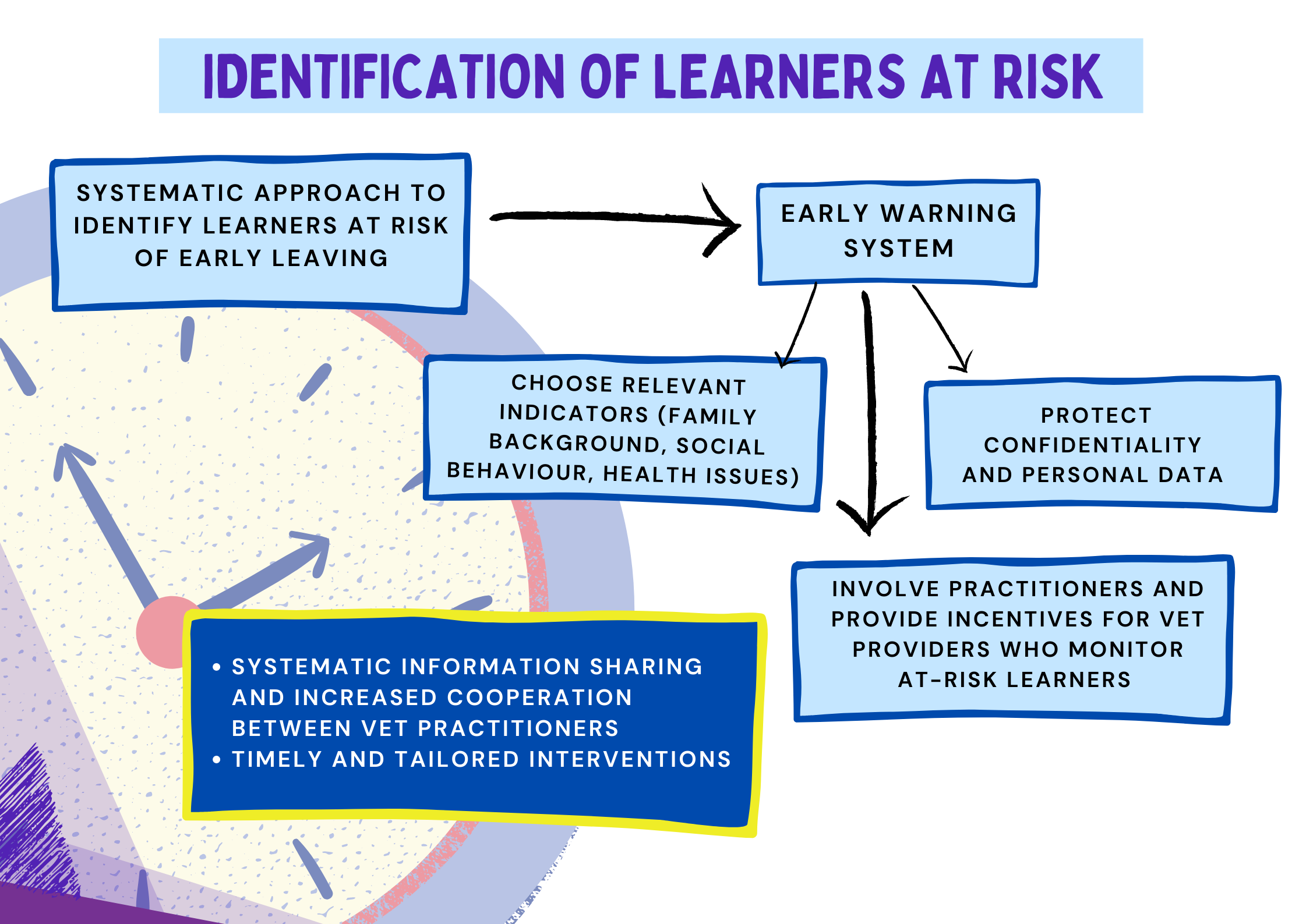
Practitioners are best placed to recognise distress signals and spot pupils at risk, as they are in direct and regular contact with the learners and routinely track attendance and academic progress. However, they often lack the dedicated time, training, or institutional support needed to identify and act upon signs of risk in a systematic and efficient way. A whole-institution approach, combining practitioner observation with structured data collection and digital tools, is a key condition to identifying learners at risk of early leaving and to eventually preventing early leaving.
Beneficiaries
Addressing the problem
Tips: How can VET providers identify learners at risk of early leaving?
The following tips are intended for policy-makers and practitioners involved in the design and implementation of VET measures and draw on Cedefop research into successful interventions and existing early warning systems.
Before selecting indicators or designing data collection processes, it is important to clearly define the purpose(s) that the early warning system is intended to serve. The overarching goal is always to identify learners at risk of dropping out so that timely and appropriate support can be provided. However, data collection additionally can serve a range of other purposes such as:
- Monitoring trends in the risk of early leaving at institutional, local, regional or national level;
- Evaluating the effectiveness of measures aimed at preventing early leaving;
- Deepening knowledge on protective and risk factors;
- Informing staff professional development and curriculum development; and
- Supporting learner transition between education levels or providers.
Defining the purpose(s) of data collection upfront, shapes all subsequent decisions: which indicators to collect, how often, at what level of detail, and with whom data may be shared. It also determines what data governance arrangements are required.
For data to be comparable over time and usable for monitoring or evaluation of measures, providers should consider:
- Using existing administrative data to minimise additional burden on practitioners;
- Developing additional data collection tools (e.g. well-being questionnaires);
- Using flexible formats, so that the system can be updated as knowledge of early leaving evolves or as the institutional context changes; and
- Aligning data collection with national or regional monitoring frameworks, so that comparable data can be meaningfully aggregated.
Early warning systems are built around the selection of indicators that reflect known risk factors. These indicators can cover information on family background, academic attainment, behaviour and attitudes, health and well-being. The table below presents the main indicators found in Cedefop’s research on early leaving from VET. VET providers should choose the combination most suited to their context and available resources.
| FAMILY ENVIRONMENT | ATTAINMENT, BEHAVIOUR AND ATTITUDES | HEALTH AND WELL-BEING |
|---|---|---|
|
|
|
* In some countries, collecting data on ethnic or migrant background is not possible to due to legal provisions. Providers should verify applicable data protection and equality legislation before including such indicators.
When selecting indicators, VET providers should bear the following principles in mind:
- No single indicator is sufficient to definitively identify a learner as ‘at risk’. The combination and trajectory of indicators over time is most informative.
- Indicators should be sensitive to change: a sudden deterioration (e.g. a sharp increase in absences or marked decline in grades) may be more significant than a chronically low score.
- Qualitative observations made by practitioners regarding learner behaviour and signs of disengagement (such as a learner becoming withdrawn, changing friendship groups, or expressing hopelessness) are valuable and should have a recognised place in the system.
- Transition points (e.g. start of a new school year or a work-based learning placement; or moving between levels) are periods of heightened vulnerability and should be monitored with particular attention.
Practitioners are best placed to collect data on risk indicators because they observe and interact with learners directly and regularly. Teachers and trainers as well as counsellors, work-based learning supervisors, and other professionals and support staff, may each have access to different information regarding the same learner. For this reason, effective identification of those at risk of dropping out requires all of them to contribute.
Different practitioners contribute different kinds of information:
- Teachers and trainers observe changes in academic performance, motivation, classroom behaviour, and peer relationships on a day-to-day basis.
- Counsellors and health professionals are often the first to hear about personal or family difficulties not visible in academic data.
- In-company trainers and employers are well-placed to detect problems arising during work-based learning.
- Administrative staff often have sight of attendance and registration data and can flag anomalies at an early stage.
Practitioners can also use structured tools to collect data on less visible indicators. Well-being questionnaires, brief check-in surveys and structured observation protocols can complement informal observation and ensure that quieter, more withdrawn learners are not overlooked. These tools should be quick and practical to use.
To facilitate practitioners’ involvement in data analysis and collection, it is important to make data easily accessible to them. This means ensuring that data systems are user-friendly, that relevant data is presented clearly, and that practitioners receive guidance on how to use data to inform their practice.
Personal data protection is a major concern when developing an early warning system. Such systems need to comply with legal frameworks for data protection and make sure that:
- Data gathered is used for a legitimate purpose: to provide appropriate support to learners at risk of early leaving. Only data strictly necessary for the stated purpose should be collected and retained (data minimisation), and personal data should be stored only for as long as necessary to provide support to the learner concerned.
- Data is only accessed by professionals who have an immediate and direct role in providing this support. Only practitioners working with a certain student should have access to their data. Tiered access arrangements are advisable, so that more sensitive data (e.g. on health or mental health) is restricted to a smaller group of authorised staff (e.g. head teacher and counsellor).
- Learners and, where applicable, parents or guardians should be clearly informed about what data is collected, why, who can access it, and how long it is retained.
An adequate follow-up of learners at risk of early leaving may require sharing data with other relevant services (e.g. social services, health services, youth services, or other). A legal basis for sharing must be established before any data is exchanged and formal data sharing protocols and existing frameworks must be respected.
Usually, data sharing will require arrangements to be put in place, including:
- Informing learners and, where appropriate, obtaining consent for data processing beyond what is legally required for educational purposes. Where consent is used, learners should receive clear information on how their data may be shared and used by other entities. Before giving their consent, students need to receive clear information on how data might be shared and used by other entities.
- Signing protocols of collaboration to enable databases to be shared and used by various organisations. The development of protocols for data sharing can be a technically complex and lengthy process. It requires political leadership to bring all actors on board, and close collaboration between policy officers and technical staff from statistical and IT backgrounds.
Data should only be used by organisations providing support to young people, or by researchers and evaluators assessing the effectiveness of support measures. Part of the data can be transmitted to national or regional level authorities to develop aggregated indicators at that level (for instance, this is often done with data on absenteeism) or be used in research. For these purposes, data needs to be anonymised. Specific ethical guidelines for the use of data should be followed by all actors involved.
In many countries, it is not possible to share data on learners or contact young people. In these cases, the use of anonymised data for research on the factors related to early leaving, can enable the design of more targeted measures.
Building practitioner capacity is a core condition for success, not an optional add-on. Capacity building should be embedded in regular continuing professional development and should not be treated as a one-off training event. Practitioners need support from national and regional administrations, in several areas:
- Understanding of risk and protective factors: practitioners need a grounded understanding of the evidence and factors influencing early leaving, and how these interact differently for different learner groups.
- Data literacy: practitioners need support in collecting, interpreting and acting on data, including understanding the limitations of data and the dangers of over-interpreting individual data points or systemic bias in data.
- Use of digital tools: as data management systems and digital early warning tools become more prevalent, practitioners need training in how to use these tools effectively, critically and ethically (see also Tip 9).
- Legal and ethical literacy: practitioners need to understand the data protection rules that apply to their work, the boundaries of their role, and when and how to involve other services.
The identification of learners at risk cannot be left solely to the initiative of individual providers. National and regional administrations can play a critical enabling role by creating the conditions under which providers can invest in identifying and preventing early leaving sustainably and confidently. Practical forms of support and incentivisation include:
- Recognising the time spent by practitioners on the design and development of early warning systems and data collection, by formally incorporating these activities into job descriptions and workload planning. In this way, these tasks are not perceived and treated as burdensome additions to existing duties.
- Providing dedicated funding or additional budget to VET providers who demonstrate strong early warning systems and systematic monitoring of at-risk learners.
- Sharing and celebrating good practices through national or regional events, awards, or good practice repositories, to create positive recognition and stimulate peer-learning.
- Providing useful and timely feedback to providers on their performance regarding identifying and preventing early leaving (e.g. informing them on their performance regarding different indicators compared to the national average or to providers of similar characteristics).
- Developing national frameworks, templates or digital platforms that smaller or less well-resourced providers can adopt and adapt, rather than building from scratch.
- Supporting inter-provider learning networks and communities of practice, particularly where VET providers are small or geographically dispersed.
The growing availability of digital data management systems and learning platforms offers opportunities to make early warning systems more systematic, timely and easier to use. Digital tools can strengthen existing monitoring and identification processes by facilitating data collection, integration and visualisation.
Digital tools can support the identification of learners at risk of early leaving in several ways:
- Data integration: Digital systems can bring together information on attendance, grades, assignment completion and learner engagement, providing practitioners with a completer and more up-to-date picture of each learner's situation.
- Automated alerts: Digital systems can generate notifications when patterns associated with disengagement emerge, such as repeated absences, declining attainment or prolonged inactivity in online learning environments, helping practitioners initiate follow-up actions in a timely manner.
- Digital dashboards: Dashboards can summarise and visualise learner-level and aggregated information, supporting practitioners in reviewing risk indicators and helping managers and policy-makers monitor trends and identify vulnerable groups.
- Monitoring participation in blended and online learning: In digital and hybrid learning environments, information on participation and engagement can complement practitioner observations and provide additional insights into learners' learning experiences.
- Data analysis: In some contexts, analytical tools may support the identification of patterns associated with early leaving and inform institutional planning and the allocation of preventive resources.
Digital tools should complement rather than replace practitioner judgement. Their use should comply with data protection legislation, remain transparent, and avoid reinforcing existing inequalities. Human oversight should be ensured at all stages, and learners with limited access to digital technologies should not be disadvantaged by the use of digital monitoring systems.
Early warning systems, if not carefully designed, can inadvertently reproduce or amplify existing inequalities. Learners from migrant and ethnic minority backgrounds, learners with special educational needs and disabilities, learners from lower socio-economic backgrounds, and learners with caring or work responsibilities are groups for whom standard indicators and identification approaches may need to be adapted to ensure equitable identification.
Data collection and monitoring systems must therefore foresee space for differentiating between different subgroups (by gender, migrant background, special educational needs, socio-economic status etc.). This would enable providers to identify whether any specific group is systematically over- or under-identified, and to take appropriate corrective action.
Early warning systems and data collection processes should also be sensitive to language and speech barriers. Well-being questionnaires and other tools should be available in learners’ home languages where possible, and cultural mediators should be involved in the development and administration of tools for use with specific communities.
In the end, VET providers, but also regional and national authorities, need to take into account that individual-level interventions are insufficient when risk is driven primarily by structural factors, such as poverty, housing instability or discrimination. Early warning systems and efforts to mitigate risk at provider level should be accompanied and supported by policies and services that support learners in facing complex needs.
For identification to lead to meaningful outcomes, it must trigger an intervention. If learners become aware they have been identified as ‘at risk’ but nothing changes, trust in the institution is damaged and re-engagement becomes less likely. The identification system must be connected to clear response pathways.
Such a pathway should include the following elements:
- A defined protocol that specifies what happens when a learner is identified as at risk: who is responsible for initiating a response, within what timeframe, and with what resources.
- Regular, structured team meetings, where practitioners review data together, share observations, and decide on appropriate measures on a case-by-case basis.
- An established response framework including different levels matching the intensity of the response to the severity and complexity of the risk profile and the learner’s needs.
- Clear criteria and pathways for referral to specialist services outside the VET provider (counselling, social services, health, mentoring), with established relationships with those services in place before they are needed.
- A standard process for reviewing and updating the risk assessment as learners’ circumstances change, including at key transition points.
Data collected by early warning systems for the identification of at-risk learners can also be used in the evaluation of the measures put in place to prevent early leaving. In order for this to be possible providers should link individual risk indicator data with records of support measures received by each learner, so that changes in risk indicators can be examined in relation to the support measures received.
Moreover, long-term observation and tracking of risk indicators for learners who have received support, can be used to assess whether their risk profile improves, stabilises, or deteriorates following the intervention.
Data drawn by early warning systems can be anonymised and aggregated to identify patterns at class, year or institution level and help answer questions such as: “are certain interventions consistently associated with better outcomes?”, and “are certain groups of learners consistently under-served?”.
Once data is analysed, VET institutions need to organise reflection sessions with practitioners to discuss teaching pedagogies and support measures and adapt accordingly.
Families are often the first to notice when a young person is struggling, and they can play a vital role in alerting practitioners and supporting re-engagement. Yet in many VET systems, family engagement in the early warning process is limited or inconsistent. Actively cultivating family and community partnerships strengthens identification and increases the likelihood that at-risk learners will accept and benefit from support.
For this reason, establishing clear and accessible channels through which families can raise concerns about a learner’s well-being or engagement, can be of paramount importance. Moreover, VET providers can adopt proactive communication approaches with families when a learner is identified as showing signs of risk, and do so in a way that is respectful, non-stigmatising and focused on solutions. Families can also be actively involved in the development of individual support plans.
To efficiently communicate with families, information must be presented to them in a clear and accessible way, including, when necessary, in languages other than the language of instruction. Community organisations, cultural mediators, and peer support networks can also help reach families from migrant or minority backgrounds, where trust in formal institutions may be limited.
Expected outcomes
Effective systems for the identification of learners at risk of early leaving generate benefits at the individual, institutional and system levels. The table below summarises the main expected outcomes of a well-functioning identification system.
 |  |  |
|---|---|---|
INDIVIDUAL | INSTITUTIONAL | SYSTEM |
|
|
|