NQF state of play
In 2011, the government laid the foundation for developing an integrating national qualifications framework for lifelong learning for Liechtenstein (NQFL), potentially covering all parts of education and training ([1] Governmental Decree RA 2010/2909-4000.). From the beginning, the development of NQFL was closely coordinated with Switzerland with whom Liechtenstein has established a common VET system.
In the first phase, the NQFL has been developed for formal education in higher education and vocational education. In 2013, a qualifications framework for higher education, defined in terms of learning outcomes in line with the qualifications framework in the European higher education area (QF-EHEA), was adopted and included in higher education law ([2] Government of the Principality of Liechtenstein (2013). Qualifikationsrahmen für den Hochschulbereich im Fürstentum Liechtenstein (NQFL-HS) [Qualifications framework for higher education in the Principality of Liechtenstein]. http://www.llv.li/files/sa/pdf-llv-sa-qualifikationsrahmen_fuer_den_hochschulbereich_im_fl_nqfl_hs_2013.pdf). It was self-certified against the qualifications framework for European higher education area (QF-EHEA) in 2013 ([3] https://www.llv.li/files/sa/nqfl-hs-prufbericht-v130710-def.pdf) and forms an integral part of the NQFL. The Ordinance on national qualifications framework for vocational qualifications – Nationaler Qualifikationsrrahmen des Fürstentums Liectenstein für Abschlüsse der Berufsbildung (NQFL-BBV) ([4] https://www.gesetze.li/konso/pdf/2017396000?version=1) – was adopted on 19 December 2017 and put in force on 1 January 2018 paving the way to full implementation of the framework. As in Switzerland, general education is currently not included in the framework.
The NQFL was referenced to the EQF in October 2016 with the referencing report published in 2017.
The NQFL, and certificate and qualification supplements, aim at improving the transparency and comparability of qualifications from Liechtenstein and referencing them to the EQF.
More specifically, the NQFL aims to (Ministry of Education, 2017, p.25):
- describe adequately the education system, improving the transparency, the clarity and the comparability of qualifications in VET, higher VET and higher education;
- support, in terms of labour market needs, an employer's assessment of the skills of vocational graduates from Liechtenstein and enable a similar process for graduates with qualifications from abroad;
- improve the employability of Liechtenstein-educated specialists and managers in the country and abroad.
In the longer term, NQFL is seen as a tool to support lifelong learning through better understanding of qualifications and learning opportunities, improved access to and participation in education and training, and valuing all learning outcomes, in formal, non-formal and informal settings.
The NQFL comprises eight levels. Competence-oriented descriptors describe requirements for each level; these are closely aligned with the EQF descriptors, but also adjusted to suit specific national features. Level descriptors ([5] Level descriptors are included in Annex 1 of the ordinance on NQFL-BBV. ) are identical to level descriptors of the Swiss NQF-VPET.
Table 1. The main elements of the descriptors in NQFL-BBV
|
Knowledge |
Knowledge |
|
Understanding |
|
|
Skills |
Procedural skills |
|
Sensorimotor skills |
|
|
Social competence |
Professional competences |
|
Personal competences: ● autonomy ● social competences ● leadership competences |
Source: Adapted from Government of the Principality of Liechtenstein (2017).
Level descriptors are defined in terms of knowledge, skills and competences. Knowledge refers to declarative knowledge and is further subdivided into knowledge and understanding. Skills refer to the capacity to apply knowledge and solve problems: a distinction is drawn between procedural and sensorimotor skills. Competences express application of knowledge and skills in the work context and are subdivided into professional and social competences.
All subsystems have taken important steps in implementing a learning outcomes approach, but to varying degrees. Learning outcomes already play an important accreditation role in higher education; a qualifications framework for higher education was implemented in 2013. In general education, standards were introduced in 2010 and subsequently tested for grades 3, 4, and 8. A competence-based approach is being strengthened in teaching and evaluation of general education. In line with the amended VET law in 2008 ([6] Article 6 of the Vocational Training Act. Government of the Principality of Liechtenstein (2008). Berufsbildungsgesetz [Vocational Training Act]. Liechtenstein law gazette, 412.0, No 103. https://www.gesetze.li/konso/pdf/2008103000?version=3) qualifications and curricula have been revised with stronger focus on competences and equipping students with the competence to act (Handlungskomptenz) (Cedefop, 2016).
The NQFL is supervised by the Ministry of Education. The National Agency for International Educational Affairs (AIBA) ([7] AIBA is an independent institution, supervised by the Ministry of Education. AIBA website: https://www.eeagrants-li.com/) has been appointed the EQF national coordination point (NCP) to carry out administration and coordination tasks connected with the NQFL.
Liechtenstein started the Bologna process several years ago and this is now an integral part of the University of Liechtenstein. The NQFL builds on experience in developing the qualifications framework for higher education.
[8] This section draws mainly on input from the 2018 update to the European inventory on validation of non-formal and informal learning (European Commission et al., forthcoming).
Since the 2016 Inventory on non-formal and informal learning, no major changes have been made. Validation approaches have been developed in initial VET and higher education, taking into account different target groups, responsibilities and methods. The Vocational Training Act determines that admission to any examination or qualification does not depend on undertaking specified educational programmes; those who have at least five years' work experience can participate in the final examinations. The validation process in VET is based on a similar process to that developed by Switzerland, following a similar series of steps. However, due to the small size of the country, only first step (information and advising) is performed in Liechtenstein; after that the candidates are sent to Switzerland.
Most development in higher education has occurred in the past five years. The Education Authority (Schulamt) regards development of the national qualifications framework for higher education (Nationaler Qualifikationsrahmen Fürstentum Liechtenstein für den Hochschulbereich) (NQFL-HS) as an opportunity for anchoring lifelong learning more within higher education, and for improving validation and recognition of prior learning achieved outside the higher education system. The legal bases for admission to higher education have been formalised. The Law on higher education regulates conditions and process of admission without a matura certificate ([9] Article 24 of the Higher Education Act. Government of the Principality of Liechtenstein (2005). Gesetz über das Hochschulwesen (Hochschulgesetz; HSG) [Law on higher education (Higher Education Act; HSG)]. Liechtenstein law gazette, 414.0, No 2. https://www.gesetze.li/lilexprod/lgsystpage2.jsp?formname=showlaw&lgblid=2005002000&gueltigdate=07032017) and limitation of crediting learning acquired outside the higher education system. It is possible to recognise non-formal and informal learning as contribution to achieving a qualification, up to a maximum of one sixth of the necessary workload (European credit transfer and accumulation system credit points) for the whole qualification.
Standards used in VET and higher education for validation, are those of existing programmes. The NQFL offers opportunities to integrate further non-formal and informal learning outcomes. However, the NQFL-BBV was adopted in 2017 with no plans to include non-formal and informal learning.
Liechtenstein has committed to an integrating national qualifications framework for lifelong learning for Liechtenstein (NQFL) (Ministry of Education (2017). The first phase of implementation focuses on formal education in VET and HE, underpinned by two sectoral qualifications frameworks: one encompassing HE qualifications (NQFL-HS), adopted in 2013 and one for vocational education (NQFL-BBV), in force since January 2018. As in Switzerland, general education qualifications are not included in the NQFL.
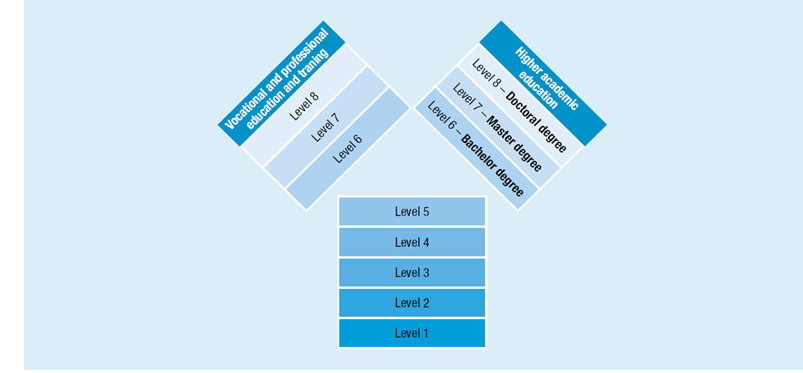
An important characteristic of the NQFL is that levels 6 to 8 are also open to higher vocational qualifications awarded outside higher education as a separate strand next to HE qualifications.
Figure 1. Y-Model of NQFL
Source: Ministry of Education (2017).
The process of assigning vocational and professional qualifications a level is carried out by Switzerland. By January 2019 ([10] https://www.admin.ch/opc/de/classified-compilation/20151046/index.html) a total of 474 formal vocational and professional qualifications had been attributed levels in Switzerland: 207 IVET qualifications mostly distributed to levels 3 and 4; and 264 of professional qualifications, mostly at levels 5 to 7; and three to level 8. The process is expected to continue ([11] For more information please consult the chapter on Switzerland in the NQF European inventory 2018.).
As defined in the ordinance on NQFL-BBV (Article 7), the Liechtenstein Government has to approve the inclusion and the level of a qualification, in a separate procedure, and can take into account those qualifications assigned by the State Secretariat for Education, Research and Innovation (SERI) in Switzerland. So far, the Liechtenstein Government has approved the first 37 qualifications. The national coordination point – AIBA – will publish the necessary documents on the website at the end of March 2019. No database has yet been set up.
Figure 2 outlines the main steps in the levelling process.
Figure 2. Main steps of the levelling process

Source: Ministry of Education (2017), p. 29.
The NQF for higher education (NQFL-HE) is already operational.
For public involvement and information, the NQFL website (Nationaler Qualifikationsrahmen Fürstentum Liechtenstein) was established in spring 2013, providing information and updates ([12] NQFL (Nationaler Qualifikationsrahmen Fürstentum Liechtenstein) website: http://www.nqfl.li/).
The NQFL was referenced to the EQF in October 2016 and the referencing report was published in 2017 (Ministry of Education, 2017).
With the first qualifications approved by the Liechtenstein Government and included in the NQFL-BBV, the framework for vocational qualifications has entered an early operational stage. The qualification framework for HE (NQFL-HS) is fully operational and well embedded in the higher education sectors. Having both sectoral frameworks as part of integrating NQFL offers opportunities to integrate further non-formal and informal learning outcomes.
One important task of the EQF NCP is to make the NQFL more visible to end-users: students, employers, guidance practitioners and training providers. The NQL homepage is currently under construction and will be available by the end of March 2019.
| NQF level | Qualification types | EQF level |
|---|---|---|
| 8 | 8 | |
| 7 | 7 | |
| 6 | 6 | |
| 5 | 5 | |
| 3 | 3 | |
| 2 | 2 | |
| 1 | 1 |
● The National Agency of International Education Affairs (AIBA) is the EQF NCP:
● NQFL website: http://www.nqfl.li/
● Ministry of Education (2017). The EQF referencing report for the Principality of Liechtenstein. https://ec.europa.eu/ploteus/sites/eac-eqf/files/nqfl-liechtenstein_final2017.pdf
|
AIBA |
National Agency of International Education Affairs |
|
EQF |
European qualifications framework |
|
NQFL |
national qualifications framework for Liectenstein |
|
NQFL-BBV |
Nationaler Qualifikationsrahmen des Furstentum Liechtenstein für Abschlüsse der Berufsbildung [national qualifications framework for vocational education] |
|
NQFL-HS |
Nationaler Qualifikationsrahmen Furstentum Liechtenstein für den Hochschulbereich [national qualifications framework for higher education] |
|
NQF-VPET |
Swiss national qualifications framework for vocational and professional education and training |
|
SERI |
Staatssekretariat für Bildung, Forschung und Innovation [State Secretariat for Education, Research and Innovation] |
|
VET |
vocational education and training |
|
VPET |
vocational and professional education and training |
[URLs accessed 7.3.2019]
Cedefop (2016). Application of learning-outcome approaches across Europe: a comparative study. Luxembourg: Publications Office. Cedefop reference series; No 105. http://www.cedefop.europa.eu/en/publications-and-resources/publications/3074
European Commission; Cedefop (2018). Survey on implementation, communication and use of NQF/EQF [unpublished].
European Commission; Cedefop; ICF International (forthcoming). European inventory on validation of non-formal and informal learning 2018: country report Liechtenstein.
Government of the Principality of Liechtenstein (2011). Bildungsstrategie Fürstentums Liechtenstein 2020 [Education strategy of the Principality of Liechtenstein for 2020]. Vaduz: Government of the Principality of Liechtenstein. http://www.regierung.li/fileadmin/dateien/downloads/AEusseres_Bildung_Kultur/Bildungstrategie_2020.pdf
LLV (2013). Bericht über die Überprüfung der Kompatibilität des Qualifikationsrahmens für den Hochschulbereich im Fürstentum Liechtenstein (NQ.FL-HS) mit dem Qualifikationsrahmen für den europäischen Hochschulraum [Report on the review of the compatibility of the qualifications framework for higher education in the Principality of Liechtenstein (NQ.FL-HS) with the qualifications framework for the European Higher Education Area]. https://www.llv.li/files/sa/nqfl-hs-prufbericht-v130710-def.pdf
Government of the Principality of Liechtenstein (2017). Verordnung über Nationaler Qualifikationsrrahmen des Fürstentums Liechtenstein für Abschlüsse der Berufsbildung (NQFL-BBV) [Ordinance on national qualifications framework for vocational qualifications]. https://www.gesetze.li/konso/pdf/2017396000?version=1
Ministry of Education (2017). Referencing report for the Principality of Liechtenstein (NQFL). https://ec.europa.eu/ploteus/sites/eac-eqf/files/nqfl-referencing_report_liechtenstein_en2017.pdf
Swiss Confederation State Secretariat for Education, Research and Innovation (2015). Swiss EQF referencing report. https://ec.europa.eu/ploteus/sites/eac-eqf/files/e_referencing_report_final_ch.pdf
Related content
Overview
Compare with other NQF
Cedefop (2023). NQF online tool. https://cedefop.europa.eu/en/tools/nqfs-online-tool