
NQF state of play
1.1. Policy context
The structure of the education system is characterised by the small size of the country, which makes it irrational to offer a complete education system at all levels. In VET and higher education, cooperation networks have been established with neighbouring countries, mainly Switzerland. At upper secondary level, for example, the entire school-based part of the basic vocational education takes place in Switzerland. The participation in upper secondary vocational education and training (VET) was 68.3%, well above the EU average, which for the same year was 49.0% ([1]More information at Eurostat [educ_uoe_enra13], accessed 27 March 2025.). It is noteworthy that 100% of IVET students combined work- and school-based upper secondary IVET, while at the same year, the percentage in EU was 29.8% ([2]More information at Cedefop - Key indicators on VET.). The participation in early childhood education in 2022 was only 50.1% ([3]More information at Eurostat [educ_uoe_enra21], accessed 27 March 2025.), almost half than the EU average, which was 93.1%. Following the nine years of compulsory schooling (primary and lower secondary level), approximately 65% of young people attend basic vocational education and training (apprenticeship) with or without an integrated baccalaureate ([4]Examination that certifies access to higher education.). Around 20 to 25% of learners attend a general upper secondary baccalaureate (Gymnasium) and a small proportion of students enrol in specialised schools, while others enter the workforce as semi-skilled employees ([5]More information in Eurydice (2024).).
From the beginning, the development of NQFL has been closely coordinated with Switzerland, as the two countries have established a common VET system.
1.2. NQF legal basis
In 2011, the government laid the foundation for developing and integrating a national qualifications framework for lifelong learning, potentially covering all parts of education and training (Decree RA 2010/2909-4000). The legal basis for the NQFL-BBV is the decree adopted on 19 December 2017 and put into force on 1 January 2018.
The NQFL aims at improving the transparency and comparability of qualifications from Liechtenstein and referencing them to the EQF.
More specifically, the NQFL aims to:
- describe adequately the education system, improving the transparency, the clarity and the comparability of qualifications in VET, higher VET and higher education;
- support, in terms of labour market needs, an employer's assessment of the skills of vocational graduates from Liechtenstein and enable a similar process for graduates with qualifications from abroad;
- improve the employability of Liechtenstein-educated specialists and managers in the country and abroad (Ministry of Education, 2017).
3.1. NQF structure and level descriptors
The NQFL comprises eight levels. Competence-oriented descriptors detail the requirements for each level; these are closely aligned with the EQF descriptors, but also adjusted to suit specific national features. NQFL-BBV level descriptors ([6]Level descriptors are included in Annex 1 of the ordinance on NQFL-BBV.) are identical to those of the Swiss NQF-VPQ.
Table 1. The main elements of the descriptors in NQFL-BBV
| Knowledge | Knowledge |
| Understanding | |
| Skills | Procedural skills |
| Sensorimotor skills | |
| Competences | Professional competences |
Personal competences:
|
Source: Adapted from Government of the Principality of Liechtenstein (2017).
Level descriptors are defined in terms of knowledge, skills and competences. Knowledge refers to declarative knowledge and is further subdivided into knowledge and understanding. Skills refer to the capacity to apply knowledge and solve problems: a distinction is drawn between procedural and sensorimotor skills. Competences express application of knowledge and skills in the work context and are subdivided into professional and social competences.
3.2. NQF scope and coverage
The NQFL covers qualifications from VET, higher VET and higher education (HE). General education is currently not included in the framework. The first phase of implementation has focused on formal education in VET and HE. Two sectoral qualifications frameworks have been developed: one encompassing HE qualifications (NQFL-HS), adopted in 2013 and included in the HE law, and one for VET (NQFL-BBV), in force since January 2018. The latter has been a major step towards the full implementation of the framework. An important characteristic of the NQFL is that levels 6 to 8 are also open to higher vocational qualifications awarded outside higher education as a separate strand next to higher education qualifications.
Figure 1. Y-Model of NQFL
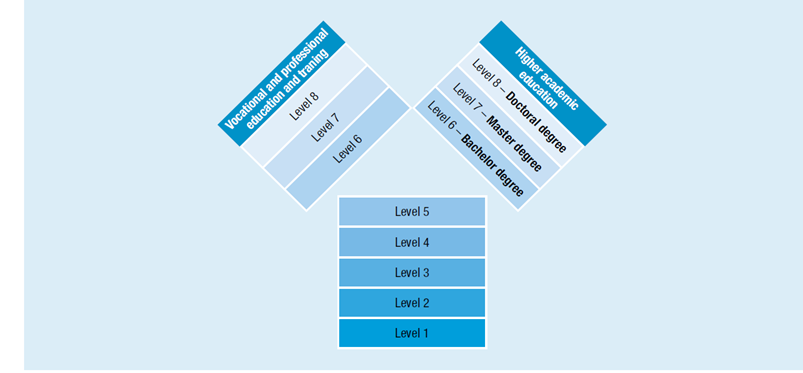
Source: Ministry of Education (2017).
Since 2022, there have been no new qualifications classified within the NQFL. As of 2024, 78 professions are included in the dual vocational education system. However, an ongoing process is classifying 169 new professions, expected to be completed by 2026 (European Commission & Cedefop, 2024).
The NQFL does not include qualifications awarded outside formal education and training. As a result, no such qualifications are currently part of the framework, nor is there a plan to incorporate them in the future. Similarly, the NQFL does not recognise or include partial qualifications, microcredentials, international qualifications, or modules or units of learning outcomes. None of these qualification types are currently part of the framework, and there are no plans to integrate them in the future (European Commission & Cedefop, 2024).
3.3. Use of learning outcomes
All education subsystems have taken important steps in implementing the learning outcomes approach, but to varying degrees. In general education, standards were introduced in 2010 and subsequently tested for grades 3, 4, and 8. A competence-based approach is being strengthened in teaching and evaluating of general education. In line with the amended VET law in 2008 (Article 6 of the Vocational Training Act), qualifications and curricula have been revised with a stronger focus on competences and equipping students with the competence to act (Handlungskomptenz) (Cedefop, 2016). Learning outcomes already play an important accreditation role in higher education. The learning content for specific professions in vocational education is regularly revised. At present, many apprenticeship programmes are undergoing updates, with new learning outcomes being developed to align with changes in the labour market. (European Commission & Cedefop, 2024).
The NQFL is supervised by the Ministry of Education. The National Agency for International Educational Affairs (Agentur für Internationale Bildungs-angelegenheiten, AIBA) - an independent institution, supervised by the Ministry of Education - has been appointed as the EQF national coordination point (NCP) to carry out administration and coordination tasks connected with the NQFL. Due to an error in the budget submission for the 2021-2023 call, Liechtenstein was unable to apply for NCP funds. As a result, the EQF-NCP's activities were suspended during this period (European Commission & Cedefop, 2024).
Supervision of vocational education and training is carried out by the Office of Vocational Training and Career Counselling (Amt für Berufsbildung und Berufsberatung, (ABB)). It is also noted that the ABB is responsible for the quality assurance arrangements in vocational education. The educational part of dual training, vocational education at school and professional tertiary education are conducted at Swiss institutions and are therefore the responsibility of these authorities. In addition, the concept of VET includes an obligation of internal quality assurance for the providers of vocational training.
Responsible bodies in higher education are the Government and the higher education institutions themselves. The Government is the supervisory body of the higher education institutions and is supported by the Office of Education (Schulamt).
Due to Liechtenstein's small size, communication between stakeholders is frequent and straightforward. The short communication channels facilitate ongoing exchanges among them (European Commission & Cedefop, 2024).
5.1. Recognising and validating non-formal and informal learning and learning pathways
Validation approaches have been developed in initial VET and higher education, considering different target groups, responsibilities and methods. The Vocational Training Act determines that admission to any examination or qualification that does not depend on undertaking specified education programmes; those who have at least five years work experience can participate in the final examinations. The validation process in VET is based on a similar process to that developed by Switzerland, following a similar series of steps. However, due to the small size of the country, only the first step (information and advising) is performed within the country; after that the candidates are referred to Switzerland (Auzinger, 2024).
The Office of Education (Schulamt) regards development of the national qualifications framework for higher education (NQFL-HS) as an opportunity for anchoring lifelong learning more within higher education, and for improving validation and recognition of prior learning achieved outside the higher education system. The legal basis for admission to higher education have been formalised. The Law on higher education regulates the conditions and process of admission without a matura certificate ([7]Government of the Principality of Liechtenstein, Gesetz über das Hochschulwesen (Hochschulgesetz; HSG), 2005 [Law on higher education (Higher Education Act; HSG)], Article 24 on bachelor studies.) and limitation of crediting learning acquired outside the higher education system. It is possible to recognise non-formal and informal learning as a contribution to achieving a qualification, up to a maximum of one sixth of the necessary workload (European credit transfer and accumulation system credit points) for the whole qualification (Auzinger, 2024).
Currently, there are validation arrangements in place at NQFL levels three, four and five (at level five for qualification type 'Federal VET diploma (three- or four-year dual VET programmes)'), leading to a partial of full qualification, giving credits/ exemptions towards a qualification and giving access to programmes leading to a qualification (European Commission and Cedefop, 2024). Certificates for VET qualifications awarded through validation are identical to those obtained through traditional pathways. However, it is technically possible to distinguish whether a VET qualification was obtained through validation, as the certificate will lack the name of an apprenticeship training company (Auzinger, 2024).
Standards used in VET and higher education for validation are those of existing programmes. Although, the NQFL could offer opportunities to integrate further non-formal and informal learning outcomes, the NQFL-BBV was adopted in 2017 with no plans to include non-formal and informal learning.
5.2. Recognition of foreign qualifications
NQFL plays an important role for comparability and transparency of qualifications with the other European countries. It supports the recognition of foreign qualifications, as Liechtenstein recruits 50% of the workers from the neighbouring countries (European Commission & Cedefop, 2020).
6.1. Stage of implementation
The NQFL has reached an activation stage; implementation structures are in place and main working methods and instruments are being developed. The framework and its related services are communicated to raise end-users' awareness. The NQF for higher education (NQFL-HS) is already operational.
6.2. Procedures for including qualifications in the NQF
As defined in the ordinance on NQFL-BBV (Article 7), the government must approve the inclusion and the level of a qualification, in a separate procedure, and can take into account those qualifications assigned by the State Secretariat for Education, Research and Innovation (SERI) in Switzerland. So far, the Liechtenstein Government has approved almost all out of the 120 qualifications ([8]Source: internal communication with AIBA the national EQF - NCP.). Figure 2 outlines the main steps in the levelling process.
Figure 2. Main steps of the levelling process

Source: Ministry of Education (2017)
The process of assigning vocational and professional qualifications a level is carried out by Switzerland.
6.3. Indicating EQF/NQF levels
The NQFL/ EQF levels are indicated on some certificates/diplomas and on all Europass certificate supplement at NQFL levels three, four and five (at level five only on the qualification type 'Federal VET diploma (three- or four-year dual VET programmes)'). It is planned NQFL/EQL levels to be indicated in the qualification database/register for the abovementioned qualifications (European Commission & Cedefop, 2024).
6.4. NQF dissemination
For public involvement and information, the NQFL website was established in spring 2013, providing information and updates.
6.5. Qualifications databases and registers
The country does not have a fully-fledged qualifications database or register yet. On the NQFL website there is a section where vocational qualifications are registered, providing links to certificate supplements.
6.6. Awareness and use of the NQF
Awareness of the NQFL and the EQF differs among various groups. Graduates generally have a high level of awareness, as diploma certificates indicate the corresponding NQFL and EQF levels, along with a reference to an online platform where they can access certificate supplements.
In contrast, awareness among workers and job seekers is assumed to be low, whereas education and training providers, particularly vocational trainers and teachers, are believed to have a moderate understanding of the NQF/EQF.
Labour market stakeholders show varying levels of awareness. Employers have a moderate understanding, while trade unions exhibit very low awareness. (European Commission & Cedefop, 2024).
The use of the framework varies among different groups. Learners and students use the framework to a moderate extent, as diploma certificates display NQFL and EQF levels (levels three to five). However, workers and job seekers make limited use of the framework, likely due to low awareness.
Labour market stakeholders, such as employers, demonstrate low use of the NQF/EQF.
Education and training providers make moderate use of the NQF/EQF, particularly in vocational training, where knowledge of the framework is assumed to be present. Meanwhile, bodies responsible for designing and reviewing qualifications, as well as guidance and counselling practitioners, such as the Office for Vocational Education and Career Counselling, which is part of the NQFL working group, actively use the framework, as they are directly involved in its implementation and development (European Commission & Cedefop, 2024).
6.7. Monitoring and evaluating the NQF
An evaluation of the NQFL is not yet planned as the framework is quite new. An analysis, however, is foreseen after the framework has been used for some time.
6.8. Impact of the NQF
The NQFL is a reference point for the use of learning outcomes and plays a role in improving transparency and comparability of qualifications at national and international levels. More specifically, in vocational education, assigning levels to specific professions, which is carried out by Switzerland, has significantly improved transparency and comparability. It also highlights the certificate supplements for individual professions, which help improve understanding of the dual education system and its opportunities. By categorising and organising professions, the NQFL facilitates mobility, both within Liechtenstein and across Europe (European Commission & Cedefop, 2024).
Education providers particularly benefit from the greater transparency the NQFL provides. With its focus on competences, the NQFL supports transparent descriptions of expected learning outcomes in programmes and assessment and can thus make an important contribution to quality assurance in education. As the education market is international, EQF and NQFL also open new options for international offers and cooperation in education.
The NQFL was referenced to the EQF in October 2016 (the referencing report was published in 2017). In 2013, the qualifications framework for higher education was self-certified against the QF-EHEA; it forms an integral part of the NQFL.
The NQFL integrates two sectoral qualifications frameworks: for higher education (NQFL-HS) and VET (NQFL- BBV). Levels 6 to 8 are also open to higher vocational qualifications as a separate strand next to higher education qualifications. Although the country is closely following developments in the recognition of qualifications awarded outside the formal system in the neighbouring countries, there are no plans for the NQFL-BBV to include non-formal and informal learning.
The main success factor in the implementation of the NQFL is that each individual profession in vocational education is classified, which has naturally enhanced transparency and comparability within the field of vocational education.
The main challenge for the NQFL is that, while individual professions and their learning content are well known in the job market, in large companies with HR departments unfamiliar with the dual vocational education system, level assignments and certificate supplements are still valuable and need to be visible (European Commission & Cedefop, 2024).
As a next step, the country intends to indicate the NQFL level on diplomas and certificates, including the link to the framework's webpage, aiming to make the NQFL more visible. Also, the current priorities and plans for NQFL implementation include the development of a national and European data register (European Commission & Cedefop, 2024).
| NQF level | Qualification types | EQF level |
|---|---|---|
| 8 | 8 | |
| 7 | 7 | |
| 6 | 6 | |
| 5 | 5 | |
| 4 | 4 | |
| 3 | 3 | |
| 2 | 2 | |
| 1 | 1 |
[URLs accessed 31/3/2025]
National Agency of International Education Affairs (AIBA).
Ministry of Education. (2017). The EQF referencing report for the Principality of Liechtenstein.
| ABB | Amt für Berufsbildung und Berufsberatung [Office of Vocational Training and Career Counselling] |
| AIBA | Agentur für Internationale Bildungsangelegenheiten [National Agency for International Education Affairs] |
| EQF | European qualifications framework |
| NQFL | national qualifications framework for Liechtenstein |
| NQFL-BBV | Nationaler Qualifikationsrahmen des Fürstentum Liechtenstein für Abschlüsse der Berufsbildung [national qualifications framework for vocational education] |
| NQFL-HS | Nationaler Qualifikationsrahmen Fürstentum Liechtenstein für den Hochschulbereich [national qualifications framework for higher education] |
| NQF-VPQ | Swiss national qualifications framework for vocational and professional education and training |
| QF-EHEA | Qualifications framework for the European higher education area |
| SERI | Staatssekretariat für Bildung, Forschung und Innovation [State Secretariat for Education, Research and Innovation] |
| VET | vocational education and training |
[URLs accessed 1/4/2025]
Auzinger, M. (2024). European inventory on validation of non-formal and informal learning 2023 update: Liechtenstein. European Commission & Cedefop.
Cedefop. (2016). Application of learning-outcome approaches across Europe: a comparative study. Publications Office of the European Union. Cedefop reference series; 105.
European Commission & Cedefop. (2020). Survey on implementation, communication and use of NQF/EQF [unpublished].
European Commission & Cedefop. (2024). Survey on implementation, use and impact of NQF/EQF [unpublished].
Eurydice. (2024). Liechtenstein overview.
Government of the Principality of Liechtenstein. (2017). Verordnung über Nationaler Qualifikationsrrahmen des Fürstentums Liechtenstein für Abschlüsse der Berufsbildung (NQFL-BBV) [Decree on national qualifications framework for vocational qualifications].
Ministry of Education. (2017). The EQF referencing report for the Principality of Liechtenstein.
Related content

Overview
Eight
Ordinance on the national qualifications framework of the Principality of Liechtenstein for VET qualifications (2017)
(in German)
Qualifications framework for higher education (2013) and included in the Higher Education Act and in the Higher Education Ordinance
(in German)
Compare with other NQF
Cedefop (2025). NQF online tool. https://cedefop.europa.eu/en/tools/nqfs-online-tool