

Problem statement
Addressed problem: Unmet expectations of practical training in vocational programmes
When young people choose a vocational programme, they expect learning to be practical, hands-on, and closely linked to real work. They want to develop skills that are directly relevant to a profession and valued by employers.
If these expectations are not met, learners can become demotivated and may eventually drop out. This can happen if the training content or equipment is outdated, or if students do not see how theoretical knowledge applies to real-world tasks.
Students are often discouraged when vocational programmes emphasize theoretical or academic subjects over practical learning. However, theoretical content cannot be eliminated entirely from VET programmes because:
- Vocational programmes aim to develop key competences and foundational skills that are necessary across professions.
- Technological advances have changed the nature of work, making many tasks more abstract or computer-based, which requires a stronger theoretical understanding.
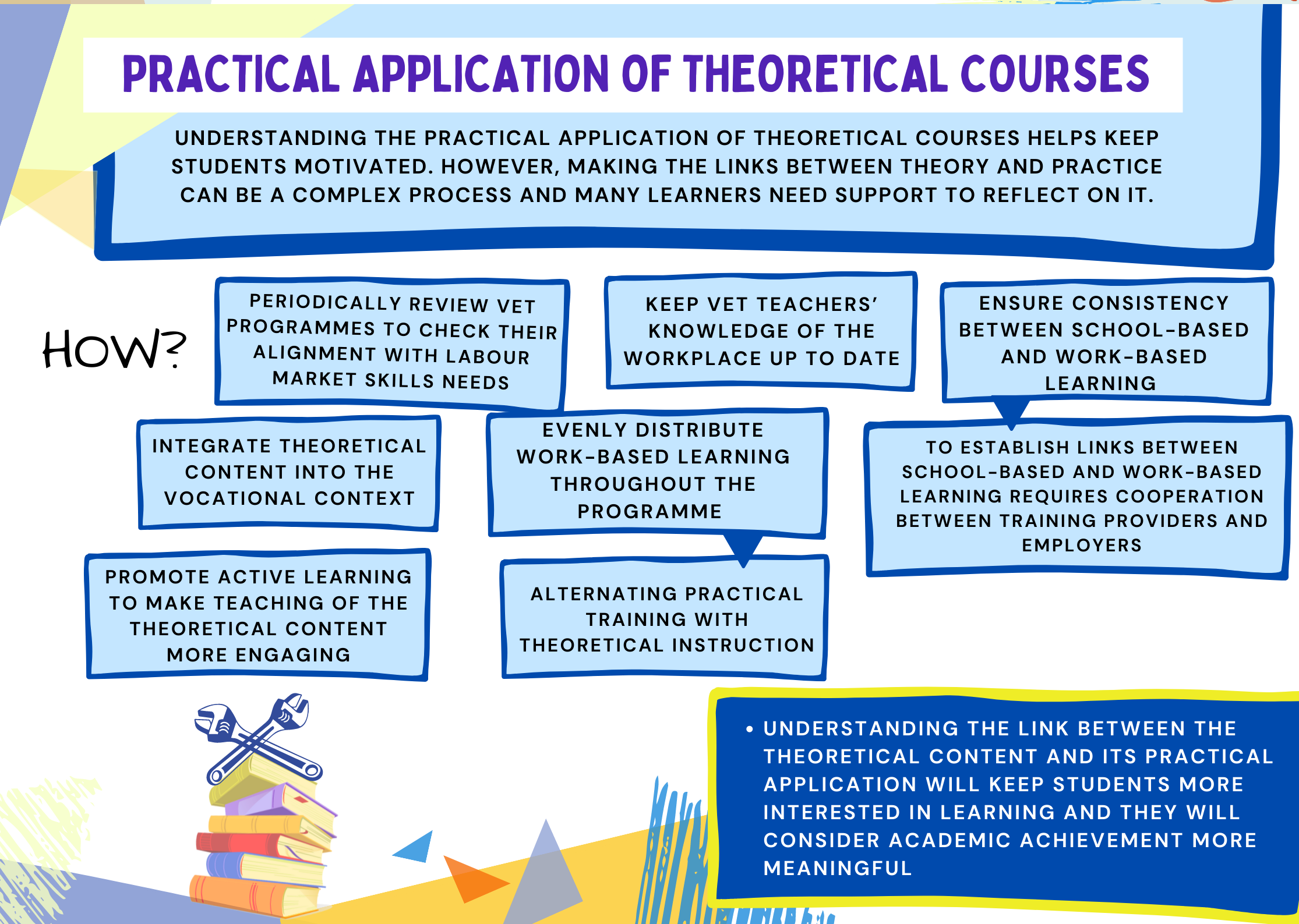
Supporting students to understand and experience the practical application of theoretical courses helps maintain motivation. Linking theory to practice can be challenging, so learners often need guidance and structured support to make these connections meaningful.
Beneficiaries
A strong alignment between the skills acquired through VET and those required in the labour market is important for all learners. Equally, it is crucial that the connection between theoretical knowledge and practical application is clear. Learners who struggle with academic subjects often benefit most from seeing how their studies are applied in real-world contexts and understanding the purpose of their efforts.
Addressing the problem
Tips: How can we strengthen the links between theory and practice?
The following tips are offered to policy makers and practitioners involved in the design and delivery of VET measures. The information is based on Cedefop research into successful measures.
VET programmes should be periodically reviewed to ensure that the knowledge and skills being taught are relevant to employers. Cooperation with employer associations and workplace representatives is essential in defining intended learning outcomes and required competences when updating curricula.
Programmes should integrate, among other, green skills and sustainable education as well as new technology, digital skills, and AI literacy to reflect the evolving demands of the twin transition in the labour market.
Clear communication of programme relevance helps learners make informed choices and remain motivated throughout their studies.
VET teachers must understand evolving labour market and skill requirements and incorporate them into teaching. Continuing professional development (CPD), upskilling, and exposure to current workplace practices are crucial.
Teachers should have opportunities to visit companies, accompany learners during work-based training, and observe how digital tools and AI are applied in real work environments. This ensures that theoretical concepts are demonstrated using up-to-date, practical examples. AI and digital tools can also be used as pedagogical allies, helping teachers to effectively bridge theory and practice.
Structured partnerships between VET schools and companies are a proven mechanism for keeping teachers’ knowledge current. Research by Cedefop shows that most European countries have established formal links (e.g. agreements or contracts) between schools and companies providing work-based learning. These partnerships are most effective when they include active teacher participation: visiting enterprises, co-assessing learners, and collaborating with workplace mentors on curriculum delivery.
Beyond visits and placements, some countries have gone further by institutionalising ‘hybrid teacher’ models, where professionals work simultaneously in a VET institution and a company. This model ensures that industry knowledge is continuously renewed rather than periodically refreshed. The development of dedicated CPD frameworks and incentives to support such hybrid roles is indispensable to strengthen the sustainable integration of industry expertise within VET systems.
Strong collaboration between training providers and employers ensures a coherent learning pathway. Employers should be involved in designing and implementing training, defining intended learning outcomes, and coordinating practical activities.
Digital platforms can support this cooperation by enabling co-creation of simulations, virtual projects, and learning activities that integrate school theory with workplace practice.
Integrating theoretical and academic content into vocational training makes learning complete and meaningful for young people. This can be achieved by connecting theory to real or realistic work tasks, for example:
- Using authentic materials: Demonstrate theoretical concepts through practical work with relevant instruments in a laboratory or state-of-the-art workshops with advanced technologies.
- Using authentic contexts: Conduct learning at workplaces or outdoor environments that replicate real tasks, such as farms, workshops, or company sites.
- Working for real clients: Involve learners in delivering products or services to external customers or beneficiaries, such as NGOs.
- Using VR/AR simulations: Create immersive, realistic scenarios where students can apply theoretical knowledge without leaving the classroom.
- Structuring activities like workplaces: Organize tasks so groups of students assume roles of different departments in a simulated organisation.
These approaches help learners see the practical application of theory, engage actively with their learning, and increase motivation.
Vocational programmes that deliver most theoretical content before learners experience practical tasks can be demotivating. Alternating practical training with theoretical instruction throughout the programme helps maintain engagement and reinforces learning.
Health and safety content must be covered before learners begin any workplace experience.
When physical placements are not immediately feasible, digital simulations and AI-based exercises can provide hands-on practice and prepare learners for real-world tasks.
Learners are more motivated when they actively construct knowledge rather than passively receive it. Methods include:
- Project-based and problem-based learning: Learners identify problems, explore solutions, and apply theory in practical projects.
- Adaptive instruction: Tasks are tailored to learners’ level of understanding and ability, supported by AI-powered platforms.
- Interdisciplinary projects: Combining skills from different subjects reflects real workplace challenges.
- Active learning encourages collaboration, critical thinking, and engagement while making theoretical content more relevant.
Active learning encourages collaboration, critical thinking, and engagement while making theoretical content more relevant.
Some learners struggle with theoretical content due to limited literacy, numeracy, or digital skills.
Support should be tailored to the learners’ needs. Some may benefit from pre-programme interventions, helping them develop the basic skills needed to follow the curriculum. Others may require ongoing support throughout their studies, which can be delivered through mentoring, tutoring, or embedded learning activities. Providing this support helps learners engage more fully with the programme and improves their chances of successful completion.
VET programmes should explicitly develop teamwork, communication, problem-solving, and time management skills. Integrating these competences across school and workplace activities enhances employability and ensures learners are ready for real-world professional contexts.
In addition to school-based support, workplace mentors help learners navigate real-world work contexts. These mentors provide guidance on professional behaviour, task execution, and problem-solving, reinforcing the link between theoretical knowledge and practical application.
Regular feedback on both theoretical understanding and practical performance is critical. Structured reflection sessions, using journals, digital portfolios, or group discussions, help learners make explicit connections between classroom content and workplace practice.
Continuous evaluation ensures that VET programmes remain relevant and responsive to learners’ needs, while providing data for iterative improvements.
Learners progress at different rates in theory and practice. Flexible scheduling, blended learning, and modular course design allow students to consolidate knowledge without losing engagement. Personalized approaches, supported by AI tools, can address individual needs while maintaining alignment with programme goals.
Expected outcomes
Connecting theoretical content to practical application helps learners see the relevance of their studies, making learning more engaging and meaningful. Learners are encouraged to recognise achievements that have practical value, which can improve motivation, self-confidence, and long-term commitment to education and training. Exposure to real work environments and digital tools also strengthens employability skills and career readiness.
The following outcomes can be expected at different levels:
 |  |  |
|---|---|---|
| INDIVIDUAL | INSTITUTIONAL | SYSTEM |
|
|
|
