

Problem statement
Addressed problem: Low motivation disengagement and negative attitudes towards learning
Once a learner at risk of early leaving or an early leaver is identified, it is important to assess his or her motivation to continue or return to education. Many of these young people have experienced continued underachievement at school which has undermined their trust in their own capacities and their interest in education and training.
Many support measures can contribute to building motivation. For instance, career counselling involves discussions with the young person about their future and encourages them to take responsibility and act upon his/her aspirations.
However, such measures are often insufficient. In particular, they may not succeed at engaging young people with a long history of negative experiences at school, and who have internalised a vision of themselves as ‘poor students’. These young people often need to strengthen their self-confidence and rediscover an interest in learning, before they actually engage in education and training.
Low motivation is often linked to wider issues such as poor mental health, repeated failure, conflict with teachers or peers, bullying, unstable home environments, poverty, or uncertainty about future career opportunities. Learners who do not see the relevance of education to their personal goals or future lives are also more likely to disengage.
In many cases, low motivation is visible through warning signs such as poor attendance, lateness, low participation, reduced effort, behavioural problems, isolation, or a decline in academic performance. Early identification and support are therefore essential.
Beneficiaries
Measures to build motivation can help all learners to build trust in their capabilities and interest in education and training. These activities are particularly useful to reengage those who are highly disengaged from education and training, and at-risk students showing signs of low motivation.
These measures can be particularly beneficial for learners with a history of repeated failure, poor attendance, mental health difficulties, behavioural issues, low self-esteem, unstable family situations, or limited confidence in their future opportunities.
Addressing the problem
Tips: How can motivation to learn be strengthened among young people at risk of early leaving?
Motivational activities are most often used in the context of a comprehensive set of measures for young people who are highly disengaged from education and training, and who distrust the education and training ‘system’ and the people who work for the system (teachers, trainers, etc.). However, such activities can be used in other contexts, including general education schools, VET schools, and after-school activities.
The following tips are given as advice to policy-makers and practitioners involved in the design and delivery of VET measures, in particular those targeting learners at risk of early leaving or aimed at re-engaging early leavers. The information is based on Cedefop research into successful measures.
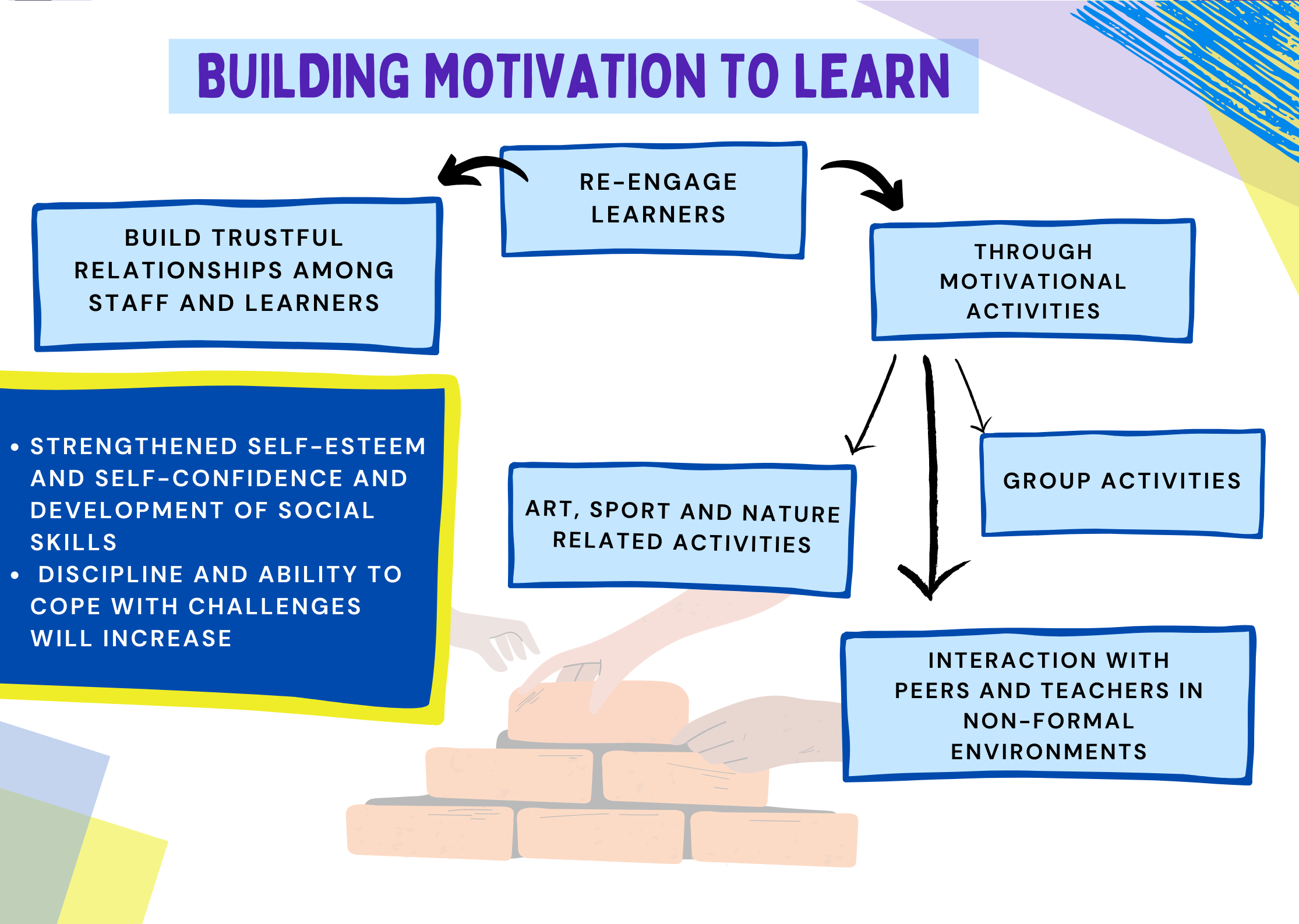
Re-engaging measures for young people with a long history of negative experiences at school tend to include activities that are not directly linked to a training programme or qualification. These activities promote interaction with peers, teachers, or other staff outside a formal learning environment. The main objective is to ensure that the young person can enjoy an activity in a group and feel valued for his/her contribution, promoting his or her sense of belonging.
These activities can be particularly useful in the early stages of re-engagement, when young people may not yet be ready to return immediately to formal education and training. They can provide a lower-pressure environment where trust, confidence and routines can gradually be rebuilt.
Motivational activities mainly include:
- Artistic activities, which can include the organisation of performances
- Sporting activities
- National and international youth exchanges and trips
- School-related nature activities (e.g. community gardens)
- School-related active citizenship activities (e.g. related to local environment)
- Other group activities (e.g. cooking together, organising an event)
These activities can be developed in cooperation with local services and organisations. For instance, sporting activities can be developed in cooperation with local sports clubs, and municipalities can promote nature and active citizenship activities.
Digital and creative activities can also play an important role. Coding clubs, robotics, digital media production, podcasting, video-making, gaming, design, music technology or digital storytelling can help motivate learners who may not engage through more traditional activities.
Activities should reflect learners’ interests, backgrounds and aspirations. Giving young people some choice and responsibility in selecting or designing activities can increase ownership and engagement.
Motivational activities provide a safe place for young people to spend their time in. Moreover, such activities can be a forum for young people to open up about their problems, and an opportunity for staff to offer support.
Even if provided outside a formal learning environment, motivational activities must establish concrete objectives and be guided by professionals (e.g. teachers and trainers, counsellors, etc.). Such activities aim at helping young people to get to know themselves better and to interact with others, and should for instance promote cooperation and conflict resolution. This will strengthen learners’ ability to cope with difficulties or challenges.
Activities should also help learners develop resilience, emotional regulation, communication skills, self-awareness and confidence in their own abilities. Reflection activities, group discussions, peer support and structured feedback can help learners recognise their progress.
Where appropriate, motivational activities can be linked to personal goals, career interests and practical future opportunities, helping young people understand why learning matters for their own lives.
A key factor in enabling young people to succeed in education and training is for the adults around them to show that they believe in their abilities and to support them towards achieving their goals. Motivational activities which bring together staff and young people in an informal activity can help young people form a positive relationship with a member of staff. This staff member could just turn out to be the one adult who they can ‘connect with’ and who motivates them to work towards achieving a qualification.
Trusting relationships are particularly important for young people who have experienced repeated failure, rejection or conflict in education. A stable and supportive relationship with one adult can help learners feel safe, understood and motivated to persist.
Staff should be trained to recognise early signs of disengagement, respond in a supportive way, and avoid approaches that reinforce shame, failure or negative self-perceptions.
Digital tools can help learners engage with education in more personalised and flexible ways. Interactive learning platforms, gamified activities, e-portfolios, digital badges and short online modules can help learners experience small successes and build confidence.
Digital tools can also support communication between learners and staff, provide regular encouragement and feedback, and help identify early warning signs of disengagement such as reduced participation, low attendance or changes in behaviour.
Artificial intelligence tools may also support motivation by helping learners explore career options, identify their strengths and interests, and receive more personalised learning recommendations. However, these tools should complement, rather than replace, personal relationships and professional judgement.
Expected outcomes
Motivational activities aim at strengthening self-esteem and self-confidence and contribute to the development of social skills. These activities can help stimulate young people’s interests and curiosity and encourage a positive attitude towards learning.
These activities can also promote discipline and reduce aggression, they can help in dealing with conflicts, and also strengthen resilience or the ability to cope with difficulties or challenges.
The following outcomes can be expected at individual level:
 |  |  |
|---|---|---|
INDIVIDUAL | INSTITUTIONAL | SYSTEM |
|
|
|