
Reference year 2026
Version 2026
Drafted by Olga Kafetzopoulou, Director for VET and LLL Planning and Development, General Secretariat for VET, LLL and Youth, Ministry of Education and Religious Affairs, Greece - Member of Cedefop Community of apprenticeship experts for Greece
1Scheme history
The “Apprenticeship class” scheme was first introduced by Law 4186/2013 within the formal education system but was not implemented as such. By law 4386/2016, the EPAL apprenticeship scheme was established. The EPAL “Post-Secondary Year - Apprenticeship Class” lasted for about 9 months, and was not included in formal education (post-secondary non-formal level). The scheme was launched in the school year 2016-17 as a pilot project and since then it has been constantly expanding in more schools and specialties throughout the country.
The significant expansion of the scheme since its pilot introduction, and the attraction of new learners and employers to apprentices led the EC to include it in the list of good practices of projects funded by the ESF regarding apprenticeship / VET.
Law 4763/2020 (See Q1 of the Country fiche) includes provisions for the scheme, including its adaptation to labour market needs and the active involvement of social partners in the scheme governance and in the design of training guides.
Training guides include the requirements to enter the profession, the curriculum, teacher qualifications, teaching methods and the certification process, including a certification question bank for the National Qualifications Framework exams.
Also, the law increased apprentice remuneration by 25%.
The ‘Post Secondary Year – Apprenticeship Class’ scheme was introduced as one of the pathways offered to graduates of the upper secondary vocational programmes (EPAL). The scheme was introduced in the context of the VET reforms to help meet Greece’s priorities and objectives both at national and European level, considering the Council Declaration on the European Alliance for Apprenticeships of 15 October 2013, the National Commitment of 2013 and the detailed Strategic Plan for VET and Apprenticeship of 2016.
2Beneficiaries
The scheme admits students aged 18+ who must have completed upper secondary vocational education (EQF 4, typically three-year-long school-based programmes operating under the supervision of the Ministry of Education).
They may hold (a) school-leaving certificate and Specialty degree from a Vocational Upper Secondary School or (b) a school-leaving certificate from a General Upper Secondary School Certificate and a Specialty degree from a Vocational Upper Secondary School.
There is no maximum age limit for enrolment.
The scheme is offered as an option to these graduates among other pathways like higher education, post-secondary VET, upper secondary VET courses in a different specialty, IVET in Vocational training institutes or the labour market.
Since the 2018/19 school-year, graduates of special education vocational schools can enrol in the scheme, after recommendation of the teacher board and the opinion of the relevant Educational and Counselling Support Centre (KESY).
The average age of apprentices is 23.
Since school year 2018/19, data for the “Post-Secondary Year-Apprenticeship Class” are kept in the pilot Apprenticeship Information System. Furthermore, relevant data (microdata) are kept for statistical reasons at the relevant authority due to the funding of apprenticeship programmes from European Social Fund. https://e-mathiteia.minedu.gov.gr/
8,331 apprentices were enrolled in the scheme in 2025-26 (compared to 3,899 in 2022-23).
The number of apprentices and the classes offering programmes through this scheme have increased significantly since its introduction (by 745% and 501% respectively).
The posts offered in 2025-2026 has increased by 25% compared to the previous year. 72% of the posts offered come from the private sector and 28% come from the public sector.

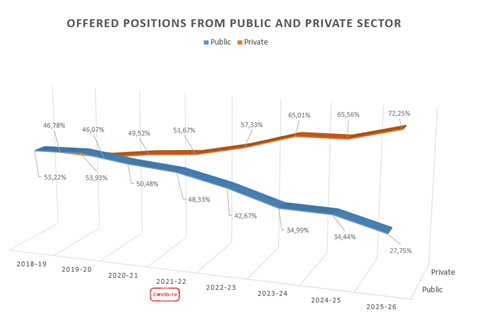
Evolution of the scheme 2016-2026
School year | Number of classes | Employers | Apprentices |
2016/17 | 179 | 393 appx | 1,119 |
2017/18 | 406 | 1,547 appx | 3,089 |
2018/19 | 409 | 1,715 | 3,694 |
2019/20 | 373 | 2,000 | 3,244 |
2020/21 | - (Covid) | - | - |
2021/22 | 333 | 1,427 | 2,872 |
2022/23 | 469 | 2,079 | 3,897 |
2023/24 | 680 | 3,135 | 5,770 |
2024/25 | 802 | 3,800 | 6,946 |
2025/26 | 896 | 4,826 | 8,331 |

Source: Information System for the Post Secondary Year – Apprenticeship Class https://e-mathiteia.minedu.gov.gr/
3Qualifications
The scheme leads to qualifications at NQF level 5.
Cedefop’s NQF online tool presents information on the state of play of the NQF: https://www.cedefop.europa.eu/en/tools/nqfs-online-tool
According to the Article 36 of Law 4763/2020, NQF level 5 is awarded to: a) graduates of “Post-secondary year-apprenticeship class”, after certification or b) graduates of Vocational Training Institutes (IEK) after certification (these are mainly school-based post-secondary VET programmes that include a shorter workplace training part, usually in the form of internship but possibly also as an apprenticeship).
So, it is possible that the same specialty can be offered by two different pathways at the same level.
Upon successful completion of the "Post-Secondary Year- Apprenticeship class” scheme, graduates receive a Vocational Training Certificate, which is a requirement to participate in certification exams, in order to achieve Level 5 of the National and the European Qualifications Framework.
The National organization for the Certification of Qualifications and Vocational Guidance (EOPPEP) organizes national-level certification exams for “Post-secondary year- apprenticeship class” for each specialty.
Upon successful examination results, graduates are awarded a Degree in the corresponding Vocational Specialty, Education and Training level 5 (Ptyxio), recognised both in Greece and in the EU member states.
After succeeding in the national certification exams, graduates of the “Post-secondary year-Apprenticeship class” can take part in the exams required to enter Higher education (universities).
Legislative reforms have progressively increased the quota for VET graduates to access higher education, with recent regulations allowing those from apprenticeship classes to enter university departments relevant to their speciality. Moreover, graduates of EPAL and SAEK who have successfully completed the initial vocational training certification examination and hold a Level 5 VET specialty diploma (or an equivalent qualification) may now sit special admission examinations organised by higher education institutions to access programmes related to their field.
Programmes under the “Post-secondary year-apprenticeship class” scheme have a duration of eleven months.
It must be noted that the scheme is offered only to graduates of upper secondary school-based VET (i.e. holders of VET qualifications at EQF level 4).
Workplace training must be at least 50% of the training programme. The exact distribution between the workplace component and the school-based one (laboratory courses) is defined in the Training Guide of each specialty.
In practice, the workplace component is usually considerably higher than the minimum 50%, as the typical alternation mode foresees that every week each apprentice spends one day at the vocational school and four days at the employer’s premises.
4Governance
By Law 4763/2020, the Ministry of Education established two new Directorates that share the responsibility of VET, including apprenticeships: The Directorate for the Implementation of Vocational Training and the Directorate for the design and development of VET and Lifelong Learning.
Within the former, the Department for the Organization and Implementation of the Post- Secondary Year - Apprenticeship Class is responsible for regulating and supervising the apprenticeship programme.
Within the latter, the Department for Linking VET and Lifelong Learning with the Labor Market is responsible for ensuring the quality of education, cooperating with stakeholders in order to find positions for apprentices, collecting and maintaining statistical data regarding the programme and developing training guides with the collaboration of social partners.
At the regional level, an Apprenticeship coordinator has been appointed in every regional education directorate. Coordinators are responsible for the implementation of the Post Secondary Year – Apprenticeship Class in their region. They act as liaisons between the schools and the employers and support teachers, trainers and apprentices during implementation. Coordinators also support SMEs by offering advice and guidance, including mentoring and networking opportunities to support employers setting up apprenticeship schemes.
Collaboration and coordination among stakeholders is also facilitated by new Councils set up at national, regional and sectoral level (see below).
Law 4763/ 2020 further promotes the involvement of social partners, chambers and labour market representatives as well as employee representatives in the overall apprenticeship governance.
At national level, the Central Council for Vocational Education and Training (KSEEK) was established and has a competence on apprenticeship among all VET. It consists of the Secretaries-general from competent ministries, the manager of Public Employment Service (DYPA), the President of the National Organisation for the Certification of Qualifications and Vocational Guidance (EOPPEP) the president of Institute of Educational Policy (IEP) as well as representatives of chambers, employer and employee associations. The Council monitors labor market developments and formulates proposals to the Ministry of Education, for the continuing adaptation of the sectors and specialties offered by VET providers. It also makes proposals for the design of the national policy on VET and lifelong learning.
This committee is supported by the Central Scientific Committee (KEE) whose members are a tertiary teacher, VET experts, Vet teachers and representatives from the Ministry of Education, Public Employment Service (DYPA), the Institute of Educational Policy (IEP). The committee is responsible for conducting scientific research and providing documentation on issues related to improving the quality and effectiveness of vocational education and training, as well as lifelong learning programmes.
At regional level, Liaison Councils for the Production and Labour Market (SSPAE) were established. The Councils consist of representatives of Vocational Education Institutes, Secondary Vocational Schools, DYPA vocational schools, regional authorities as well as employer and employee representatives. Their aim is to mobilize local businesses to participate in internship or apprenticeship programmes and offer consultation to the Central Council for Vocational Education and Training on issues relating to specialties, programmes, activities and special courses in VET.
Sector Skills Councils were introduced at regional level support the work of KSEEK by systematically monitoring needs for professional skills of each sector and identifying skills shortages and mismatches. Their aim is to improve the link between skills supply and demand by putting forward proposals which will help VET adapt to the constantly changing skills needs of the industry. The first Council that was established is the Textile, Clothing and Leather Sector Skills Council.
Under Law 4763/2020, social partners and sectoral stakeholders are formally foreseen to participate in the development of the new Training Guides for the Post-Secondary Year – Apprenticeship Class, as well as in related curricula, teaching guides and certification arrangements. This role is defined as consultative and contributory, aiming to ensure that learning outcomes and occupational profiles reflect labour-market needs However, the new Training Guides and related materials are still under development.
There are currently no apprentice associations or apprentice unions in Greece, and therefore apprentices do not have formal representation in apprenticeship governance or in the design of qualifications or curricula.
According to the Common Ministerial Decision “Quality Framework for Apprenticeship” (B’ 4146/2021), representatives of social partners, sectoral associations or chambers may sit in the panel for the final assessment together with VET teachers.
However, this provision has not been integrated in the daily operation of the scheme yet.
Employer and employee representatives participate in the newly established Liaison Councils, which, at the implementation level, intend to mobilize local businesses to participate in internship or apprenticeship programmes.
There is no further regulated role for representatives of social partners in the actual delivery of the apprenticeship scheme.
Nevertheless, the social partners have taken the initiative to promote apprenticeship among teachers and trainers (Centre for the Development of Educational Policy of Greek Workers (GSEE)).
In addition, the Union of Hellenic Chambers of Commerce (UHCC) run the project “Upgrading and Enhancing Apprenticeship - Apprenticeship Partnerships” (Operational Programme “Development Education and Lifelong Learning” of the NSRF 2014-2020), aiming to attract businesses in apprenticeships and to support the implementation of apprenticeships in these businesses. The results of the above-mentioned project are still to be evaluated.
There are currently no apprentice associations or apprentice unions in Greece, and therefore apprentices do not have formal representation in apprenticeship governance or in the design of qualifications or curricula.
The Ministry of Education and, in particular, the General Secretariat for VET & LLL plans and coordinates VET as well as LLL programmes, including the Post-secondary year - Apprenticeship Class. The Department for Linking VET & LLL with the labor market provides regulation to ensure the quality of the apprenticeship, cooperates with stakeholders in order to find positions for apprentices, collects and maintains statistical data regarding the programme, and is responsible for the design of the curricula used for the Post-Secondary Year - Apprenticeship Class. The Department of Organization and Implementation of the Post-secondary year - Apprenticeship Class organizes and supervises the apprenticeships.
The National organization for the Certification of Qualifications and Vocational Guidance (EOPPEP) is responsible for the national certification exams.
Secretaries-general of competent ministries, the manager of Public Employment Service (DYPA), the President of the National Organisation for the Certification of Qualifications and Vocational Guidance (EOPPEP), the president of Institute of Educational Policy (IEP) sit in the Central Council for VET (KSEEK), together with representatives of chambers, employers and employee.
Representatives from the Ministry of Education, the Public Employment Service (DYPA), the Institute of Educational Policy (IEP) participate in the Central Scientific Committee (KEE).
Representatives of Vocational Education Institutes, Secondary Vocational Schools, DYPA vocational schools and regional authorities participate in the regional Liaison.
Regional education directorates appoint Apprenticeship coordinators, responsible for the preparation, the coordination and monitoring of the implementation of the Post- Secondary Year - Apprenticeship Class in their region (See Q13).
VET schools and Laboratory Centers (Ministry of Education) offer the school-based component of the programme. VET school principals and Lab Center directors supervise the implementation of the Apprenticeship Classes that are held in their institution.
VET teachers who participate in the Post-Secondary Year - Apprenticeship Class cooperate with local stakeholders in order to find positions for apprentices, teach their classes once a week and supervise the apprentice performance both in the school labs and in the workplace.
In the Post-Secondary Year – Apprenticeship Class of EPAL, apprenticeships are provided by public upper-secondary vocational schools (EPAL) operating under the responsibility of the Ministry of Education, Religious Affairs and Sports.
No higher-education institutions, private training centres or other VET providers are involved in delivering this apprenticeship pathway.
Teaching in the school-based component of the Post-Secondary Apprenticeship Class is carried out by qualified secondary-level vocational education teachers employed in public EPAL schools. These teachers are required to hold higher-education qualifications (university or former technological-education degrees) relevant to the occupational specialty they teach, in accordance with national legislation governing secondary education staff. In addition, they must meet pedagogical competence requirements applicable to teachers in upper-secondary education. EPAL teachers are responsible for delivering the theoretical and laboratory modules of the apprenticeship programme, supporting apprentices in linking school-based learning with workplace experience, and monitoring learning progress in coordination with the institutional requirements of the programme.
A multi-year project completed in 2024 provided specialised continuing professional development (CPD) for teaching staff who used to work in school-based programmes and were subsequently (re)allocated to apprenticeship programmes. The programme focused on developing teachers’ knowledge and competences to enable further cooperation with enterprises and apprentices. It included thematic areas such as basic principles of adult education and modern teaching technologies, counselling and vocational guidance, occupational safety and health and entrepreneurship
For more detailed information, you can also see Cedefop’s activities on VET teachers and trainers: https://www.cedefop.europa.eu/en/themes/vet-youth-teachers-trainers
Law 4763/2020 and the 2021 Quality Framework for Apprenticeships.
1. Monitoring
Monitoring in the EPAL apprenticeship scheme focuses primarily on two core dimensions:
a) Multi-level governance
Monitoring covers the multi-level governance structure of apprenticeship implementation, from the school level up to the Central Council for Vocational Education and Training (KSEEK). It ensures coordination and supervision across different administrative levels, including schools, regional coordinators, and central bodies, supporting the coherent operation of the scheme. The Council is supported by the Central Scientific Committee (KEE) whose members are a tertiary teacher, VET experts, Vet teachers and representatives from the Ministry of Education, Public Employment Service (DYPA), the Institute of Educational Policy (IEP). The committee is responsible for conducting scientific research and providing documentation on issues related to improving the quality and effectiveness of vocational education and training, as well as lifelong learning programmes.
b) Apprentices’ assessment and participation in certification
Monitoring also includes the assessment of apprentices during the programme: these include compulsory monitoring tools such as the Workplace Learning Diary and supervisory responsibilities assigned to EPAL schools and teachers, ensuring systematic follow-up of programme implementation in enterprises. In addition, a dedicated online information system (e-mathiteia) is used to manage and monitor all stages of implementation, from applications and placements to documentation and reporting, providing structured and centralised data support. In addition apprentices’ monitoring cover the systematic recording of their participation in certification examinations, which lead to the award of the NQF/EQF Level 5 diploma. This dimension focuses on participation, completion, and certification outcomes rather than impact evaluation.
2. Evaluation
Evaluation refers to distinct, complementary efforts to assess the implementation and effectiveness of the EPAL apprenticeship scheme over time. These include:
a) The 2017 evaluation survey conducted by the Institute of Educational Policy (IEP), focusing on the first phase of apprenticeship implementation.
b) a growing body of studies and academic articles (up to 2024) produced by individual researchers, examining different aspects of apprenticeship implementation and outcomes.
c) Policy texts and position papers issued by social partners, addressing the evaluation of the newly established EPAL apprenticeship institution.
d) Pilot actions within the e-mathiteia.minedu.gov.gr platform, aiming to integrate a graduate observatory, with a specific focus on employment outcomes and on whether graduates remain employed by the same employer where they completed their apprenticeship.
These evaluation activities contribute evidence for policy reflection, improvement, and further development of the scheme.
3. Recognition
Recognition constitutes a distinct third pillar and refers to the national and European-level distinctions and acknowledgements received by the Post-secondary Year – Apprenticeship Class. This includes:
a) formal recognition through certification at Level 5 NQF/EQF,
b) acknowledgement of the scheme as a good practice by European institutions and initiatives,
c) inclusion in European platforms, databases, and policy frameworks, enhancing the visibility, credibility, and institutional legitimacy of the EPAL apprenticeship model.
However, systematic graduate-tracking mechanisms do not currently exist for EPAL apprenticeship graduates. Broader VET graduate-tracking initiatives and observatory-type mechanisms are under development at national level, but until 2025 there is no evidence of a dedicated or operational tracer system that regularly monitors the labour-market outcomes of graduates from the EPAL Post-Secondary Apprenticeship Class. While EOPPEP has launched a nationwide survey of VET graduates, this is not targeted specifically at EPAL apprenticeship graduates and is not yet established as a regular tracing mechanism for this pathway.
Likewise, impact evaluation or cost–benefit analysis is not institutionalised for this apprenticeship pathway. While ad-hoc studies or evaluations may exist at system level, they do not form part of a regular, formal evaluation framework specifically targeting the EPAL apprenticeship scheme.
5Training at the workplace
By Law 4763/2020, the “Post-Secondary Year - Apprenticeship Class” combines workplace learning in public or private companies with training in a VET school (a seven- hour laboratory course (workshop), i.e. once a week).
Every week, apprentices spend one day at the vocational school and four days at the employer’s premises. Apprentices do not attend school lessons during school breaks (Christmas, Easter) and summer (July, August).
Similar specialties are offered by other VET programmes but the Post Secondary Year –Apprenticeship Class is a distinct apprenticeship scheme, different in many aspects from e.g., school-based VET or the PES apprenticeship scheme (EPAS DYEP) in terms of duration and training content.
Training Guides are designed in particular for the "Post-secondary year-Apprenticeship class" and are regulated by decision of the Minister of Education.
Law 4763/2020 foresees that new curricula are to be developed with the collaboration of social partners thus ensuring that they meet the needs of the labour market.
The new Training Guides will include:
a) requirements needed to enter the profession,
b) professional functions and standards,
c) curriculum for the specialty as well as the expected learning outcomes,
d) timetable,
e) teacher qualifications,
f) teaching methods and the necessary equipment,
g) certification process, including a certification question bank for the National
Qualifications Framework exams.
The design of the training guide of each specialty takes into account the relevant occupational profiles (if applicable) certified by the National Organization for Certification of Qualifications and Vocational Guidance (EOPPEP).
Under Law 4763/2020, the Post-Secondary Year – Apprenticeship Class of EPAL is structured around learning outcomes. The law stipulates that the learning outcomes to be achieved during the apprenticeship are to be specified in Training Guides (Οδηγοί Κατάρτισης), which describe the expected knowledge, skills and competences of graduates and guide both the school-based and workplace learning components. These Training Guides are currently under development and have not yet been fully published or implemented across all specialties. The forthcoming Training Guides are intended to update and further systematise the definition of learning outcomes in line with the National Qualifications Framework (EQF level 5) and to reflect current and emerging labour-market needs. They are being designed with the involvement of social partners and labour-market stakeholders, with a stronger focus on technical and occupational skills and on transversal competences, including digital, green and sustainability-related skills, as well as problem-solving, teamwork and communication. The development of these Training Guides for the post-secondary apprenticeship pathway was recognised in 2024 by the European Commission as a “Lighthouse” inspiring practice in its Compendium of practices supporting VET modernisation and the green transition.
In the meantime, the Post-Secondary Year – Apprenticeship Class continues to rely on existing curricula, which are also defined in learning-outcome terms. These curricula integrate technical and occupational competences specific to each specialty with opportunities to develop basic skills, such as applied knowledge and problem-solving, and personal and interpersonal competences, such as professional behaviour, teamwork, communication and responsibility. Learning outcomes are achieved through the combined school-and-workplace structure of the programme, in which laboratory and theoretical instruction at school is directly linked to structured learning tasks in the workplace. Overall, by regulation, the Post-Secondary Year – Apprenticeship Class of EPAL is characterised by a comprehensive set of learning outcomes encompassing technical/occupational, basic and personal/interpersonal competences, with a clear policy shift underway towards updated curricula and Training Guides that will further embed digital, green and other transversal skills in response to evolving labour-market needs.
Under Law 4763/2020, companies hosting apprentices in the Post-Secondary Year – Apprenticeship Class of EPAL are required by regulation to implement workplace learning in accordance with a defined training plan / workplace curriculum, which is to be specified in the Training Guides (Οδηγοί Κατάρτισης) for each specialty. These Training Guides constitute the formal instrument for defining the structure, content and learning outcomes of the workplace component of the apprenticeship and are subject to certification by EOPPEP.
However, as of 2026, the Training Guides for the Post-Secondary Year – Apprenticeship Class have not yet been formally published or fully implemented. Until their adoption, companies follow the existing workplace training arrangements defined through the current curricula, the apprenticeship contract, and the operational requirements of the Quality Framework (including the workplace learning diary and supervision by EPAL schools).
According to the Common Ministerial Decision on a «Quality Framework for Apprenticeship» (Β’ 4146/2021), employers must:
a) sign the Apprenticeship Contact
b) provide good conditions for on-the-job training, have the appropriate facilities and
equipment, and designate a responsible trainer for trainees
c) meet the necessary hygiene conditions and employee safety and provide them with the necessary personal protective equipment during workplace learning
d) must inform the apprentice of the activities, objects and areas of the job and
integrate him/her into the work environment.
e) contribute to the acquisition of personal skills and the development of work culture
f) cooperate with the VET school for the implementation of the WBL curriculum, as
defined in the Training Guide of the specialty.
Trainers must have the necessary formal and professional qualifications for the profession they train and they must also have attended a special training programme focused on pedagogical content knowledge and skills.
Their duties include a) making sure that the terms of the Apprenticeship Contract are observed as far as working and learning in the workplace is concerned, b) planning, organizing and implementing quality apprenticeship training and c) implementing the curriculum for the specific specialty.
If the trainers lack the required qualifications, then the employer appoints a supervisor from a sectoral body who does.
Law 4763/2020 stipulates that the training and certification of trainers is provided by chambers and sectoral bodies together with social partners in collaboration with co- competent ministries, scientific bodies and educational institutions.
Nevertheless, this has not been implemented yet.
Until a registry of certified trainers is created, local education and training centres hold seminars on improving competences of in-company trainers. With regard to professional development, Law 4763/2020 explicitly foresees continuous training and upskilling of workplace trainers, particularly in pedagogical competences, as part of the overall quality framework for apprenticeships. The law provides that chambers, sectoral bodies and social partners, in cooperation with co-competent ministries, scientific bodies and educational institutions, are responsible not only for initial training and certification but also for supporting the ongoing professional development of trainers.
Although the national system for certified trainers and structured continuing professional development has not yet been fully implemented, interim professional-development activities are organised at local or regional level, mainly in the form of short seminars and training actions aimed at strengthening pedagogical, supervisory and mentoring skills of in-company trainers.
There is no information on arrangements for compensation, in case a company cannot ensure the acquisition of all required learning outcomes for company-based learning as defined by the Training Guide.
In practice, if the company fails to provide the indicated training, the contract can be eventually terminated, and the school would be less willing to co-operate with that company in the future.
6Contract and compensation
According to Articles 10, 11 & 12 of the Ministerial Decision for the Regulation of the “Post- secondary year-Apprenticeship class” (B’ 4771/2022), an apprentice has specific rights and obligations for the apprenticeship period.
The apprentice status is also mentioned in the Quality Framework for Apprenticeship (B’ 4146/2021).
An apprenticeship contract is signed between the employer and the apprentice and is stamped by the director of the Vocational School. The contract is provided by the VET school and includes the obligations and rights of the stakeholders as well as the duration of the training programme. A copy of the signed contract is given to the student, the employer and the VET school (Article 7 of Common Ministerial Decision «Quality Framework for Apprenticeship» - Β’4641/2021).
In 2021, the General Secretary of VET, Lifelong Learning and Youth issued an apprenticeship contract template which should be used for all Post SecondaryYear – Apprenticeship Class contracts (B’ 4937). The contract template describes the rights and obligations of the stakeholders as defined in the Quality Framework for Apprenticeship (B’ 4246/2021) and Greek labour legislation and it is posted on the Apprenticeship Information System for the Post-secondary year-Apprenticeship class Apprenticeship.
During the workplace training, apprentices receive a wage (currently covered by ESF funds, see Q32) while employers pay social security contributions, so that apprentices can enjoy social protection and insurance benefits. The time spent at the workplace also counts towards retirement.
With regard to social protection, the apprenticeship contract provides that apprentices are insured as wage earners with e-EFKA (the Unified Greek Social Security Fund) for the full duration of the workplace training. Social insurance coverage includes old-age pension insurance, health care in kind and in cash, and supplementary pension insurance, as applicable. The employer is responsible for declaring the apprenticeship in the national labour information system and for paying the required employer and employee social security contributions in accordance with general labour-law provisions. The time spent in workplace training under the apprenticeship contract is fully recognised as insured time and counts towards pension entitlements. Apprentices are entitled to paid leave, as well as to absence and income protection in cases of sickness, in accordance with applicable labour and civil-law provisions, as specified in the contract and the Quality Framework for Apprenticeships.
All apprenticeship contracts are registered in the central information system used by the Ministry of Labour for all types of employment contracts (ERGANH), under the specific contract type (field) for apprenticeships. https://eservices.yeka.gr/(S(ppskitjb0fphgyesfo2k5iuj))/login.aspx?ReturnUrl=%2f
Apprentices in the public sector are registered also in the Greek State Payroll Registry.
All apprentices receive a remuneration for the apprenticeship period which is 95% of the minimum wage of the unskilled worker for all in-company training days.
Wage by employers is in principle taxable. In practice, the subsidised part of the wage is tax-free as it is below the taxation thresholds.
By law 4763/2020, the remuneration for the apprenticeship period is set at 95% of the minimum wage of the unskilled worker (as determined by the National General
Collective Labor Agreement/EGSEE) for all in-company training days.
This is reiterated in the Joint Ministerial Decision for the Apprentices of the “Post- secondary year-Apprenticeship class” (B’4531/2021).
7Financing and incentives
Originally, apprentice wages are to be paid by employers. According to the current provisions (as of 2021), apprentice wages are co-financed by the ESF and State budget.
As a result, since 2021 employers are required to pay only the costs of the wage related to social protection and insurance contributions plus the remuneration for the paid leave days to which apprentices are entitled (currently 12).
An informative note for future (or current) employers is posted on the official website of the Greek Ministry of Education, which lists guidelines on how to offer an apprenticeship place, what are the financial charges for employers, what are the insurance obligations etc..
Employers pay the social protection and insurance contributions.
The bulk of the resources (€44.228.246) for apprentice remuneration was provided by the ESF co-financed O.P “OP Human Resources Development, Education and Lifelong Learning 2014-2020”, with the rest of the planned resources coming from the Ministry of Education budget.
For the period 2021-2027 (until 2029) the budget from ESF + is raised to 182 million euros.
Teachers, school supervisors and programme coordinators receive remuneration that is covered by ESF funds. While ESF funds and national public budgets support apprentice remuneration and programme-related costs, there is no separate training fund mechanism specifically earmarked for apprenticeships in this pathway.
As of school year 2021 -2022, employers participating in the Post Secondary Year – Apprenticeship Class pay only for the social protection and insurance contributions. Employers also cover the remuneration for the paid leave days to which apprentices are entitled (currently 12). The rest of apprentice remuneration is funded by the ESF.
For the Post-Secondary Year – Apprenticeship Class of EPAL, non-financial incentives for employers mainly take the form of structured information, guidance and administrative support.
Employers can post apprenticeship placements and recruit apprentices through a dedicated online platform (e-mathiteia). In addition, the official website of the General Secretariat for Vocational Education, Training, Lifelong Learning and Youth centralises calls for placements, submission manuals and guidance material for employers.
Clear guidelines support day-to-day collaboration between companies and EPAL schools, while seminars and guidance actions are available to support in-company trainers.
An informative note for future (or current) employers is posted on the official website of the Greek Ministry of Education, which lists guidelines on how to offer an apprenticeship place, what are the financial charges for employers, what are the insurance obligations etc..
These measures are well-established and recurring, helping to reduce administrative burden and facilitate employer participation, even though no systematic national campaigns or formal intermediary role for chambers are foreseen.
At the regional level, an Apprenticeship coordinator has been appointed in every regional education directorate. Coordinators are responsible for the implementation of the Post Secondary Year – Apprenticeship Class in their region. They act as liaisons between the schools and the employers and support teachers, trainers and apprentices during implementation. Coordinators also support SMEs by offering advice and guidance, including mentoring and networking opportunities to support employers setting up apprenticeship schemes.
Although the national system for certified trainers and structured continuing professional development has not yet been fully implemented, interim professional-development activities are organised at local or regional level by training centers, mainly in the form of short seminars and training actions aimed at strengthening pedagogical, supervisory and mentoring skills of in-company trainers.
The wage refers only to the workplace component of training (typically, four days in a week).
Graduates of the programme can benefit from a Preparatory course, that prepares them for the centralised examinations that are required to pass before they practice the profession (wherever applicable).
In addition, learners benefit from guidance and learner-support measures during the apprenticeship. EPAL schools provide pedagogical support and supervision through designated teachers, who monitor apprentices’ progress, liaise with employers and support learners in addressing difficulties related to workplace learning or programme requirements. Guidance is also provided in relation to certification and progression pathways, including information on examination procedures and professional rights.
A 2025 circular has introduced specific support measures targeting apprentices with disabilities or special educational needs, providing also guidance on related support measures and implementation arrangements
For more information on guidance and validation arrangements in the country, you may visit Cedefop’ inventory of lifelong guidance systems and practices and Cedefop’s information hub on validation of non-formal and informal learning.