
Reference year 2026
Version 2026
Drafted by Breda McNally, Project Manager SOLAS, Ireland - and member of Cedefop's Community of apprenticeship experts for Ireland
The national statutory apprenticeship system is underpinned primarily by the Industrial Training Act, 1967 (and subsequent amendments including those in the Higher Education Authority Act 2022), and by the Qualifications and Quality Assurance (Education and Training) Act 2012 and relevant labour law including the Labour Servies Act 1987 and associated Labour Services Act Apprenticeship Rules 1997, and subsequent amendments.
Statutory apprenticeship in Ireland is defined as: ‘a programme of structured education and training which formally combines and alternates learning in the workplace with learning in an education or training centre. It is a dual system, a blended combination of on-the-job employer-based training and off-the-job training’ (Generation apprenticeship, 2024 a) (1). It involves ‘earning and learning’ and apprentices are considered employees (2). A minimum of 50 per cent of learning must be on-the-job and there can be only one, national-level, apprenticeship for any occupation.
All apprenticeships must lead to a qualification on the 10-level Irish National Framework of Qualifications (NFQ). A [statutory] apprentice is a statutorily registered participant on a statutory apprenticeship.
Non-statutory apprenticeship-type models of teaching and learning are prevalent in areas such as law, medicine (including nursing since 2002), primary and secondary school teaching, and in other occupations including, for example, hairdressing.
References to ‘apprenticeship’ in this document are to statutory apprenticeship unless otherwise stated or implied.
(1) See also Generation apprenticeship 2024b, 2024c, and 2024d for further information, and www.apprenticeship.ie
(2) For most purposes, with some specific arrangements allowed relating to, for example, dismissal and pay
The national apprenticeship system in Ireland is a formal, statutory, and regulated part of what has recently been referred to in policy documents and legislation as the tertiary education system. Tertiary education comprises further education and training and higher education and research (https://www.irishstatutebook.ie/eli/2022/act/31/enacted/en/html). This definition of tertiary in Ireland - including further and higher education - may be different to that understood in some other countries and contexts.
Statutory apprenticeship currently includes a ‘craft’ model introduced in 1990s and a new ‘consortium-led’ or ‘enterprise-led’ model introduced in 2015, both of which are currently operational (end 2025). Apprenticeships are between 2 and 4 years, in a wide range of sectors and occupations, leading to awards from levels 5 (certificate) to 10 (doctorate) on the 10-level National Framework of Qualifications (NFQ).
Apprenticeships span both further education and training (FET) and higher education (HE), leading to awards from levels 5 (certificate) to 10 (doctorate) on the National Framework of Qualifications. The place of statutory apprenticeship in relation to the NFQ and the post-primary education system in Ireland, and the European Qualifications Framework, is summarised in Table 1.
Table 1: Apprenticeship in the National Framework of Qualifications and education system in Ireland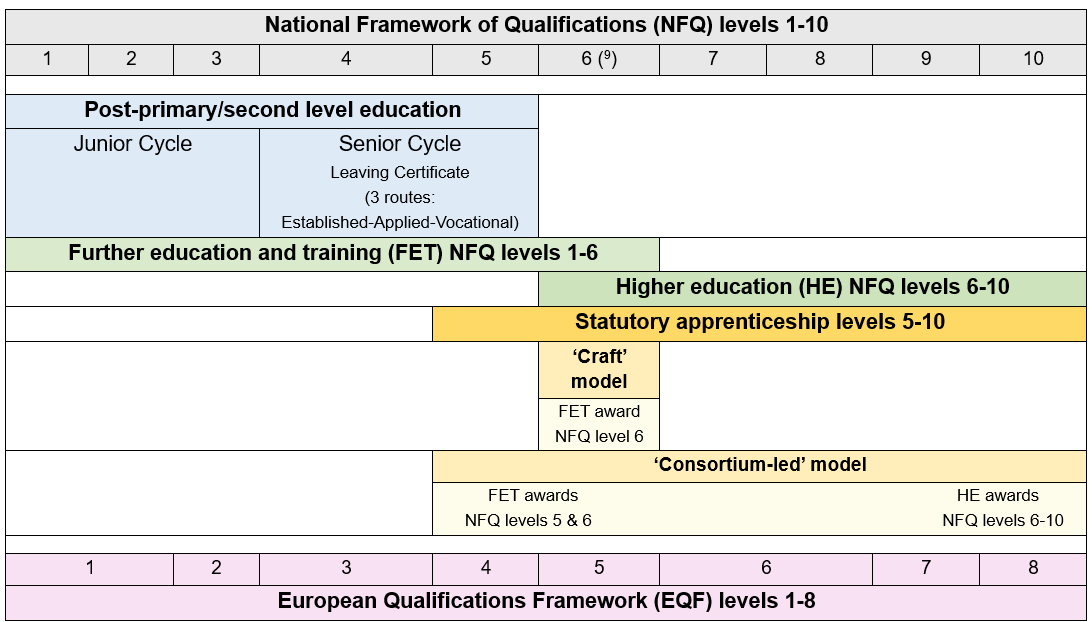
Source: adapted from McNally, 2025
Entry to a statutory apprenticeship, whether leading to a FET or HE award, is based on an employer employing an individual as an apprentice. It requires statutory approval of the employer, and registration of the apprentice, for that specific apprenticeship, by the statutory and regulatory authority for apprenticeship in Ireland (SOLAS) followed by registration of the student apprentice with the relevant FET or HE provider. Access to apprenticeships in HE is separate from and outside the Central Applications Office process which forms the basis for access to most undergraduate programmes in Ireland and is largely based on performance in the Leaving Certificate examination taken at the end of post-primary/second level education.
Statutory apprenticeship operates outside the second level system. In fact, vocational (further) education and training does not form a significant part of post-primary/second level (junior or senior cycle) education. At this level, there are three programmes or pathways that lead to the Leaving Certificate award: Established, Applied, and Vocational but most students taking the Leaving Certificate programme choose the Established route. For example, in 2018, some 121,274 students undertook or repeated one of the Leaving Certificate pathways and of these, 83,113 (69%) undertook the Established programme, 31,411 (26%) the Vocational programme and 5,939 (5%) the Applied programme (Oireachtas Research and Library Service, 2020).
Cedefop’s VET in Europe database provides additional information on the national VET system and the position of apprenticeships within it: https://www.cedefop.europa.eu/en/tools/vet-in-europe/systems/
Over the past 50 years or so the national apprenticeship system has gone through several formal national-level reviews that have led to major changes in the way in which apprenticeship is designed, developed, and delivered. Apprenticeship in Ireland therefore has both a long and a recent history.
Fundamental reform of the apprenticeship system took place in the 1990s, leading to a change from the traditional time served to a standards-based model (also known as ‘craft’ apprenticeship).
Another national level review in 2013 led to further changes including the introduction of a new ‘consortium-led’ model that aimed to be more ‘enterprise-led’, ‘employer-led’ and more ‘flexible and responsive’. Both models are currently operational (end 2025).
One of the most significant aspects of recent (2015/2016) reforms is that for the first time all higher education institutions (HEIs), including publicly funded universities and ‘independent’ (including private) HEIs can be involved in the development and delivery of apprenticeships that also for the first time lead to higher education awards up to and including at doctoral degree level.
There is a commitment to create a single integrated statutory apprenticeship system during the lifetime of the national Action Plan for Apprenticeship 2021-2025 and work is ongoing in this regard and on the development of a new national apprenticeship plan 2026-2030. A public consultation process for this new plan commenced in December 2025.