
Please cite as:
Cedefop; Agency for Vocational Education and Training and Adult Education (2019). Vocational education and training in Europe: Croatia [From Cedefop; ReferNet. Vocational education and training in Europe database]. https://www.cedefop.europa.eu/en/tools/vet-in-europe/systems/croatia
General themes
VET in Croatia comprises the following main features:
- About 70% of learners at upper secondary level participate in VET with no significant oscillation over time;
- the number and share of 3-year apprenticeship programmes 1 learners in all VET programmes has decreased by more than a half in the last 10 years 2 ;
- The education ministry proposed the Model of Croatian Dual Education in June 2018 3 with an experimental pilot phase that started in 2018/19;
- The lowest rate of early leaving from education and training in the EU, but very low attendance in lifelong learning.
Distinctive features 4 :
VET in Croatia has two main roles. Alongside preparation for labour market entry, it enables progression to tertiary education, primarily through four-year VET programmes, where learners spend approximately half of their time acquiring general competences. Almost 80% of four-year VET graduates take matura exams and around 60% of VET graduates continue to higher education.
The level of participation in VET at upper secondary level is one of the highest in the EU (69.6 % compared to the EU average of 47.8 % in 2017). Work based learning is present in all forms of VET, while work placements are present mostly in apprenticeship programmes.
Croatia has the lowest rate of early school leaving in the EU (3.3 % in 2018, compared to the EU average of 10.6 %) and has already met its Europe 2020 national target of 4%.
Support services are available for learners at all VET schools. Legislation requires schools to employ either a psychologist or a specialist in pedagogy, who monitors teaching and learning processes and oversees extra-curricular activities. Most schools employ both types of support staff. Some have other professionals that help learners address learning difficulties.
Self-assessment at VET schools is part of the quality assurance system, which has been developed in line with the EQAVET. Systematic collection of information and follow-up of quality improvement processes at VET schools is possible thanks to the comprehensive online tool e-Kvaliteta. The tool also allows comparison between schools.
The education ministry and Agency for Vocational Education and Training and Adult Education ASOO are continuing with the VET curriculum reform that begun in 2008 with the introduction of the first unit-based and credit-rated qualifications and learning-outcomes-oriented modular curricula. New curricula are based on occupational and qualifications standards developed in cooperation with employers. The system for recognition of prior learning/validation of non-formal and informal learning is being prepared.
Determined VET reform efforts are necessary to update curricula in order to be more relevant to labour market needs. The share of work-based learning and its quality needs to be increased. More effort will be placed on widening VET reform with the support of EU structural funds in 2014-20. Special emphasis will be put on curriculum reform, the development of sectoral and VET curricula, and improving work-based learning in all types of VET. The VET system development programme 2016-20, adopted in September 2016, addresses these issues with measures, which, among others, aim to align VET with labour market needs, develop new curricula and strengthen the work-based learning model.
Youth unemployment has been gradually decreasing (23.8% in 2018 among 15 to 24 year-olds), as well as the share of youth (aged 15 to 24) neither in employment nor in education and training (NEET) to 13.6% in 2018. Youth guarantee schemes are expected to help young people get into employment, apprenticeship, traineeship or get the chance to continue their education or training within four months of leaving school or becoming unemployed. Both the education, science and technology strategy (October, 2014) and the VET system development programme 2016-20 aim to improve the skills and competences of Croatia's citizens and the country’s economic competitiveness.
Participation in adult learning/continuing training was 2.9% in 2018, among the lowest in the EU. There are incentives for entrepreneurs in the form of tax deductions of up to 60% of adult education and training costs (80% for small and medium-sized enterprises).
However, uptake by companies is low, due to lack of awareness and the complexity of administrative procedures involved. New measures to address these issues are foreseen in the EU Structural Funds operational programmes for 2014-20.
Data from VET in Croatia Spotlight 2016 5 , updated in May 2018.
Population in 2018: 4 105 493 6
It decreased by 3.7% since 2013 due to negative natural growth and emigration that has been steadily intensifying since Croatia joined the EU in 2013 7 .
As in many other EU countries, the population is ageing. The old-age dependency ratio is expected to increase from 28 in 2015 to 54 in 2060.
Population forecast by age group and old-age-dependency ratio

Source: Eurostat, proj_15ndbims [extracted 16.5.2019].
Unfavourable demographic trends combined with obsolete enrolment principles, higher educational aspirations of learners and parents and the deterioration of crafts and industry sectors has made a big impact on enrolment in three-year VET upper secondary programmes. The increased economic migration in the period that followed accession to the EU also contributed to this trend. Overall decrease in the number of learners at upper secondary level has been reflected in a sharp decline in enrolment rates in three-year VET programmes over the past years. Specifically, the number of students finishing three-year programmes has fallen from 21 000 in 1998 to 9 965 in 2017, declining as a share of upper secondary education graduates from 40% to 22%.
There is only a small number of VET providers that offer education in minority languages (9 institutions, 618 enrolled students). Language options include Serbian and Italian, followed by Hungarian, and VET providers are located in regions with higher representation of minority communities.
In 2016, the number of small and medium enterprises equalled 92% of all SMEs registered in 2008.
SMEs’ contribution to the Croatian ‘non-financial business economy’ is of key importance. In 2017, 60.8% of overall value added and 68.1% of employment is generated by SMEs, exceeding the respective EU averages of 56.8% and 66.4%.
In 2017, the positive trend in business registrations that started in 2016 continued. 16 759 businesses were registered, 8.3% more than in 2013. SMEs are concentrated in major urban centres (Zagreb, Split, Rijeka, Osijek) and the surrounding areas.
According to total revenues, the leading industrial branches are the production of food, drinks and tobacco, chemical and oil industries.
Tourism is an important driver of the economy and generates strong multiplying effects spilling over to other economic fields. The total contribution of travel and tourism to GDP is of 25.0% for the year 2017, which grew to 25.1% of GDP until October 2018 and is expected to increase by 3.3% until the end of 2018. The prediction the World Travel and Tourism Council makes for 2028 is that tourism will constitute 31.7% of the Croatian GDP.
The Operational program ESF Efficient Human Resources 2014 - 2020 identified five priority areas in VET: tourism and hospitality, mechanical engineering, electrical engineering and ICT, health care and agriculture.
Besides a fair number of regulated professions, the labour market is flexible to some extent.
Regulated professions extend over a range of sectors relevant to VET, including occupations in crafts and trades, medical care, tourism, transportation, etc.
The list of regulated professions is published by the Ministry of Labour: https://mrms.gov.hr/UserDocsImages/dokumenti/Uprava%20za%20tr%c5%bei%c5%a1te%20rada/Popis%20reguliranih%20profesija%20u%20Republici%20Hrvatskoj_3.1.2019.pdf
Total unemployment 8 (2018): 7.1% (6.0% in EU28); it increased by 0.2 percentage points since 2008 9 .
Unemployment rate (aged 15-24 and 25-64) by education attainment level in 2008-18

NB: data based on ISCED 2011; breaks in time series; low reliability for ISCED 0-2 and 5-8, age 15-24.
ISCED 0-2 = less than primary, primary and lower secondary education. ISCED 3-4 = upper secondary and post-secondary non-tertiary education. ISCED 5-8 = tertiary education.
Source: Eurostat, lfsa_urgaed [extracted 16.5.2019].
The figure above shows unemployment rate is significantly higher among young people (aged 15-24) then among those aged 25-64 and it is distributed unevenly between those with low and high-level qualifications.
Since 2013, for the 25-64 age group, the gap has increased, with unemployment rate steadily decreasing for the unskilled workers (11.4%) and still high in comparison to those with medium-level qualifications, including most VET graduates (7.2%) and to those with tertiary education (5.7%) in 2018.
Employment rate of 20 to 34-year-old VET graduates increased from 67.9% in 2014 to 77.7% in 2018 10 .
Employment rate of VET graduates (20 to 34 years old, ISCED levels 3 and 4)

NB: Data based on ISCED 2011; breaks in time series.
ISCED 3-4 = upper secondary and post-secondary non-tertiary education.
Source: Eurostat, edat_lfse_24 [extracted 16.5.2019].
The increase (+9.8 pp) in employment of 20-34 year-old VET graduates in 2014-18 was higher compared to the increase in employment of all 20-34 year-old graduates (+8.0 pp) in the same period in Croatia 11 .
In 2018, 14.9% of population (aged 25-64) in Croatia attained lower education level (ISCED 0-2), 59.7% attained medium education level (ISCED 3-4) and 25.4% attained tertiary education (ISCED 5-8).
Population (aged 25 to 64) by highest education level attained in 2018

NB: Data based on ISCED 2011. Low reliability for ‘No response’ in Czechia, Iceland, Latvia, and Poland.
ISCED 0-2 = less than primary, primary and lower secondary education.
ISCED 3-4 = upper secondary and post-secondary non-tertiary education.
ISCED 5-8 = tertiary education.
Source: Eurostat, lfsa_pgaed [extracted 16.5.2019].
Share of learners in VET by level in 2017
|
lower secondary |
upper secondary |
post-secondary |
|
10.3% |
69.6% |
Not applicable |
Source: Eurostat, educ_uoe_enrs01, educ_uoe_enrs04 and educ_uoe_enrs07 [extracted 16.5.2019].
At tertiary level, 29% of higher education students attended professional programmes in 2017 12 .
In 2017, there were 55% male students enrolled in initial VET, against 45% female students 13 .
Male students are more represented in 3-year industrial programmes in IVET, whereas female students are more represented in 5-year programme for general care nurses.
Croatia traditionally has very low rate of early school leaving, 3.3% in 2018. It is significantly lower than 10.6%, the EU28 average.
Early leavers from education and training in 2009-18

NB: Share of the population aged 18 to 24 with at most lower secondary education and not in further education or training; break in series;
Source: Eurostat, edat_lfse_14 [extracted 16.5.2019] and European Commission: https://ec.europa.eu/info/2018-european-semester-national-reform-programmes-and-stability-convergence-programmes_en
[accessed 14.11.2018].
Participation in lifelong learning in 2014-18

NB: Share of adult population aged 25 to 64 participating in education and training.
Source: Eurostat, trng_lfse_01 [extracted 16.5.2019].
The share of adults participating in training programmes in 2018 remains among the lowest in the EU (2.9%) and significantly below the EU-28 average (11.1%).
The national target for participation in lifelong learning is set at 5% by 2020 14 .
In general, all IVET learners are under 19 years old, with some exceptions, such as students with disabilities.
The majority of CVET learners are in the 25-34 and 35-44 age groups. The available data on IVET and CVET learners by age is not comparable.
The education and training system comprises:
- preschool education (ISCED level 0);
- integrated primary and lower secondary education (ISCED level 2) (hereafter basic education);
- upper secondary education (ISCED level 3);
- post-secondary non-tertiary education (ISCED level 4);
- tertiary education (ISCED levels 5, 6, 7 and 8).
Early and preschool education is offered from very early age of six months and is provided at childcare institutions (dječji vrtići). One-year pre-school education is compulsory before enrolling into primary education.
Primary end lower secondary education is integrated and lasts eight years; typically from age 6 to 15, the latest till 21 for special education needs learners.
Upper secondary education includes four-year general education gymnasium programmes, art education and initial VET programmes that might last from one to five years.
VET specialist development programmes (strukovno specijalističko usavršavanje i osposobljavanje) are envisaged as further education programmes (specialization) at the post-secondary level (CROQF/EQF 5, 120 ECVET/ECTS) for learners who completed VET programmes at secondary level (at least CROQF/EQF 4.1. or higher). Up to the present moment, these programmes have not been developed, nor delivered by VET providers in Croatia.
Access to tertiary education is ensured through achieving adequate results in State matura (exams) (državna matura) for general education, art education and four-year programmes VET graduates. The majority of the three-year VET programmes are offered as apprenticeship and lead to labour market. Graduates can enter an optional one-to two-year bridge programme, and if successful, take matura exams to qualify for tertiary education. In order to enrol into higher education, VET graduates can opt to take the State Matura exams (ispiti državne mature) following the completion of four- and five-year programmes. The National Centre for External Evaluation of Education administers the State Matura exams in cooperation with upper-secondary schools. The State Matura exams serve three aims: final examination and requirement for graduation from general upper-secondary schools, entrance exams for undergraduate studies at tertiary level for all students (including VET graduates) and external evaluation of student competencies and learning outcomes. State Matura exams are administered in general education subjects only, as obligatory and optional exams. Obligatory exams are in Croatian language, mathematics and foreign language and they may be taken on A (advanced) and B (elementary) level. The list of optional exams is determined by the National Centre for External Evaluation of Education for each school year. Higher education institutions set the required level of exams and optional exams among their admission criteria independently.
Professional higher education is offered at polytechnics in the form of short-cycle undergraduate programmes (ISCED 5), professional undergraduate programmes (ISCED 6) and graduate professional specialists programmes (ISCED 7).
Initial and continuous VET is offered. The majority of initial VET programmes are three-year or four-year programmes leading to formal upper secondary VET qualifications. These programmes might be delivered as:
- apprenticeships (alternation schemes);
- school-based, with training periods at employers;
- dual education programmes (in experimental phase since 2018/19 school year in four occupations only).
Delivery modes of upper secondary IVET programmes
|
IVET programmes |
Delivery modes offered |
||
|
Apprenticeship programmes |
School-based VET with periods of training at the workplace |
Dual education programmes) |
|
|
Three-year VET programmes for crafts (WBL performed through practical training in licenced crafts and/or legal entities and school workshops) |
x |
||
|
Three-year VET programmes for industry and related education programmes (WBL is performed through practical training in school workshops, in the workplace and in school laboratories, and through professional practice performed in the workplace (included in most programmes)) |
x |
x |
|
|
Four-year VET programmes (WBL is performed through practical training in school workshops and laboratories and through professional practice performed in the workplace (included in most programmes)) |
x |
x |
|
|
Five-year VET programme – general care nurse (WBL is performed through training in school facilities, laboratories and clinical training) |
x |
||
Source: Agency for Vocational Education and Training and Adult Education.
IVET at upper secondary level lead to VET qualifications at levels 3 and 4 that are the same as in the European qualifications framework (EQF). There is an offer of one-to two-year VET programmes leading to levels 3, but these are minor pathways, for less than 1% of upper secondary learners. There is one five-year programme only (general care nurse) with the implementation mode different from other programmes (two-year general education training and three-year VET programme)
Four-year VET programmes combines general and vocational education on average in the same shares. Therefore, they have good progression opportunities to tertiary education if learners successfully pass the matura exams that are entrance exams.
Most three-year programmes are delivered as apprenticeships leading to labour market. Graduates who want to progress to tertiary education will take one-to two-year bridging programme that will allow them to take matura exams.
Professional education and training programmes at tertiary non-university level are not considered VET.
Non-formal continuing VET is part of adult learning regulated by the Adult Education Act 15 .
Currently, there are two types of apprenticeship programmes in Croatia:
- Unified Model of Education (Jedinstveni model obrazovanja, JMO);
- experimental dual education programme based on the Model of Croatian Dual Education.
Unified Model of Education (Jedinstveni model obrazovanja, JMO)
As of school year 2004/05, the apprenticeship scheme is implemented in three-year initial VET programmes for crafts and trades, also known as the Unified Model of Education (Jedinstveni model obrazovanja, JMO).
Previously, programmes in dual education were introduced in the school year 1995/96. Their main characteristic was the separation of the general education from the vocational theoretical and practical education. In consequence, students were issued two certificates: one for general education and the other for vocational education. Due to the complexity, dual education programmes were replaced by the Unified Model of Education (JMO).
JMO programmes consist of two parts - general education part and apprenticeship. Apprenticeship consists of professional-theoretical part and practical training and exercises. The share of work-based learning at apprenticeship providers is about 60% of the programme.
Apprenticeship providers are normally business entities such as craft business workshops or trade associations, institutions or cooperatives, licenced to offer practical training and exercises for apprentices. In order to get the licence, apprenticeship providers must ensure conditions for students to acquire competencies in the real work environment, including a student mentor with adequate qualifications and pedagogical competences.
The student in JMO programme has the status of regular student and apprentice in craft. Entry requirements include completed primary education, demonstrated medical fitness for particular profession, as well as placement and apprenticeship contract with a licenced apprenticeship provider.
The apprenticeship contract in writing is concluded between the apprenticeship provider and the student or his/her parents or guardian if the student is not of legal age. It is not a contract of employment. The apprenticeship contract also prescribes the obligation to pay monthly awards to the student.
JMO programmes end with formal qualification at EQF level 4, ISCED 353. Students finish their education with the preparation and the presentation of the final practical assignment and their school issues a certificate of completion (svjedodžba o završnome radu). After successful completion of JMO programmes students also take journeyman exams (pomoćnički ispit). The main destination of graduates is the labour market. As of 2014, graduates from three-year VET programmes can enter an optional one- to two-year bridge programme and, if successful in gaining a second VET qualification, can also take matura exams to access higher education. JMO graduates can also apply for the master craftsman exam after two to three years of work experience in the field.
Various stakeholders are involved in the implementation of JMO programmes. The Ministry of Science and Education has the overall responsibility. It also decides on enrolment quotas, approves VET curricula and adopts the programmes with prior consent of the ministry in charge of crafts. The ministry responsible for crafts shares the responsibility with the ministry in charge of education. It defines and supervises the licencing procedure for apprenticeship providers, maintains the database of licensed crafts, sets minimum conditions for apprenticeship contracts and keeps record of the contracts; it also defines the method and process of the journeyman exams and issues journeyman certificates. The Agency for VET and Adult Education is responsible for organising journeyman exams. The chamber of trades and crafts issues licenses to apprenticeship providers and publishes lists of licenced apprenticeship providers. Apprenticeship providers offer practical training and exercises to students. VET schools enrol students in JMO programmes, implement the general, vocational theoretical part and a smaller part of the practical training of the programme, organise the preparation and presentation of the final practical assignment and issue certificates of completion.
In the school year 2018/19, 9 830 students were enrolled in 42 JMO programmes delivered by 100 VET providers, which equals 6.7% of all secondary school students, and 10.1% of all VET students. JMO programmes are facing a steady decline in participation, with the number and share of JMO students in all VET programmes decreasing by more than a half in the past 10 years. JMO programmes are offered in nine sectors: agriculture, food and veterinary medicine; forestry and wood technology; textiles and leather; mechanical engineering, shipbuilding and metallurgy; electrical engineering and computing; construction and geodesy; economy and trade; tourism and hospitality; and personal and other services. The most popular qualifications in 2018/19 were hairdresser, car mechanic, car mechatronic, cook and carpenter.
Experimental dual education programme based on the Model of Croatian Dual Education
In 2018, the Ministry of Science and Education (MoSE) launched the experimental dual education programme based on the document Model of Croatian Dual Education 16 . The responsible institution for the implementation of the programme is MoSE, with other ministries, agencies, economic and crafts chambers, employers’ associations and with the support from partner institutions from Germany, Austria and Switzerland. Key participants in dual education represent students, VET schools and business entities. The partnership of VET schools and business entities reflects in cooperation in planning and implementation of work-based learning, continuous professional development of VET teachers and mentors in business entities, exchange of new technologies and know-how, monitoring and assessment of students’ progress in work-based learning activities and the organisation of final exams. VET schools are responsible for teaching and learning activities in line with vocational curricula, planning work-based learning activities with business entities, preparing students for work-based learning, supporting and supervising mentors in business entities, etc. In the first year of the programme, work-based learning is mostly organised in VET schools, while in the following years, most work-based learning is undertaken in business entities. The entities are required to employ and provide training and continuous professional development to mentors, as well as to ensure quality assurance of work-based learning. Students sign contracts with business entities and are entitled to monthly allowance for the period of work-based learning undertaken in business entities. The experimental phase of the programme is planned to happen over two years, starting in the 2018/19 school year. It is conducted in four programmes at EQF level 4 (three-year programmes for sales assistant, glazier, chimney sweeper and 4-year programmes for beautician) in 11 VET schools. The programme is financed from the State Budget and from the Swiss-Croatian Cooperation Programme as part of the project Modernisation of VET Programmes.
Learn more about apprenticeships in the national context from the European database on apprenticeship schemes by Cedefop: http://www.cedefop.europa.eu/en/publications-and-resources/data-visualisations/apprenticeship-schemes/scheme-fiches
Please, see also Cedefop Thematic country review on apprenticeship in Croatia 17 .
Although several governmental ministries have an influence on the development of VET for the sectors under their remit, the Ministry of Science and Education (Ministarstvo znanosti i obrazovanja) is responsible for the overall VET policy. As such, it monitors the overall compliance of the VET system with legislation and coordinates multiple executive agencies in the field of education.
Since mid-2000s, the government established several new agencies. Establishing Agency for VET in 2005 marked the beginning of profound reforms in VET. In 2010, VET and adult education agencies merged into Agency for VET and adult education (Agencija za strukovno obrazovanje i obrazovanje odraslih, ASOO) 18 . As an executive body in charge of the overall development and organisation of the VET system, ASOO is responsible for the following:
- development of VET programmes/curricula;
- ensuring stakeholders involvement in VET;
- supporting and follow-up the self-assessment of VET schools;
- monitoring the work of VET and adult education institutions;
- provision of advice and counselling services for VET and adult education institutions;
- professional exams for new, and promotions for experienced VET teachers, offering continuous professional development opportunities for VET teachers;
- foreign VET qualification recognition process;
- organising national skills competitions..
Other stakeholders in VET are:
- Ministry of Economy, Entrepreneurship and Crafts (Ministarstvo gospodarstva, poduzetništva i obrta) defines conditions for taking learners into apprenticeship, issues apprenticeship exam certificates, oversees journeyman exam procedure, etc.;
- Ministry of Labour and Pension System (Ministarstvo rada i mirovinskog sustava) is in charge of employment policies and labour market forecasting;
- Council for VET (Vijeće za strukovno obrazovanje) consists of 21 members from various stakeholders. The role of this body is to coordinate activities of all stakeholders in VET, initiate the development of new curricula and revision of existing curricula, recommend new developments in VET, and to provide its assessment for the establishment of the network of regional centres of competence;
- Adult Education Council (Vijeće za obrazovanje odraslih) is a counselling body of the government for monitoring and proposing improvements in adult education, issue opinions on legislative proposals and suggestions on financing of adult education;
- Education and Teacher Training Agency (Agencija za odgoj i obrazovanje, AZOO) – responsible for development of general education part of VET curricula;
- Croatian Chamber of Trades and Crafts issues licenses to apprenticeship providers and publishes lists of licenced apprenticeship providers. It is also a partner in the experimental programme in dual education, launched as of school year 2018/2019.
- Croatian Chamber of Economy (Hrvatska gospodarska komora) is an independent organisation of all legal bodies performing business activities. The chamber advocates for the advancement of VET in Croatia and it is also a partner in the experimental programme in dual education, launched as of school year 2018/2019.
- Croatian Employers' Association (Hrvatska udruga poslodavaca) is an independent organisation of all legal bodies performing business activities. Its tasks are to represent interests of members during the development of economic system, assess means and conditions of economic growth, improve the development of entrepreneurship, develop business relations with foreign partners, support innovation and development, etc.;
- Industrial trade unions (six confederations of trade unions) are key stakeholders in social dialogue in Croatia who represent the position of Croatian labour force.
IVET providers are public and private secondary vocational schools that can be vocational or polyvalent (offer both gymnasium and VET programmes). The majority of schools are public, with the share of private VET schools of 4%. Local authorities are legal founders and owners of the public schools. Vocational schools can be technical, industrial, craft and others, based on the type of programmes and their duration (two-, three- (industrial and crafts schools), four- or five-year (technical schools)). Some VET schools offer programmes from a single education sector or subsector, such as health and medicine, economy, commerce, administration, forestry, carpentry, agriculture, veterinary medicine, maritime, traffic, aviation, hospitality, tourism, engineering, electrical engineering, construction, etc.
Based on new legislative provision in 2018 19 , 25 schools from the sectors of tourism and hospitality, mechanical engineering, electrical engineering and ICT, health care and agriculture have been chosen in the process of establishing the network of regional centres of competences.
Since 2001, the financing of public upper secondary VET schools has been decentralised.
The State budget finances:
- salaries for teachers and other employees in education;
- in-service training of teachers and other specialists;
- education of at-risk groups (ethnic minorities, learners with special needs) and gifted learners;
- transportation costs of learners;
- teaching materials and equipment;
- information and communication technology infrastructure and software for schools;
- school libraries;
- capital investments (buildings, infrastructure).
Local and regional governments cover:
- costs related to school premises and equipment;
- operating costs of secondary schools;
- transportation costs of employees;
- co-financing of food and lodging in learner residences;
- capital investments (buildings, infrastructure) according to criteria determined by the Minister of Education 20 .
If local/regional governments cannot ensure minimum funding, the centrally managed equalisation fund (Fond za izravnavanje) provides the deficit amount.
In 2015, the distribution of education expenditure 21 indicates that the largest share (38.6%) of the education budget was spent on primary education (ISCED 1-2), while 14.0% was spent on pre-primary education (ISCED 0), 22.4% on secondary education (ISCED 3, both general and vocational) and 17.9% on higher education (ISCED 5-8).
In CVET, adult learners usually cover the expenses of the education programmes they attend. The exception are primary education programmes, which are free of charge for adults and financed by the Ministry of Science and Education. The public employment service as a part of ALMP covers for the education expenses of the unemployed, and some adult education programmes have recently been financed through different ESF-funded projects.
The foreseen reforms of IVET and CVET 22 strongly rely on EU structural funds.
In VET, there are:
- general subject teachers;
- vocational teachers and trainers.
Teachers of general subjects, e.g. Mathematics, English, etc. are qualified according to general regulations on teachers set by education ministry. These require graduate university or professional studies, as well as pedagogical competencies.
Teachers and trainers in IVET and formal CVET 23 :
- teachers of theoretical vocational subjects (nastavnik stručno-teorijskih sadržaja) require higher education (180 ECTS or more) and completed supplementary pedagogical-psychological education (60 ECTS) and other requirements according to the VET curriculum;
- teachers of practical training and exercises (nastavnik praktične nastave i vježbi) require an undergraduate university or professional degree (180 ECTS or more), pedagogical competencies and holding a qualification of a required profile;
- vocational teachers (strukovni učitelj) require a level of education defined by VET curriculum (at least a secondary vocational education of the corresponding profile) pedagogical competencies and at least five years of work experience in the appropriate profession;
- teaching associate (suradnik u nastavi) requires a secondary education,pedagogical competencies and at least five years of work experience, unless regulated differently by the vocational curricula.
In three-year VET programmes (JMO), apprenticeships providers (crafts and legal entities) have to assign a mentor, usually a qualified staff member who accompanies apprentices during their work at employers. According to the legislation 24 and, mentors can be either:
- master craftspersons;
- persons who have the same rights as the persons who have passed the master craftsman’s exam and also have passed the exam that proves their basic knowledge on teaching;
- persons with the appropriate high school qualification who have their trades and crafts businesses registered in the regions of particular national interest and have three years of experience in the profession for which they conduct apprenticeships, and have passed the exam that proves their basic knowledge on teaching;
- persons who have the appropriate high school qualification and at least ten years of work experience in the profession for which they conduct apprenticeship, and have passed the exam that proves their basic knowledge on teaching 25 .
In IVET schools, there are approximately 12 000 teachers, trainers and assistants. Due to difficulties in recruiting the appropriate teaching staff, caused by the lack of in-service training of VET teachers, a proportion of vocational subjects teaching is carried out by teachers not holding the required qualification.
The continuing professional development and in-service training of VET staff is mainly provided by the Agency for VET and Adult Education and is based on an annually updated catalogue for in-service training (Katalog stručnog usavršavanja). VET schools are also expected to provide in-house staff development activities. However, there is currently no data available on the quality or effectiveness of these activities (see also below for school-based developmental projects and mobility projects funded by EU programmes). Data related to the in-service teacher training of VET school teachers are regularly recorded in the VETIS, where teachers register their participation at in-service teacher training events. Travel and accommodation costs of in-service training for teachers are covered by VET institutions, which affect the numbers of teachers attending training. Overall, the provision of in-service training for VET staff is extremely underfinanced and generally perceived as insufficient.
Apart from the State-funded in-service training described above, in-service training of VET teachers is also implemented by:
- professional associations and other non-governmental organisations offering training (fee-based or free of charge);
- public open universities (Pučka otvorena učilišta);
- the Chamber of Crafts and Trades;
These in-service trainings do not require programme or provider accreditation.
The system enables promotion in the profession of teachers, vocational trainers and teaching associates. The Regulation on the Promotion of Teachers in Primary and Secondary Education 26 guides the promotion in the profession, and teachers can acquire title of mentors and advisors.
In addition, they can be awarded for outstanding achievements in education. The above mentioned Regulation prescribes levels, conditions and ways of progression. Evaluation elements of expertise and teaching excellence are: teaching success (e.g. methodological creativity in teaching, application of the latest working methods in teaching and the latest sources of knowledge, etc.); extracurricular expert work (e.g. lecturing in teacher training events on at least county level, mentorship of a trainee up to in-service professional exam, mentorship of students that won one of first three places in international competitions, authorship of a textbook, etc.); in-service teacher training. Requirements for promotion are proscribed with the number of years of work experience, grade, number of points and regular in-service teacher training. The school initiates the process of VET teacher promotion, with evaluation of teachers work by school director and with the consent of teacher council and the process is implemented by the Agency for VET and Adult Education.
Teachers are elected into positions of mentor and advisor for the period of five years and can be re-elected.
In 2018, the Agency for Vocational Education and Training and Adult Education (AVETAE) produced the concept for the new model of continuing professional development (CPD) and open programme of CPD for VET school teachers 27 . The concept significantly expands the scope, the quality and the modalities of CPD and defines general and elective modules delivered through guided training, individual assignments and assessment activities. Modules are directed at developing teaching competencies, teaching talented students and students with disabilities, quality assurance, class management, innovative teaching methods, adult education, service learning, as well as strengthening peer- and lifelong-learning, digital and project management competencies.
More information is available in the Cedefop ReferNet thematic perspective on teachers and trainers 28 .
Based on the Government’s Decree on the monitoring, analyses and prediction of labour market needs and the development of an educational enrolment policy 29 , PES 30 (Hrvatski Zavod za zapošljavanje) conducts an annual analysis and prediction of labour market needs for specific qualifications. This analysis is based on relevant statistical data and employment indicators of currently unemployed persons with specific qualifications, data from the Employers questionnaire (anketa poslodavaca) and regional and local development strategies and plans. PES publishes the Recommendations for educational enrolment and stipend policies (Preporuke za obrazovnu upisnu politiku i politiku stipendiranja). These recommendations are regionally and locally determined and are qualitative, rather than quantitative in nature, indicating only if there is a need for an increase or decrease in the enrolment in a specific VET programme. As such, these recommendations have not always taken into account whilst determining the enrolment vacancies in the specific VET programmes and the need for a more efficient and precise system was recognised.
Legislation on NQF 31 in 2013 provided a new tool for qualification development and the reshaped the structure for labour market anticipation and feedback loops between occupational standards, qualification standards and curricula. The process of adjusting education to labour market needs begins with an estimation of future needs for knowledge and skills, as outlined in key strategic documents 32 . The process of adjustment between education and labour market needs is based on the development of occupational standards (standard zanimanja) and subsequently upon the development of qualification standards (standard kvalifikacija). The occupational standards are empirically founded upon the sector profiles (profil sektora) and the occupation standard survey (anketa o standardu zanimanja).
Both development and accreditation of VET curricula are based on the qualification standards.
In order to support qualification development, the Ministry of Labour has in previous years launched the Croatian Qualifications Framework (CROQF) web portal 33 as the central portal with labour market and education indicators. The CROQF portal is designed to serve as the central tool for labour market monitoring, mid-term and long-term skills anticipation and the main evidence base for the development of sector profiles and occupational standards as the key mechanisms of CROQF. The portal offers data visualization, statistics and analyses by CROQF sectors. In particular, it integrates data on employment, unemployment, enrolment in secondary and higher education programmes, key economic activities and corresponding employment rates, and distribution of different occupations in sectors in relation to economic activities. The portal associates data on unemployment from the Croatian Employment Service, data on employment from the Croatian Pension Insurance Institute, enrolment in secondary and higher education programmes from the Ministry of Science and Education and the relevant statistical indicators from the Croatian Bureau of Statistics.
See also Cedefop’s skills forecast 34
VET qualifications
The three major elements of qualification development are foreseen:
- occupational standards (standard zanimanja)
The occupational standards are a tool developed to identify the skills and associated knowledge required to be ‘competent’ in a particular job role. The standards are broken into units, which classify different sets of skills and knowledge. For VET qualifications, the occupational standards are being developed to a level of detail that highlights and describes the broad skills and knowledge sets that may be applied across a number of sub-sectors and related job roles within a particular industry.
- qualification standard (standard kvalifikacija)
The qualification standards take the skills identified and described within the occupational standards and translate them into criteria against which learners are evaluated. The qualification standards are broken down into a series of logical ‘units’. Each unit is comprised of a set of ‘learning outcomes’ and ‘assessment criteria’. The learning outcomes describe what a learner should be able to achieve once a programme of study has been completed. The assessment criteria establish the activities and benchmarks that must be achieved by the learner in order to demonstrate that learning outcomes have been achieved. Each unit is also given a credit value that identifies the amount of time required by an average learner to complete all relevant learning and assessment activities to achieve the required learning outcomes. Finally, when a range of qualification standards has been developed, a decision is made as to which units need to be ‘mandatory’ or ‘elective’.
- VET curriculum (strukovni kurikulum)
The final phase of the development process is associated with the production of VET curricula, which set out what needs to be taught in order to ensure that learning outcomes can be achieved.
The qualification development in VET follows the general process for qualification development at all levels, described in the CROQF Act 35 and the Ordinance on CROQF Register 36 . The CROQF Register represents the central repository of approved occupational standards, qualification standards and units of learning outcomes, organised in corresponding sub-registers. In order to be approved, the proposals for occupational standards and qualification standards follow the prescribed procedure for the enrolment in the CROQF Register.
Consequently, the first stage of qualification development consists in the development and enrolment of the relevant occupational standard for the qualification. According to the CROQF Act, any legal entity or natural person, as well as public administration body, with legitimate interest, may propose an occupational standard for enrolment in the CROQF Register. The proposed occupational standard needs to be empirically founded upon relevant development strategies, sector profiles and occupational standard survey, which ensures the input of employers. The proposed occupational standard is submitted to the Ministry of Labour and then evaluated by the relevant CROQF sector council. If approved by the council and appropriately revised if requested, the Ministry of Labour decides on the enrolment of the occupational standard in the CROQF Register.
Qualification standard development follows a similar process, with the Ministry of Science and Education responsible for the enrolment of the qualification standard in the CROQF Register and the sector councils responsible for the evaluation of qualification standards.
The final stage comprises the development of vocational curriculum, which is based on the qualification standard and aligned to the occupational standard. The proposed vocational curricula should be aligned with the National curriculum for VET and the relevant sectoral curricula. Based on the learning-outcome approach, the National curriculum for VET from 2018 describes teaching and learning processes, including work-based learning and learning cycles. It encompasses qualifications on CROQF/EQF levels 2-5 and defines the curricular framework for VET, which comprises sectoral curricula, vocational curricula and VET school curricula. The document sets out the structure for each qualification level in terms of the proposed teaching time devoted to general content, vocational modules, elective modules and work-based learning in line with sectorial and vocational curricula. Finally, the National curriculum for VET defines enrolment, permeability and assessment in VET. It allows for learning flexibility and specialisation through elective modules integrated in qualifications at CROQF level 4.1. and 4.2. / EQF level 4 for up to 30% of vocational curricula. The sectoral curricula set out the framework for all vocational curricula for qualifications on EQF levels 2-5 within particular education sectors. This way, the sectoral curricula ensure the attainment of broader competences relevant for all occupations within a sector. The sectoral curricula development is envisaged within the current AVETAE project for the modernisation of vocational education and training system in Croatia.
Managing qualifications
Several bodies are involved in designing, updating and awarding qualifications:
- 25 CROQF sectoral councils (HKO sektorska vijeća): as advisory bodies on the sector-level, the sectoral councils evaluate proposals for occupational standards, qualification standards and units of learning outcomes. They also analyse existing and necessary competences on the sector level and propose changes to qualification standards based on changes in occupational standards;
- Ministry of Science and Education: as the national coordinating body responsible for CROQF, the Ministry of Science and Education is also in charge of the sub-registers of qualification standards and learning outcomes. It offers methodological guidelines for the development of qualification standards and decides on the enrolment of the proposed qualification standards in the CROQF Register. It also coordinates quality assurance of qualifications and learning outcomes, and is responsible for developing a system for the recognition and validation of non-formal and informal learning;
- Ministry of Labour: as the responsible authority for the labour market, the Ministry of Labour is in charge of the sub-register of occupational standards. It offers methodological guidelines for the development of occupational standards and decides on the enrolment of the proposed occupational standards in the CROQF Register. It is also responsible for producing evidence-base for the development of occupational standards by collecting information about the current and the future labour market needs and the necessary competences. The Ministry of Labour is expected to monitor the labour market needs and propose corresponding development of qualification standards and occupational standards;
- Agency for VET and Adult Education (AVETAE): as the public administration body in charge of VET, AVETAE proposes occupational standards, qualification standards and curricula in VET. Currently, AVETAE leads a large-scale project for the modernization of vocational education and training system in Croatia, as the largest initiative for update of VET qualifications and reform of VET curricula. AVETAE representatives also sit in the CROQF sectoral councils relevant to VET;
- The National Council for the Development of Human Potential (Nacionalno vijeće za razvoj ljudskih potencijala): as the strategic advisory body responsible for CROQF, the National Council offers recommendations for policies relevant to qualification development and the alignment of education to the labour market.
Developing a coherent system
Currently, the area of quality assurance is informed by:
- external assessment of student competencies and VET providers, administration of the State Matura exams and national exams in VET, based on the VET Act and the National Centre for External Evaluation of Education Act 37 , by the National Centre for External Evaluation of Education;
- external assessment of institutions 38 , inspection 39 performed by the Ministry of Science and Education and professional-pedagogic supervision of VET providers 40 by the Agency for VET and Adult Education;
- quality assurance of programmes for acquiring qualifications by the Ministry of Science and Education and the Agency for Science and Higher Education through the CROQF 41 ;
- surveillance over organising and implementation of apprenticeships 42 by the Ministry of Economy, SME and Crafts and the Ministry of Science and Education;
- external assessment of journeyman exam by the Agency for VET and Adult Education and the National Centre for External Assessment of Education 43 ;
- self-assessment of VET providers
44
, based on the VET Act and relevant methodology
45
, organised and supported by the Agency for VET and Adult education. VET schools do self-assessment once a year, within the six assessment areas:
- planning and programming of work;
- teaching and support to learning;
- learning outcomes;
- material & human resources, including continuing professional development of staff;
- cooperation within the VET school and with stakeholders; and
- administration and management.
Each area is further broken down into quality areas, which are described using individual quality criteria. All areas are applied primarily to IVET. In 2011, secondary VET schools launched a self-assessment process and the first annual reports were produced and analysed. To assist VET schools in the process, the VET agency developed a comprehensive manual and an online ’E-quality’ tool 46 (e-kvaliteta) that enabled secondary VET schools to effectively present their self-assessment data and plans for improvements. Both measures are evidence-based.
The strategic documents call for the establishment of a coherent, unified system of VET quality assurance at the national level, at the level of VET providers and at the level of qualifications developed in line with EQAVET recommendations. This system is to be used for both IVET and CVET. Strong argumentation for a coherent, unified system comes from analyses indicating the existence of parallel and uncoordinated structures that are insufficiently used for the amelioration of school practice and the development of VET policy.
Formal qualifications cannot be acquired through recognition of non-formal and informal learning 47 .
Allowances in apprenticeship
In the three-year VET programmes for crafts and trades, the contract for apprenticeship (ugovor o naukovanju) regulates learner allowances as stipulated by the legislation 48 .
Scholarships for shortage occupations
In 2018, the Ministry of Economy, SME and crafts awarded 3,020 scholarships to learners in three-year VET programmes in crafts and trades (jedinstveni model obrazovanja, JMO) for which there is a labour market shortage. The total amount awarded was around EUR 3.6 million, indicating a sharp increase from 2017, when the amount was EUR 2.8 million. The list of eligible programmes was determined nationally, but allows regional modification. Local communities, as well as professional associations and private firms, also provide incentives and stipends for learners.
In Croatia, the main employment policy relevant to VET is the Active Labour Market Policy (Mjere aktivne politike zapošljavanja, ALMP).
Tax exemptions
Companies that provide apprenticeships for three-year VET programmes learners have tax breaks reducing their taxable income 49 . Entrepreneurs that train one to three learners per year on their premises may reduce their taxable income by 5%; an additional learner further reduces the taxable income by one percentage point, up to a limit of 15%.
The Croatian Employment Service (CES) systematically organises activities aimed at giving information, guidance and counselling for students in the final years of primary and upper secondary education (including VET).
Several elements developed by CES within this comprehensive guidance and counselling system are aimed at young persons. In recent years, CES has organised a regional network of 13 centres for career information and guidance under the name of CISOK ([ 50 ]) (Centri za informiranje i savjetovanje o karijeri). This allowed for a tailor-made approach to guidance and counselling. The services are free of charge and open to both students and parents. Trained guidance counsellors provide services. Guidance is provided to learners in transition from primary to secondary and from secondary to higher education through open days and career fairs. These initiatives are supported by chambers, employers, former students and parents.
Career guidance for learners is conducted through the joint efforts of school counsellors and CES career guidance counsellors. Particular attention is devoted to learners who, according to the evaluations, might face labour market problems after they complete their education, i.e. those with developmental and health issues, learning disabilities or behaviour disorders. CES pays special attention to vocational guidance for VET students with disabilities. Furthermore, secondary school students who achieve poor results are referred to an expert team for career guidance. Here, expert opinions concerning the most adequate choice for further education, labour market needs and educational opportunities are taken into account, as well as the learner's individual abilities and needs. If needed, a team evaluation is carried out, which might include psychological assessment, an interview and a medical examination by a physician specialising in occupational health.
CES has also developed a web portal e-Guidance ( www.e-Usmjeravanje.hzz.hr) to offer the information needed for the selection of education programmes and to provide assistance in setting and reaching professional goals and searching for jobs.
Finally, CES conducts a yearly survey of the vocational intentions of primary and secondary schools’ students. Using the results of this survey, expert teams of school and CES representatives define target groups that need specific services for career guidance. The aggregate results of the survey indicate the trends in the intentions of learners and are forwarded to stakeholders in the fields of education and employment at both regional and national level.Please see:
- guidance and outreach Croatia national report 51 ;
- Cedefop’s labour market intelligence toolkit 52 .
Vocational education and training system chart
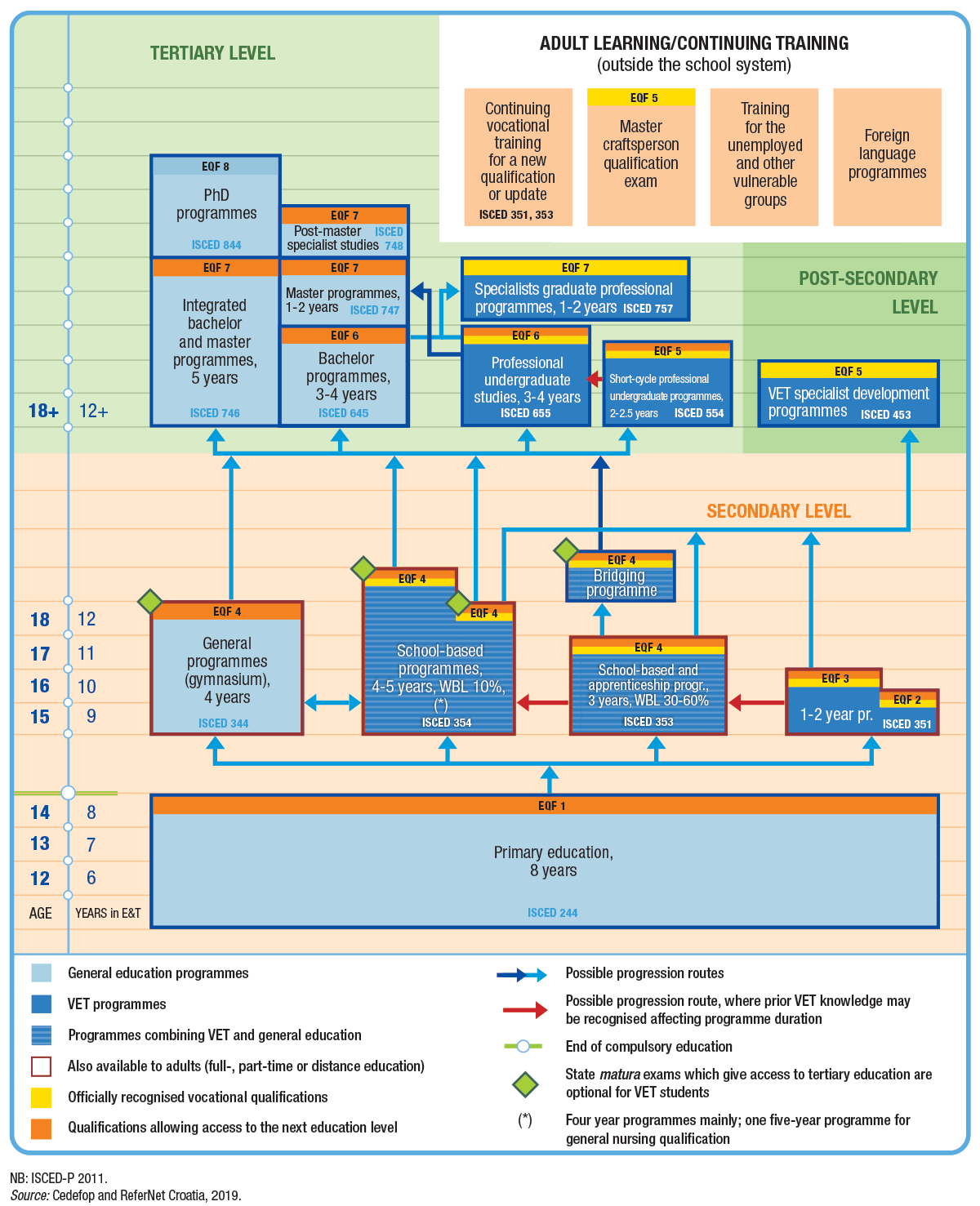
Programme Types
| ECVET or other credits | The total workload for acquiring a qualification at EQF level 3 is a minimum of 60 ECVET and / or HROO credits of the EQF level 3 or a higher level of units of learning outcomes. 53 . The total workload for acquiring a qualification at EQF level 2 is a minimum of 30 ECVET and / or HROO credits of the EQF level 2 or a higher level of units of learning outcomes. ECVET credits are awarded for vocational education and training at EQF levels 2-5. HROO credits are awarded at levels 1-4 for general education qualifications and general education content of vocational qualifications. Each ECVET and HROO credit includes 15 to 25 hours of study work in the duration of 60 minutes. |
|---|---|
| Learning forms (e.g. dual, part-time, distance) |
|
| Main providers | Upper secondary VET schools |
| Share of work-based learning provided by schools and companies | > 50% 54 |
| Work-based learning type (workshops at schools, in-company training / apprenticeships) |
|
| Main target groups | Vocational training programmes at EQF level 2 are particularly popular with adult learners in CVET. 2-year programmes at EQF level 3 are particularly suitable for young people aiming to enter the labour market upon completion of the programme, or learners at risk of early leaving. Students with disabilities may enrol adapted two-year VET programmes, which could extend for up to three years. |
| Entry requirements for learners (qualification/education level, age) | Entry requirements include a certificate of completion of primary education and good physical and mental health, as required by the curricula. |
| Assessment of learning outcomes | In case of 1-2 year programmes at EQF level 3, VET providers perform the final assessment of learners, which consists in production and presentation of the final practical assignment (završni rad). |
| Diplomas/certificates provided | For vocational training at EQF level 2, training certificate (uvjerenje o osposobljavanju) represents a formal award recognised by the education and training and labour authorities. For 1-2-year programmes at EQF level 3, certificates of completion (svjedodžba o završnome radu) represents a formal award recognised by the education and training and labour authorities. |
| Examples of qualifications | For 1-2-year programmes at EQF level 3: welder (zavarivač), administrator (administrator). For vocational training at EQF level 2: trained forklift operator (osposobljen za rukovatelja viličarom), trained for bartending jobs (osposobljen za poslove barmena), trained for simple jobs in the occupation of butcher (osposobljen za jednostavne poslove u zanimanju mesar). |
| Progression opportunities for learners after graduation | Students holding this certificate normally enter the labour market meeting requirements to execute simple tasks in familiar conditions. Furthermore, after completing two-year VET programmes, learners have the possibility of vertical mobility and continuing their education at a higher level in the status of regular learners. They can enrol in a three-year VET programme and pass additional and supplementary examinations. |
| Destination of graduates | 1-2-year programmes at EQF level 3 are labour market-oriented, which is the primary destination of graduates. |
| Awards through validation of prior learning | No |
| General education subjects | Currently, the share of the general education content in the total teaching load for 1-2-year programmes ranges from 20-40% 55 . |
| Key competences | Depending on the curricula, key competences in programmes at EQF level 3 usually encompass competences in Croatian and foreign languages, mathematics and ICT. Vocational training programmes at EQF level 2 generally do not comprise key competence development. |
| Application of learning outcomes approach | No |
| Share of learners in this programme type compared with the total number of VET learners | In the school year 2018/19, 10 VET providers enrolled 163 students (0.2% of all IVET learners) in 7 programmes at EQF level 3. In 2018, estimated 14 000 adult learners 56 enrolled in vocational training programmes at EQF level 2, as the most popular education pathway in CVET. |
| ECVET or other credits | The total workload for 3-year programmes is a minimum of 180 ECVET and / or HROO credits, with at least 120 ECVET and / or HROO credits of the level 4 or a higher level of units of learning outcomes 57 . ECVET credits are awarded for vocational education and training at EQF levels 2-5. HROO credits are awarded at levels 1-4 for general education qualifications and general education content of vocational qualifications. Each ECVET and HROO credit includes 15 to 25 hours of study work in the duration of 60 minutes. |
|---|---|
| Learning forms (e.g. dual, part-time, distance) | JMO programmes:
Industrial programmes:
|
| Main providers | JMO programmes: VET secondary schools Companies (licenced craft workshops or legal entities) Industrial programmes: VET secondary schools |
| Share of work-based learning provided by schools and companies | JMO programmes: 60% Industrial programmes: 5%-10% 58 |
| Work-based learning type (workshops at schools, in-company training / apprenticeships) | JMO programmes:
The education is implemented according to a VET curriculum that consists of two parts, the general education part and the apprenticeship. The apprenticeship consists of a professional-theoretical part and practical training and exercises. The general education and the professional-theoretical parts are implemented in VET schools. The practical training and exercises are implemented mainly in the work process, in craft business workshops or in a trade association, institution or cooperative and to a lesser extent in VET school workshops in a certain number of hours, according to the curriculum for each qualification. Industrial programmes:
|
| Main target groups | Programmes are available for young people and also for adults (as a school-based option only). Many curricula at this level, for example for assisting professions, are also suitable for learners with special educational needs, such as moderate and severe disability. Special arrangements are available for them in VET schools and social welfare institutions. Programmes are also suitable for learners at risk of early school leaving. |
| Entry requirements for learners (qualification/education level, age) | The entry requirements for three-year programmes include:
For JMO programmes, an apprenticeship contract is also required. |
| Assessment of learning outcomes | For the completion of the educational programme learners need to take a final practical assignment (izradba i obrana završnog rada) which is mandatory for all learners in order to receive a valid qualification. The final assessment is organised and conducted by schools 59 ; upon successfully passing it, a learner acquires a secondary school qualification and the VET school issues a certificate. The final exam 60 is a small project composed of the theoretical part, the practical part and the defence. Each school can have different timelines regarding the organisation of the final exam as well as the specificities regarding the choice of topics. Learners choose topics (tema) themselves or with the teacher support (usually by 1 October of the third year) and consult with the mentor in craft whether he/she can accomplish that. The final exam covers both the theoretical and practical part, both in written form. In the practical part, the learner describes what he/she did and also defends it in front of the commission; in some schools the practical part takes place at the craft or legal entity. These commissions usually consist of VET teachers. Some schools include in-company mentors; from those interviewed no one took part. Additionally, JMO graduates can take also a journeyman exam (pomoćnički ispit 61 afterwards. A journeyman exam 62 is taken after the successful completion of the educational programme; it is organised by Agency for VET (Agencija za strukovno obrazovanje i obrazovanje odraslih, ASOO) and takes place in schools. The journeyman exam is free for learners for two years after they graduate. In addition, during one school year after graduation, the practical part of their final exam is usually recognised and they do not have to do it again as a part of the journeyman exam. The implementation includes a number of activities: Croatian Chamber of Crafts (Hrvatska Obrtnička komora) suggests the commission members to ASOO; VET schools send applications of learners, organise the exam on their premises, prepare documentation and fill the online system (e-naukovanje); Ministry of Economy, Entrepreneurship and Crafts (Ministarstvo gospodarstva, poduzetništva i obrta, MoEEC) finances members of the commissions and issues certificates signed by the minister. ASOO organises, supervises and coordinates all these activities. Learners in JMO programmes can also take an intermediate test (kontrolni ispit) in the second year [ 63 ]. Some learners call this test ‘small matura’ (mala matura). |
| Diplomas/certificates provided | For 3-year programmes, certificates of completion (svjedodžba o završnome radu) represent a formal award recognised by the education and training and labour authorities. |
| Examples of qualifications | JMO programmes: Chef, hairdresser, auto-mechanic, carpenter, photographer, Industrial programmes: CNC operator |
| Progression opportunities for learners after graduation | According to the legislation 64 , both horizontal and vertical pathways are stipulated. As of 2014, graduates from three-year VET programmes can enter an optional one- to two-year bridge programme 65 and, if successful in gaining a second VET qualification, can also take matura exams to access higher education. JMO graduates can also apply for the master craftsman exam after two to three years of work experience in the field. In 2016, an additional regulation on the conditions and the pathways of continuing education for obtaining higher level of qualifications has been introduced, specifying that learners can continue education for two years after acquiring the lower level qualifications, conditional on previous educational achievements, i.e. the minimum average score achieved during the period of their three-year education. Schools providing JMO programmes are obliged to organise a tuition-free fourth year for learners wishing to continue their education. According to the findings of the Cedefop review 66 , provisions for access to higher levels of education are not widely used in practice. It is very hard for JMO learners to continue with their education: schools reported approximately 10 per cent of their third year learners continuing their studies. Learners have to take many exams to catch up with learners from other programmes and enrol in the regular fourth year: according to some, about 20-25 exams, or equal to two years of schooling, the successful graduation of which gives access to the State matura (državna matura) exams. Most schools offer, and learners opt for, adult education programmes that are not free of charge but are provided as evening school option allowing learners work full-time. The learners who decide to continue their education are mostly learners with higher grades achieved during the three-year period of the JMO programme. |
| Destination of graduates | Students holding this certificate generally enter the labour market. In the school year 2018/2019, 225 students are recorded to have enrolled a 4-year VET programme with supplementary examinations, after having completed a 3-year programme, which equals 0.3% of students in 4-year VET programmes. The trend is similar for previous years. |
| Awards through validation of prior learning | No |
| General education subjects | JMO: Currently, the share of the general education content in the total teaching load for JMO programmes is around 20%. Industrial programmes: Currently, the share of the general education content in the total teaching load for 3-year school-based programmes is 20-40 % in the 1st and the 2nd year, and 25-40% in the 3rd year 67 . |
| Key competences | Depending on the curricula, key competences in 3-year programmes at EQF level 4 usually encompass competences in Croatian and foreign languages, mathematics and ICT. |
| Application of learning outcomes approach | In the school year 2018/19, one 3-year outcome-based programme for salespersons is in implementation in Croatian VET schools. Other qualifications and vocational curricula in line with the learning-outcome approach are yet to be developed in the VET reform process, which is currently underway. |
| Share of learners in this programme type compared with the total number of VET learners | In the school year 2018/19, 214 VET providers enrolled 26 791 students (27.6% of all IVET learners) in 136 programmes. Over the last 15 years, student participation in these programmes has been steadily declining. Specifically, the number of students finishing three-year programmes has fallen from 21 000 in 1998 to 9 965 in 2017, declining as a share of upper secondary education graduates from 40% to 22%. |
| ECVET or other credits | The total workload for 4- and 5-year programmes is a minimum of 240 ECVET and / or HROO credits, with at least 150 ECVET and / or HROO credits of the level 4 or a higher level of units of learning outcomes 68 . ECVET credits are awarded for vocational education and training at EQF levels 2-5. HROO credits are awarded at levels 1-4 for general education qualifications and general education content of vocational qualifications. Each ECVET and HROO credit includes 15 to 25 hours of study work in the duration of 60 minutes. |
|---|---|
| Learning forms (e.g. dual, part-time, distance) | For four-year programmes:
Five-year programme for general nursing qualification follow the different structure:
|
| Main providers | VET schools |
| Share of work-based learning provided by schools and companies | In 4-year programmes: Less than 10% 69 5-year programme: 60% in the final three years of the programme. |
| Work-based learning type (workshops at schools, in-company training / apprenticeships) | In 4-year programmes:
For five-year general nursing qualification programme, practical trainings are organised in hospitals and other teaching healthcare institutions. |
| Main target groups | Young people |
| Entry requirements for learners (qualification/education level, age) | The entry requirements include a certificate of completion of primary education and adequate physical and mental health, as required by the occupational standards. |
| Assessment of learning outcomes | For the completion of the educational programme learners need to produce and present final practical assignment (izradba i obrana završnog rada) which is mandatory for all learners in order to receive a valid qualification. A final assessment is organised and conducted by schools 70 ; upon successfully passing it, a learner acquires a secondary school qualification and the VET school issues a certificate. In order to enrol into higher education, VET graduates can opt to take the State Matura exams (ispiti državne mature) following the completion of four- and five-year programmes. The National Centre for External Evaluation of Education administers the State Matura exams in cooperation with upper-secondary schools. The State Matura exams serve three aims: final examination and requirement for graduation from general upper-secondary schools, entrance exams for undergraduate studies at tertiary level for all students (including VET graduates) and external evaluation of student competencies and learning outcomes. State Matura exams are administered in general education subjects only, as obligatory and optional exams. Obligatory exams are in Croatian language, mathematics and foreign language and they may be taken on A (advanced) and B (elementary) level. The list of optional exams is determined by the National Centre for External Evaluation of Education for each school year. Higher education institutions set the required level of exams and optional exams among their admission criteria independently. |
| Diplomas/certificates provided | For 4-year programmes, certificates of completion (svjedodžba o završnome radu) represent the formal award recognized by the education and training and labour authorities. For 5-year programmes, certificates of completion (svjedodžba o završnome radu) equally represent the final formal award. However, after completing the first two years of the nursing programme, which focuses on the general education content exclusively, the candidates also receive a certificate of completion of 2-year general education programme for attainment of medical care qualification (uvjerenje o završenome dvogodišnjem općeobrazovnom programu za stjecanje zdravstvene kvalifikacije). |
| Examples of qualifications | In 4-year programmes: beautician, mechanical engineering technician, ICT technician, commercialist in 5-year programme: general care nurse |
| Progression opportunities for learners after graduation | In order to enrol into higher education, graduates can opt to take the State Matura exams (ispiti državne mature) following the completion of four- and five-year programmes. Students holding the certificates of completion (svjedodžba o završnome radu) as well as a certificate on the passed State Matura exams (potvrda o položenim ispitima državne mature) can apply to higher education. The National Centre for External Evaluation of Education administers the State Matura exams in cooperation with upper-secondary schools. The State Matura exams serve three aims: final examination and requirement for graduation from general upper-secondary schools, entrance exams for undergraduate studies at tertiary level for all students (including VET graduates) and external evaluation of student competencies and learning outcomes. State Matura exams are administered in general education subjects only as obligatory and optional exams. Obligatory exams are in Croatian language, mathematics and foreign language and they may be taken on A (higher) and B (elementary) level. The list of optional exams is determined by the National Centre for External Evaluation of Education for each school year. Higher education institutions set the required level of exams and optional exams among their admission criteria independently. National data from 2016/17 suggest that over 80% of four- and five-year VET programme students expressed a wish to study at the tertiary level by enrolling in the national information system and taking the three obligatory State matura exams (Croatian language, mathematics, foreign language). |
| Destination of graduates | In the academic year 2018/19, fewer than 60% of VET graduates enrolled higher education studies, including over 40% of VET graduates that finished upper secondary education in 2018. |
| Awards through validation of prior learning | No |
| General education subjects | The programmes consist of general education and vocational parts in approximately equal shares. The share of the general education content in the total teaching load in 4-year programmes ranges from 40-70% in the 1st year, 40-60% in the 2nd year and 30-40% in the 3rd and the 4th year. The National curriculum for VET defines those vocational curricula for 4-year programmes in IVET should comprise up to 45% of general education content. For five-year general nursing programme, the general education ratio is 100% the first two years, and VET part ratio is 100% in the second three years. |
| Key competences | Depending on individual curricula, 8 key competences 71 are integrated in 4-year programmes at EQF level 4 to different extents. |
| Application of learning outcomes approach | In 2018/19, 25 outcome-based curricula were in implementation in Croatian schools in 4-year IVET programmes. All other programmes are content-based teaching programmes 72 . |
| Share of learners in this programme type compared with the total number of VET learners | In 2018/19, 290 VET providers enrolled 65 125 students (67.1% of all IVET learners) in 129 4-year programmes. In addition, 24 VET providers enrolled 5 034 students (5.2% of all IVET learners) in 1 (general care nurse) 5-year programme. |
| ECVET or other credits | 60 ECVET or HROO credits ECVET credits are awarded for vocational education and training at EQF levels 2-5. HROO credits are awarded at levels 1-4 for general education qualifications and general education content of vocational qualifications. Each ECVET and HROO credit includes 15 to 25 hours of study work in the duration of 60 minutes. |
|---|---|
| Learning forms (e.g. dual, part-time, distance) | Depending on the curricula, learning forms may include:
|
| Main providers | VET schools |
| Share of work-based learning provided by schools and companies | Information not available |
| Work-based learning type (workshops at schools, in-company training / apprenticeships) | Depending on the curricula, WBL types may include: • practical training at school • in-company practice |
| Main target groups | Graduates from IVET 3-year programmes, leading to EQF level 4, ISCED 353, may enrol bridging programme to attain qualification at EQF level 4 (ISCED 354, normally attained after completing 4-year programmes). |
| Entry requirements for learners (qualification/education level, age) | Completed 3-year programme, leading to EQF level 4, ISCED 353, normally in the same education sector, and average GPA of at least 3.50 on the 5.0 scale from the previous education level in VET (three-year IVET programme). |
| Assessment of learning outcomes | Before enrolling into the bridging programme, the teaching council at the VET provider determines the list of additional and supplementary exams the student needs to pass based on the programme completed earlier and the qualification the student will attain by completing the bridging programme. VET provider is responsible for organising the assessments for students to pass the prescribed additional and supplementary exams. While a student can enrol into the bridging programme of education as a regular student, the number of the additional and supplementary exams determines the duration of the bridging programme. Namely, students with a lower number of supplementary exams can immediately integrate into regular classes of the final year of 4-year programme under condition they pass the exams before 31 March of the same school year. Students with a higher number of exams first take one year to pass the exams, and then the next year attend classes regularly. For the completion of the educational programme learners need to produce and present the final practical assignment (izradba i obrana završnog rada) which is mandatory for all learners in order to receive a valid qualification. The final assignment is organised and conducted by schools 73 ; upon successfully passing it, a learner acquires a secondary school qualification and the VET school issues a certificate of completion. In order to enrol into higher education, graduates can opt to take the State Matura exams (ispiti državne mature) following the completion of four- and five-year programmes. The National Centre for External Evaluation of Education administers the State Matura exams in cooperation with upper-secondary schools. The State Matura exams serve three aims: final examination and requirement for graduation from general upper-secondary schools, entrance exams for undergraduate studies at tertiary level for all students (including VET graduates) and external evaluation of student competencies and learning outcomes. State Matura exams are administered in general education subjects only, as obligatory and optional exams. Obligatory exams are in Croatian language, mathematics and foreign language and they may be taken on A (advanced) and B (elementary) level. The list of optional exams is determined by the National Centre for External Evaluation of Education for each school year. Higher education institutions set the required level of exams and optional exams among their admission criteria independently. |
| Diplomas/certificates provided | Certificates of completion (svjedodžba o završnome radu) represent the formal award recognized by the education and training and labour authorities. |
| Examples of qualifications | Commercialist, mechanical engineering technician |
| Progression opportunities for learners after graduation | In order to enrol into higher education, graduates can opt to take the State Matura exams (ispiti državne mature) following the completion of four- and five-year programmes. The National Centre for External Evaluation of Education administers the State Matura exams in cooperation with upper-secondary schools. The State Matura exams serve three aims: final examination and requirement for graduation from general upper-secondary schools, entrance exams for undergraduate studies at tertiary level for all students (including VET graduates) and external evaluation of student competencies and learning outcomes. State Matura exams are administered in general education subjects only as obligatory and optional exams. Obligatory exams are in Croatian language, mathematics and foreign language and they may be taken on A (higher) and B (elementary) level. The list of optional exams is determined by the National Centre for External Evaluation of Education for each school year. Higher education institutions set the required level of exams and optional exams among their admission criteria independently. |
| Destination of graduates | Information not available |
| Awards through validation of prior learning | No |
| General education subjects | General education share depends on the curricula of the programme students enrol. As the bridging programme mostly means integration in regular 4-year programmes, the share of the general education content in the total teaching load would thus normally range from 30-40% in the 3rd and the 4th year, as in all standard 4-year programmes. |
| Key competences | Depending on individual curricula, 8 key competences 74 are integrated to different extent. |
| Application of learning outcomes approach | No |
| Share of learners in this programme type compared with the total number of VET learners | In 2018/19, 225 students are recorded to have enrolled a 4-year VET programme with supplementary examinations, after having completed a 3-year programme, which accounts for 0.3% of students in 4-year VET programmes. The trend is similar for previous years. |
| ECVET or other credits | The total workload for programmes at EQF level 5 is a minimum of 120 ECVET or ECTS credits, with at least 60 ECVET or ECTS credits of the level 6 or a higher level of units of learning outcomes 75 . ECVET credits are awarded for vocational education and training at EQF levels 2-5. Each ECVET credit includes 15 to 25 hours of study work in the duration of 60 minutes. ECTS credits are awarded for higher education at EQF levels 5-7. Each ECTS credit includes 25 to 30 hours of study work in the duration of 60 minutes. |
|---|---|
| Learning forms (e.g. dual, part-time, distance) | VET specialist development programmes may include: • school-based learning • practical training at school and in-company |
| Main providers | VET schools or higher education institutions |
| Share of work-based learning provided by schools and companies | > 50% 76 |
| Work-based learning type (workshops at schools, in-company training / apprenticeships) | VET specialist development programmes may include: • practical training at school • in-company practice (preferred) |
| Main target groups | Learners who completed VET programmes at secondary level (at least CROQF/EQF 4.1. or higher) |
| Entry requirements for learners (qualification/education level, age) | Completed VET programmes at secondary level (at least CROQF/EQF 4.1. or higher) |
| Assessment of learning outcomes | Not defined. Qualifications at this level were foreseen by the Act on NQF 77 in 2013, yet no VET specialist development programmes have been developed thus far. |
| Diplomas/certificates provided | VET post-secondary development and training certificate (strukovno specijalisticko usavrsavanje i osposobljavanje) |
| Examples of qualifications | Qualifications at this level were foreseen in 2013 by the Act on NQF 78 , yet no VET specialist development programmes have been developed thus far. |
| Progression opportunities for learners after graduation | These programmes have strong labour market orientation. Progression mechanisms to higher education are not defined at this point. |
| Destination of graduates | Information not applicable since programmes are not introduced yet. |
| Awards through validation of prior learning | No |
| General education subjects | No |
| Key competences | Not defined. Qualifications at this level were foreseen by the Act on NQF 79 in 2013, yet no VET specialist development programmes have been developed thus far. |
| Application of learning outcomes approach | All future qualifications, developed in line with the National curriculum in VET, should be outcome-based. |
| Share of learners in this programme type compared with the total number of VET learners | Qualifications at this level were foreseen by the Act on NQF 80 in 2013, yet no VET specialist development programmes have been developed thus far. |
| ECVET or other credits | 120 -150 ECTS |
|---|---|
| Learning forms (e.g. dual, part-time, distance) |
|
| Main providers | Higher education institutions |
| Share of work-based learning provided by schools and companies | Practical training duration is determined by individual curricula. |
| Work-based learning type (workshops at schools, in-company training / apprenticeships) |
|
| Main target groups | For full-time studies: young people, secondary school graduates at EQF level 4 For part-time studies: young people and working adults |
| Entry requirements for learners (qualification/education level, age) | Previously acquired EQF level 4 qualification or higher (3-year or 4-year general education or IVET programmes) |
| Assessment of learning outcomes | Continuous written or oral examinations at course level Final assessment may include written and/or oral examination or final thesis, as determined by the curricula |
| Diplomas/certificates provided | Professional associate (stručni pristupnik) |
| Examples of qualifications | Professional associate in chemical engineering (stručni pristupnik kemijskog inženjerstva) |
| Progression opportunities for learners after graduation | Graduates may continue their education at professional undergraduate programmes. Depending on the curricula, graduates may also enrol in university graduate programmes or specialist graduate professional programmes; under condition they successfully pass additional and supplementary exams. |
| Destination of graduates | Information not available |
| Awards through validation of prior learning | No |
| General education subjects | General education subjects are normally taught only in relation to vocational subjects. |
| Key competences | Some courses may be offered to teach key competences |
| Application of learning outcomes approach | Not consistent |
| Share of learners in this programme type compared with the total number of VET learners | In 2017/18, there were 51 students enrolled in short-cycle professional undergraduate programmes, representing 0.11% of students in higher education professional programmes, and 0.03% of all students in higher education. |
| ECVET or other credits | 180-240 ECTS |
|---|---|
| Learning forms (e.g. dual, part-time, distance) |
|
| Main providers |
|
| Share of work-based learning provided by schools and companies | Practical training duration is determined by individual curricula. |
| Work-based learning type (workshops at schools, in-company training / apprenticeships) | • practical training at education institution • in-company training |
| Main target groups | For full-time studies: young people, secondary school graduates at EQF level 4 For part-time studies: young people and working adults |
| Entry requirements for learners (qualification/education level, age) | Entry requirements consist in the completion of secondary education and successful completion of the State Matura exam. Higher education providers may set additional requirements and different weights to average secondary school GPA, Matura exams or entry exams independently. Work experience may be considered for enrolment in part-time programmes. |
| Assessment of learning outcomes | Continuous written or oral examinations at course level. Final assessment may include written and/or oral examination or final thesis, as determined by the curricula. |
| Diplomas/certificates provided |
|
| Examples of qualifications | Professional bachelor (baccalaureus) in economy (stručni prvostupnik (baccalaureus) ekonomije) (bacc. oec.) Professional bachelor (baccalaureus) engineer in information technology (stručni prvostupnik (baccalaureus) inženjer informacijske tehnologije) (bacc. ing. techn. inf.) |
| Progression opportunities for learners after graduation | Upon graduation, students are allowed to progress to specialist professional graduate studies or university graduate programmes, EQF 7. |
| Destination of graduates | Information not available |
| Awards through validation of prior learning | Higher education providers are required to set internal guidelines for recognising prior learning at EQF levels 6 and higher. |
| General education subjects | Some general education subjects may be taught in relation to vocational subjects. |
| Key competences | Depending on the programme, courses may be offered to teach key competences |
| Application of learning outcomes approach | Yes |
| Share of learners in this programme type compared with the total number of VET learners | In 2017/18, there were 40 117 students enrolled in professional undergraduate programmes, representing 84.9% of students in higher education professional programmes, and 24.3% of all students in higher education. |
| ECVET or other credits | 60-120 ECTS |
|---|---|
| Learning forms (e.g. dual, part-time, distance) |
|
| Main providers |
|
| Share of work-based learning provided by schools and companies | Practical training duration is determined by individual curricula. |
| Work-based learning type (workshops at schools, in-company training / apprenticeships) | • practical training at education institution • In-company training |
| Main target groups |
|
| Entry requirements for learners (qualification/education level, age) | Entry requirements are the completed undergraduate professional studies or completed undergraduate university studies. |
| Assessment of learning outcomes | Continuous written or oral examinations at course level Final assessment may include written and/or oral examination or final thesis, as determined by the curricula |
| Diplomas/certificates provided |
|
| Examples of qualifications | Professional specialist engineer in civil engineering (stručni specijalist inženjer građevinarstva) (struč. spec. ing. aedif.) Professional specialist in accounting and finances (stručni specijalist računovodstva i financija) (struč.spec.oec.) |
| Progression opportunities for learners after graduation | Specialist graduate professional studies are designed as a terminal professional degree leading to the labour market. |
| Destination of graduates | Information not available |
| Awards through validation of prior learning | Higher education providers are required to set internal guidelines for recognising prior learning at EQF levels 6 and higher. |
| General education subjects | General education subjects are normally taught only in relation to vocational subjects. |
| Key competences | Some courses may be offered to teach key competences |
| Application of learning outcomes approach | Yes |
| Share of learners in this programme type compared with the total number of VET learners | In 2017/18, there were 7 062 students enrolled in specialist graduate professional programmes, representing 14.95% of students in higher education professional programmes, and 4.28% of all students in higher education. |