Agenda
Image
fal_header.png
-
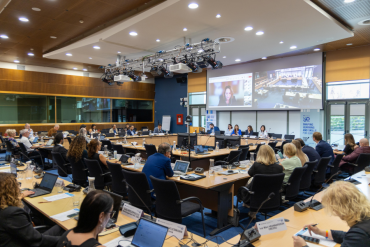
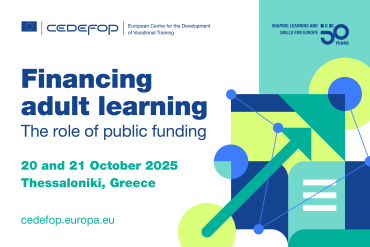
In response to the European commitment to increasing adult participation in learning, this conference aimed to provide an overview of the range of funding instruments available across the EU Member States, and to discuss the future role of public (co-) financing of adult learning. The debate focused on individual learning ...

In response to the European commitment to increasing adult participation in learning, this conference aimed to provide an overview of the range of funding instruments available across the EU Member States, and to discuss the future role of public (co-) financing of adult learning. The debate focused on individual learning accounts and training funds, based on the results of dedicated Cedefop research projects.  

The programme, speeches, presentations and summaries of workshop discussions are available in the Downloads section below.

The European commitment to increasing adult participation in learning is essential to improve employability, boost innovation, ensure social fairness, and close the digital skills gap. As the widely cited Draghi report on the future of EU competitiveness states: ‘While Europe should aim to match the US in terms of innovation, we should aim to exceed the US in providing opportunities for education and adult learning and good jobs for all throughout their lifetimes’. One of the key priorities for the new Commission is to address skills and labour gaps, particularly by establishing a Union of Skills. This aims to ensure that everyone in Europe, no matter where they are, is empowered to build solid skills foundations and engage in lifelong upskilling and reskilling.

Funding plays an important role in providing adult learning opportunities. Achieving the ambitious EU Social Pillar target to increase the level of adult learning requires a corresponding increase in financing from different sources. Currently, public support for adult learning in the EU stands at around 0.5% of GDP, representing around one third of the total, with the rest mostly covered by employers (including public employers) dedicated to employee training. This highlights the important role of government in co-financing adult learning, which can take many forms, including grants, tax incentives, and publicly financed provision of learning opportunities.

To ensure adequate and sustainable funding for adult learning, there is a need for the right strategy and institutional set-up to mobilise public and stimulate private investment, including cost-sharing arrangements. It is important to find the appropriate role for public financing in adult learning systems, and to strike a balance between the different financing instruments – publicly financed provision, financial incentives, and other support for individuals and companies – to maximise the impact of limited public resources. 

Therefore, the objective of the conference was to provide an overview of the various public funding instruments dedicated to adult learning, and to reflect on their future. In particular, the conference presented recent Cedefop research on the following topics:

  • The overall structures of public (co-)financing for adult learning across the EU, drawing on dedicated ReferNet country-specific reports, and on the Cedefop database on financing adult learning.
  • Financial support for individuals to take up learning, with a focus on individual learning accounts, presenting the results of a dedicated Cedefop study on the topic.
  • Arrangements to incentivise employers to provide training, presenting the results of recent Cedefop study on Training Funds in the EU, and an upcoming report on the results of the latest round of the CVTS survey


Image
refernet_forum_2025-plenary_event-page.png
-
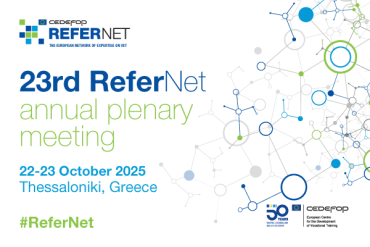
The 23rd ReferNet annual plenary meeting took place in Thessaloniki, Greece and welcomed the representatives of our partner organizations under the 2024-27 framework partnership agreement, as well as national representatives of the network and the representatives from the European Commission (EU).

The 23rd ReferNet annual plenary meeting took place in Thessaloniki, Greece and welcomed the representatives of our partner organizations under the 2024-27 framework partnership agreement, as well as national representatives of the network and the representatives from the European Commission (EU).

The aims of the meeting were to:

  • inform partners of the latest EU policy developments on VET, skills and qualifications;
  • take stock of the work carried out in 2025 and the outcomes published and disseminated;
  • prepare the 2026 work plan: VET policy reporting, spotlight, news, visibility actions, etc.;
  • foster partnership and knowledge-sharing through interactive (joint) presentations of national developments, debates, etc.;
  • hold individual meetings for deeper cooperation among members and between members and Cedefop experts.
  • convey in a physical open space, which will encourage creative reflection on how partners would like ReferNet to develop in the 2024-27 period.

Participants also had the opportunity to exchange good dissemination practices in a dedicated space where they could display their national publications, newsletters, videos, promotional items, etc and benefit from bilateral meetings.

In addition, just prior to the Plenary, on 20–21 October 2025, a conference dedicated to “Financing adult learning: The role of public funding”, was hosted where the first results of this year’s ReferNet Activity titled "Financing adult learning/CVET and recent developments on ILA" were presented. 

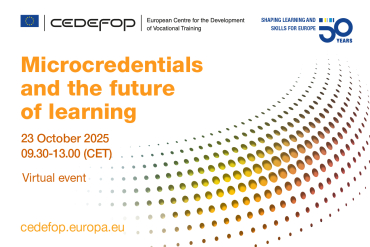
Furthermore, during the second day of the Plenary (23 October), a thematic event focusing on “Microcredentials and the future of learning” took place, offering our partners the opportunity to present preliminary findings from the 2025 ReferNet Activity titled "Deepening on Microcredentials - labour market sector relevance, quality, and inclusion". Through these events, we aimed to showcase the work of ReferNet to the broader public and further enhance its visibility and impact at the European level.

Watch the recordings


Image
microcredentials_oct_2025_update_web.jpg
-
The workshop focused on the diversity (profile and function) of microcredentials outside formal education and training, and the role of quality assurance and recognition in this context. Participants were presented the first insights of the current research during the plenary an...

The workshop focused on the diversity (profile and function) of microcredentials outside formal education and training, and the role of quality assurance and recognition in this context. Participants were presented the first insights of the current research during the plenary and interactive breakout sessions.

Watch the recordings 


Discussions positioned microcredentials within specific labour market sectors and will examine their potential to promote social inclusion of end-users (notably disadvantaged groups or individuals).

The event brought together policymakers, stakeholders, experts, and researchers to reflect on the role of microcredentials in redefining learning and work in the 21st century.

A dedicated session with ReferNet network was organised live (during the ReferNet Plenary) where they presented insights from their deliverable on microcredentials.

Engage in the discussion #Microcredentials #Microcredentials4LabourMarket
 

Image
gcm_event_page_900x600px.png
-

The second Global Careers Month ran throughout the month of November 2025. It was organised by the Inter-Agency Working Group on Career Guidance (IAG WGCG), composed by Cedefop, the European Commission, ETF, ILO, OECD, UNESCO and World Bank. 

The international organisations promoted a series of global and regional level events in partnership with associations operating in the area of career development. The International Association for Educational and Vocational Guidance (IAEVG) served as a key partner and a focal point for coordinating regional and national efforts this year.

  • Opening webinar: 5 November 2025, from 14.00 to 15.00 Central European Standard Time (CEST). Video of the webinar is here.
  • Closing webinar: 26 November 2025, from 14:00 to 15:00 Central European Standard Time (CEST). Video of the webinar is here.

The IAG WGCG announced also the publication of the newly updated Investing in Career Guidance joint statement and advocacy leaflet, just in time for the Second Global Careers Month.

Please visit the webpage of the Global Careers Month for more information on events and resources and spread the word #GlobalCareersMonth2025.  

Information on previous Global Careers Month can be found here.

Image
event_visual_website_community_vlasis_page_2.jpg
-
The 2025 annual meeting of the Cedefop Community of apprenticeship experts took place online on Monday 10 November 2025.The meeting was only open to members of the Cedefop Community of apprenticeship experts.

The 2025 annual meeting of the Cedefop Community of apprenticeship experts took place online on Monday 10 November 2025.

The meeting was only open to members of the Cedefop Community of apprenticeship experts.

During the meeting, apprenticeship experts had the opportunity to:

  • share information on their work on apprenticeships and learn from one another;
  • discuss the progress of the 2025 Community activity on the evolving position of apprenticeships in the education and training system;
  • explore potential ways to analyse and promote the topic further;
  • discuss the 2026 Community activity


Image
vgt_learning_in_eu_workplaces_website.jpg
-
A successful transition towards Industry 5.0 puts human wellbeing at the core of production in a more sustainable, human-centric and resilient European industry. Empowered workers with decision-making responsibility require the skills to do their job, and the expertise needed to use their autonomy effectively. Provided the...

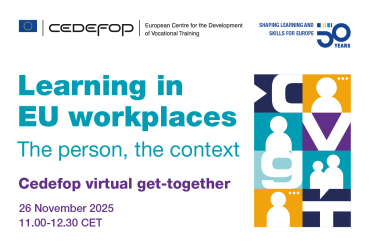
A successful transition towards Industry 5.0 puts human wellbeing at the core of production in a more sustainable, human-centric and resilient European industry. Empowered workers with decision-making responsibility require the skills to do their job, and the expertise needed to use their autonomy effectively. Provided they understand the context in which they make choices and organisational needs, values and goals, workers can do things right and do the right things.

To understand better how workers develop expertise through learning, Cedefop carried out the first European Training and Learning Survey (ETLS) in 2024 in All EU Member States and Norway and Iceland. The ETLS is a unique survey among workers using a framework in which workplace features – as experienced by workers – can hinder or support expertise development.

In this virtual get together, which targeted policymakers, social partners and researchers, Cedefop presented the first comprehensive ETLS findings. The event also served as a platform to discuss and share views about learning, and skills and expertise development in the workplace with key stakeholders and experts in the field.

Video recording 

The video recording of the event can be watched from here.
(By following the link, the YouTube privacy policy and cookies will apply)

Programme

Times are indicated in CET.

11.00 - 11.05

Introduction

Antonio Ranieri, Head of Department for VET and Skills, Cedefop

11.05 - 11.25

Learning in enterprises, messages from the ETLS

Giovanni Russo, Expert in skills and workplaces, Cedefop

11.25 - 11.35Q & A
11.35 - 12.20

Panel discussion

Moderator: Jasper van Loo, Coordinator, Department for VET and skills, Cedefop

  • Steve Dhondt, Senior research scientist TNO, Professor at K.U.Leuven
  • Pär Lundström, Senior Policy Advisor, The Swedish Installation Federation
  • Juan José Luis Delgado, Policy Adviser, industriAll European Trade Union
  • Dominik Sobczak, Deputy Head of Unit, DG Research and Innovation, European Commission
12.20 - 12.30Q & A and Final remarks

Additional keywords

Image
vgt_2_december_event_banner.png
-
The 25 million small and medium-sized enterprises (SMEs) in the European Union drive growth, innovation and employment and play a key role in digitalisation. By leveraging digital technology, SMEs can improve operations, expand their market reach and contribute to innovative solutions to pressing challenges such as fightin...

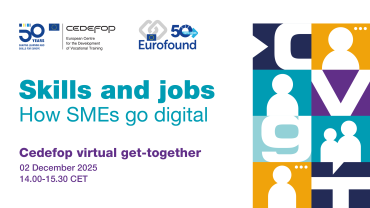
The 25 million small and medium-sized enterprises (SMEs) in the European Union drive growth, innovation and employment and play a key role in digitalisation. By leveraging digital technology, SMEs can improve operations, expand their market reach and contribute to innovative solutions to pressing challenges such as fighting climate change and increasing social cohesion.

In this virtual get together, Cedefop and Eurofound, EU agencies which both celebrate their 50th anniversary in 2025, teamed up to present new joint work on digitalisation policies and to explore how digital SMEs in Europe are today. Live from Dublin and Thessaloniki, the two EU agencies presented the key challenges and barriers SMEs face in becoming more digital and review digitalisation and digital skills support measures. The links between digitalisation and job quality in SMEs were assessed by looking at how digital tools and algorithmic management practices affect work organisations and working conditions.

This virtual get-together was open to policy makers, social partners and sectoral representatives, SME representation organisations, VET providers and institutions, representatives from national, regional, and local authorities, and labour market, education and training, and skills experts.

The presentation of Cedefop/ Eurofound is available in the Downloads section below.

Video recording

The video recording of the event can be watched from here.
(By following the link, the YouTube privacy policy and cookies will apply)

Programme

14:00 - 14:15Welcome and introductionJuergen Siebel (Cedefop Executive Director) and Ivailo Kalfin (Eurofound Executive Director)
14:15 - 14:40How SMEs go digitalJasper van Loo (Department coordinator at Cedefop) and Franz Eiffe (Research manager at Eurofound)
14:40 - 15:15Panel conversation

Moderated by Jasper van Loo

Valentina Guerra (Policy Director at SMEUnited)

Ants Sild (Lecturer-Consultant BCS Digital skills academy, Estonia)

Thomas Oberholzner (Director of KMU Forschung, Austria)

Dr. Mairéad Nic Giolla Mhichíl  (co-ordinator of the DigiAdvance Project)

15:15 – 15:30Policy pointers and take-awaysSara Riso (Senior research manager at Eurofound) and Jasper van Loo


Image
2025.12.9_event_nqfs_in_action_website2.png
-
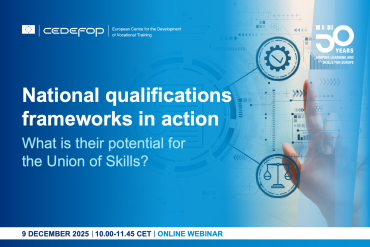
The webinar will offer policy-makers, stakeholders, experts, researchers, and the wider public an opportunity to deepen their understanding of the evolution of National Qualifications Frameworks (NQFs), as well as of current trends across countries participating in the European Qualifications Framework (EQF) process. Cedef...

The webinar will offer policy-makers, stakeholders, experts, researchers, and the wider public an opportunity to deepen their understanding of the evolution of National Qualifications Frameworks (NQFs), as well as of current trends across countries participating in the European Qualifications Framework (EQF) process. Cedefop will present the latest key findings from its research and analysis on NQFs, along with the new version of the NQF online tool.


Register here 


When: 9 December 2025 - Time: 10.00-11.45 CET

 For over 15 years, NQFs aligned with the EQF have been instrumental in promoting transparency, comparability and portability of qualifications across Europe. 

The EU is currently strengthening its action to remain competitive. The Union of Skills initiative seeks to accelerate efforts to address skill shortages, promote lifelong learning, support recognition of qualifications across borders and value skills regardless of where and how they have been acquired.

In this context, the webinar will explore:

  • how countries make the best use of NQFs;
  • how NQFs contribute to making qualifications easier to understand and skills more visible;
  • the level of awareness and use of NQFs among learners, employees, jobseekers and companies;
  • the potential of NQFs within the Union of Skills.

Based on the analysis of the latest NQF developments across the 41 countries participating in the EQF process, Cedefop will present and discuss emerging trends, success factors, challenges and future priorities in NQF implementation. The webinar will also introduce the updated version of the NQF online tool. Discussions will focus on NQF developments in specific EU Member States and candidate countries, as well as on EQF developments at EU level. 

Image
headline_danish_presidency_3.png
-
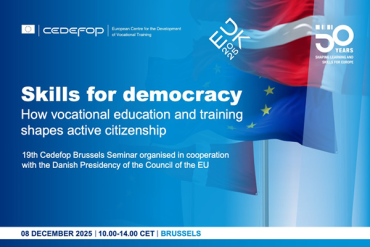
This edition focuses on active citizenship and the role that vocational education and training (VET) plays in supporting it. The seminar will present the first findings from Cedefop’s 2025-27 study on citizenship education in initial VET, alongside contributions from a range of European policymakers, education experts, and...

This edition focuses on active citizenship and the role that vocational education and training (VET) plays in supporting it. The seminar will present the first findings from Cedefop’s 2025-27 study on citizenship education in initial VET, alongside contributions from a range of European policymakers, education experts, and civil society representatives. 

OrganiserCedefop
In cooperation withThe Danish Presidency of the Council of the EU
FormatPhysical
Participant profileStakeholders from the Permanent Representations of Member States to the EU, representatives from the European Commission and the European Parliament, European Social partners for education, Brussels-based stakeholders working on active citizenship.
Working languageEnglish


Programme - (all times are CET)

Monday, 8 December 2025
9.30-10.00Participant arrival and registration 
10.00-10.15

Opening remarks

  • Marie Juel Bech Nielsen, Deputy Permanent Secretary, Ministry of Children and Education, Denmark

  • Jürgen Siebel, Executive Director, European Centre for the Development of Vocational Training (Cedefop)

Chair: Irene Mandl, Head of Department for VET and qualifications, Cedefop

10.15-10.55

Session 1. 
Promoting inclusive citizenship education and active participation in society

  • Dmitrijs Kuļšs, expert in VET systems and policies, and key competences, Cedefop: Citizenship education in IVET: initial findings from Cedefop study

  • Allan Kortnum, Director of Herningsholm Vocational College, Denmark: Skills city – a concept and campus designed to promote community, diversity, and democratic engagement among youth in VET

Moderator: Irene Mandl, Head of Department for VET and qualifications, Cedefop

10.55‑11.10

Coffee break

11.10-11.50

Session 2. Panel discussion

Policy perspectives – setting the framework for active citizenship in VET

  • Anna Banczyk, European Commission, Head of Unit Vocational Education and Training, Skills Portability, Cedefop (EMPL.B.3)

  • Marie Juel Bech Nielsen, Deputy Permanent Secretary, Ministry of Children and Education, Denmark

  • Michaela Franke, Research Administrator, Directorate for Citizens, Equality and Culture, European Parliament

Q&A

Moderator: George Kostakis, Coordinator, Department for VET and qualifications, Cedefop

11.50‐12.50

Session 3. Panel discussion

Making it happen – practices that empower active citizens in VET

  • Kristina Aaltonen, DLI – Danish Teacher Trade Unions

  • Sabina Casini, senior adviser, BDA – German Employers, BusinessEurope

  • Carlo Frising, Chambre des salariés Luxembourg, European Trade Union Confederation

  • Allan Kortnum, Director of Herningsholm Vocational College, Denmark

  • Erika Somlyay, Lifelong Learning Platform – European Civil Society for Education

Q&A

Moderator: George Kostakis, Coordinator, Department for VET and qualifications, Cedefop

12.50-13.00

Closing remarks

  • Irene Mandl, Head of Department for VET and qualifications, Cedefop
13.00-14.00Reception hosted by the Danish Presidency of the European Union
Image
careersnet_final_2025_event_page_11.12.25.png
-

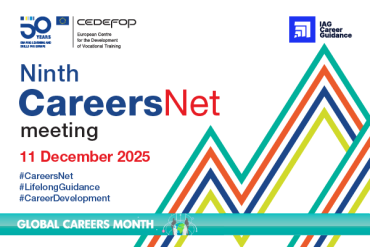
We are pleased to announce that the 9th annual meeting for CareersNet experts will take place online on two separate, non-consecutive, days: 11 December 2025 (9:30 to 16:30 CET) and 29 January 2026 (9:15 to 17:00 CET).

The last two network meetings gathered network core experts in person at venues in Sweden (2023) and Finland (2024) in connection with conference opportunities for members. This year the annual meeting is hosted online to accommodate core and alternate members, outgoing and incoming members in two different days.

Members will gather online over the two days. 

On Day 1 the meeting activities will include:

  • discussing network management and renewal of the network membership including orientation of new experts and showing appreciation for outgoing members;
  • sharing information on the current efforts members and their national reference groups have made on the Inventory of lifelong guidance systems and practices, such as recently uploaded records since 2022;
  • review and discuss the network’s cooperation activities since the last meeting in 2024, including the renewed lifelong guidance framework and guidelines at the heart;
  • plan and exchange views on ongoing and future activity, such as the next Inventory update and uses for the content, launch of the Call for papers on quality and effectiveness, and future events diving into challenges and opportunities for integrating lifelong guidance across diverse policy contexts.

Day 2 will include more opportunities for interaction, member thematic inputs, and groupwork facilitated by members. Please see the separate event page.

Participation is restricted. Members will receive information, a link to register and join the meeting, and the draft agendas, separately, for the two meetings/workshops held on Day 1 (11 December 2025) and Day 2 (29 January 2026).

Working with us
Reference
CEDEFOP/2025/OP/0011
Closing date
10/11/2025
Extended closing date
24/11/2025

INTER-AGENCY call for applications

Reference
Cedefop/2025/05/AD
Closing date
13/11/2025