Solo una parte del contenuto è disponibile nella lingua selezionata. Vedi quale contenuto è disponibile in Italiano.

Automatic translation is available for this page in Italian Translate this page
Agenda
Image
evts_4th.jpg
-
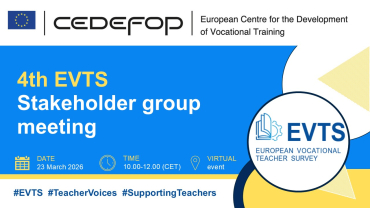
The fourth online meeting of the European Vocational Teacher Survey (EVTS) Stakeholder Group will take place on 23 March 2026 (10.00 - 12.00 CET) and will focus on the progress of the EVTS fieldwork and emerging insights from the data collection phase.

The fourth online meeting of the European Vocational Teacher Survey (EVTS) Stakeholder Group will take place on 23 March 2026 (10.00 - 12.00 CET) and will focus on the progress of the EVTS fieldwork and emerging insights from the data collection phase.

Participants will be informed about the overall status of teacher interviews, as well as their country-specific progress, highlighting key strengths, challenges, and response patterns. The meeting will provide space to discuss practical solutions to improve participation and data quality, drawing on stakeholder experience across countries.

Image
event_website_visual_-_flagship_event_updated_060326_4.png
-
We are pleased to announce our flagship event in Thessaloniki on 12th and 13th May to launch and promote Cedefop’s forthcoming new framework for policy and systems development for lifelong guidance and to recognise the valuable contributions of those who supported this work, which is designed to provide inspiration and a p...

We are pleased to announce our flagship event in Thessaloniki on 12th and 13th May to launch and promote Cedefop’s forthcoming new framework for policy and systems development for lifelong guidance and to recognise the valuable contributions of those who supported this work, which is designed to provide inspiration and a platform for structured collaboration. 

Register now using the link below. Spaces are limited and participation is subject to confirmation by the organisers.

REGISTER

This policy forum brings together stakeholders in Europe who have an interest in finding and re-locating common ground with the help of this shared framework, aligned with the aims of the Union of Skills and the European Pillar of Social Rights and related ambitions. The effort is aimed at enhancing the quality of policies, services and systems – through the winds of change – for the development of lifelong guidance, to adequately meet the changing information, guidance and advisory needs of a diverse population. 

Europe faces unprecedented challenges, where frequent social, economic and policy changes have become commonplace - societal shifts, transitions and transformations, coupled with evidence of mounting resource constraints. The event provides a timely opportunity to contextualise the new framework in a broader perspective. This includes its relevance for unfolding developments affecting careers and learning across the lifespan, within and beyond education and training, including VET’s rising attractiveness; as well as labour market, and civil society contexts.

An open webinar was held in April 2025 previewing the work against the backdrop of Cedefop’s long involvement in the guidance field. Speakers discussed the changing expectations for guidance systems, calling for further cooperation, adaptation and innovation, while building on previous experiences in the countries, growing expertise, research and awareness of the benefits of guidance, and accumulated knowledge and know-how on the ground.   

The new framework will inform Cedefop’s work including the online EU+ Inventory of systems and practices populated through the efforts of Cedefop’s CareersNet independent experts, and cooperation with national reference groups.

High-quality guidance and career support act together with other measures and policy fields recognised as helping achieve the aims of public policies supporting comprehensive skills development and social cohesion. They help connect and integrate other services and areas essential to lifelong learning, in turn, fostering societies that are more resilient, productive, sustainable and fair.

During the event, drawing on these wider perspectives and the structure of the framework and its essential messages, participants will hear from knowledgeable speakers and stakeholders, facilitating reflection. Focus will be placed on multifaceted implications for policy, implementation, research and frontline services across different contexts and for different actors in the wider ecosystems. 

Join us as we present this new framework and explore how it can help shape the future of lifelong guidance across Europe.

Image
tenth_cnet_meeting_visual_for_webpage_used.jpg
-
The 10th annual meeting for CareersNet experts will take place in Thessaloniki on 13 May 2026 (14.15 – 17.45 EET/EEST) directly following Cedefop’s flagship event on 12-13 May, dedicated to the launch of the new systems and policies framework for lifelong guidance. ✔️ Attending CareersNet members can join both ev...

The 10th annual meeting for CareersNet experts will take place in Thessaloniki on 13 May 2026 (14.15 – 17.45 EET/EEST) directly following Cedefop’s flagship event on 12-13 May, dedicated to the launch of the new systems and policies framework for lifelong guidance. 

✔️ Attending CareersNet members can join both events.

Over the two days at Cedefop’s networking-friendly premises, gathering in person will create ideal opportunities for interaction leading to community building and peer learning, bringing new and longer-term members together, also with other event participants, experts and stakeholders in the VET and skills ecosystem.

Members will need to reply to the save-the-date and receive further information included in their invitation, confirming their intention to attend through a link to the meeting registration form.  

Meeting activities will include:

  • follow up discussions and activities from the Day 2 January 29 meeting guided by the key themes of the framework for lifelong guidance policies and systems;
  • sharing views, national and local practices, member research and other activities, for building knowledge on the themes under discussion, locating common priorities, challenges and areas to address for policies supporting career development across the ecosystem;
  • presenting plans for the Call for papers on changing expectations for quality in lifelong guidance amid evolving transformations, as well as presenting Lifelong guidance Inventory sections relevant to the topic.

Participation is restricted

Image
event_template_website_refernet_pafo_bonn.png
-
In 2026, the Federal Institute for Vocational Education and Training - (Bundesinstitut für Berufsbildung), (BIBB), home of the ReferNet Germany team will welcome their colleagues and partners to the 2026 partnership forum organised jointly with Cedefop.

In 2026, the Federal Institute for Vocational Education and Training - (Bundesinstitut für Berufsbildung), (BIBB), home of the ReferNet Germany team will welcome their colleagues and partners to the 2026 partnership forum organised jointly with Cedefop.

In this forum, ReferNet members will have the opportunity to discuss issues related to vocational education and training (VET), skills and qualifications, improve their knowledge by sharing information on recent developments in national policies and systems while at the same time hear and learn about the VET system of Germany. The first of this year’s partnership forum will take place on 18 and 19 March 2026 in Budapest, Hungary.

We warmly thank the Federal Institute for Vocational Education and Training - (Bundesinstitut für Berufsbildung), (BIBB), home of the ReferNet Germany team for hosting the event.

ReferNet is a network of institutions across Europe representing the 27 Member States, plus Iceland and Norway. The network provides Cedefop with information and analysis on national vocational education and training, skills and qualifications. National partners also disseminate information on European VET and Cedefop’s work to stakeholders in the EU Member States, Iceland and Norway. ReferNet publications can be accessed through the ReferNet page on Cedefop’s website.

Image
ag_ivet_may_2026_web_visual.png
-

In May 2025, Cedefop launched a study to improve understanding of how initial vocational education and training systems in Europe contribute to the development of citizenship competences.

Running until 2027, the study aims to generate evidence and identify good practices to support policy-making and implementation, in line with the Union of Skills initiative and the Basic Skills Action Plan, which emphasise the importance of civic knowledge and competences for democratic resilience.

The second meeting of the advisory group will take place on 27 May 2026 and will focus on discussing preliminary field research findings in the pilot countries: Czechia, the Netherlands, Norway and Portugal.

Image
26.05.28_harnessing_web_data_skills_intelligence_3.jpg
-

This research conference, organised by Cedefop and Eurostat, will showcase innovative methods and approaches for analysing and interpreting web-based data sources in the context of occupational, sectoral, and thematic labour market and skills analysis.

Building on the success of the 2025 research conference ‘Using data from the web to shape next-generation labour market and skills analysis’ organised in cooperation with Eurostat's Web Intelligence Hub, Cedefop and Eurostat are pleased to announce the 2026 follow-up event –including a new call for abstracts– which will take place on 28-29 May 2026 in Thessaloniki.

The insights and findings shared during the event will enhance our understanding of how web data can be leveraged for labour market and skills intelligence, helping to shape the future of research in this evolving field. As with the previous edition, the conference will provide a valuable platform for community building, fostering new collaborations, knowledge exchange and idea generation, while strengthening networks among experts committed to advancing labour market monitoring and skills foresight. 

Register now using the link below. Participation is subject to confirmation by the organisers.


Image
mee_63_2026_visual_20th_bbs_cy_pres_skills_for_europes_competitiveness_websitev2.jpg
-
Cedefop, in collaboration with the Cypriot Presidency of the Council of the European Union, is organising the 20th Cedefop Brussels seminar. These research-driven seminars, held in cooperation with the rotating EU Council Presidencies, build on Cedefop’s research and address issues relevant to European debates on education...

Cedefop, in collaboration with the Cypriot Presidency of the Council of the European Union, is organising the 20th Cedefop Brussels seminar. These research-driven seminars, held in cooperation with the rotating EU Council Presidencies, build on Cedefop’s research and address issues relevant to European debates on education, training, and employment.

The goal of this seminar is to examine skills development and workplace learning as the essential framework through which the EU can reach its twin goals of increasing economic competitiveness and enhancing the quality of employment.
Cedefop will showcase its evidence focusing on what underlies low skill demands and skill formation and how these underpin low competitiveness of EU organisations. It will also present latest findings from its European Training and Learning survey (ETLS), a new survey mapping the determinants of learning and skills development in European workplaces. 
In addition, the seminar brings together policy makers, social partners, and researchers to encourage a constructive dialogue on strengthening EU competitiveness through human-centred technological innovation and job quality. 
Finally, this Brussels seminar will unveil the details of the 2026 European Skills and VET Week (ESVW), which will take place between 6 and 13 November. The ESVW aims to raise awareness about Europe’s urgent need to rethink its approach to skills and VET to remain competitive, economically strong and strategically independent. It will also address the broader Skills and VET community to share data and insights that may drive strategies for upskilling and reskilling people across different life stages. It will also allow discussing how skills and workplace learning can strengthen the connection between technological innovation and competitiveness.

OrganiserCedefop
In cooperation withThe Cypriot Presidency of the Council of the European Union
FormatPhysical
Participant profileStakeholders from the Permanent Representations of Member States to the EU, representatives from the European Commission and the European Parliament, researchers, Brussels-based stakeholders working on skills. 
Working languageEnglish
Image
event_template_website.jpg
-
Eurofound, Cedefop, the European Agency for Safety and Health at Work (EU-OSHA) and the European Training Foundation (ETF) are organising a Tripartite Exchange Seminar on digital and artificial intelligence and the role of social dialogue. It is aimed at strengthening the capacity of social partners and governments to enga...

Eurofound, Cedefop, the European Agency for Safety and Health at Work (EU-OSHA) and the European Training Foundation (ETF) are organising a Tripartite Exchange Seminar on digital and artificial intelligence and the role of social dialogue. It is aimed at strengthening the capacity of social partners and governments to engage and act effectively in social dialogue.

The residential seminar in Brussels is planned for June 2026. The deadline for applications was Monday, 8 December 2025.

Registration to the seminar is closed.

The TES 2026 will focus on the role of social dialogue in the digital and artificial intelligence (AI) transitions in EU Member States and selected candidate countries.

The aims, structure and themes of the seminar, the draft agenda and the selection criteria can be found here

With this call, the four EU Agencies invite professionals working in national, subnational-level social partner and government organisations to apply to participate in the 2026 seminar.

Residential face-to-face session in Brussels, Belgium, hosted by the European Economic and Social Committee 10-12 June 2026 (provisional).

The TES 2026 has three interactive modules:

  1. Online introductory and preparation session (13 May 2026)
  2. Residential face-to-face session in Brussels, Belgium, hosted by the European Economic and Social Committee (10-12 June 2026 - provisional)
  3. Online follow-up knowledge sharing sessions (9 December 2026)
Image
etls_website_.jpg
-
Cedefop is organising the flagship conference ‘Strengthening foundations for a competitive Europe’, as part of the European VET and Skills Week. The event positions skills development and workplace learning as the primary pathway through which the EU can achieve the dual objectives of enhanced competitiveness and improved ...

Cedefop is organising the flagship conference ‘Strengthening foundations for a competitive Europe’, as part of the European VET and Skills Week. The event positions skills development and workplace learning as the primary pathway through which the EU can achieve the dual objectives of enhanced competitiveness and improved job quality. A high-skilled workforce is crucial for deploying corporate investment in human-centred technology and designing quality jobs. Learning during one’s career and the development of workers’ expertise as integral parts of quality jobs are also key to ensuring that technological innovation can enhance workers’ capabilities and boost productivity.

This conference will explore cutting-edge research on how workplace learning, skills development and human-centred technological change can be leveraged to shape quality jobs that strengthen competitiveness of EU industries and firms. The discussions will also draw on Cedefop’s recent European Training and Learning survey (ETLS). This survey provides unique insights into the drivers and contextual factors affecting workplace learning among EU citizens. Evidence from experts and policy actors within the skills ecosystem will complement these findings in interactive sessions designed to generate actionable recommendations.

Skills and learning: pathway to competitiveness

European economies are facing considerable challenges due to transformative global geopolitical shifts and rapid technological innovation driven by artificial intelligence (AI). Productivity gaps and lagging competitiveness relative to major competitors exacerbate these issues.

While the Draghi report on EU competitiveness identifies insufficient technological innovation as the primary cause of low productivity, the European Commission’s Competitiveness Compass highlights the need to overcome overly bureaucratic procedures and regulations that limit the Single Market’s potential. The European Union promotes adopting digital technologies through its Apply AI strategy and the AI Continent action plan.

The 2025 Union of Skills communication emphasises the importance of high-quality education, training and lifelong learning. Building a competitive EU calls for a coordinated, multi-stakeholder approach to developing skills for quality jobs, offering targeted upskilling and reskilling opportunities, and retaining and circulating talent across the Union. These priorities align with ongoing European Commission efforts to improve job quality via the Quality Jobs Roadmap, initiated in December 2025, and an upcoming Quality Jobs Act to be adopted in 2026. Investment in the workforce’s initial and continuing skills development is the foundation of these efforts.

Productivity growth, technological innovation, skills, and job quality have often been treated as separate elements of competitiveness in policy initiatives. Helping EU firms transition from outdated, less competitive processes to high-productivity, high-skills business strategies requires understanding the multifaceted nature of competitiveness. It is also necessary to promote systematic approaches to align priorities and policy actions to improve European competitiveness.

Competitiveness through people

EU firms could aim to strengthen their competitiveness by investing in automation technology and low-cost production. Emerging digital and AI technologies now have significant scope to replace labour, even in high-skilled, professional work that used to be immune to technological displacement. Alongside job and task loss, evidence shows that digital technology increases job insecurity, routinisation, work pressure and workers’ fear of technological replacement. Algorithmically managed workplaces, with less human control and oversight, risk deteriorating job quality. Such practices could modernise Tayloristic production models under the guise of competitiveness.  

However, the effects of technology on job quality are not deterministic. Managerial, policy, and collective bargaining choices influence these outcomes, as do organisational learning cultures. New technologies can also expand workers’ capabilities, enabling them to take on new tasks or improve their efficiency in current roles, and improve job quality and productivity. This high-road approach to competitiveness requires continuous skills and expertise development among workers to handle unpredictability and non-routine tasks. Calls to transition from the Industry 4.0 paradigm to Industry 5.0 highlight efforts to foster ‘human centred technology’, which enhances job quality by building on workers’ capabilities.

Striking the right balance between job design elements (e.g. work autonomy, problem solving, delegation of decision-making, and work pressure) and contextual organisational factors (e.g. managerial support, organisational climate and culture, and workplace psychological safety) is crucial for maintaining a human-centred approach that stimulates job quality and continuous skill-building in firms. However, in a challenging economic climate, simply automating jobs is not necessarily appealing. Pursuing the high road by translating workers’ skills development into ‘practical wisdom’ and expertise – learning to do the right thing and to do things right – offers significant potential for improving Europe’s competitiveness.

Conference objectives

While the partial connections between technological progress, job quality, skills, and productivity have been well-documented in the literature and discussed in policy discourse, a clearer understanding of their complex interactions and comprehensive context is still needed, especially regarding their effect on business competitiveness. Identifying skills policies that foster quality jobs and competitiveness is also essential. Achieving this requires reframing EU skills and vocational training policies, and a shift away from the siloed approach that has long characterised discussions on skills, technology, and job quality in the EU.

The goal of this Cedefop flagship conference is to showcase the synergies created by integrated policy approaches to skills development, job quality and competitiveness. To achieve this, Cedefop will bring together researchers and scholars from various disciplines, practitioners, and policymakers to encourage a productive dialogue on strengthening EU workplace competitiveness through human-centred technological innovation and job quality.

In addition to presentations from external experts on adult education and competitiveness, Cedefop will share its latest research findings on the factors influencing workplace learning. These findings will be based on analyses of the European Training and Learning survey (ETLS), a new Cedefop survey mapping learning and skills development in European workplaces.

The event will address the following questions:

  • How do new technologies affect workers’ skills development needs?
  • Under what conditions can investment in skills align the objectives of good job quality and competitiveness of EU firms?
  • How can technological innovation support a human-centred business strategy that remains globally competitive?
  • How can skills and workplace learning strengthen the connection between technological innovation and competitiveness?
  • How does adopting new technologies in firms influence corporate human resource management, learning practices, job design, and skills utilisation strategies?
Working with us
Reference
CEDEFOP/2026/CEI/0001
Closing date
18/02/2031
Reference
GP/DVQ/ReferNet_FPA/001/26
Closing date
26/03/2026
Job opportunities

INTER-AGENCY call for applications

Reference
Cedefp/2026/01/AD
Closing date
07/04/2026

Ready to kick-start your career in an international environment?

Reference
Traineeships 2026
Closing date
21/04/2026